Multipitch Atlas

Acqua in bocca

Teghie Lisce · Bavella · France

Read the cautionsBail with caveatsBolting confidence: medium

A sampler of everything Bavella granite does: a technical 7a wall, layback and jamming cracks, an off-width, a squeeze slot behind a tree, and three pitches of pure friction slab to finish. Bolted well enough to climb on quickdraws, which is rare here. The wide pitches are awkward and bruising if you are not used to the style.

Teghie Lisce, Bavella, with the belays of Acqua in bocca marked in redPhoto: pastou09 · CC BY-SA 3.0

Topo

Teghie Lisce, Bavella, with the belays of Acqua in bocca marked in redPhoto: pastou09 · CC BY-SA 3.0
Hardest pitch
7a
Pitches
10
Length
300 m
Approach
60 min
Aspect
S
South-facing
Rope
2×50 m
Read before you go

Climbable on quickdraws and well bolted on the hard wall, but the slabs and wide crack are spaced in the Corsican way and a hanger was once missing on pitch 5.

The route

Overview

Acqua in bocca climbs the left side of the Teghie Lisce ('smooth slabs') above the Polischellu bridge on the Solenzara side of the Col de Bavella. The route falls into three parts: four pitches up a pillar, with a very technical 7a wall on the second; after a roped walk across a ledge, two pitches of wide corner crack and a tight slot; then four pitches of friction slab. It was opened between 2002 and 2004. The 7a can be aided on its close bolts, but the cracks and the slab at 6b+ have to be climbed, and gulliver.it places the obligatory 6b in the wide crack. Recent parties took 5 to 6.5 hours up and an hour to abseil.

The climbing

Pitch by pitch

Pitches of Acqua in bocca
PitchGradeLengthNotes
P16a–A superb pillar following cracks to a big detached flake, then the first part of a large wall to the belay.
P27a–A big, vertical, very technical wall, hard to read near the top, to tafoni and a belay on a comfortable terrace. Very well bolted, about every metre in the hard section. Gulliver.it suggests a 0.5 or 0.75 cam for the finish; recent parties did without.
P36c–From a small ledge, a wall split by a fine crack climbed by laybacking or hand jams, short and well protected, to a ramp with a big pine. Follow the ramp up right to a hanging belay left of a flared crack. Gulliver.it gives 6b.
P46b–The flared crack, with knee jams and bolts that are not close, then a friction slab to the belay on top of the pillar. Hard to leave the belay; parties find it tougher than the grade, and gulliver.it gives 6c. Then follow cairns, moving together, to the foot of the crack on the wall opposite.
P56b+–A wide corner crack: a tight chimney, fist jams, then off-width, with a vegetated section in the middle, to a belay at a tree below the slot. Demanding and hard to protect yourself from scrapes. About 55 m if started from the ledge without an intermediate belay; some parties start at the second half. A hanger was missing here in 2019.
P66b+/6c–Go behind the tree into the slot (the 'laminoir') and climb it by back-and-foot until it narrows, then follow the corner crack to tafoni and the belay. Very awkward with a rucksack; parties haul.
P76a+20 mA short slab pitch to a belay on a tree on a ledge.
P86b+–An impressive pure friction slab, weaving around the bolts. The start is intimidating with the tree behind you, and the bolts are further apart as it eases higher up.
P96a–An easier friction slab to a belay under a steep step. Still spaced.
P106a–The step by a crack on the right with a mantel, then friction slab trending left and straight up to the top belay. Spaced again.

Getting there

Approach

To the parking

From the Col de Bavella drive down the D268 towards Solenzara and park just after the bridge over the Polischellu. A 2023 party reports a paid car park about 300 m below the bridge (5 euros for 5 hours, 10 euros for the day) and free roadside parking 600 m before it.

On foot · about 60 min

40 min to 1 h 15, on faint paths where several parties went astray. From the bridge go up the left bank of the stream (as you face upstream) on a track, then take a well-marked path on the right with green marks to a junction with a cairn between two tracks. Either go right (green marks) up a cairned track to a rock band, pass it by climbing leftwards to below the cliff, then traverse down left to the left end of the cliff; or take the left track (pink marks), which leads directly to the left side of the cliff. Follow the green marks through a low step to a ramp on the right (cairns) that leads to the start, on a pillar with visible bolts, left of an obvious red roof. A 2024 party notes that you must climb the granite ramp below the route at a pine, where there is no cairn.

Finding the route · 1 photo

Approach photo

Map of the walk-in

  • Crag
  • Parking
  • GPS line

Loading map

The point marks the crag, not the exact start of the route.

GPS line: one party's recorded GPS track of the whole day, including the climb and the descent. One party's recorded day on 28 October 2019 from the Polischellu bridge: walk-in by the right-hand (green-marked) track, the climb and the return. Do not follow it blindly.

GPS line: phill06, MLoïc, floflo06 · CC BY-NC-ND 3.0

Coordinates · crag

41.82836, 9.25564

Parking

41.82167, 9.26028

Pont du Polischellu on the D268 (camptocamp waypoint 141008)

Point from camptocamp waypoint 42263

For your phone or watch

Download GPX

Contains the route point, parking and a GPS line. Opens in most mapping apps and GPS watches.

Points are compiled from published sources, with the precision stated above. They were not surveyed on the ground: check them against a current topo.

Getting down

Descent

Abseil the route, about 1 hour. Gulliver.it lists abseils from belays 10, 9, 8 and 7 (from 7 go down the slab beside the chimney, not the chimney itself), a walk across the ledge, then belays 4 and 2. A 2025 party with 50 m ropes went from the top of the slot to the middle of the corner pitch and from the ledge to the foot of the layback. Ropes snag: one party had to re-climb two pitches to free theirs from a bush.

Retreat

Bailing off the route

Bail with caveats

Abseiling the route is the normal descent, so you can turn round at any belay, and an October 2023 party retreated in the rain from the top of pitch 2. The catches are that parties describe the abseils as laborious, ropes have snagged in bushes, one belay is a tree, and the two halves of the route are joined by a walk across a ledge.

Retreat from
Any belay. Gulliver.it's abseil sequence uses belays 10, 9, 8, 7, then on foot across the ledge, then 4 and 2.
Point of no return
None stated. Retreat from pitches 5 and 6 means reversing or abseiling wide, vegetated corner ground where ropes catch.
Carry
Two 50 m ropes. A sling and maillon in reserve for the tree belay.
Basis
Stated in the sourcesAbseil descent is given by camptocamp and gulliver.it; the retreat in rain and the snagged ropes come from dated camptocamp reports.

Safety

Hazards

  • The final slabs (pitches 8 to 10) and the flared crack on pitch 4 have long gaps between bolts where a fall would be unpleasant.
  • A hanger was reported missing on the off-width of pitch 5 in May 2019. Later reports do not mention it, but none confirms it was replaced.
  • Belay 7 is a tree, and there is no intermediate belay on the ledge before pitch 5.
  • Abseil ropes catch on bushes and in the corner.
  • The approach is poorly marked and easy to lose in both directions.

Sun and weather

Conditions

South-facing granite. Hot from late spring: a July party found it very warm. Dries fast: it was dry the day after heavy rain in October 2024. Friction slabs and wide cracks are no place to be in rain: an October 2023 party was washed off after two pitches.

Usual season · Apr to Jun, Sep to Oct

Sun on the wall · S-facing

Working out the sunlit hours for this month.

  • January: not yet worked out
  • February: not yet worked out
  • March: not yet worked out
  • April (usual season): not yet worked out
  • May (usual season): not yet worked out
  • June (usual season): not yet worked out
  • July: not yet worked out
  • August: not yet worked out
  • September (usual season): not yet worked out
  • October (usual season): not yet worked out
  • November: not yet worked out
  • December: not yet worked out

Sun on the wallDaylight, wall in shade● Usual season

Estimated from the wall's aspect only. Ignores surrounding terrain, gullies and the wall's exact shape. Clock times are local to the wall (Central European time), for the 15th of each month.

Climate figures for Bavella are not available yet

What to carry

Gear

13 quickdraws, several extendable, and slings. Two 50 m ropes for the abseils. Cams are not needed according to camptocamp and recent parties; gulliver.it suggests a few medium cams and, after the missing hanger in 2019, a spare 10 mm hanger or a very large cam for pitch 5. Tape or crack gloves and long trousers are recommended for the wide pitches. Helmet.

Checklist

Quickdraws
13
Rope
2×50 m
Helmet
One each
Abseil device and prusik
The descent or the retreat involves abseiling
Slings
Mentioned for retreat
Maillons or spare karabiners
To leave behind if you retreat

Derived from the route data; check it against a current topo

From climbers

Reader reports

Reader reports are not being collected yet. Until they are, check a current topo and the local club or guidebook publisher for recent changes to Acqua in bocca.

Worth knowing

Tips

  • Haul the rucksack on pitch 6.
  • If the wide cracks are not your style, expect pitches 4 to 6 to feel harder than the 7a.
  • Follow cairns towards the face if the paper topo's approach description makes no sense, as one 2025 party did.

Open questions

Where sources disagree

  • Pitch grades: camptocamp gives 6a, 7a, 6c, 6b, 6b+, 6b+/6c, 6a+, 6b+, 6a, 6a; gulliver.it gives 6a, 7a, 6b, 6c, 6b+, 6c, 6a, 6b+, 6a, 6a. Camptocamp's are used.
  • Cams: gulliver.it (text revised 2023, based on a 2019 ascent) says to bring a few medium cams; camptocamp says cams are not obligatory and an October 2024 party says none are needed.
  • Approach time: 1 hour (camptocamp), 40 min (two parties), 1 h 15 (a party that lost the path).
  • Belay 7: camptocamp says the belay is on a tree; gulliver.it describes ring belays in general and a tree belay on the ledge.

Provenance

Sources

Around 7a · about 10 pitches

Similar elsewhere

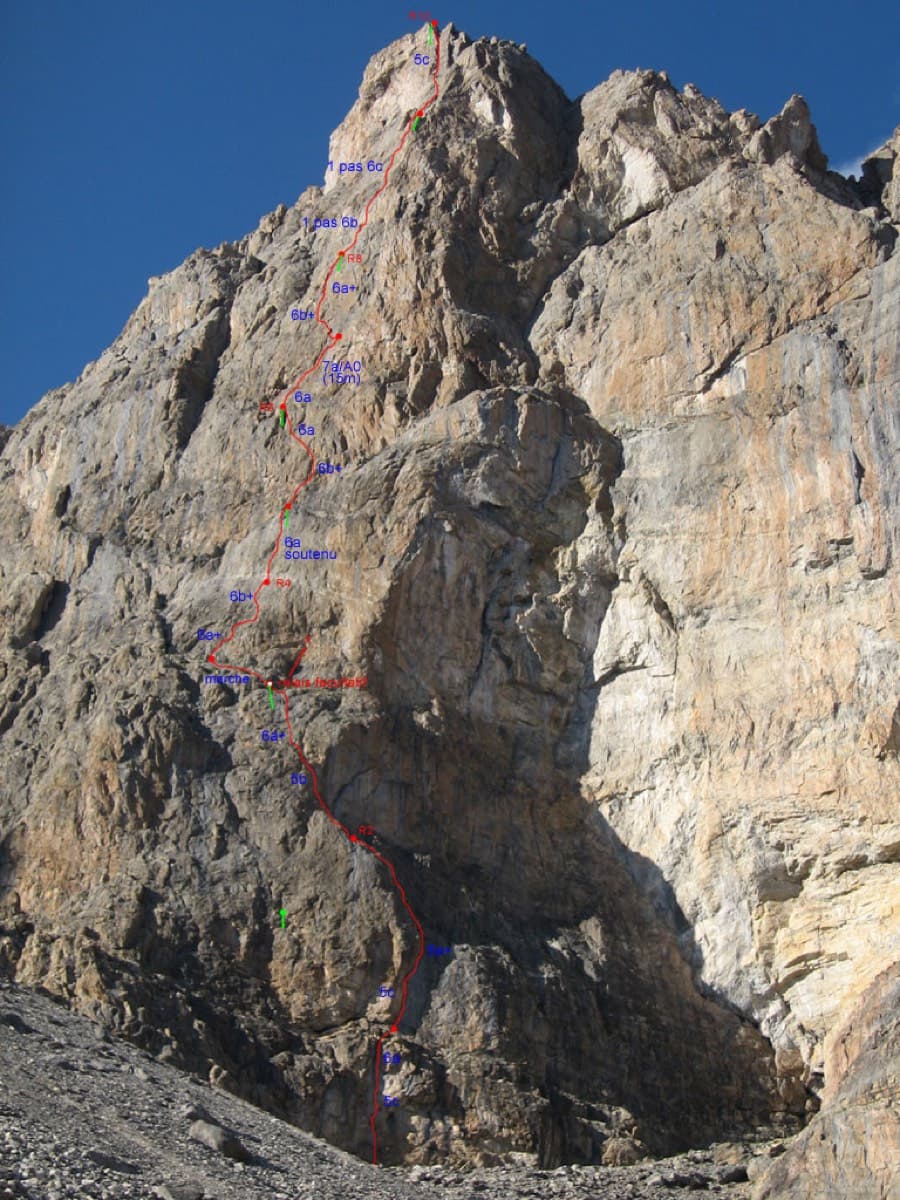
Photo-topo of Feu Sacré on the south-west face of the Tour Termier

France · Cerces

Feu Sacré

The classic hard route of the Tour Termier: ten steep, technical pitches on superb compact limestone at 3000 m, a short walk from the Col du Galibier road. It is never athletic but sustained at 6a+ to 6b, with a 7a pitch and a 6c move that both go at 6a A0. Cold, wind and thin footwork make it feel bigger than the numbers.

7a10 pitches320 m
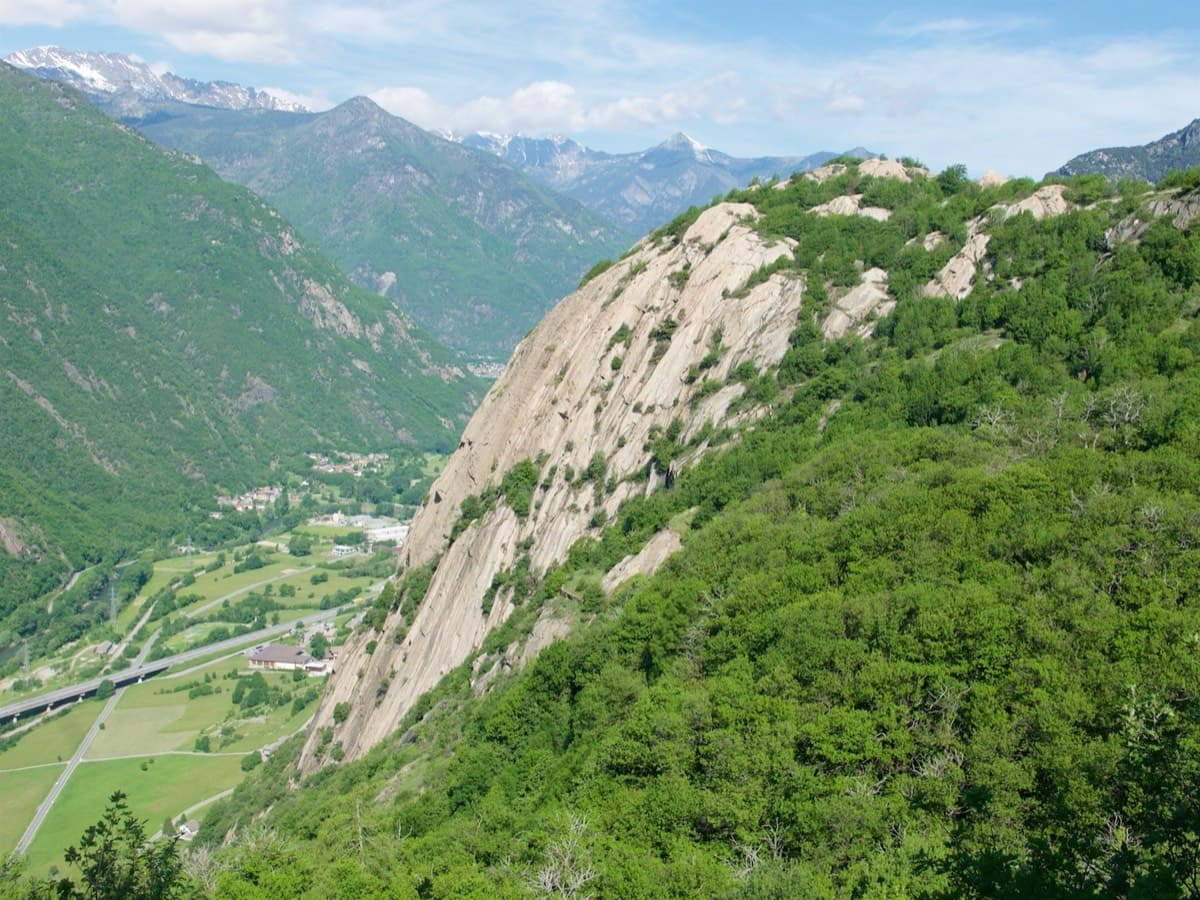
The Paretone di Arnad (Corma di Machaby) above the Dora Baltea valley, seen from the path to the Pilastro Lomasti

Italy · Aosta Valley

Sputnik

The hard route at the far left of the Paretone: two ordinary pitches, then steep walls on pitches 4 and 5 that are less slabby than the neighbours. Pitch 6 follows the arete at 7a, or 6a+ with a strenuous few metres of aid. Harder than the board at the car park suggests.

7a10 pitches250 m

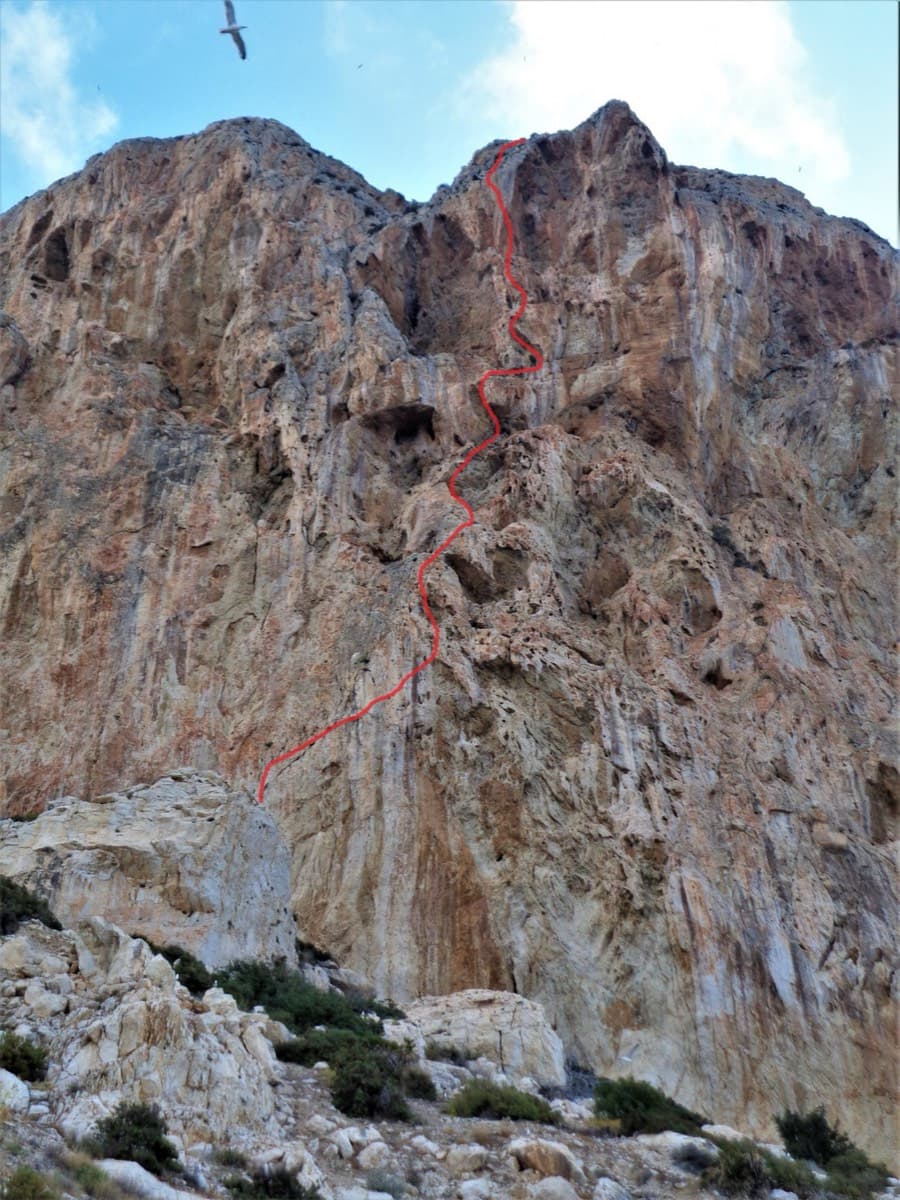
The line of Mare Nostrum on the south face of the Peñón de Ifach.

Spain · Costa Blanca (Peñón de Ifach)

Mare Nostrum

Nine steep pitches up the wildly sculpted right side of the south face, overhanging almost throughout. Two long 7a pitches open the route and a third comes near the top, and even the 6a+ pitches are athletic. The rock is covered in holds and much less polished than the classics to the left.

7a9 pitches310 m

Read the cautions

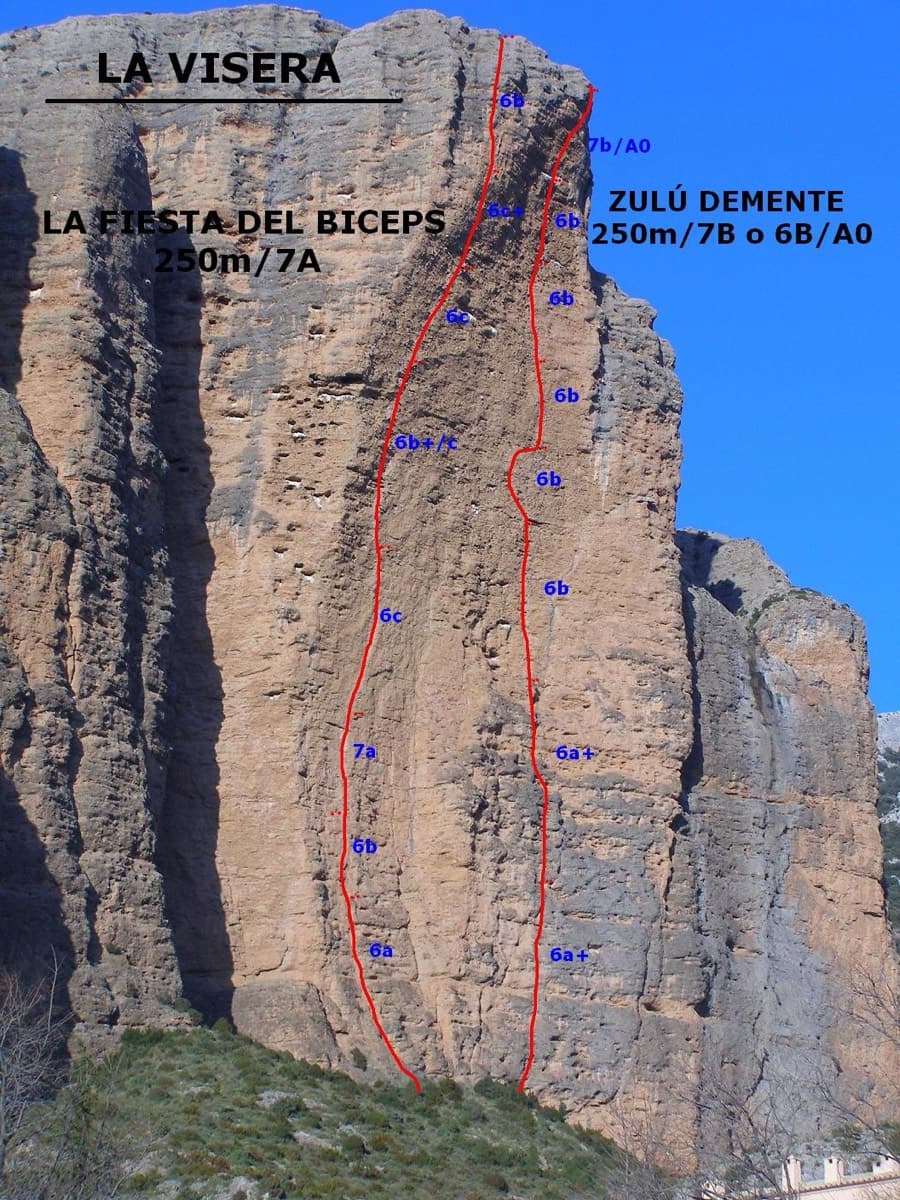
Photo-topo of La Visera at Riglos with La Fiesta de los Bíceps (left line) and Zulú Demente (right line)

Spain · Riglos & Agüero (Mallos)

La Fiesta de los Bíceps

The famous overhanging line up the left side of the Visera, following the white chalk stripe you can see from the village. A polished, technical 7a pitch low down, then five pitches of ever steeper climbing on huge cobbles where the difficulty is staying un-pumped. Bolts are sound but spaced, and above the third belay the only practical way off is the top.

7a8 pitches250 m

Read the cautionsCommitting

Compiled from published sources and last verified October 2026. Bolts, anchors and access change. Climbing is dangerous and you are responsible for your own decisions: check a current topo and read the disclaimer.