Multipitch Atlas

Mare Nostrum

Peñón de Ifach, south face (right side) · Costa Blanca (Peñón de Ifach) · Spain

Read the cautionsBail not documentedBolting confidence: high

Nine steep pitches up the wildly sculpted right side of the south face, overhanging almost throughout. Two long 7a pitches open the route and a third comes near the top, and even the 6a+ pitches are athletic. The rock is covered in holds and much less polished than the classics to the left.

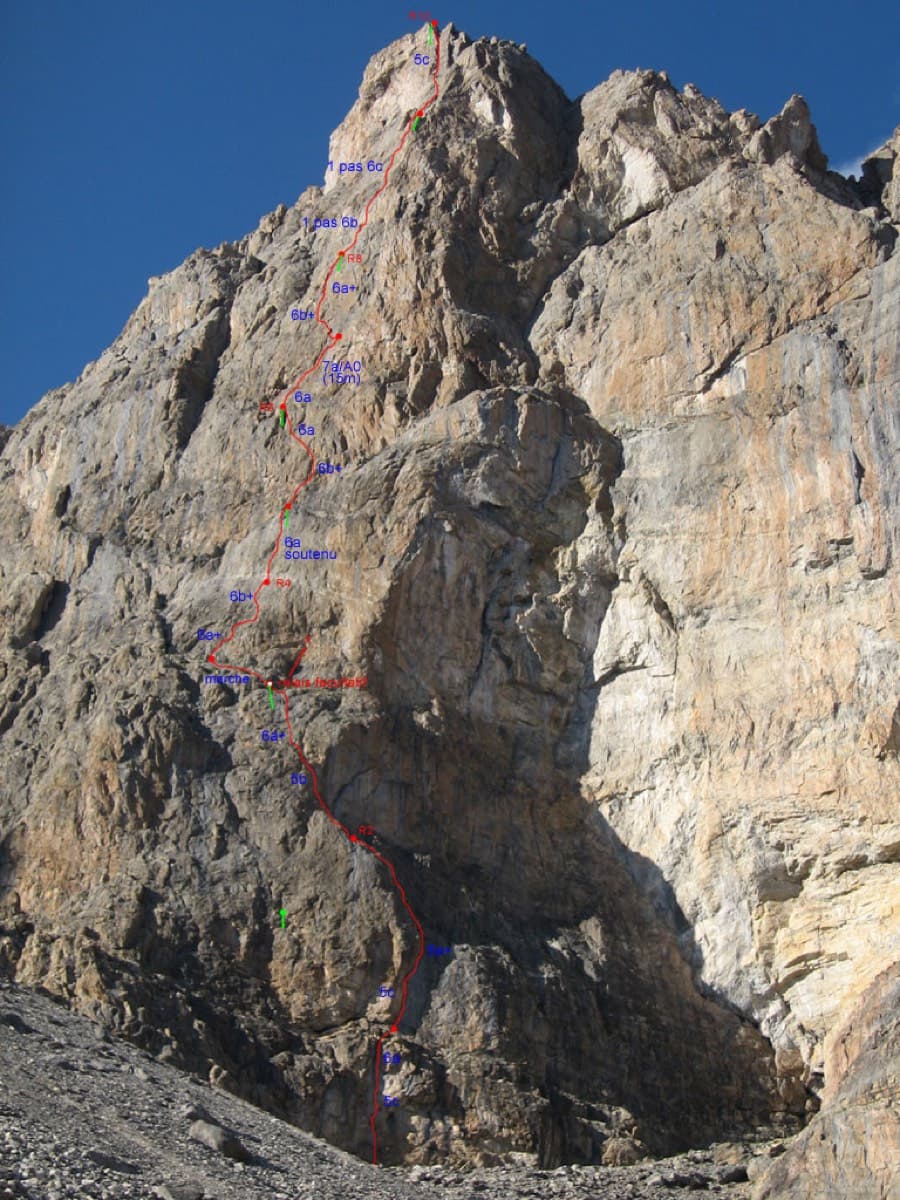
The line of Mare Nostrum on the south face of the Peñón de Ifach.Photo: lio65 · CC BY-NC-ND 3.0

Topo

The line of Mare Nostrum on the south face of the Peñón de Ifach.Photo: lio65 · CC BY-NC-ND 3.0
Hardest pitch
7a
Pitches
9
Length
310 m
Approach
15 min
Aspect
S
South-facing
Rope
2×50 m recommended
a single rope works with long extenders (walk-off)
Read before you go

Very well bolted, but steep and committing with obligatory moves, hard traverses for the second and rock that turns greasy in humid weather.

The route

Overview

A modern sport route of about 310 m on the big orange wall right of the Diedro UBSA tower, where most neighbouring lines need a rack. It starts up an overhanging white wall with a 45 m endurance pitch, and almost every pitch after that is steep on big, strange holds, with belays in caves and on ledges. The three 7a pitches can be eased with pulls on bolts, but several moves are obligatory and the traverses are awkward for a second who is at their limit. Conditions matter more than usual: in humid weather the rock feels as if it were coated in oil.

The climbing

Pitch by pitch

Pitches of Mare Nostrum
PitchGradeLengthNotes
P17a45 mA long endurance pitch trending slightly right, from jug to jug at first and harder all the way, with the hardest move pulling up at the end of the traverse. It takes 18 to 20 quickdraws. The belay is the only uncomfortable one on the route. Rockfax gives 7a+ and 35 m.
P27a40 mA hard, athletic start on sloping pockets, then easier. Rockfax gives 6c+ and 25 m.
P36a+30 mVery steep at the start. Belay on the right in a spacious cave.
P46a+30 mA contorted pitch that arcs round in a traverse; awkward for the second. Rockfax gives 15 m.
P56b+30 mAthletic climbing that flows well. Belay on the right.
P66a+30 mTake the ramp on the right, then come back left; athletic at the end. Near the top the bolts are out of sight: keep going straight up the steep ground. Heavy rope drag.
P7525 mA link pitch to the foot of pitch 8. Rockfax gives 5c.
P87a35 mExposed and sustained on good holds, weaving about, with a crux on a poor crimp in the upper part. A 2026 party thought 6c or 6c+.
P94+45 mEasy pitch to the summit. Take a sling to belay on a block.

Getting there

Approach

To the parking

Calp is on the N-332; from the AP-7 take exit 64 (Altea/Calp) and follow the N-332 towards Calp. For the south face follow signs to the harbour (Puerto) and park there. The provincial guide gives the harbour-side parking as 38°38'16"N, 0°04'19"E.

On foot · about 15 min

10 to 20 minutes. From the harbour-side parking follow the seafront walkway until it ends against the south face, then take a path that climbs back left under the wall. The route starts up an overhanging white wall. Look for chalk and for hangers newer than those on neighbouring lines.

Finding the route · 1 photo

Approach photo

Map of the walk-in

  • Crag
  • Parking

Loading map

The point marks the crag, not the exact start of the route.

Coordinates · crag

38.63389, 0.07611

Parking

38.63778, 0.07194

Harbour-side parking for the south face (Senderos de la Roca guide)

Point from camptocamp waypoint 249782

For your phone or watch

Download GPX

Contains the route point and parking. Opens in most mapping apps and GPS watches.

Points are compiled from published sources, with the precision stated above. They were not surveyed on the ground: check them against a current topo.

Getting down

Descent

Walk off by the summit footpath: it zigzags down the back, passes through a short tunnel to the north side and continues, waymarked, to the visitor centre. Several parties warn that the path is very polished. UKC notes that the park asks walkers to register to use the summit path.

Retreat

Bailing off the route

Bail not documented

No source describes retreating from this route. The belays are bolted, but the pitches overhang and traverse, so abseils would swing away from the wall and the rock, and several pitches are 40 to 45 m. Treat it as a route you finish, using pulls on bolts where needed.

Retreat from
Not documented. The first two belays are the most plausible, before the cave system.
Point of no return
Probably the cave belay at the top of pitch 3; this is an inference from the steepness and the traverse on pitch 4.
Carry
Double ropes if you want any chance of abseiling, plus maillons and cord. Otherwise the ability to aid on bolts.
Basis
Inferred from the route factsCamptocamp and Rockfax state bolted belays, steep traversing pitches and a walk-off; none mentions abseiling.

Partly inferred from the route facts

Safety

Hazards

  • Obligatory moves on the 7a pitches despite the close bolting (6c obligatory on camptocamp).
  • Traverses on pitches 1, 4 and 6 are serious for a weak second, and retreat from the overhanging middle section is not described anywhere.
  • Greasy rock in humid conditions makes the route feel much harder.
  • Yellow-legged gulls nest on the face and attack climbers who come close in the breeding season.
  • Rope drag on pitch 6.
  • The summit path is very polished.
  • Climbing is normally banned from 1 April to 30 June for nesting birds; a 2025 report describes an ascent on 9 May, so check the current notice.

Sun and weather

Conditions

The rock is prone to a greasy film: a May 2018 party found the first seven pitches slippery and locals blamed east and south-east winds, and a 2022 party found the first two pitches very greasy at dawn. Cold, dry north winds in winter give the best friction. A May 2025 party who started at 07:45 stayed in the shade the whole way and topped out at 14:00, despite the route being listed as south-facing.

Usual season · Jan to Mar, Nov to Dec

Sun on the wall · S-facing

Working out the sunlit hours for this month.

  • January (usual season): not yet worked out
  • February (usual season): not yet worked out
  • March (usual season): not yet worked out
  • April: not yet worked out
  • May: not yet worked out
  • June: not yet worked out
  • July: not yet worked out
  • August: not yet worked out
  • September: not yet worked out
  • October: not yet worked out
  • November (usual season): not yet worked out
  • December (usual season): not yet worked out

Sun on the wallDaylight, wall in shade● Usual season

Estimated from the wall's aspect only. Ignores surrounding terrain, gullies and the wall's exact shape. Clock times are local to the wall (Central European time), for the 15th of each month.

Climate figures for Costa Blanca (Peñón de Ifach) are not available yet

What to carry

Gear

18 to 20 quickdraws for pitch 1 (fewer if you unclip some as you go), several extendable ones for the wandering pitches, and a couple of slings for belays and the final block. Rockfax recommends double ropes; UKC climbers in 2022 and 2026 managed on a single rope with long extenders. Helmet.

Checklist

Quickdraws
18
Rope
2×50 m recommended; a single rope works with long extenders (walk-off)
Helmet
One each
Maillons or spare karabiners
To leave behind if you retreat
Cord
Mentioned for retreat

Derived from the route data; check it against a current topo

From climbers

Reader reports

Reader reports are not being collected yet. Until they are, check a current topo and the local club or guidebook publisher for recent changes to Mare Nostrum.

Worth knowing

Tips

  • Allow 4 to 6 hours. Parties report 3.5 to 4.5 hours when going well.
  • Do not start at dawn in damp weather; let the rock dry (2022 advice).
  • Pick a cold, clear day with a northerly wind.

Open questions

Where sources disagree

  • Grade: camptocamp gives 7a for pitches 1, 2 and 8 and 7a overall; Rockfax (via UKC) gives 7a+ for pitch 1 and 6c+ for pitch 2, and lists the route at 7a+. A 2018 camptocamp party says the hard sections pass fairly easily at A0. The atlas lists 7a.
  • Pitch lengths: camptocamp's total about 310 m; Rockfax's (35, 25, 35, 15, 20, 25, 20, 25, 40 m) total 240 m. Camptocamp lengths are used.
  • Ropes: Rockfax and a 2020 UKC comment say double ropes; UKC comments from 2022 and 2026 say a single is fine.
  • Sun: listed as south face, but a May 2025 party reports shade until early afternoon.

Provenance

Sources

Same area

More in Costa Blanca (Peñón de Ifach)

All routes in Costa Blanca (Peñón de Ifach)
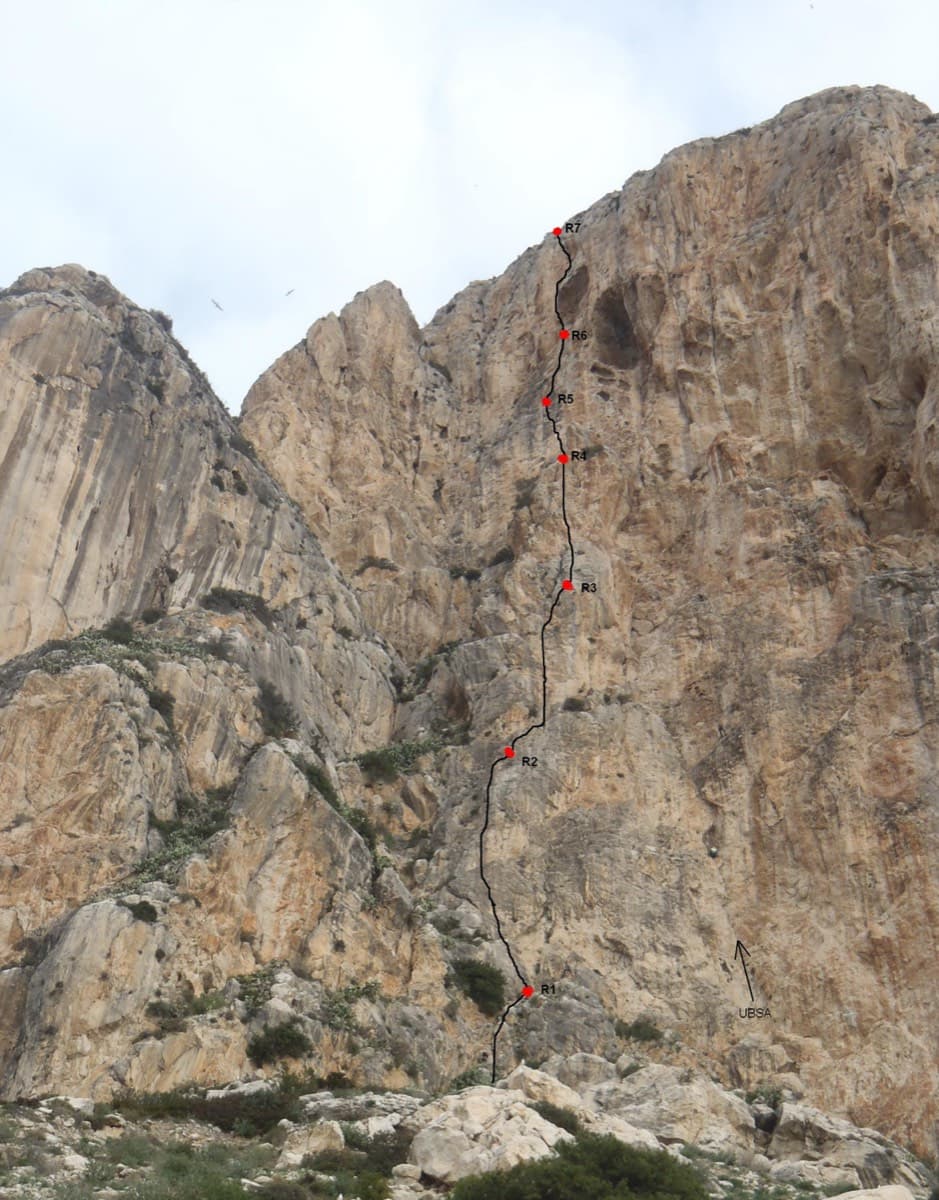
Photo-topo of Costa Blanca on the south face of the Peñón de Ifach, with belays R1 to R7 marked.

Spain · Costa Blanca (Peñón de Ifach)

Costa Blanca

The sport classic of the Peñón: a thin slab, a corner crack that steepens into an overhang, a pillar, then a wild exit from a big cave 200 m above the sea. Sustained at 6b with a 6c fifth pitch on polished slopers and a 6c+ last pitch whose crux can be pulled through on a bolt.

6c+7 pitches220 m
Around 7a · about 9 pitches

Similar elsewhere

Photo-topo of Feu Sacré on the south-west face of the Tour Termier

France · Cerces

Feu Sacré

The classic hard route of the Tour Termier: ten steep, technical pitches on superb compact limestone at 3000 m, a short walk from the Col du Galibier road. It is never athletic but sustained at 6a+ to 6b, with a 7a pitch and a 6c move that both go at 6a A0. Cold, wind and thin footwork make it feel bigger than the numbers.

7a10 pitches320 m

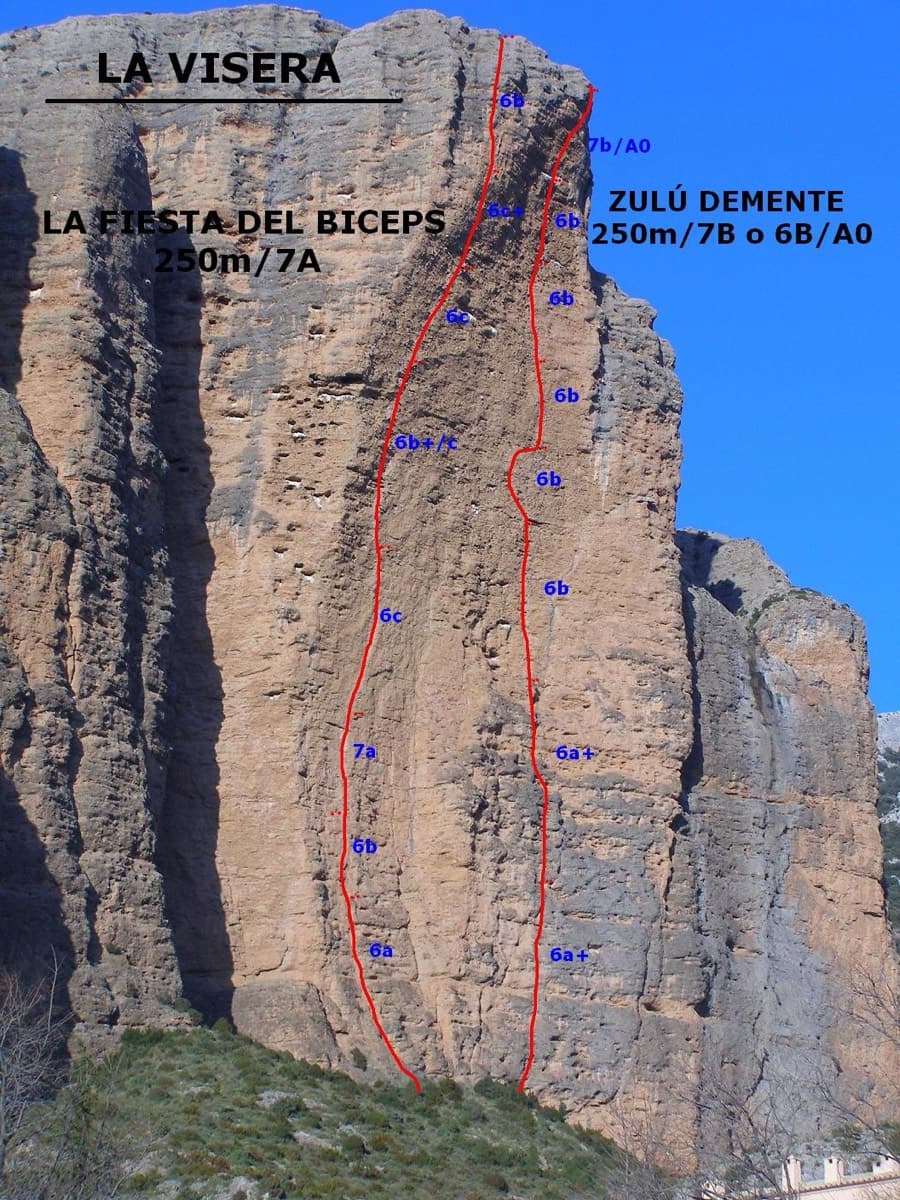
Photo-topo of La Visera at Riglos with La Fiesta de los Bíceps (left line) and Zulú Demente (right line)

Spain · Riglos & Agüero (Mallos)

La Fiesta de los Bíceps

The famous overhanging line up the left side of the Visera, following the white chalk stripe you can see from the village. A polished, technical 7a pitch low down, then five pitches of ever steeper climbing on huge cobbles where the difficulty is staying un-pumped. Bolts are sound but spaced, and above the third belay the only practical way off is the top.

7a8 pitches250 m

Read the cautionsCommitting

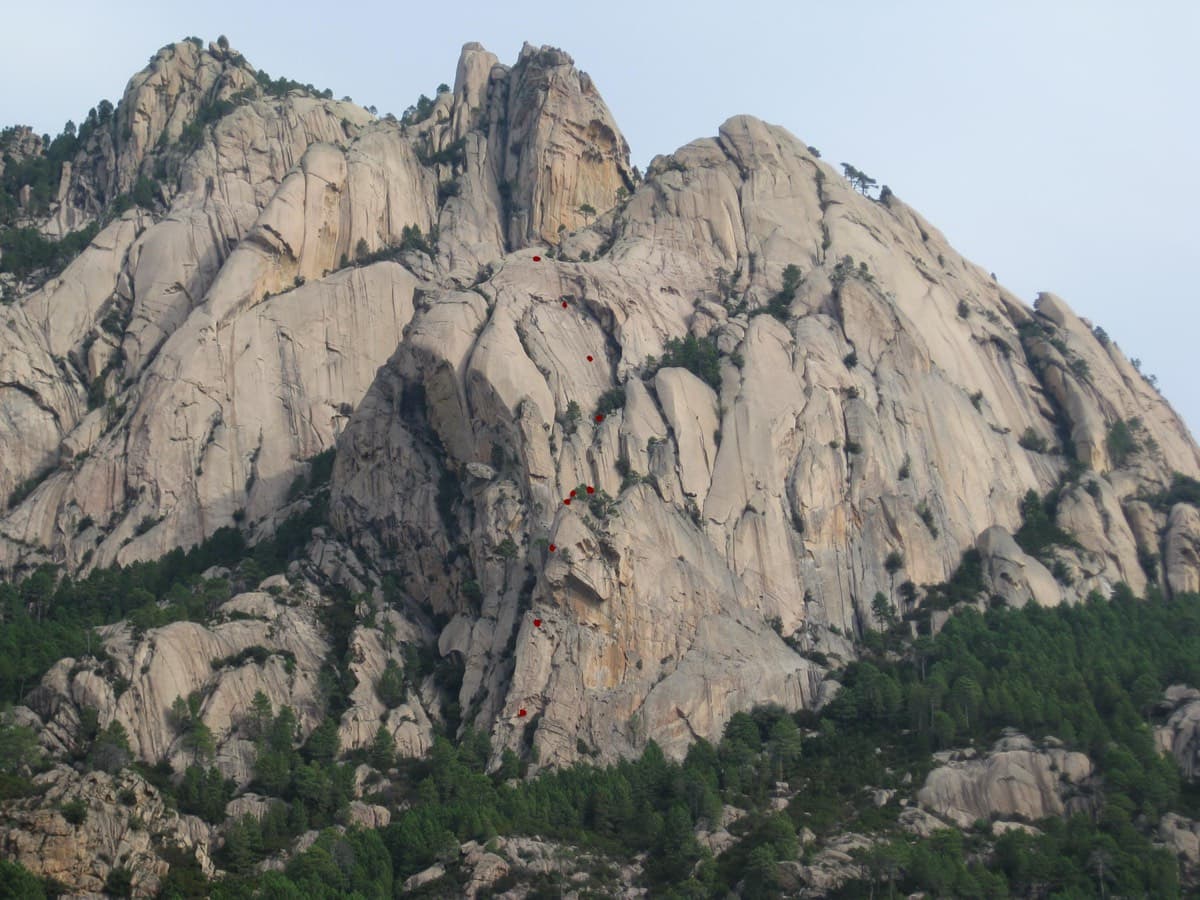
Teghie Lisce, Bavella, with the belays of Acqua in bocca marked in red

France · Bavella

Acqua in bocca

A sampler of everything Bavella granite does: a technical 7a wall, layback and jamming cracks, an off-width, a squeeze slot behind a tree, and three pitches of pure friction slab to finish. Bolted well enough to climb on quickdraws, which is rare here. The wide pitches are awkward and bruising if you are not used to the style.

7a10 pitches300 m

Read the cautions

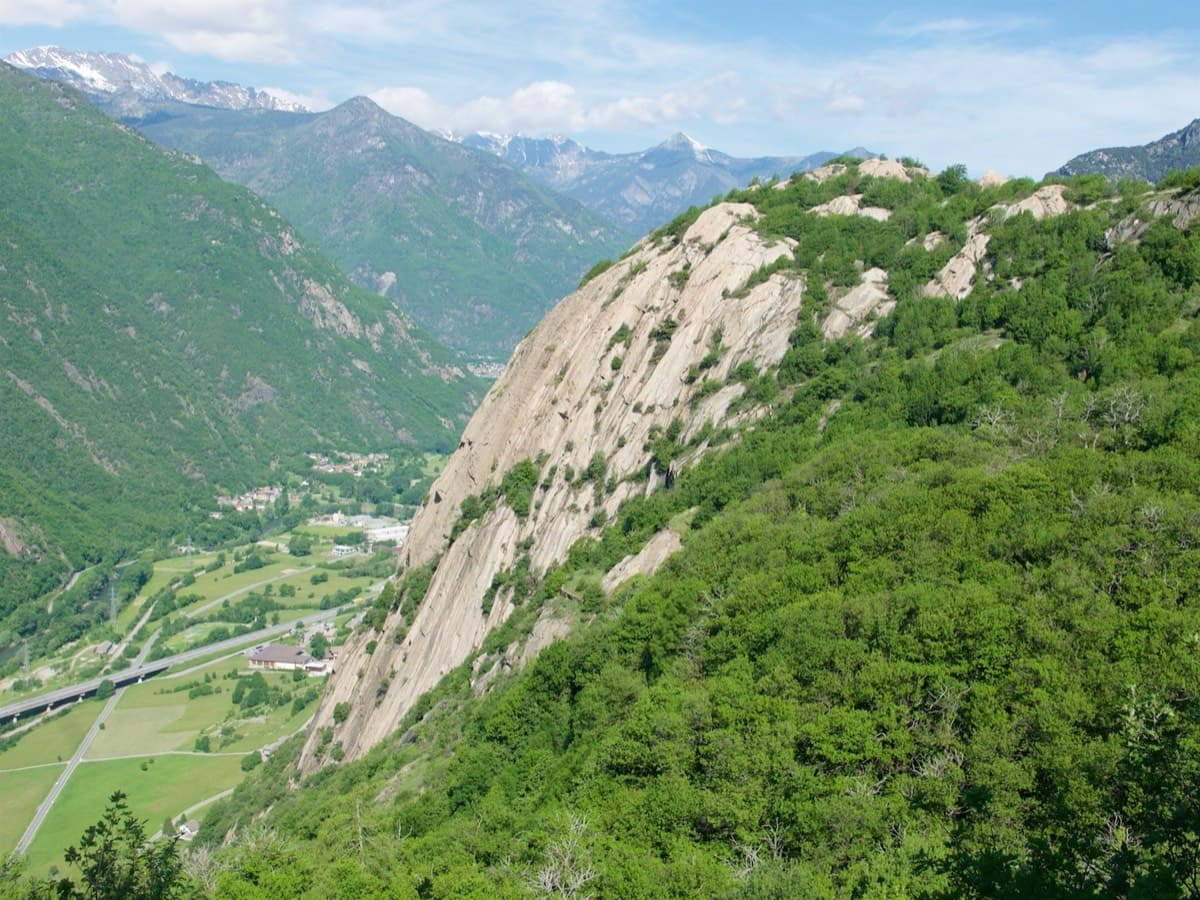
The Paretone di Arnad (Corma di Machaby) above the Dora Baltea valley, seen from the path to the Pilastro Lomasti

Italy · Aosta Valley

Sputnik

The hard route at the far left of the Paretone: two ordinary pitches, then steep walls on pitches 4 and 5 that are less slabby than the neighbours. Pitch 6 follows the arete at 7a, or 6a+ with a strenuous few metres of aid. Harder than the board at the car park suggests.

7a10 pitches250 m

Compiled from published sources and last verified October 2026. Bolts, anchors and access change. Climbing is dangerous and you are responsible for your own decisions: check a current topo and read the disclaimer.