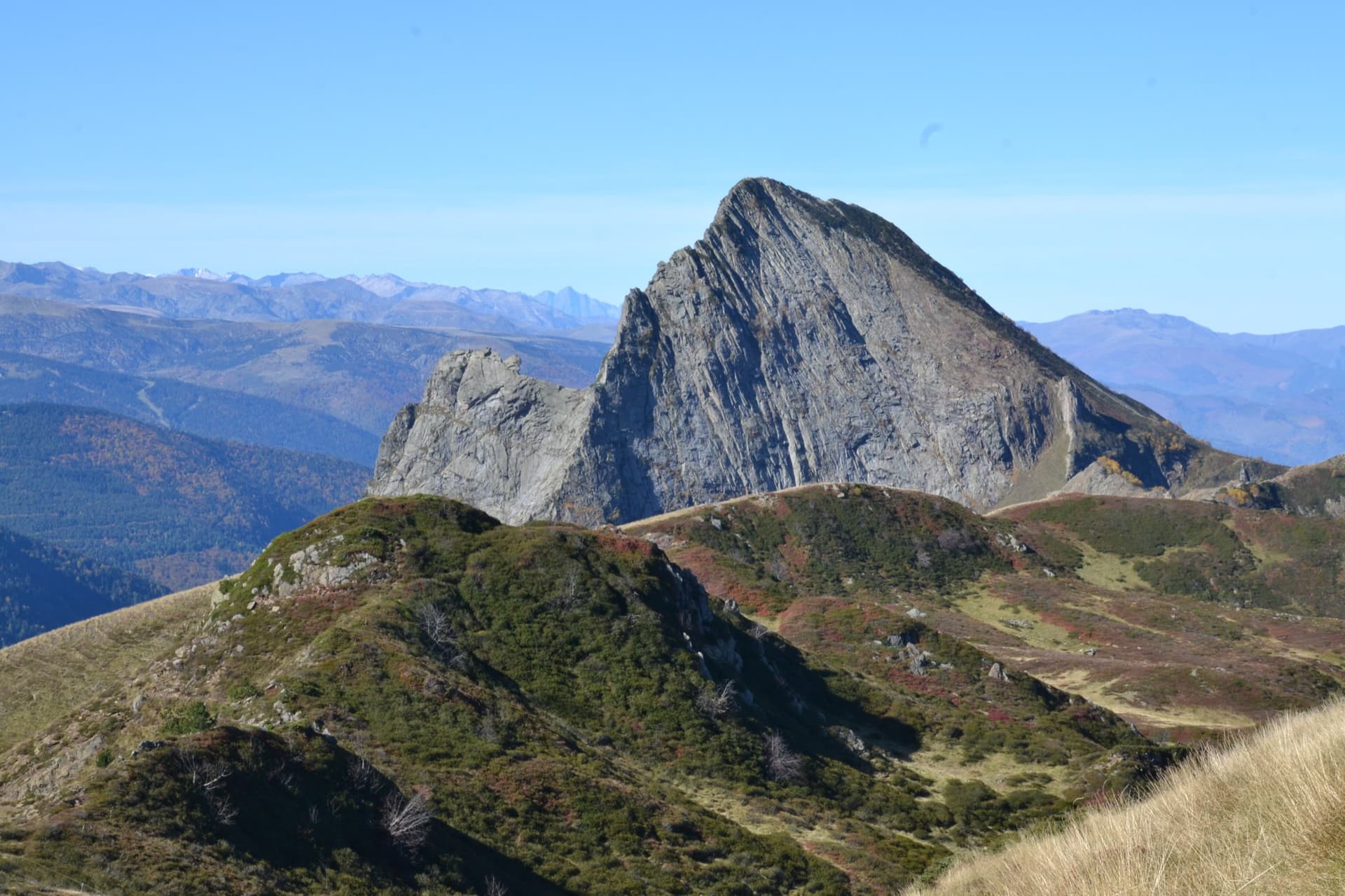
France · Ariège Pyrenees
Pink Floyd
Consistent, low-angled slab climbing on compact granite, with 10 pitches of 5a–5b+ on the big east face. Above all it is a long, sunny-morning moderate.
5b+10 pitches400 m
Read the cautions
Quié de Sinsat – Peppermint · Ariège Pyrenees · France
Easy to bailBolting confidence: high
The finest line on the big grey slabs of the Peppermint sector, a notch harder than Peppermint itself. A reachy 6b+ move and a chimney-corner start the day; a ledge splits the wall; the two pitches above it, a corner and a thin, sustained 6b slab, are the highlight.
The route
The Quié de Sinsat is the great limestone escarpment above the Ariège between Tarascon and Les Cabannes, and Peppermint is its sunniest multipitch sector, climbable right through the winter. Lisa takes eight pitches up its left-centre. The first pitch has the hardest move, a violent but optional 6b+ step that most parties pull through, followed by a squeeze up a big corner. Three easier pitches reach a terrace shared with Peppermint, and the upper wall gives three more pitches of 6a to 6b on compact rock. The grades are stiff by most standards and the bolts ask you to climb between them, but everything is in place and the belays have rings.
The climbing
| Pitch | Grade | Length | Notes |
|---|---|---|---|
| P1 | 6b+ | 42 m | A long slab pitch with one very reach-dependent move that can be passed by pulling on the bolt, then a crack and chimney-corner at 6a to 6b. Parties feel the '+'. |
| P2 | 6a+ | 40 m | Sustained crack and slab. It is easy to stray right to the Peppermint belay; the terrace above lets you regain the line. theCrag gives 6a. |
| P3 | 5c+ | 30 m | Easier slab. |
| P4 | 5 | 40 m | Easy climbing and a 10 m link along the terrace to a belay at the foot of a corner, left of the Peppermint crack. Less well protected than the rest and with loose stones on the ledges. |
| P5 | 6a+ | 35 m | A corner, then out right onto slab, then a corner again. The best of the first five pitches for one party. |
| P6 | 6b | 30 m | A thin, sustained slab: magnificent, and the real climbing highlight. |
| P7 | 5c | 20 m | A short pitch. |
| P8 | 6a | 40 m | 6a, then easier to the top, where the last belay is shared with Peppermint. |
Getting there
Sinsat is in the Ariège valley between Tarascon-sur-Ariège and Les Cabannes, south of Foix on the N20. Coming from Tarascon, turn left onto the D220 about 500 m after the level crossing (sign 'rocher d'escalade'), cross the bridge over the Ariège, turn right and park in the field laid out as a car park. Trains on the Toulouse to Latour-de-Carol line stop at Les Cabannes, about 30 min on foot (3.6 km of flat road) from the car park.
CAFMA gives 40 min; camptocamp says allow nearer 1 h, and recent parties took 35 to 60 min. From the car park follow the right bank of the Ariège for 50 m and take a path on the right between two houses (signs). It is common to the Pubis, Peppermint and Toit sectors. After about 10 min leave the Pubis path on the right and continue straight on to a level shoulder (20 min). Leave on the left the traverse to the big reddish wall of the Toit sector and climb a faint, steepening track to a rocky step, passed on the left by an airy ledge or on the right with fixed ropes. The track then zigzags up through evergreen oak and box and comes back level to the foot of the wall at the start of Peppermint. Follow the wall left to Lisa; the names are painted in red. Red dots and a few signs mark the way.
Loading map
The point marks the crag, not the exact start of the route.
Parking
Sinsat climbers' car park (camptocamp waypoint 128849)
Point from camptocamp waypoint 571631 (Quié de Sinsat, Peppermint)
Contains the route point and parking. Opens in most mapping apps and GPS watches.
Points are compiled from published sources, with the precision stated above. They were not surveyed on the ground: check them against a current topo.
Coordinates: 42.80898, 1.65833 (crag) · Parking: 42.80071, 1.66522
Getting down
By abseil down the route: each belay is two bolts, each with its own ring. With 50 m ropes you can go from belay 7 to belay 5 in one. On the terrace, abseil from the Peppermint belay to stay in line, and lower the first person or take great care, because the ledge is covered in loose stones. A 2026 party on the neighbouring route warns that a short 20 m abseil from the terrace that ends at a two-bolt station with a single ring means you have gone down the wrong line (Start Up): climb back and find Lisa further right. Then the approach path, about 40 min.
Retreat
Easy to bail
Abseiling the route is the normal descent and every belay has two ring bolts. A party stopped at the fifth belay in August 2025 and abseiled from there. The complications are the loose terrace at mid-height and choosing the right line below it.
Safety
Sun and weather
Due south between about 900 and 1180 m: at its best in autumn and spring and often climbable in a T-shirt in winter, close to unclimbable in summer. It is windy on the Quié, and without sun it gets cold fast; several parties regretted leaving their jumpers at the foot. The rock is compact on the grade 6 pitches and more delicate on the easier ones. Camptocamp states that the Peppermint sector is not covered by the nesting restrictions that close other parts of the Quié.
Sun on the wall · S-facing
Working out the sunlit hours for this month.
Sun on the wallDaylight, wall in shade● Usual season
Estimated from the wall's aspect only. Ignores surrounding terrain, gullies and the wall's exact shape. Clock times are local to the wall (Central European time), for the 15th of each month.
| Measure | Jan | Feb | Mar (usual season) | Apr (usual season) | May (usual season) | Jun | Jul | Aug | Sep | Oct (usual season) | Nov (usual season) | Dec |
|---|---|---|---|---|---|---|---|---|---|---|---|---|
| Mean daily high °C | 2 | 2 | 5 | 8 | 12 | 16 | 19 | 19 | 15 | 12 | 6 | 3 |
| Mean daily low °C | −6 | −6 | −4 | −1 | 3 | 7 | 9 | 9 | 6 | 3 | −2 | −5 |
| Rain days 1 mm or more | 11 | 12 | 12 | 15 | 18 | 17 | 17 | 17 | 13 | 12 | 12 | 11 |
● marks the usual climbing season. Averages for 1991-2020 at about 1785 m. Area climate from Open-Meteo reanalysis. Temperatures are adjusted to the height of the crag; rain comes from a grid cell of about 10 to 25 km, and summer highs on sea cliffs can read a few degrees low. The wall and valley can differ. Data: Open-Meteo, CC BY 4.0.
What to carry
13 quickdraws on camptocamp, 12 plus belays on CAFMA, and two 50 m ropes (CAFMA says a 100 m abseil). Camptocamp suggests a few small cams (0.3 to 0.75) only if you are at your limit. A small spanner is worth carrying. Helmet.
Derived from the route data; check it against a current topo
From climbers
Reader reports are not being collected yet. Until they are, check a current topo and the local club or guidebook publisher for recent changes to Lisa.
Worth knowing
Open questions
Provenance
Same area
France · Ariège Pyrenees
Consistent, low-angled slab climbing on compact granite, with 10 pitches of 5a–5b+ on the big east face. Above all it is a long, sunny-morning moderate.
5b+10 pitches400 m
Read the cautions
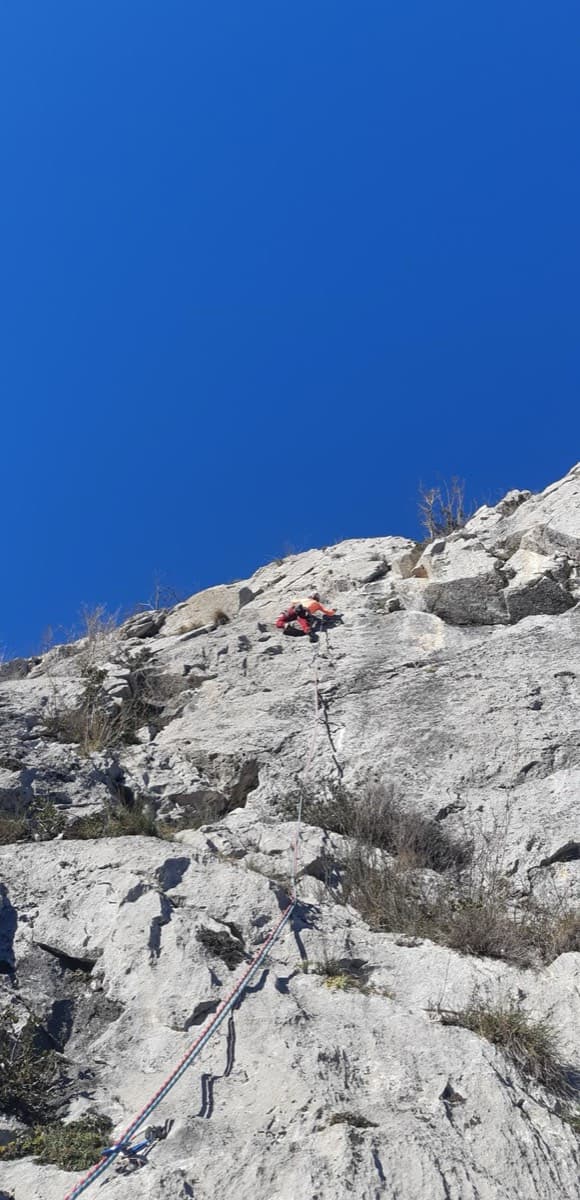
France · Ariège Pyrenees
The hard classic of the Calamès pillars above Bédeilhac: technical slabs, a well-bolted roof and a sustained 6c wall, capped by a short 7a slab pitch after a walk across a garden. Compact rock and close bolts make it a good place to try harder grades on a multipitch. The middle pitch is vegetated.
7a5 pitches180 m
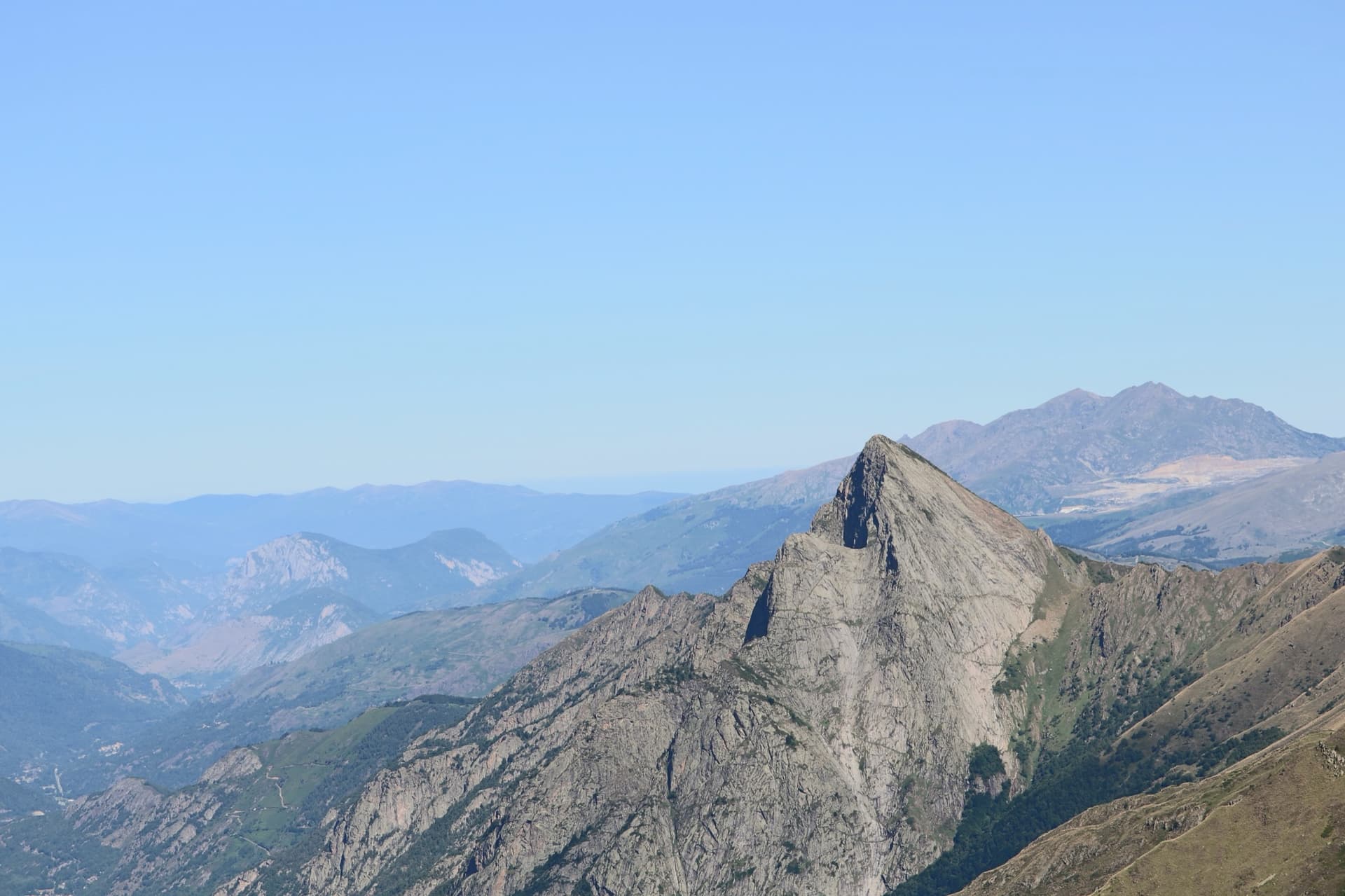
France · Ariège Pyrenees
The friendliest introduction to the granite slabs of the Dent d'Orlu: six pitches of friction climbing with a few steeper steps, shorter and better bolted than the face's big classics. It is the route to do when the weather is unsure or the longer lines are out of reach.
5c6 pitches230 m
France · Ariège Pyrenees
A short multipitch on the sculpted granite dome below the Dent d'Orlu, and a change from the big slabs above: a friction slab, a surprisingly vertical wall, a steep 6a corner and crack that finishes with a thin traverse, and a long slab to the top.
6a5 pitches120 m
Around 6b+ · about 8 pitches
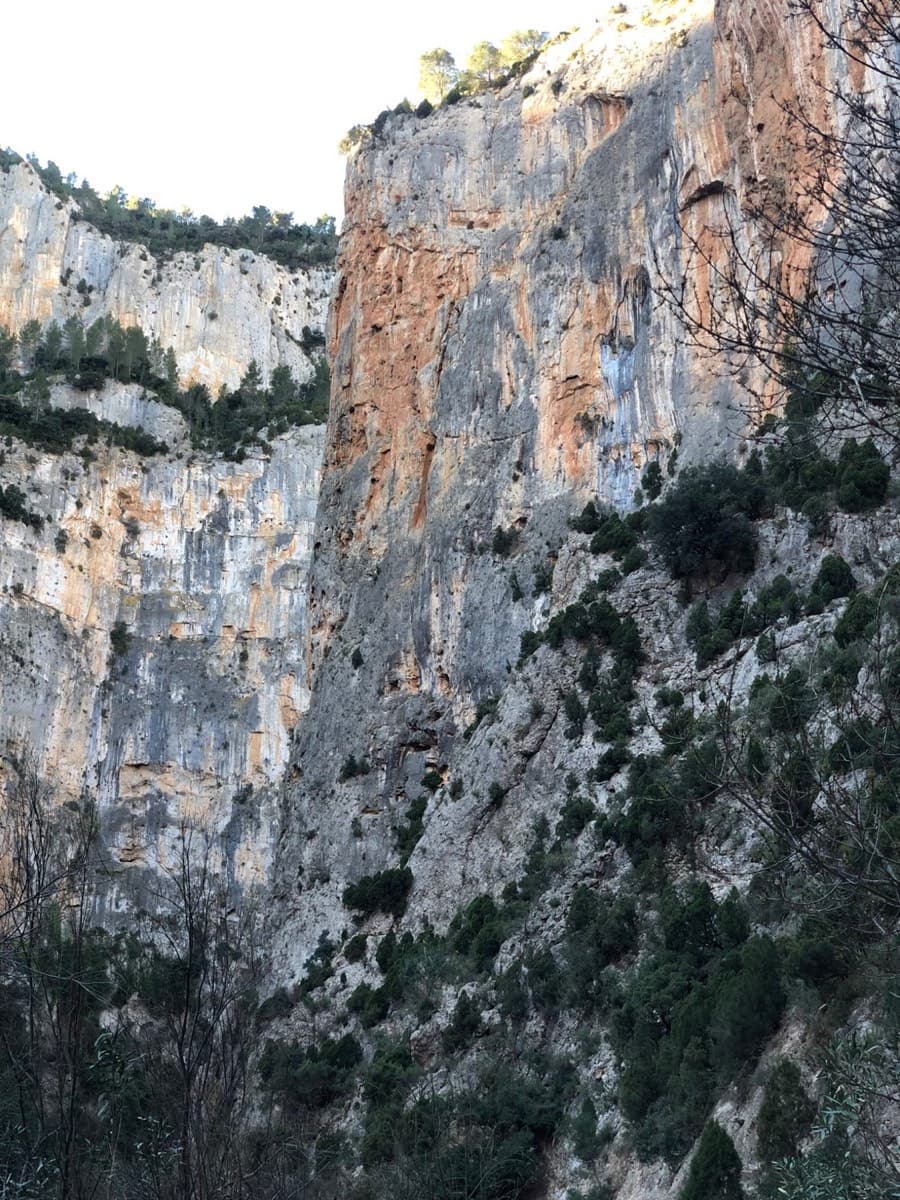
Spain · Montanejos
Eight pitches up a vertical prow deep in the Maimona canyon, on orange rock full of pockets (agujeros means holes). Sustained at 6a+ to 6b and physical throughout, with a huge roof start to the crux pitch and a bench to sit on at the third belay. Closed from January to June.
6b+8 pitches235 m
Read the cautions
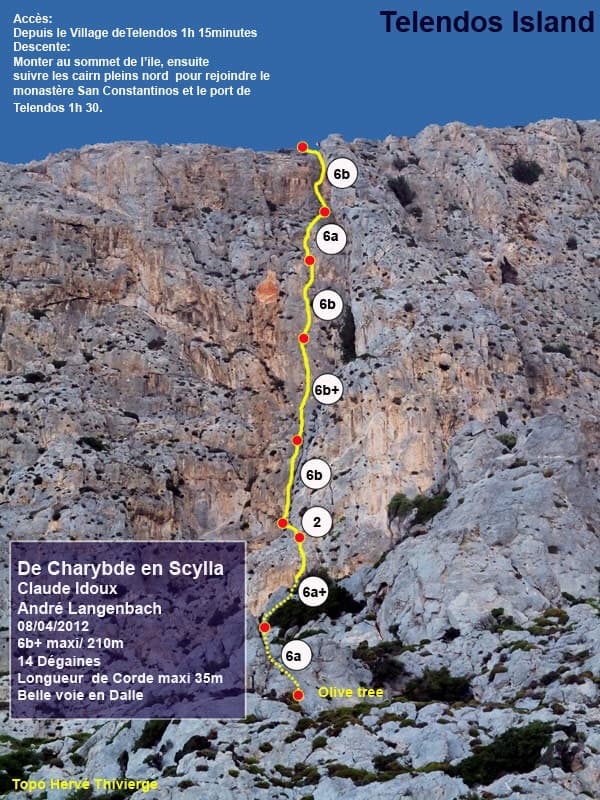
Greece · Kalymnos & Telendos
A sustained wall climb on the Telendos south face, seven pitches of 6a to 6b+ on very sharp, sculpted limestone with a short walk between the second and third. It needs route reading and tough skin. The line stays in the shade longer than its neighbours, until about 11:30.
6b+8 pitches215 m
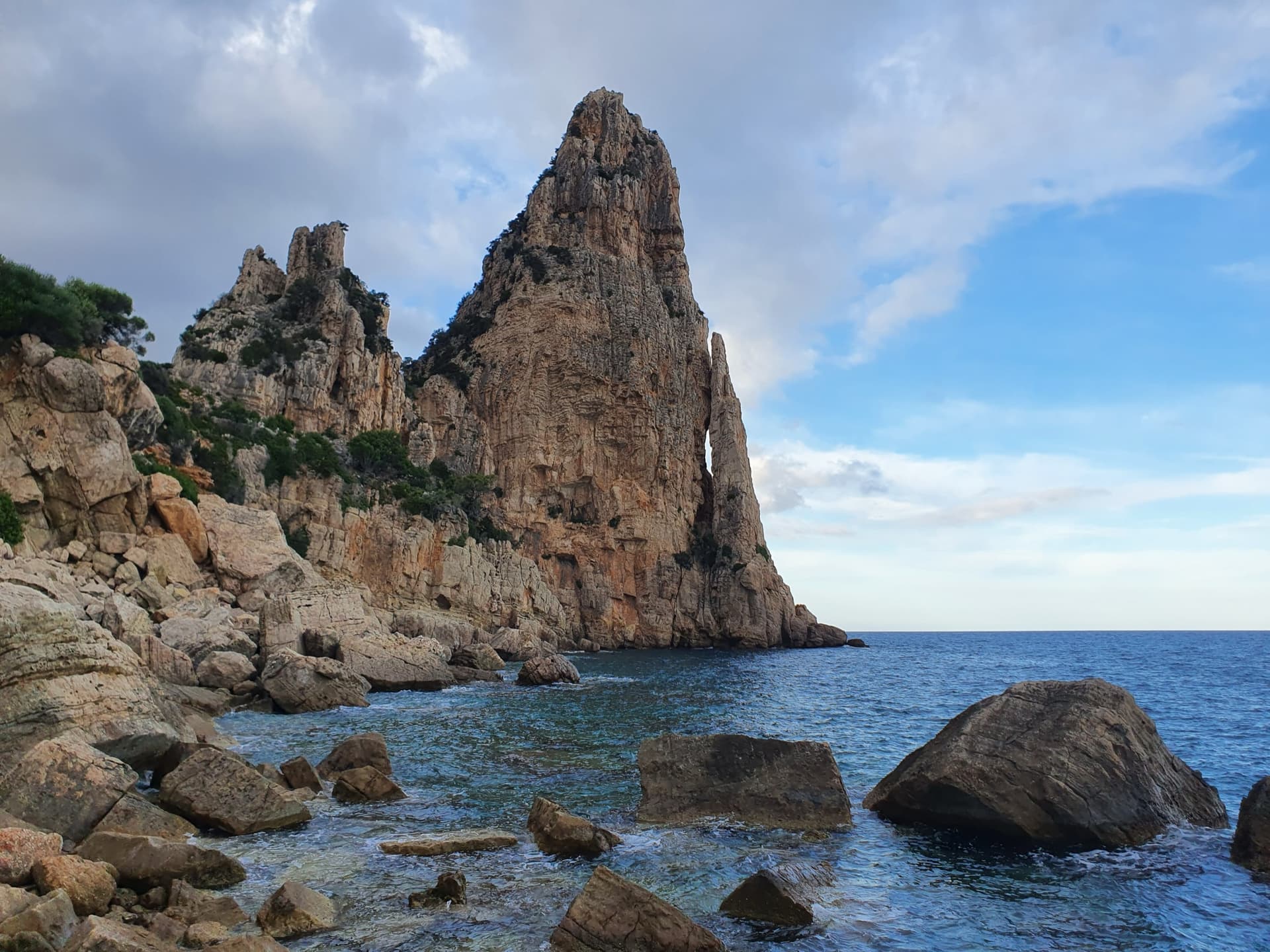
Italy · Sardinia
A sea-level start reached by abseil, then seven short pitches up the seaward face of Pedra Longa. The third pitch is a wildly exposed traverse above a line of roofs; two easy pitches on rock that needs care lead to a technical 6b and 6b+ finish on grey slab.
6b+7 pitches175 m
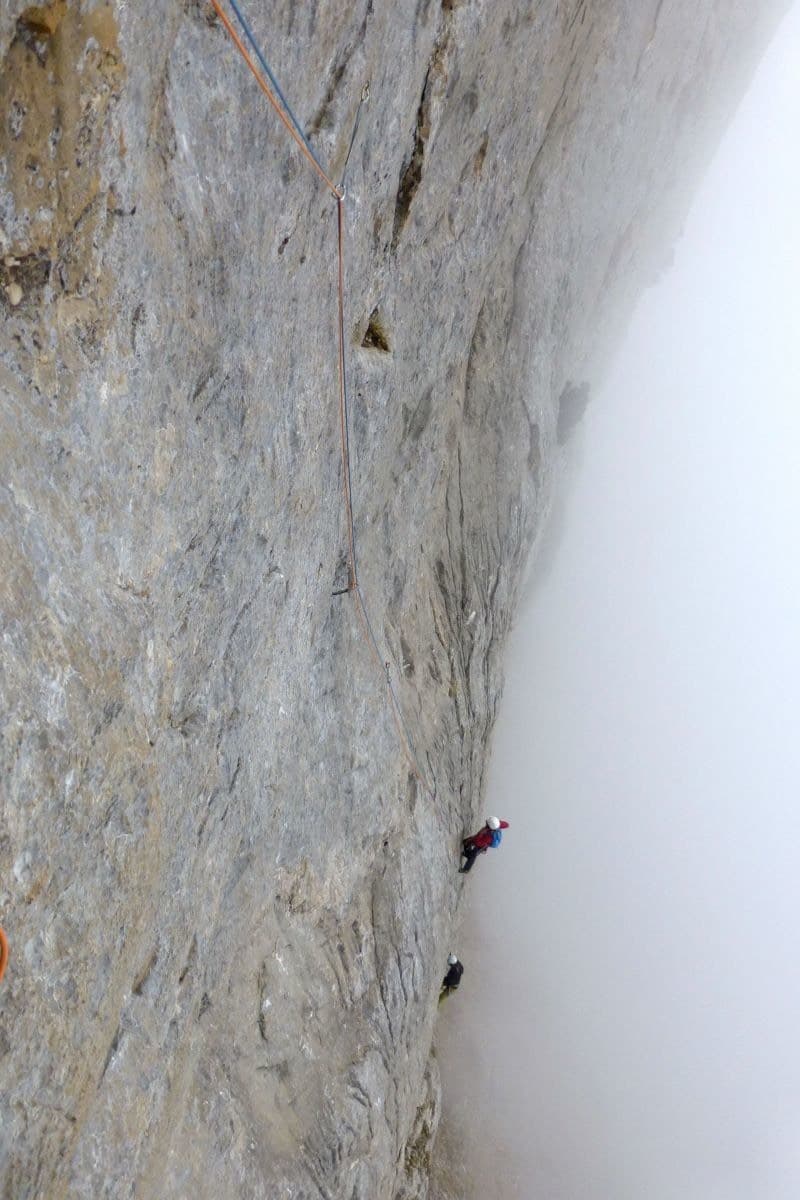
Turkey · Aladağlar
Often named as the best route in the massif: seven even pitches of 6a to 6b+ that move from delicate slabs and giant flutings through a steep, rough wall to mountain-style ground at the top. The 6b pitches are no harder than the 6a ones, but the bolts are far enough apart to keep you thinking.
6b+7 pitches235 m
Read the cautions
Compiled from published sources and last verified October 2026. Bolts, anchors and access change. Climbing is dangerous and you are responsible for your own decisions: check a current topo and read the disclaimer.