Multipitch Atlas

Lockdown

Pilier Franco Salluard (Val Ferret, Courmayeur) · Aosta Valley · Italy

Read the cautionsBail with caveatsBolting confidence: high

Technical granite slabs and short steep walls in two tiers, in a quiet corner of the Val Ferret below the Mont Blanc range. The 6b+ pitch builds through three hard moves, the last very thin. Obligatory climbing and some spaced bolts make it more serious than its neighbour Il Gatto e la Volpe.

The lower tier of Lockdown on the Pilier Franco Salluard, Val Ferret, with the line and pitch grades markedPhoto: JACOPO88 · CC BY-SA 3.0

Topo

The lower tier of Lockdown on the Pilier Franco Salluard, Val Ferret, with the line and pitch grades markedPhoto: JACOPO88 · CC BY-SA 3.0
Hardest pitch
6b+
Pitches
9
Length
250 m
Approach
–
Aspect
S
South-facing
Rope
2×60 m
Read before you go

Sound modern bolts, but spaced in places with obligatory moves and an awkward first abseil.

The route

Overview

A recent sport route about 100 m left of Il Gatto e la Volpe on the granite buttresses above Lavachey in the Italian Val Ferret. Five pitches up the lower tier are followed by a walk left across grass to a large slab, where the three best pitches lie. Camptocamp describes it as never banal and sustained, in a wild and isolated setting. The moves between bolts are obligatory in places (6a+), and gulliver.it notes that some pitches still carry earth.

The climbing

Pitch by pitch

Pitches of Lockdown
PitchGradeLengthNotes
P15a30 mA short wall on good holds that becomes a small corner with a slightly overhanging exit, then an earthy section.
P26a–A slab climbed entirely on the feet.
P36a+–A hard, obligatory move at the start, then a traverse left to pass a small step. Gulliver.it combines this with the previous pitch as one 35 m pitch of 6a+.
P45c–A slab that feels a little bold.
P54c–A very short slab. From its top walk left across grass to the second part of the route, aiming for the obvious huge slab. Camptocamp gives the walk as 300 m; gulliver.it simply calls it a transfer on grass.
P66b+–The best pitch: friction to start, then a technical vertical wall with three hard moves of increasing difficulty. Stay well left for the last one.
P76a+–A technical slab with a steeper move in the middle; gulliver.it found it a little dirty.
P84a–A straightforward traverse; gulliver.it describes it as another grass transfer and the photo-topo marks it grade III.
P96a–An easy overhang to start, then a rising traverse right across a slab of good rock. Gulliver.it gives 6a+.

Getting there

Approach

To the parking

From Courmayeur drive up the Val Ferret. Park at the car park just after the large Planpincieux car park, by the bridge over the torrent at Lavachey (gulliver.it: on the left before the bridge).

On foot

As for Il Gatto e la Volpe; no time is published, and gulliver.it gives 200 m of ascent. From the parking continue along the gravel road beside the river for 300 to 400 m to a turning on the left towards a concrete water intake. Go up onto it; 50 m on, a cairn on a large boulder shows the direction. Follow cairns and the track towards the Frébouze slabs to about half-way up the slope, cross the dry stream bed leftwards (cairns) and continue over unpleasant scree to the start of Il Gatto e la Volpe. Lockdown is about 100 m further left, at a bolt with a white sling, at roughly 1800 m.

Finding the route · 2 photos

  • OverviewThe wall seen from the scree below, with the line of Lockdown drawn in blue by the route's contributor (June 2025).Photo: JACOPO88 · CC BY-SA 3.0
  • OverviewThe wall from further back, with the upper part of Lockdown and its pitch grades drawn on by the route's contributor.Photo: JACOPO88 · CC BY-SA 3.0

Approach photo

Map of the walk-in

  • Crag
  • Parking

Loading map

The point marks the crag, not the exact start of the route.

Coordinates · crag

45.85327, 7.01323

Parking

45.85304, 7.02517

Lavachey / Pont de Frébouze (camptocamp access point)

Point from camptocamp waypoint 790072

For your phone or watch

Download GPX

Contains the route point and parking. Opens in most mapping apps and GPS watches.

Points are compiled from published sources, with the precision stated above. They were not surveyed on the ground: check them against a current topo.

Getting down

Descent

By abseil down the route. The first abseil does not reach the next belay: you have to down-climb about 2 m (easy) to get to it.

Retreat

Bailing off the route

Bail with caveats

Abseiling the route is the normal descent, so every belay is rigged for it. The caveats are the walking section between the two tiers and the first abseil from the top, which stops about 2 m above the next belay and needs a short down-climb.

Retreat from
Any belay. From the upper tier you abseil to the grass, walk back right to the top of pitch 5 and continue down the lower tier.
Point of no return
None.
Carry
Two 60 m ropes; knots in the ends for the short first abseil.
Basis
Stated in the sourcesAbseil descent and the short-abseil warning are stated on camptocamp; gulliver.it also gives abseil as the descent.

Safety

Hazards

  • Bolts are sometimes spaced and the first two on a pitch are often far apart; camptocamp rates the exposure E3 and asks for a good margin at the grade.
  • Obligatory 6a+ moves, notably the start of pitch 3.
  • The first abseil ends short of the belay and needs 2 m of down-climbing: knot the rope ends.
  • Earth and grass on some pitches and on the walking sections, slippery when damp.

Sun and weather

Conditions

South facing between about 1800 and 2000 m. A party at the end of June 2025 found it very fine and very hot. Gulliver.it's 2026 revision says some pitches are still rather dirty with earth; pitches 5 and 8 in its numbering (the 6b+ and the last pitch) are the cleanest and best.

Usual season · Jun to Sep

Sun on the wall · S-facing

Working out the sunlit hours for this month.

  • January: not yet worked out
  • February: not yet worked out
  • March: not yet worked out
  • April: not yet worked out
  • May: not yet worked out
  • June (usual season): not yet worked out
  • July (usual season): not yet worked out
  • August (usual season): not yet worked out
  • September (usual season): not yet worked out
  • October: not yet worked out
  • November: not yet worked out
  • December: not yet worked out

Sun on the wallDaylight, wall in shade● Usual season

Estimated from the wall's aspect only. Ignores surrounding terrain, gullies and the wall's exact shape. Clock times are local to the wall (Central European time), for the 15th of each month.

Climate figures for Aosta Valley are not available yet

What to carry

Gear

13 quickdraws and two 60 m ropes (camptocamp lists '60 m ropes' and an abseil descent). Helmet.

Checklist

Quickdraws
13
Rope
2×60 m
Helmet
One each
Abseil device and prusik
The descent or the retreat involves abseiling

Derived from the route data; check it against a current topo

From climbers

Reader reports

Reader reports are not being collected yet. Until they are, check a current topo and the local club or guidebook publisher for recent changes to Lockdown.

Worth knowing

Tips

  • Read the approach description for Il Gatto e la Volpe, already in this atlas, for more detail on reaching the base.
  • The Courmayeur guides publish their own topo of the route (guidemontblanc.it).

Open questions

Where sources disagree

  • Pitch count: camptocamp lists 9 climbing pitches; gulliver.it lists 8 stages of which two are grass transfers, merging pitches 2 and 3 and omitting the 5c slab. The camptocamp list, which matches the photo-topo, is used.
  • Last pitch: 6a (camptocamp) against 6a+ (gulliver.it).
  • Length: 230 m of difficulties (camptocamp) against 250 m of climbing (gulliver.it).
  • The 300 m quoted by camptocamp for the walk between the two tiers looks long against the photo-topo; treat it as approximate.

Provenance

Sources

Same area

More in Aosta Valley

All routes in Aosta Valley
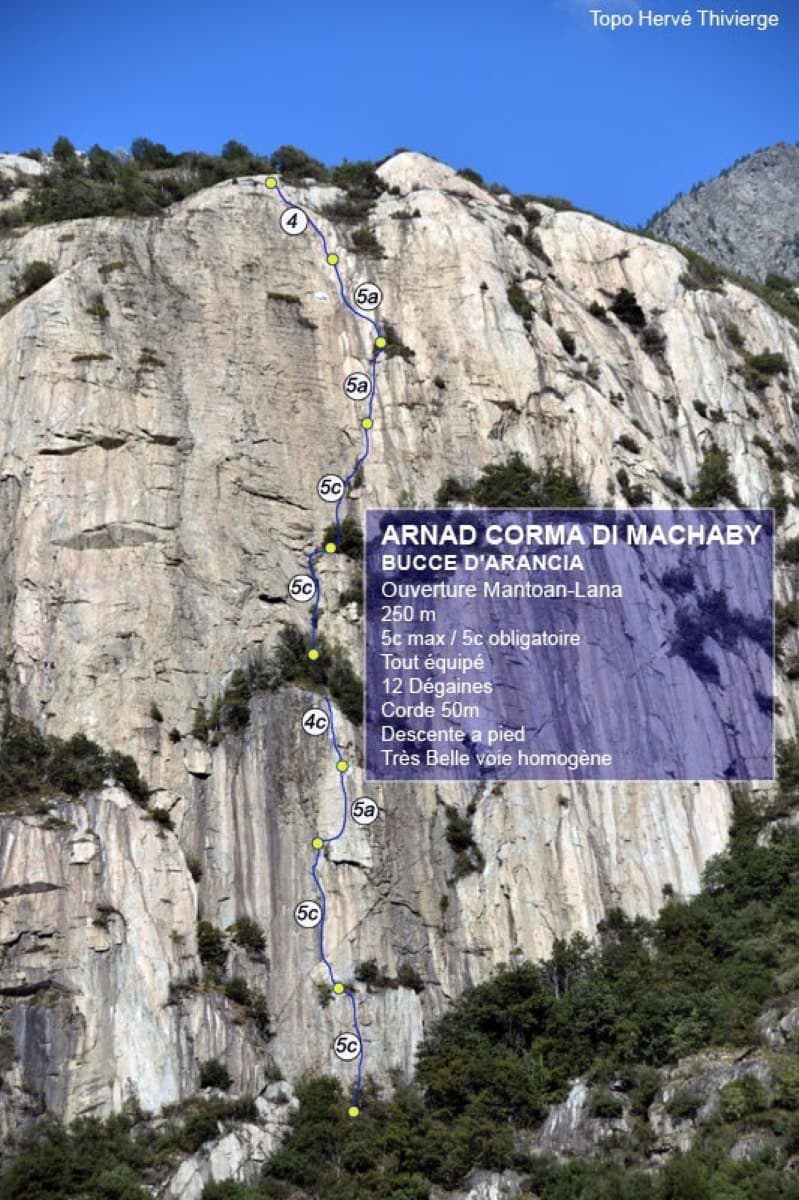
Topo of Bucce d'Arancia on the Corma di Machaby, Arnad

Italy · Aosta Valley

Bucce d'Arancia

This is the most-climbed route on the Paretone. It gives sustained, varied slab and crack climbing on good gneiss, and the hardest moves are a fine crack on P2, a slanting corner and a punchy wall. Queues are common on good days. The Mani Nude guidebook grades it stiffly; camptocamp's Italian page calls it sustained at 5b–5c+ with a single 6a.

6a10 pitches290 m

Read the cautions
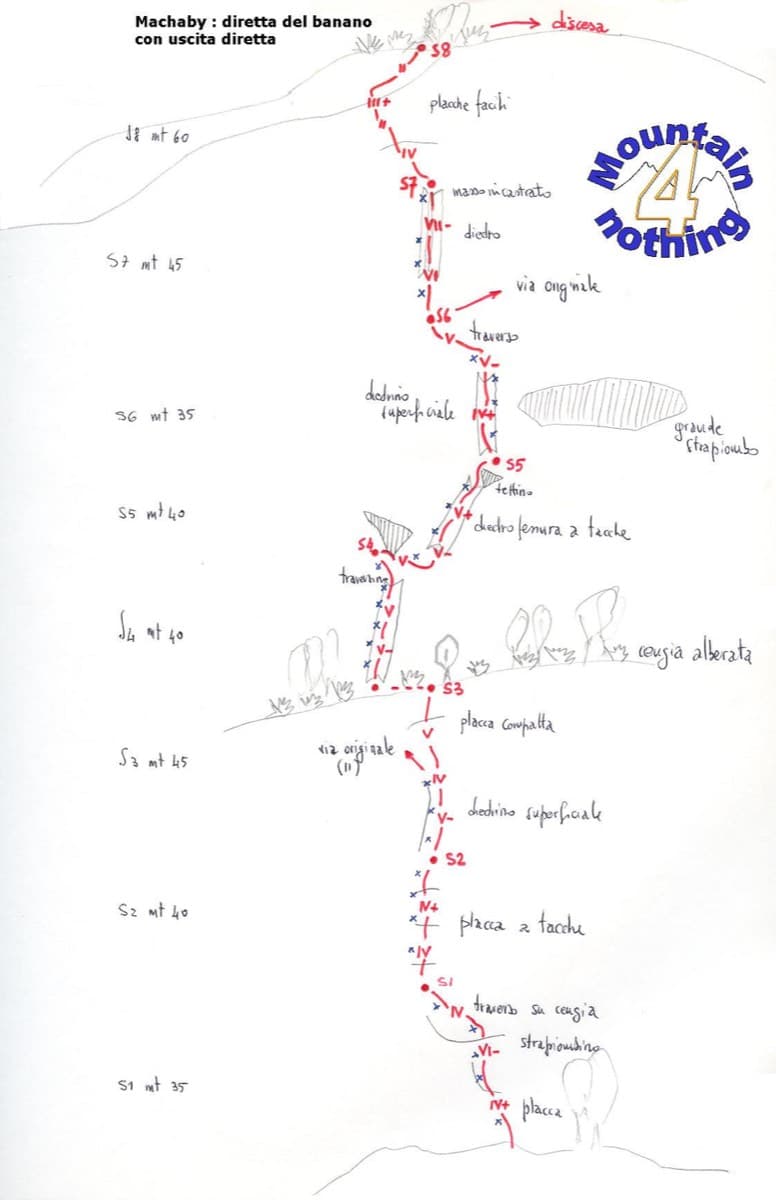
Hand-drawn topo of Diretta al Banano (direct finish), Corma di Machaby

Italy · Aosta Valley

Diretta al Banano

Along with Bucce d'Arancia this is the Paretone's other great classic (first ascent 1977, later retro-bolted). It climbs big, juggy, non-athletic slabs on beautiful rock up the centre of the wall to near the summit. Expect a few metres above the last bolt in places.

5c+9 pitches250 m

Read the cautions

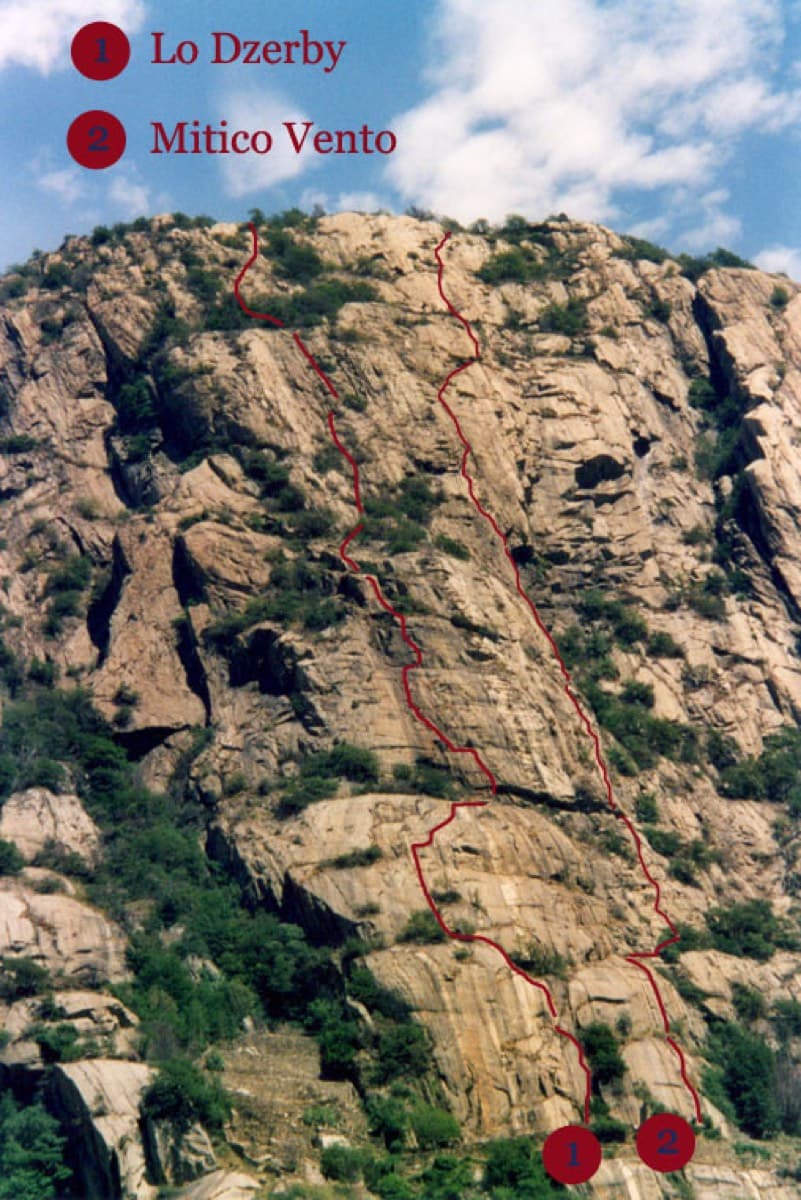
Topo of Lo Dzerby (line 1) and Mitico Vento on the Corma di Machaby, Arnad

Italy · Aosta Valley

Lo Dzerby

A long, easy-angled outing up the full height of the Paretone. A steeper lower half with an exposed pillar on P5 leads to sculpted slabs and broken steps higher up. It's a good first big multipitch.

5c13 pitches400 m

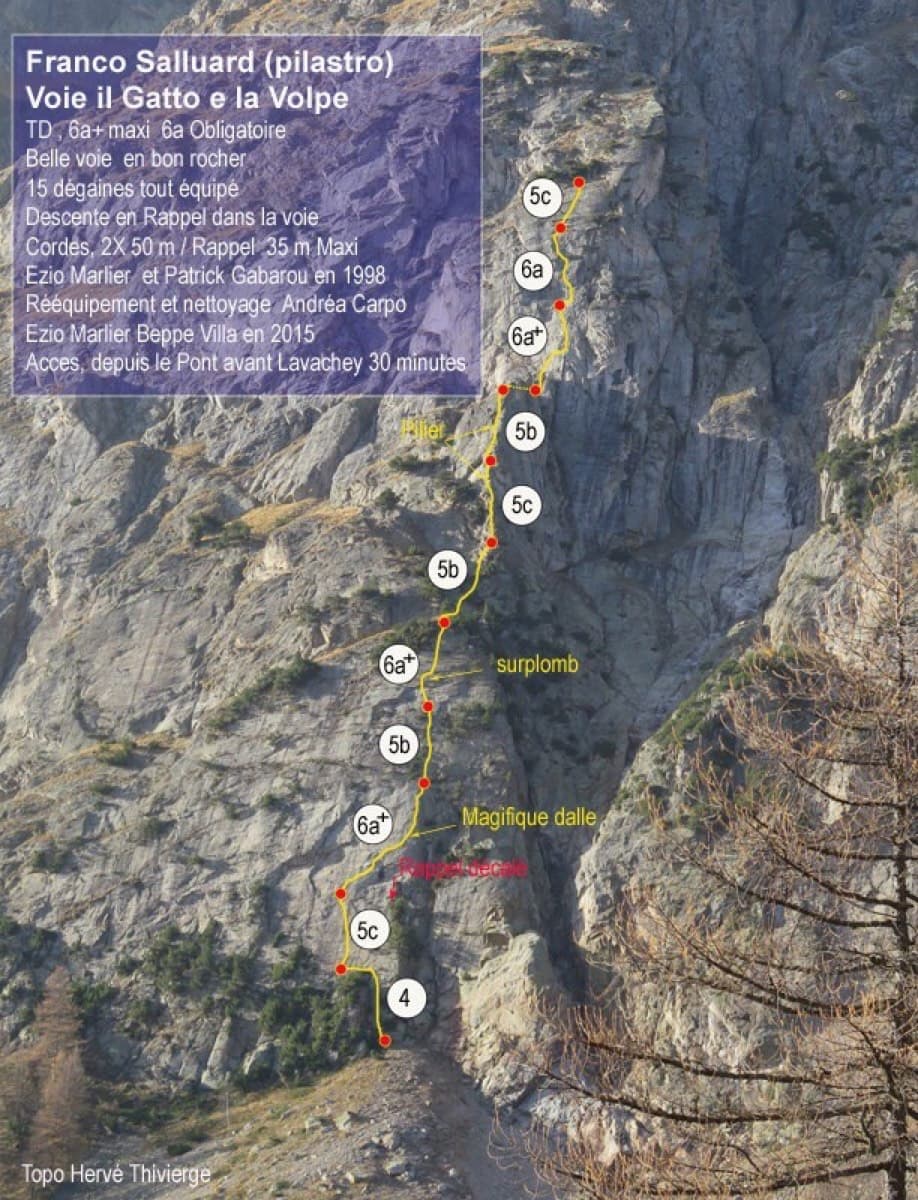
Topo of Il Gatto e la Volpe on the Pilier Franco Salluard, Val Ferret

Italy · Aosta Valley

Il Gatto e la Volpe

Rated 'great' on camptocamp: a wild setting with a short, easy approach from Lavachey. It climbs edgy granite slabs and a pillar crest, with a three-star exposed slab on P9.

6a+11 pitches350 m

Around 6b+ · about 9 pitches

Similar elsewhere

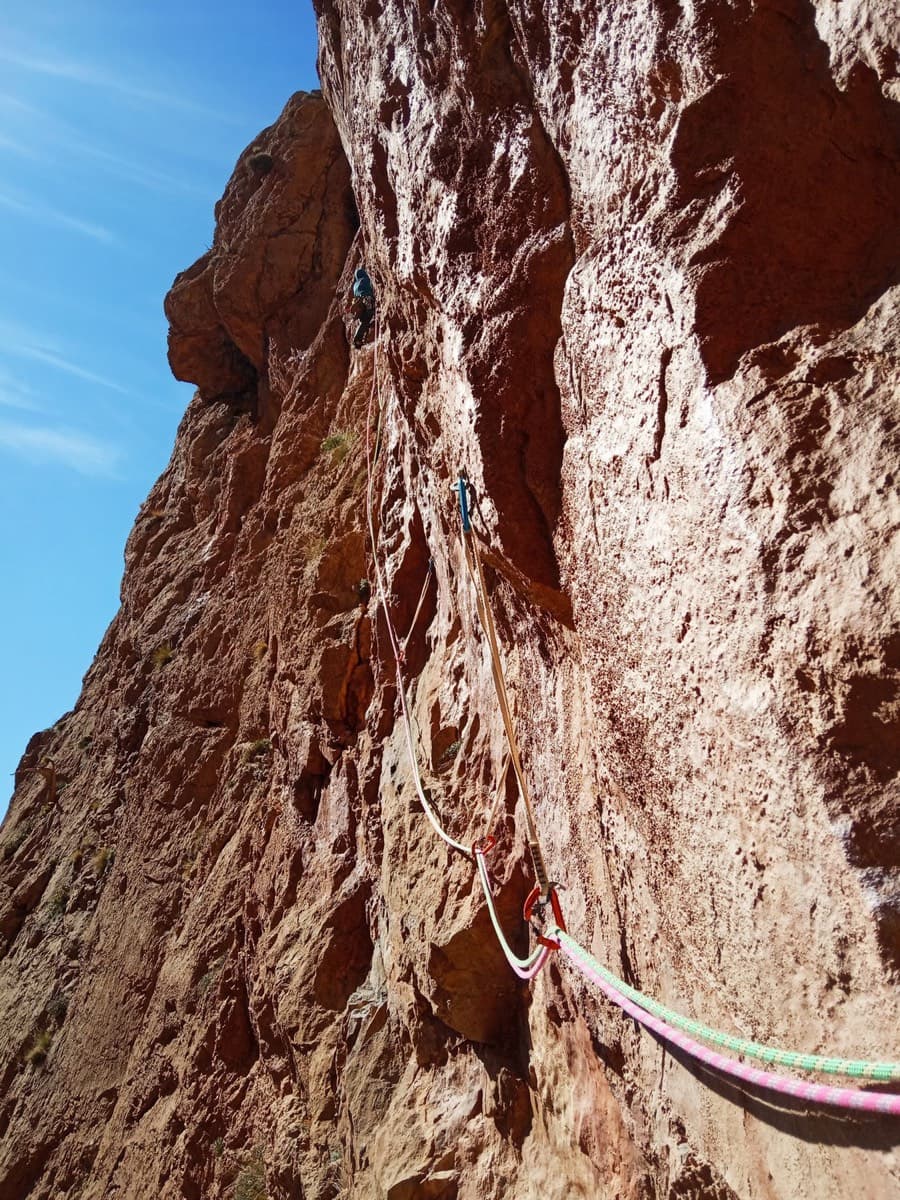
A party on the steep red rock of L'allumeur de rêves berbères, Timrazine

Morocco · Taghia

L'allumeur de rêves berbères

One of the easiest long routes in the Taghia cirque: nine sustained pitches of 6a to 6b+ on compact slabs and steep pocketed walls, starting from the bed of a canyon. The bolts are sound but airy, the obligatory grade is 6a+ and the day is long.

6b+9 pitches320 m

Read the cautions

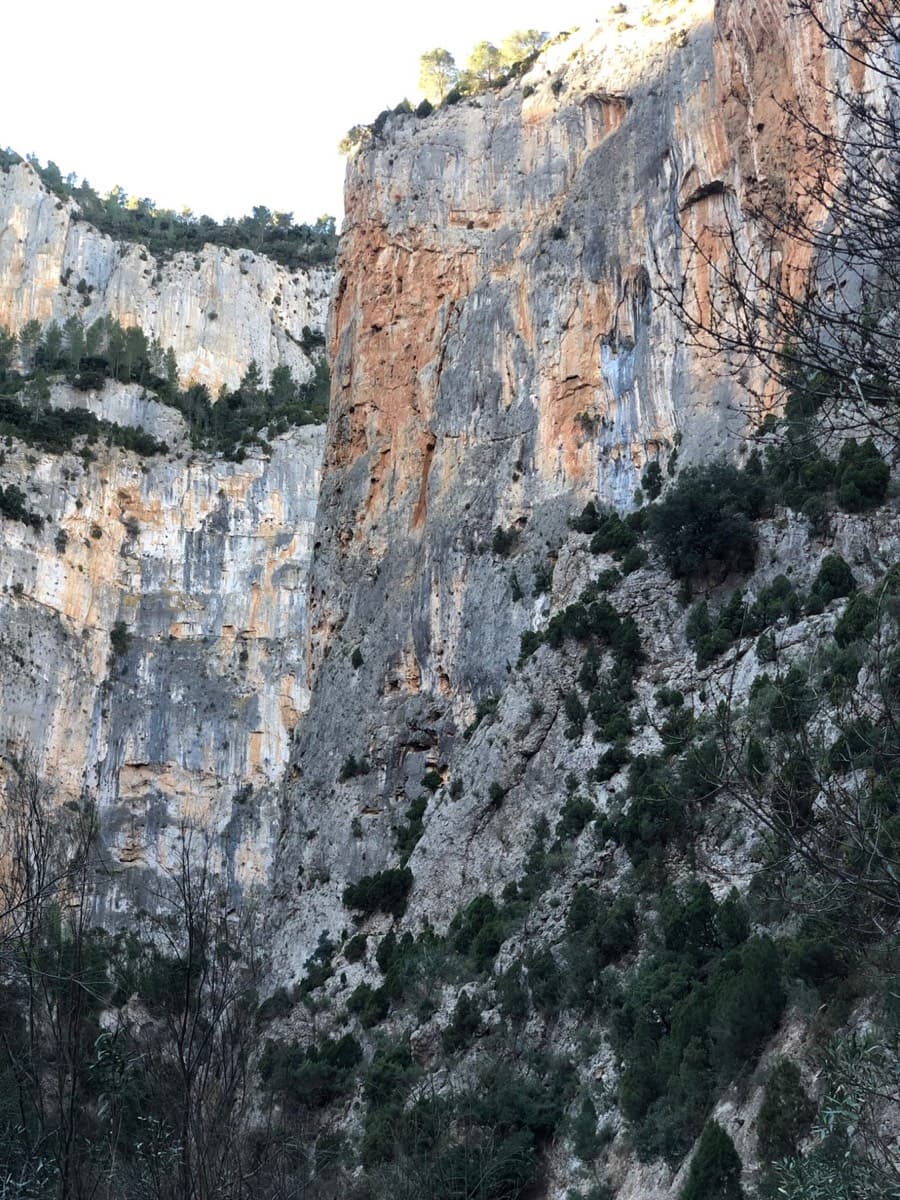
The walls of the Barranco de la Maimona at Montanejos, photographed on an ascent of La Luna.

Spain · Montanejos

La Luna

Eight pitches up a vertical prow deep in the Maimona canyon, on orange rock full of pockets (agujeros means holes). Sustained at 6a+ to 6b and physical throughout, with a huge roof start to the crux pitch and a bench to sit on at the third belay. Closed from January to June.

6b+8 pitches235 m

Read the cautions

The Himmelwand in the Kötschachtal near Bad Gastein; the Kleine Himmelwand lies beyond the main wall

Austria · Gastein (Hohe Tauern)

Father and Son

Ten pitches of varied climbing on good rock, mostly slabs with some cracks and steeper passages. Largely UIAA 5 with a few moves of 6 and three spots of 7 that go at 6+ A0. A short walk-in and a rigged abseil line.

6b+10 pitches350 m

No photo yet

France · Aravis

Heididoune

A ten-pitch line to the summit of the Pointe Percée, the high point of the Aravis, following green hangers up the cool north-west face. Seven long pitches, mostly easy with a 6a+ wall, reach the notch of the Arête du Doigt; three independent pitches finish it, including a memorable slab traverse of 6b+ that can be aided on the bolts.

6b+10 pitches400 m

Read the cautions

Compiled from published sources and last verified October 2026. Bolts, anchors and access change. Climbing is dangerous and you are responsible for your own decisions: check a current topo and read the disclaimer.