Multipitch Atlas

L'allumeur de rêves berbères

Timrazine · Taghia · Morocco

Read the cautionsBail with caveatsBolting confidence: high

One of the easiest long routes in the Taghia cirque: nine sustained pitches of 6a to 6b+ on compact slabs and steep pocketed walls, starting from the bed of a canyon. The bolts are sound but airy, the obligatory grade is 6a+ and the day is long.

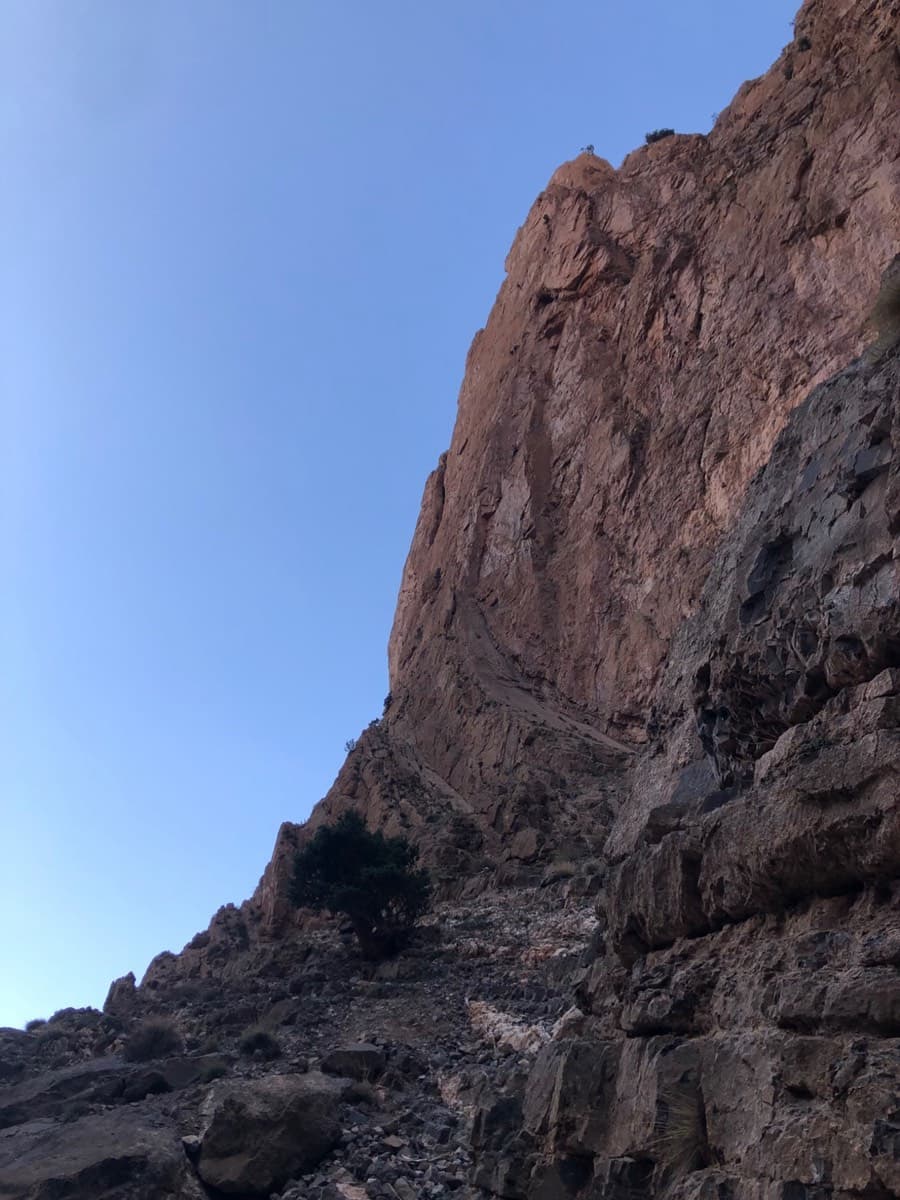
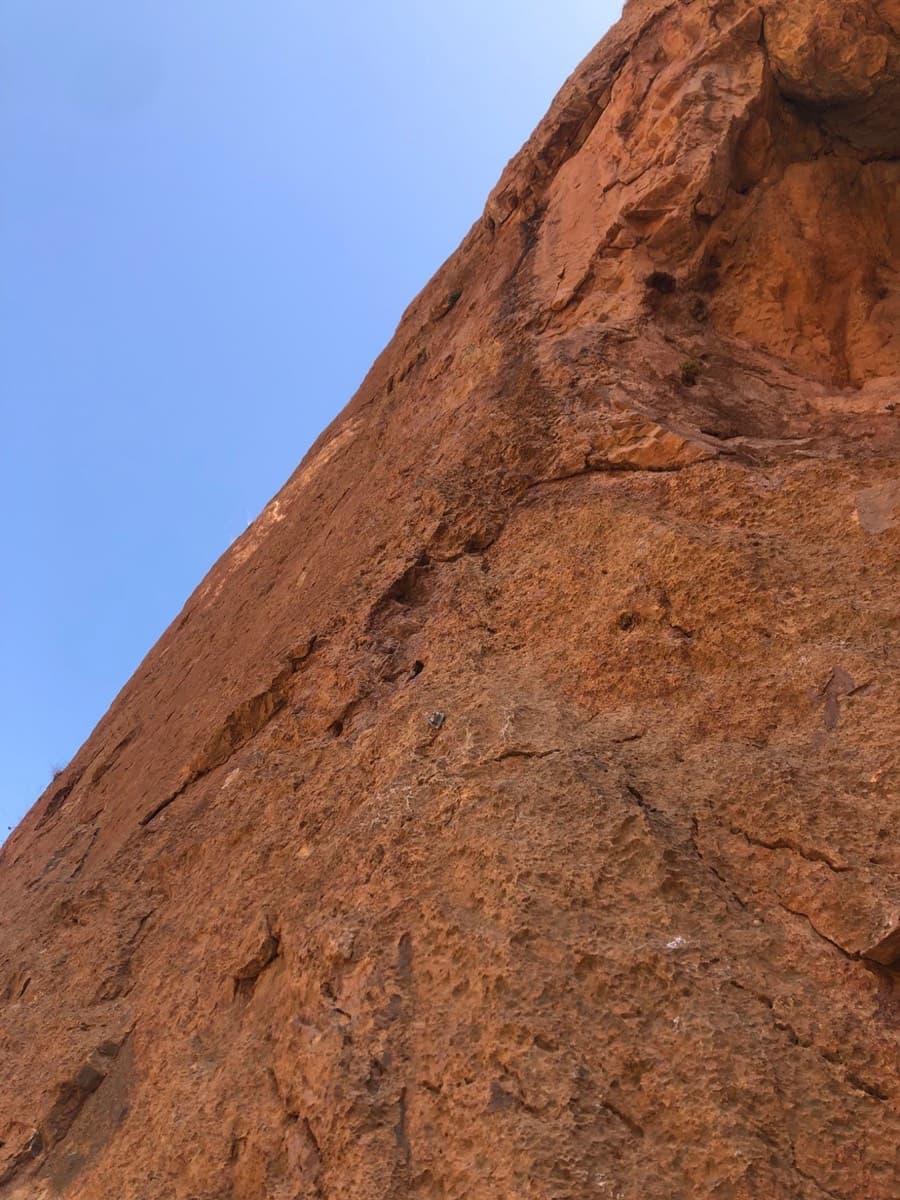
A party on the steep red rock of L'allumeur de rêves berbères, TimrazinePhoto: jup · CC BY-NC-ND 3.0

Photo

A party on the steep red rock of L'allumeur de rêves berbères, TimrazinePhoto: jup · CC BY-NC-ND 3.0
Hardest pitch
6b+
Pitches
9
Length
320 m
Approach
45 min
Aspect
SW
South-west-facing
Rope
–
Read before you go

Sound bolts on every pitch, but spaced by sport standards with a few exposed passages, an unlinked top belay and a long descent.

The route

Overview

A Piola route from 2009 on the south-west side of the Timrazine, facing the huge north face of the Taoujdad. It shares its start with Canyon Apache and then goes its own way for nine pitches: mostly technical slab climbing on positioning, broken up by more physical steep sections, with the 6b+ fourth pitch and a long 6b fifth as the highlights. Camptocamp calls it very well equipped by local standards and probably one of the easiest routes in the cirque. Recent reports agree it is homogeneous and approachable for a solid 6b climber, while stressing that the bolting is spaced and some passages are exposed.

The climbing

Pitch by pitch

Pitches of L'allumeur de rêves berbères
PitchGradeLengthNotes
P15c40 mThe approach pitch: straight on where Canyon Apache traverses right.
P26a+30 mA technical slab on positioning that finishes up fine flutings. Given 6a by a 2025 party.
P36a+25 mShort, slightly overhanging and physical on big holds.
P46b+25 mSlightly overhanging at first, then a ramp rising to the right; a disconcerting pitch. Pitches 3 and 4 can be linked if you manage the drag.
P56b40 mA technical section in the first metres, then a long, even flight at about 6a.
P66a40 mA link pitch mixing small ledges and technical slabs, with exposed moves above the ledges. Ends on a comfortable ledge.
P76a+40 mSteep and physical at the start on knobbly rock, then a slab move that needs thought. Two parties found the hard move well above the grade, one suggesting 6c.
P86a+40 mA long pitch traversing left, slabby then steeper to finish. There is a thread whose cord needed replacing in October 2025.
P96b35 mA thin traverse well to the left, then an easy corner. Stay right after the corner and go past the dead tree, or big juniper, to find the belay on two unlinked bolts. A 6c variant goes straight up on tiny holds; the 6b is reported a little polished.

Getting there

Approach

To the parking

From Marrakech go via Azilal to Zaouiat Ahansal: about 250 km and 5 to 6 hours, on tarmac throughout. From Zaouiat you walk up to Taghia or, since 2023, the gîtes can drive you up a track by 4x4. The gîtes in Taghia (Saïd's and Mohamed Amil's are the ones named in reports) offer half board and can arrange the taxi from Marrakech.

On foot · about 45 min

About 45 minutes. From Taghia go to the springs, cross them and follow the river bed to the mouth of the canyon between the Timrazine and the Taoujdad. Enter the canyon by a grade III step and an easy traverse on the true left, where there are a few bolts. Follow the canyon past a first jammed block, a Berber bridge and another grade III step with bolts in place, then continue easily on the true left to a second jammed block that forms a waterfall. The route starts just before it on the true right, sharing its first three bolts with Canyon Apache; where that route traverses right, go straight up. In October 2025 the start was at a fixed rope.

Map of the walk-in

  • Area: approximate

Loading map

The point is approximate: it marks the area, not the crag.

Coordinates · area: approximate

31.78864, -6.05906

Point from camptocamp waypoint 43751

For your phone or watch

Download GPX

Contains the route point. Opens in most mapping apps and GPS watches.

Points are compiled from published sources, with the precision stated above. They were not surveyed on the ground: check them against a current topo.

Getting down

Descent

Either abseil the route, seven abseils in all according to camptocamp, or walk off. For the walk-off follow the summit ridge to a first cairn with a bush on its left, then a second at a shoulder that gives access to a big ledge. Traverse east to a gully where the wall ends, down-climb the gully (an impressive grade IV), then descend eastwards by the easiest line to the foot of the wall and the path to Taghia. A 2025 party took 2 hours from the top to the gîte; a 2022 party used a ledge system on the west side instead.

Retreat

Bailing off the route

Bail with caveats

Camptocamp lists abseiling the route as a descent, seven abseils in all, so retreat down the line is feasible. The caveats are that abseil lengths are not published, pitches 8 and 9 traverse left, the route trends right on pitch 4, and the top belay is two unlinked bolts.

Retreat from
The belays below the traverses of pitches 8 and 9 are the simplest to abseil from. The comfortable ledge at the top of pitch 6 is the natural place to decide.
Point of no return
Not stated. After the leftward traverses of pitches 8 and 9, finishing and walking off is likely to be simpler than reversing them (inferred).
Carry
Two ropes, cord and a maillon for the top belay and any stance you find without rings.
Basis
Part stated, part inferredThe seven-abseil descent is stated on camptocamp; the effect of the traverses and the rope requirement are inferred from pitch descriptions and lengths.

Partly inferred from the route facts

Safety

Hazards

  • Spaced bolts with some exposed passages, especially above the ledges on pitch 6; a 2022 party says you need to be comfortable and it is better not to fall.
  • The last belay is two unlinked bolts and easy to miss, just beyond the dead tree.
  • The thread on pitch 8 depends on cord left by previous parties.
  • The walk-off includes a grade IV down-climb and takes time.
  • The approach and start are in a canyon bed, which is no place to be in heavy rain (inferred from the setting; the neighbouring Taoujdad gully has seen storm rockfall).
  • There is no mountain rescue service in Morocco.

Sun and weather

Conditions

South-west facing with the base in a canyon at about 1900 m. Cold in the shade in the morning and very hot once the sun arrives, which was about 12:30 on the top pitches in late October. Strong thermal winds from mid-morning are reported in April.

Usual season · Apr to Jun, Sep to Oct

Sun on the wall · SW-facing

Working out the sunlit hours for this month.

  • January: not yet worked out
  • February: not yet worked out
  • March: not yet worked out
  • April (usual season): not yet worked out
  • May (usual season): not yet worked out
  • June (usual season): not yet worked out
  • July: not yet worked out
  • August: not yet worked out
  • September (usual season): not yet worked out
  • October (usual season): not yet worked out
  • November: not yet worked out
  • December: not yet worked out

Sun on the wallDaylight, wall in shade● Usual season

Estimated from the wall's aspect only. Ignores surrounding terrain, gullies and the wall's exact shape. Clock times are local to the wall (Moroccan time), for the 15th of each month.

Climate figures for Taghia are not available yet

What to carry

Gear

Quickdraws and slings for the belays (camptocamp); no number is given. One metre of cord to replace the thread on pitch 8. Two ropes if you plan to abseil: pitches are up to 40 m and no source gives abseil lengths. Helmet.

Checklist

Quickdraws
Number not given in the sources
Rope
Length not given in the sources
Helmet
One each
Abseil device and prusik
The descent or the retreat involves abseiling
Maillons or spare karabiners
To leave behind if you retreat
Cord
Mentioned for retreat

Derived from the route data; check it against a current topo

From climbers

Reader reports

Reader reports are not being collected yet. Until they are, check a current topo and the local club or guidebook publisher for recent changes to L'allumeur de rêves berbères.

Worth knowing

Tips

  • Allow 4.5 to 7.5 hours on the route; reports range from 4.5 hours to a 9:30 to 17:00 day.
  • Do not underestimate the two 6a+ pitches near the top.
  • Fit parties continue up Princesse de Msmir on the wall above, but that route is bolted much more sparsely.

Open questions

Where sources disagree

  • Pitch 2: 6a+ on camptocamp, 6a in a 2025 report. Pitch 7: 6a+ on camptocamp, 'felt like 6c' in 2022 and 'crux of the route' in 2019.
  • Bolting: 'very well equipped' (2023) and 'good in quality and quantity' (2025) against 'relatively airy, with a few exposed passages' (2025) and 'better not to fall' (2022). All agree the bolts themselves are sound.
  • The route name appears as both 'L'allumeur de rêves berbères' and 'L'allumeur du rêve berbère'.
  • Pitch lengths come from an April 2025 trip report, not from the route page.
  • The HotRoc topo linked from camptocamp could not be opened, so the cross-check is between the route page and seven dated reports.

Provenance

Sources

Same area

More in Taghia

All routes in Taghia
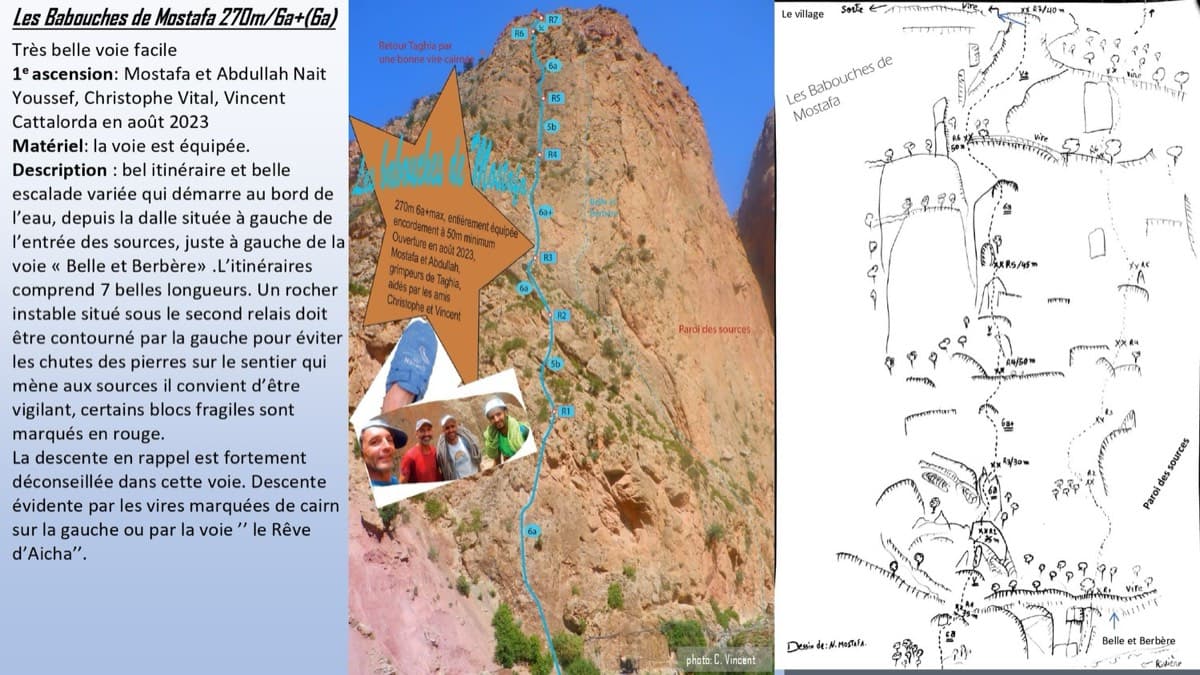
Topo of Les babouches de Mostafa on the Paroi des Sources, Taghia (photo with line and drawn topo)

Morocco · Taghia

Les babouches de Mostafa

The friendly way into Taghia, starting at the water's edge beside the springs. Seven varied pitches, well bolted by Taghia standards. Go left around the unstable rock below the second belay; fragile blocks are marked in red. In shade until midday.

6b7 pitches270 m

Committing
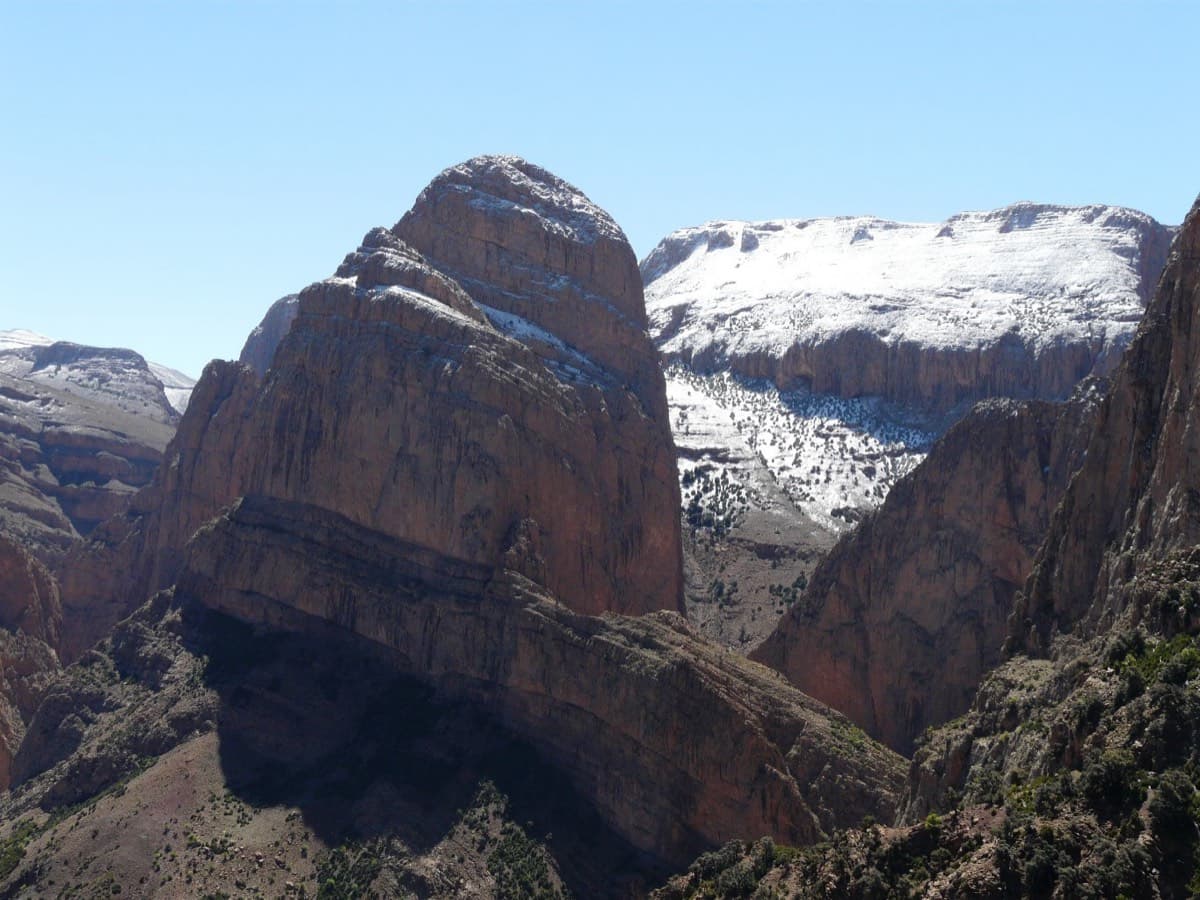
The Oujdad above Taghia

Morocco · Taghia

Ibtisane

The easiest bolted line at Taghia: three steep 5c walls linked by two long, easy garden pitches. Goes into shade around midday in April.

5c5 pitches235 m

Read the cautions

The west face of the Taoujdad from the approach, with the access ramps at its foot

Morocco · Taghia

Au nom de la Réforme

The classic first route at Taghia: steep, water-sculpted red limestone on the west face of the Taoujdad, with a 6c third pitch that is 6b until a short crux below the belay. It is better bolted than most Taghia routes and correspondingly popular, so some pitches are polished.

6c7 pitches300 m

Looking up the third pitch of Champion du Maroc on the west face of the Taoujdad

Morocco · Taghia

Champion du Maroc

Five pitches on new, very rough red rock just right of Au nom de la Réforme. The first three are steep, fingery and continuous with one short crux each; the last two are much easier. The original grades are 7a+, 7a and 6c+, now widely thought generous, and the cruxes are bolted closely enough to pull through.

6c+5 pitches200 m

Around 6b+ · about 9 pitches

Similar elsewhere

The lower tier of Lockdown on the Pilier Franco Salluard, Val Ferret, with the line and pitch grades marked

Italy · Aosta Valley

Lockdown

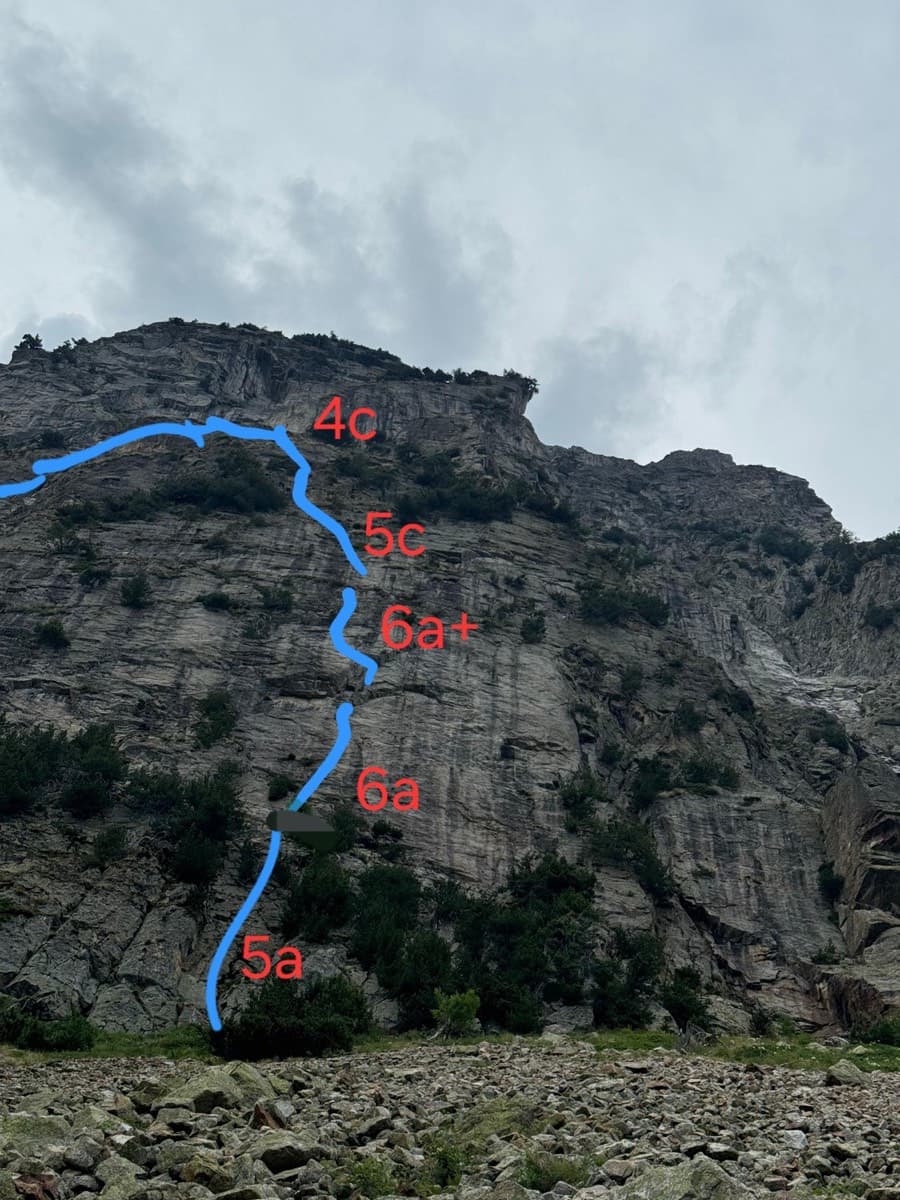
Technical granite slabs and short steep walls in two tiers, in a quiet corner of the Val Ferret below the Mont Blanc range. The 6b+ pitch builds through three hard moves, the last very thin. Obligatory climbing and some spaced bolts make it more serious than its neighbour Il Gatto e la Volpe.

6b+9 pitches250 m

Read the cautions

The walls of the Barranco de la Maimona at Montanejos, photographed on an ascent of La Luna.

Spain · Montanejos

La Luna

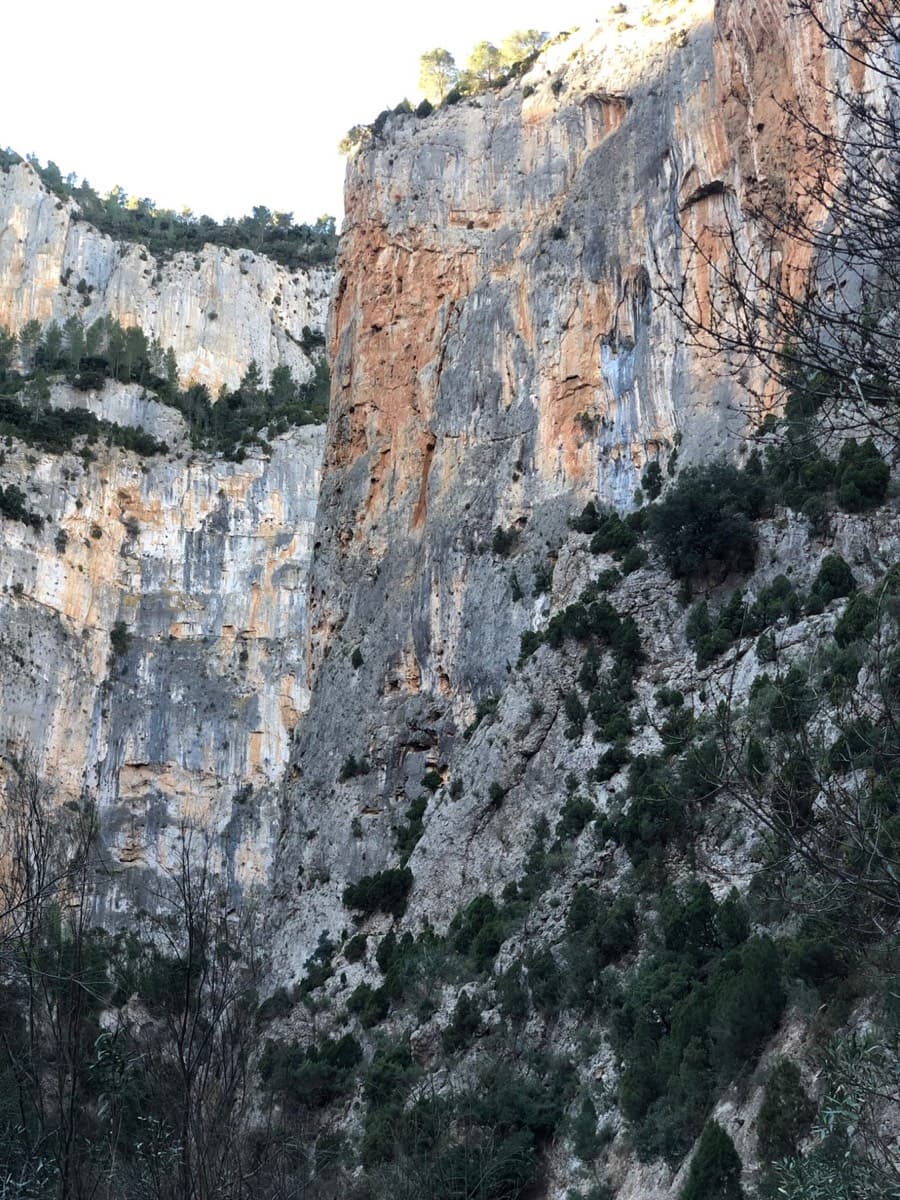
Eight pitches up a vertical prow deep in the Maimona canyon, on orange rock full of pockets (agujeros means holes). Sustained at 6a+ to 6b and physical throughout, with a huge roof start to the crux pitch and a bench to sit on at the third belay. Closed from January to June.

6b+8 pitches235 m

Read the cautions

The Himmelwand in the Kötschachtal near Bad Gastein; the Kleine Himmelwand lies beyond the main wall

Austria · Gastein (Hohe Tauern)

Father and Son

Ten pitches of varied climbing on good rock, mostly slabs with some cracks and steeper passages. Largely UIAA 5 with a few moves of 6 and three spots of 7 that go at 6+ A0. A short walk-in and a rigged abseil line.

6b+10 pitches350 m

No photo yet

France · Aravis

Heididoune

A ten-pitch line to the summit of the Pointe Percée, the high point of the Aravis, following green hangers up the cool north-west face. Seven long pitches, mostly easy with a 6a+ wall, reach the notch of the Arête du Doigt; three independent pitches finish it, including a memorable slab traverse of 6b+ that can be aided on the bolts.

6b+10 pitches400 m

Read the cautions

Compiled from published sources and last verified October 2026. Bolts, anchors and access change. Climbing is dangerous and you are responsible for your own decisions: check a current topo and read the disclaimer.