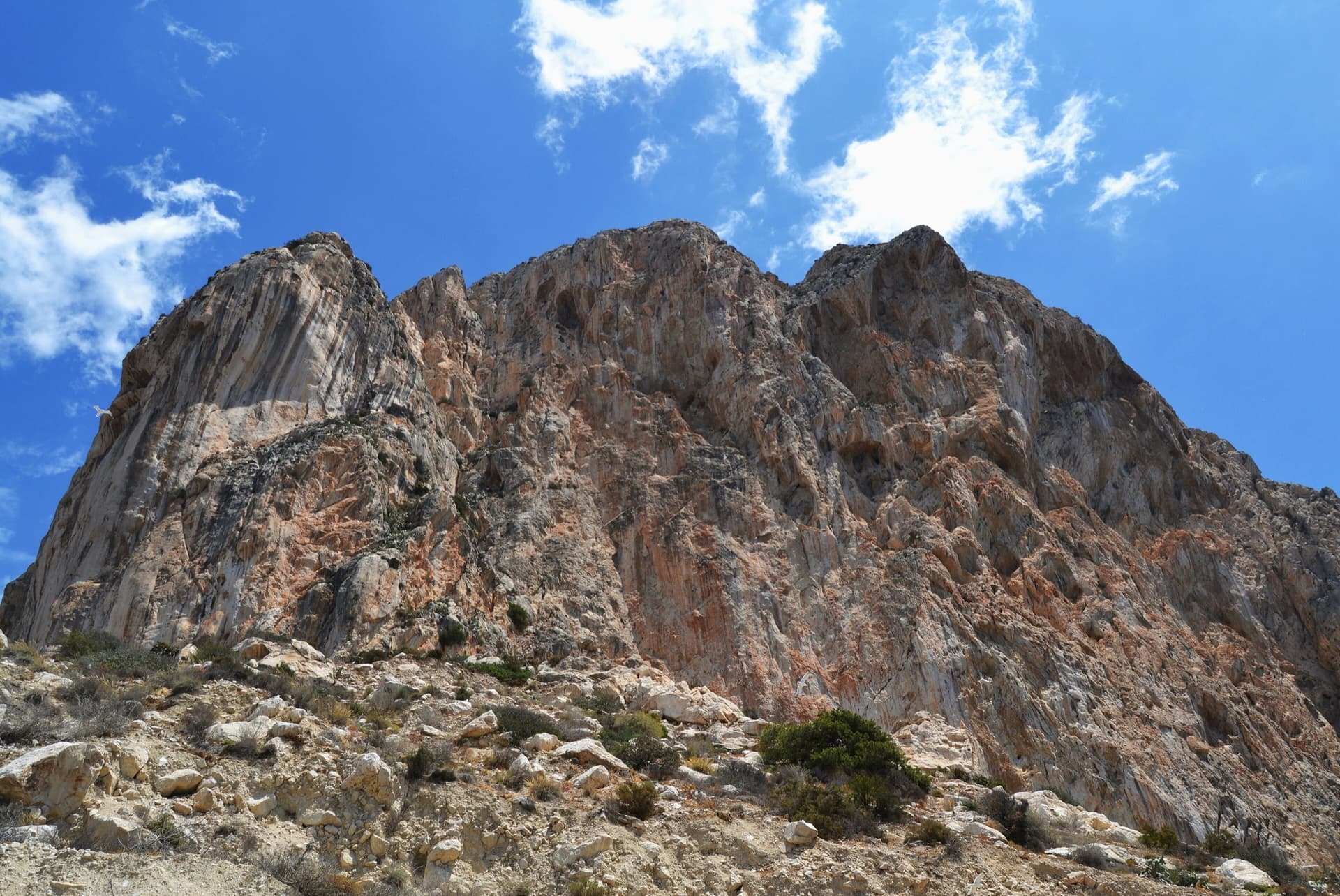
A steep, very exposed line up the left side of the double cave on the north flank of Monte Pellegrino, weaving through stalactites and concretions over a big overhang. The difficulties are never extreme for such steep ground, with the 6c+ crux on pitch 5 and 6a+ obligatory. Modern stainless bolting from 2020.
Climbing mode: Big type, screen kept awake, tick pitches as you go.
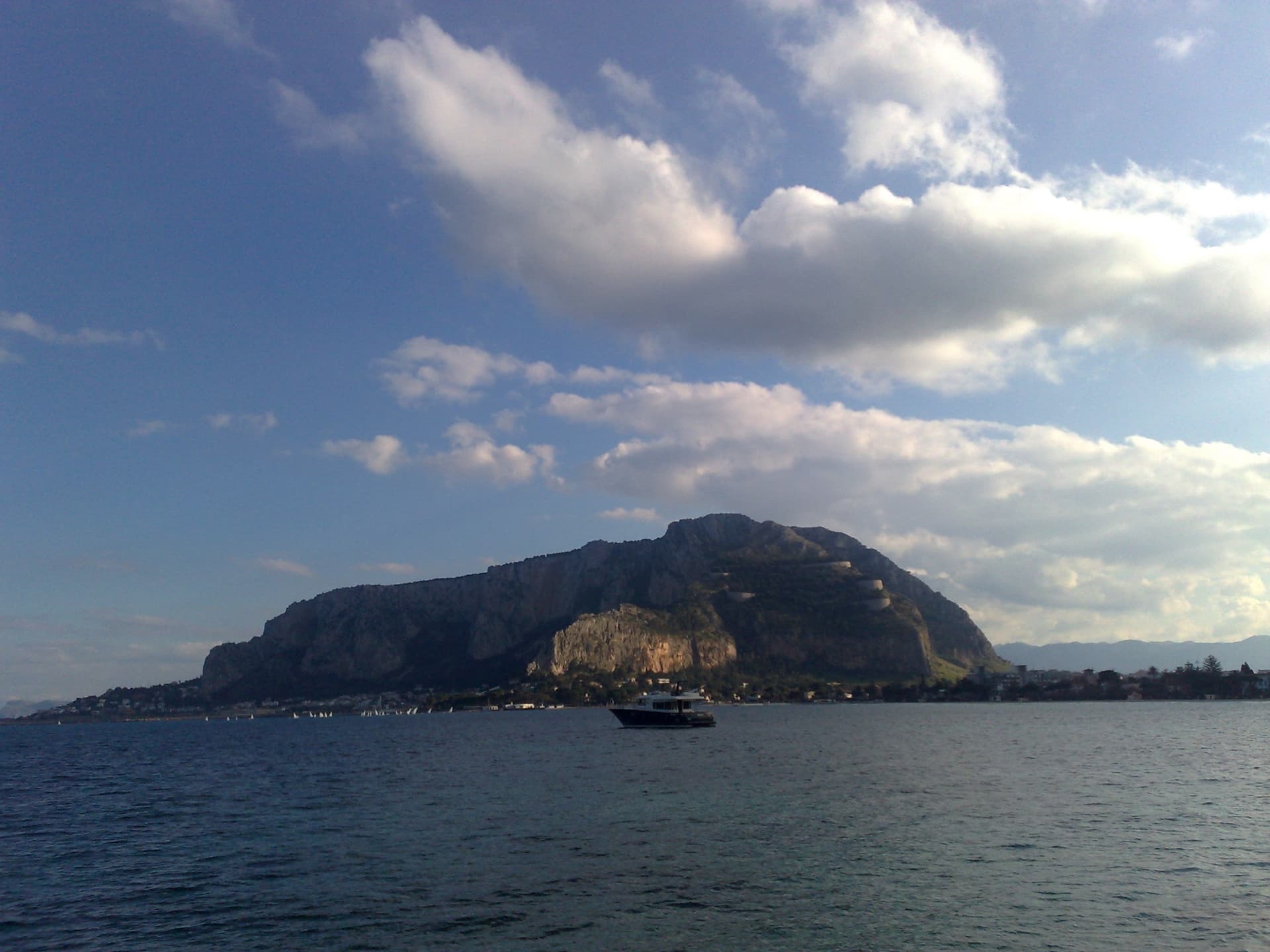
Monte Pellegrino from the cliffs on the north side of Mondello bay; the Antro della Perciata is on the mountain's north flankPhoto: Joefromthebay · CC BY-SA 4.0
Hardest pitch
6c+VIII-5.11c6c+VIII-5.11c
Pitches
7
Length
180 m
Approach
25 min
Aspect
N
North-facing
Rope
2×60 m
Highest point about 400 m above sea level (estimate: terrain height at the mapped point plus the height of the route).
Rock
limestone
Season
JFMAMJJASOND
Mar to May, Oct to Nov
Bolting confidence
Medium
Last verified
October 2026 · Aggregated by AI from published sources
Climbing modeBig type, screen kept awake, tick pitches as you go.
Overview
Ramage climbs the left-hand side of the Antro della Perciata, the huge double cave on the north side of Monte Pellegrino above Palermo. Maurizio Oviglia and Eugenio Pinotti looked for the easiest logical line through a forest of concretions on a strongly overhanging wall, and the result is seven short pitches that are always exposed but never desperate. The crux pitches (6c and 6c+) cross the big overhang in the middle of the route; 6a+ is obligatory. It is fully bolted with stainless steel and the descent is a rigged abseil line off the back of the ridge.
Worth knowing
The route was designed to be approachable: the bolting is generous by the openers' own account.
The approach passes the Grotta dell'Addaura single-pitch sector, a good warm-up.
A ramp with concretions, then a traverse on big stalactites to the belay.
P3
6b+VII+5.10d
20 m
Up the red overhang hung with stalactites.
P4
6cVIII-5.11b
25 m
Through the overhangs above.
P5
6c+VIII-5.11c
30 m
The crux pitch, following a split in the rock.
P6
6aVI+5.10a
25 m
Easier ground leftwards; the topo marks two blocks with an exclamation mark here.
P7
6a+VII-5.10b
20 m
Past a small roof and up a corner to the top.
Approach
To the parking
From central Palermo cross the Parco della Favorita towards Mondello and follow Viale Regina Margherita to a junction with traffic lights. Turn right onto via Monte Ercta, the road up to the Santuario di Santa Rosalia. After the Valdesi crag and a right-hand bend, drive about 500 m further and take a road downhill on the left (via Annone); park at its end.
On foot · about 25 min
Go through a small gate in the fence on the right and follow a path left to the Grotta dell'Addaura (single-pitch sport climbing). Pass through the cave, keep following the path left along the foot of the wall, then climb the scree to the obvious double cave. The route starts on its left-hand side at an obvious ramp, about 25 min from the car.
Map of the walk-in
Crag
Loading map
The point marks the crag, not the exact start of the route.
From the exit walk right along the ridge for about 100 m and look for a large wild olive tree near the edge of the wall, fitted with cord and a maillon. Abseil 50 m to a small terrace among the overhangs, then 55 m in free space to a ledge, then 30 m to the ground. The stations are fitted with rings. Use 60 m ropes: the topo insists on it. Abseiling down the route itself is possible but described as extremely laborious.
Bailing off the route
Bail with caveats
The belays are bolted, so you can abseil, but the route is steep and overhanging and the openers describe abseiling the line itself as extremely laborious. Above the overhang it is usually easier to finish and use the rigged descent.
Retreat from
Any belay, with two 60 m ropes; the lower pitches are the easiest to reverse.
Point of no return
Not documented; once across the big overhang (pitches 3 to 5) abseils will hang free of the rock.
Carry
Two 60 m ropes, a few spare maillons.
Basis
Part stated, part inferredThe topo states that abseiling the route is possible but very laborious; the advice on where to retreat is inferred from the line's steepness.
Italy
In an emergency
In an emergency · Italy
112Emergency, where the single number is in service
118Call 118Medical; ask for Soccorso Alpino (CNSAS)
Where 112 is not yet the single number, call 118 and ask for CNSAS.
Position of the crag
38.18323, 13.35838
Marks the crag, not the route: give route and pitch.
Say what happened, how many are hurt, and where you are. Checked October 2026 (sourceofficial sources).
Hazards
Very steep and exposed climbing through concretions; check stalactites before pulling on them.
The topo flags two blocks on pitch 6 with an exclamation mark.
The second abseil is 55 m and free-hanging: knot the rope ends and make sure your ropes are 60 m.
Gear
12 quickdraws and two 60 m ropes (the rope length is required for the abseils). Helmet.
Checklist
Quickdraws
12
Rope
2×60 m
Helmet
One each
Abseil device and prusik
For abseiling
Maillons or spare karabiners
To leave behind if you retreat
Conditions
North-side cave at about 300 m, close to the sea. The first ascent was done in November and early in the year, in the shade of the cave. The season given here is inferred from that and from the aspect; no source states one.
Forecast · next 7 days · 400 m
Loading the forecast.
Weather forecast for Sicily (Palermo) at 400 m, today and the next 6 days
Measure
– –
– –
– –
– –
– –
– –
– –
High °C
–
–
–
–
–
–
–
Low °C
–
–
–
–
–
–
–
Rain mm
–
–
–
–
–
–
–
Chance of rain %
–
–
–
–
–
–
–
Strongest gusts km/h
–
–
–
–
–
–
–
Model forecast for 400 m. It cannot tell you whether the rock is dry. Data: Open-Meteo, CC BY 4.0.
Time plan · 7 pitches
Working out sunrise and sunset.
Approach
25 min
Climbing
4 h 10 min to 6 h 35 min20% quicker to 25% slower.
Total on the way up
4 h 35 min to 7 h
Sunrise
–
Sunset
–
Start walking by
–
Descent
Not included: add time for the way down.
An estimate. Queues and route finding cost time, and shaded walls go dark before sunset. Local time (Central European time), flat horizon.
Sun on the wall · N-facing
Working out the sunlit hours for this month.
Jan
–January: not yet worked out
Feb
–February: not yet worked out
Mar ●
–March (usual season): not yet worked out
Apr ●
–April (usual season): not yet worked out
May ●
–May (usual season): not yet worked out
Jun
–June: not yet worked out
Jul
–July: not yet worked out
Aug
–August: not yet worked out
Sep
–September: not yet worked out
Oct ●
–October (usual season): not yet worked out
Nov ●
–November (usual season): not yet worked out
Dec
–December: not yet worked out
060912151821
Sun on the wallDaylight, wall in shade● Usual season
From the aspect alone; terrain is ignored. Local time, 15th of each month.
Monthly climate averages for Sicily (Palermo), 1991-2020
Measure
Jan
Feb
Mar ● (usual season)
Apr ● (usual season)
May ● (usual season)
Jun
Jul
Aug
Sep
Oct ● (usual season)
Nov ● (usual season)
Dec
Mean daily high °C
12
12
15
17
22
26
29
29
25
22
17
14
Mean daily low °C
7
6
8
10
14
18
21
21
19
15
12
8
Rain days 1 mm or more
11
11
11
9
6
4
2
3
9
10
11
12
● usual season. 1991-2020 averages at about 328 m; rain is for a 10–25 km grid cell. Weather and climate data: Open-Meteo, CC BY 4.0.
Equipped throughout with 316 stainless bolts by the first ascensionists between 2018 and 2020; the published gear list is 12 quickdraws and two 60 m ropes. The opener says the bolting was deliberately kept generous so that the route stays approachable. No repeat report was found, so the current state rests on the 2020 description.
History
Opened ground-up by Maurizio Oviglia and Eugenio Pinotti: the first three pitches in November 2018, finished in two days early in 2020, just before the Covid lockdown. Luigi Cutietta provided logistics.
Guidebook
Topo published by Maurizio Oviglia on planetmountain.com (June 2020). Buy from versantesud.it.
Where sources disagree
Camptocamp gives 7 pitches and 180 m, matching the planetmountain topo; neither gives bolt counts per pitch.
Planetmountain gives the start GPS as 38.183234, 13.358383; the camptocamp crag point for the Antro della Perciata lies about 500 m to the north-west.
A sustained modern sport multipitch on the wild north wall of the Addaura, a few hundred metres from the city. Every pitch is 6c+ or 7a with 6c obligatory, on limestone that needs to be dry. Fully rebolted with 12 mm stainless in 2022.
The sport classic of the Peñón: a thin slab, a corner crack that steepens into an overhang, a pillar, then a wild exit from a big cave 200 m above the sea. Sustained at 6b with a 6c fifth pitch on polished slopers and a 6c+ last pitch whose crux can be pulled through on a bolt.
Seven short, steep pitches up the ochre sea cliff of Cap Canaille, through three kinds of rock: overhanging jugs low down, a leftward traverse on huge fragile holds into a cave, a big roof and a thin wall of sandstone, then vertical conglomerate where you choose your cobble. Homogeneous at 6b to 6b+ with one harder move leaving the roof. The lower two pitches are sandy and friable.
Seven pitches of compact grey water-pocketed wall high above the mouth of the Verdon gorge, with a view over the Lac de Sainte-Croix. It zigzags a great deal, so both leader and second need to be happy on traverses. A short, bouldery 6c+ bulge (6a/A0) is the only move above 6b+, and the final pillar pitch is the highlight.
Four pitches in a row at 6b+ to 6c+ on extremely rough limestone: technical water-pocket moves that are hard to read, then an athletic pitch up easy tufas to a hard pull over an overhang. Quiet and steep, with 6b+ obligatory.
Researched and aggregated by AI from published sources, last compiled October 2026. It can be wrong, and bolts, anchors and access change: check a current guidebook and read the disclaimer.