Multipitch Atlas

Spelling need not be exact.

Via Mariet

Pizzo d'Erna – Punta Centa (Lecco) · Lecco & Valsassina · Italy

Read the cautionsEasy to bail

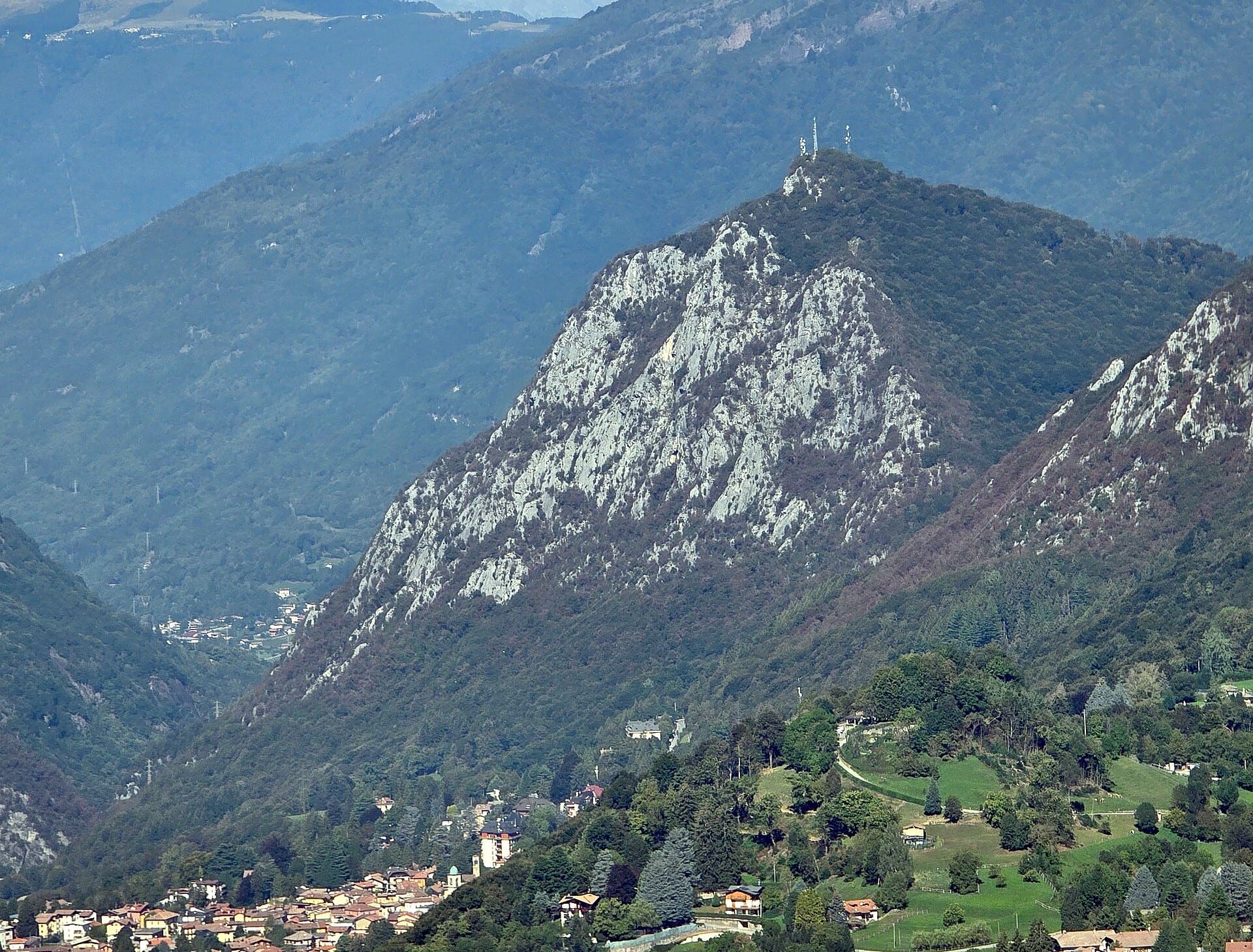
A short, steep sport multipitch on the Punta Centa, the grey limestone pillar of the Pizzo d'Erna above Lecco, climbing almost parallel to the Gamma 1 via ferrata with a big view over the town and lake. Technical slabs and walls get steadily harder, with the 6c+ and 6c pitches at the top, but the obligatory grade is only about 6a because the bolts are close. Expect a few friable holds and people on the ferrata beside you.

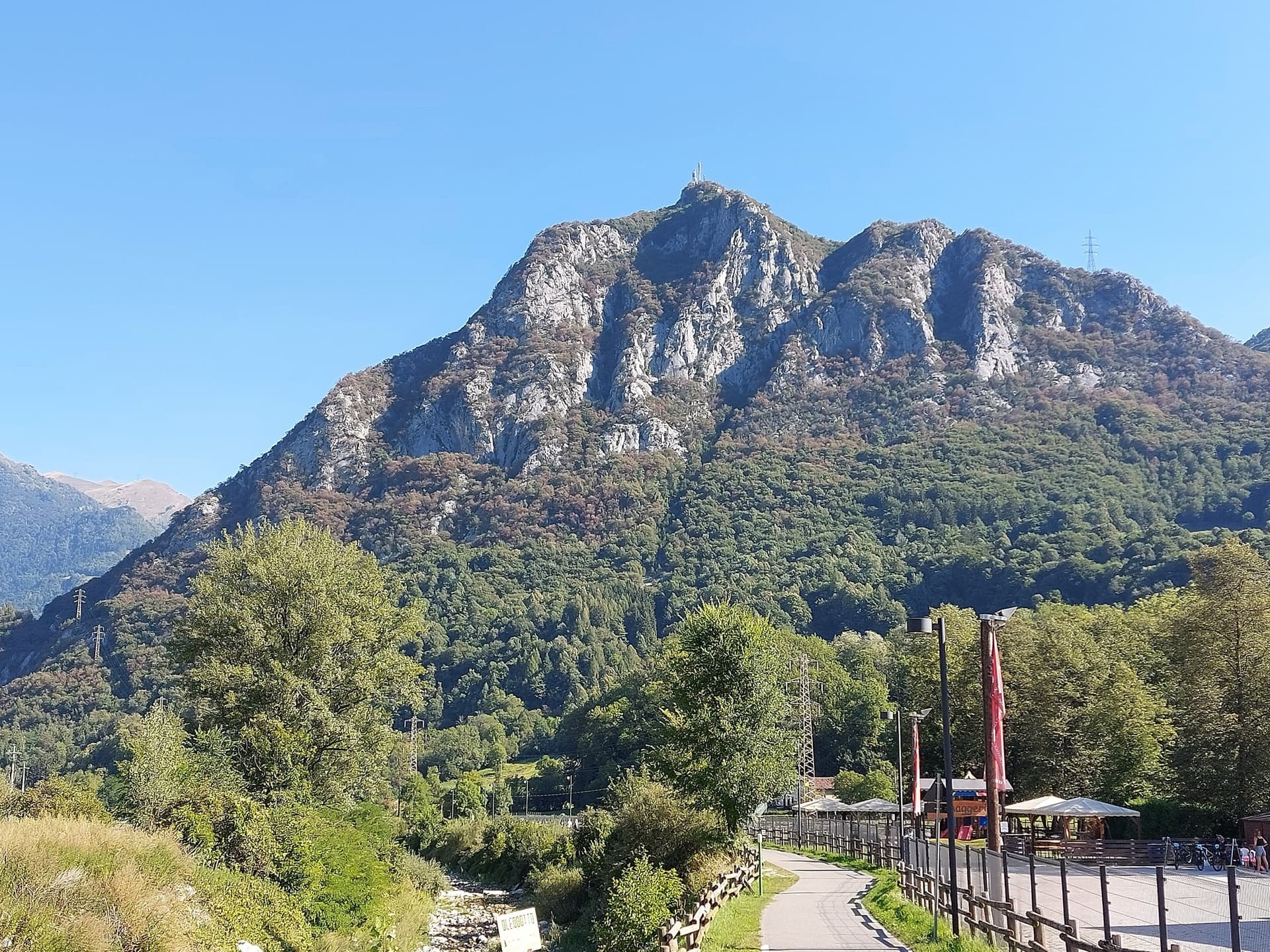
The limestone faces of the Pizzo d'Erna above Lecco; Via Mariet climbs the Punta Centa pillar on this mountain beside the Gamma 1 via ferrata (line not marked)Photo: Mame Bonacina · CC BY-NC-ND 3.0

Photo

Hardest pitch
6c+
Pitches
6
Length
150 m
Approach
50 min
Aspect
W
West-facing
Rope
1×60 m
Rock
limestone
Season
Apr to Jun, Sep to Oct
Bolting confidence
Medium
Last verified
October 2026 · Compiled from published sources
Read before you go

Closely bolted with stainless steel throughout, but there is some friable rock, stonefall from the busy via ferrata alongside, and no recent detailed report to confirm its current state.

Overview

Via Mariet climbs the Punta Centa, the pillar crossed by the upper part of the Gamma 1 via ferrata on the Pizzo d'Erna, the peak above Lecco reached by the Piani d'Erna cable car. Giuseppe Rocchi and Jacopo Valsecchi of CAI Calolziocorte equipped it over twelve days in 2013 in memory of Mario 'Mariet' Conti. It gives six pitches and about 150 m of slab and wall climbing on grey limestone, getting harder as you go: 5c to 6b in the first four pitches, then a 6c+ slab with two bulges and a 6c overhanging crack to finish. The stainless bolting is close enough that the obligatory level is about 6a, and you can retreat from any belay.

Worth knowing

  • Do not start at the first bolted line you reach on the way down the fixed rope; Via Mariet starts where the rope ends.
  • The hard climbing is on the last two pitches, but the bolts are close enough that you can pull through on them; the obligatory grade is about 6a.
  • You can turn back from any belay.

Pitch by pitch

No topo we can show; see the sources.

Pitches of Via Mariet
PitchGradeLengthNotes
P15c20 mA small slab with plenty of sculpted holds to a ledge on the right.
P26b+30 mA fine vertical slab with one technical move, sustained to a ledge, then a few more metres on the right to the belay.
P35c/6a25 mTraverse along a fixed rope to a flake with an obvious bolt, climb straight up for a few metres, then trend right on slightly delicate rock to a belay at the foot of a rounded arête.
P46b25 mA few committing moves up a small pillar with good holds, then exit right onto easier broken ground. Belay either on a tree or traverse a short way right on a fixed rope to a chain-and-ring belay.
P56c+25 mA fine vertical slab with two bulges: continuous, physical climbing with moves you cannot avoid.
P66c25 mA few vertical metres to a committing move out of a bulge, then a faint crack, overhanging at first (the crux), and a final vertical wall on big holds to the right. The rock is slightly friable in places. The route ends a few metres below the top of the pillar.

Approach

To the parking

From Lecco follow signs for the Piani d'Erna cable car to its base station car park at Versasio (about 600 m), above the Malnago district. The approach described by the sources starts on foot from this car park; the cable car itself is not needed.

On foot · about 50 min

About 50 min. From the cable car car park walk up to Rifugio Stoppani, then take the path left towards a farmhouse and continue until you meet the Gamma 1 via ferrata. Follow its easy first section to the foot of the pillar. A few metres before the ladder, leave the ferrata and go down alongside the pillar on a fixed rope to the start. The route starts where the fixed rope ends: you pass the start of another route first. Camptocamp suggests climbing the first section of the ferrata itself to the foot of the pillar as the better option.

Map of the walk-in

Coordinates · crag

45.86186, 9.44577

Parking

45.86340, 9.42826

Versasio, Piani d'Erna cable car car park (camptocamp waypoint 112589)

Point from camptocamp waypoint 286637 (Pizzo d'Erna summit; the route ends just below it beside the Gamma 1 ferrata)

For your phone or watch

Download GPX

Contains the route point and parking.

Points from published sources, not surveyed.

Descent

The route ends a few metres below the top of the pillar and 2 m from the Gamma 1 via ferrata. Follow the ferrata down; it leads back to the start in a short time. Alternatively, from the belay after the rising traverse you can abseil with two 27 m abseils.

Bailing off the route

Easy to bail

The first ascensionists say you can stop at any point. Every belay is a stainless bolt anchor, the pitches are 20 to 30 m, and after the rising traverse two 27 m abseils take you down. The top is 2 m from the via ferrata, so the descent is also short.

Retreat from
Any belay. From the belay after the traverse on pitch 3, two 27 m abseils.
Point of no return
None stated. The traverse on pitch 3 and the move right at the top of pitch 4 mean that abseils from higher up may not land on the line you climbed (inferred).
Carry
The single 60 m rope is enough for the 27 m abseils described.
Basis
Stated in the sourcesBoth the 2013 first-ascent description and camptocamp state that the climb can be abandoned at any point and give the two 27 m abseils.

In an emergency · Italy

112Emergency, where the single number is in service

  • 118Medical; ask for Soccorso Alpino (CNSAS)

Where 112 is not yet the single number, call 118 and ask for CNSAS.

Position of the crag

45.86186, 9.44577

Marks the crag, not the route: give route and pitch.

Say what happened, how many are hurt, and where you are. Checked October 2026 (source).

Hazards

  • The route runs beside the Gamma 1 via ferrata, and the last pitch can be hit by stones knocked off by ferrata users. Wear a helmet and avoid busy days if you can.
  • Three or four places have friable rock, notably the end of pitch 3 and the top pitch.
  • Two easy traverses are protected only by a fixed chain or rope, and the stance at the end of pitch 4 is a tree unless you traverse right to the chain belay.
  • The Gamma 1 ferrata was closed for maintenance and reopened on 19 March 2022 with new pegs, chains, ladders and bridges, so the ladder and fixed rope used as landmarks on the approach may have changed. A 2024 Gulliver log (seen only as a search excerpt) reports the metal ladder at the foot of the pillar removed.
  • There are no logged ascents on camptocamp, and the grades were given as provisional when the route was opened.

Gear

Single 60 m rope and 15 quickdraws (camptocamp; the first ascensionists' description says 14). Helmet essential. If you descend the via ferrata, bring whatever you need to be safe on it (the sources do not say whether climbers clip in or move roped).

Checklist

Quickdraws
15
Rope
1×60 m
Helmet
One each
Abseil device and prusik
For abseiling

Conditions

Plan B nearby

Straight-line distances, up to 30 km.

Reader reports

No reports yet.

Report a problem with this route

Say what and where. Reports are checked before they appear; no name or email is stored.

Bolts and history

Bolting
Bolted in 2013 with stainless-steel bolts on every pitch and at every belay; the first ascensionists and camptocamp both call the bolting excellent, in places closer than at a sport crag. The two easy traversing sections are protected by a fixed chain or rope. At the top of pitch 4 you choose between a tree belay or a short traverse on a fixed rope to a chain-and-ring belay.
History
Equipped over twelve non-consecutive days in 2013 by Giuseppe Rocchi, then president of CAI Calolziocorte and head of the Lecco mountain rescue station, with Jacopo Valsecchi. It is dedicated to Mario Conti, 'Mariet', who died in a fall from the Pizzo Stella on 27 March 2011.

Where sources disagree

  • Grade: the first ascensionists gave 6c/7a 'to be confirmed', 6a obligatory (Lecconews, 2013); camptocamp gives 6c+ with 6a obligatory; a 2024 Gulliver log, seen only as a search excerpt, gives 6c+ with 6a+ obligatory.
  • Quickdraws: 15 on camptocamp, 14 in the 2013 description.
  • The Lecconews description mentions fixed chains on the two easy traverses; camptocamp describes a fixed rope on the pitch-3 traverse. The fixings may have been changed since.

Sources

More in Lecco & Valsassina

All routes in Lecco & Valsassina
The south side of the Zucco dell'Angelone above Barzio, seen from the Zucco della Croce: the pale limestone spurs (speroni) that hold the multipitch routes run down from the antenna-topped summit. Condorpass is on the fourth spur; individual spurs are not labelled here.

Italy · Lecco & Valsassina

Condorpass

The first route opened on the Zucco dell'Angelone, following the natural line of the fourth spur by corners, cracks, a chimney and friction slabs. Eight varied pitches at 5a to 5b with an easy crest to finish. Never hard but never trivial either.

5b8 pitches220 m

The Zucco dell'Angelone above the Valsassina, seen from Pasturo, with the antenna on its summit. The climbing spurs are the pale limestone ribs on the sunny side of the mountain above Barzio; individual spurs and routes are not marked.

Italy · Lecco & Valsassina

La Lumaca di Vetro

A 1979 Ivan Guerini line up the big slab of the second spur: friction climbing on compact limestone with a few steeper steps, a fine third pitch and a corner to finish. Grades are even, around 5a to 5c, and the bolts are far enough apart that slab confidence matters. You abseil off.

5c6 pitches120 m

Read the cautions

The Zucco dell'Angelone above the Valsassina, seen from Pasturo, with the antenna on its summit. The climbing spurs are the pale limestone ribs on the sunny side of the mountain above Barzio; individual spurs and routes are not marked.

Italy · Lecco & Valsassina

Foto di Gruppo con Signorine

Three friendly pitches up a striking arched flake and compact slabs, then a short wall with one hard, reachy move that most people pull through. A 1980 route by the Savonittos and Alessandro Gogna, and the usual first half of a link-up with Gli Schiavi della Pietra on the spur above.

6b+4 pitches90 m

Read the cautions

The Zucco dell'Angelone above the Valsassina, seen from Pasturo, with the antenna on its summit. The climbing spurs are the pale limestone ribs on the sunny side of the mountain above Barzio; individual spurs and routes are not marked.

Italy · Lecco & Valsassina

La Striscia della Citrosodina

The harder companion to La Lumaca di Vetro on the second spur. Delicate slabs with spaced bolts lead to cracks and flakes, then a strenuous last pitch through an overhanging corner and a bulge that goes at 6b+ or mostly on aid. Varied and less travelled than its neighbours.

6b+6 pitches145 m

Read the cautions

Around 6c+ · about 6 pitches

Similar elsewhere

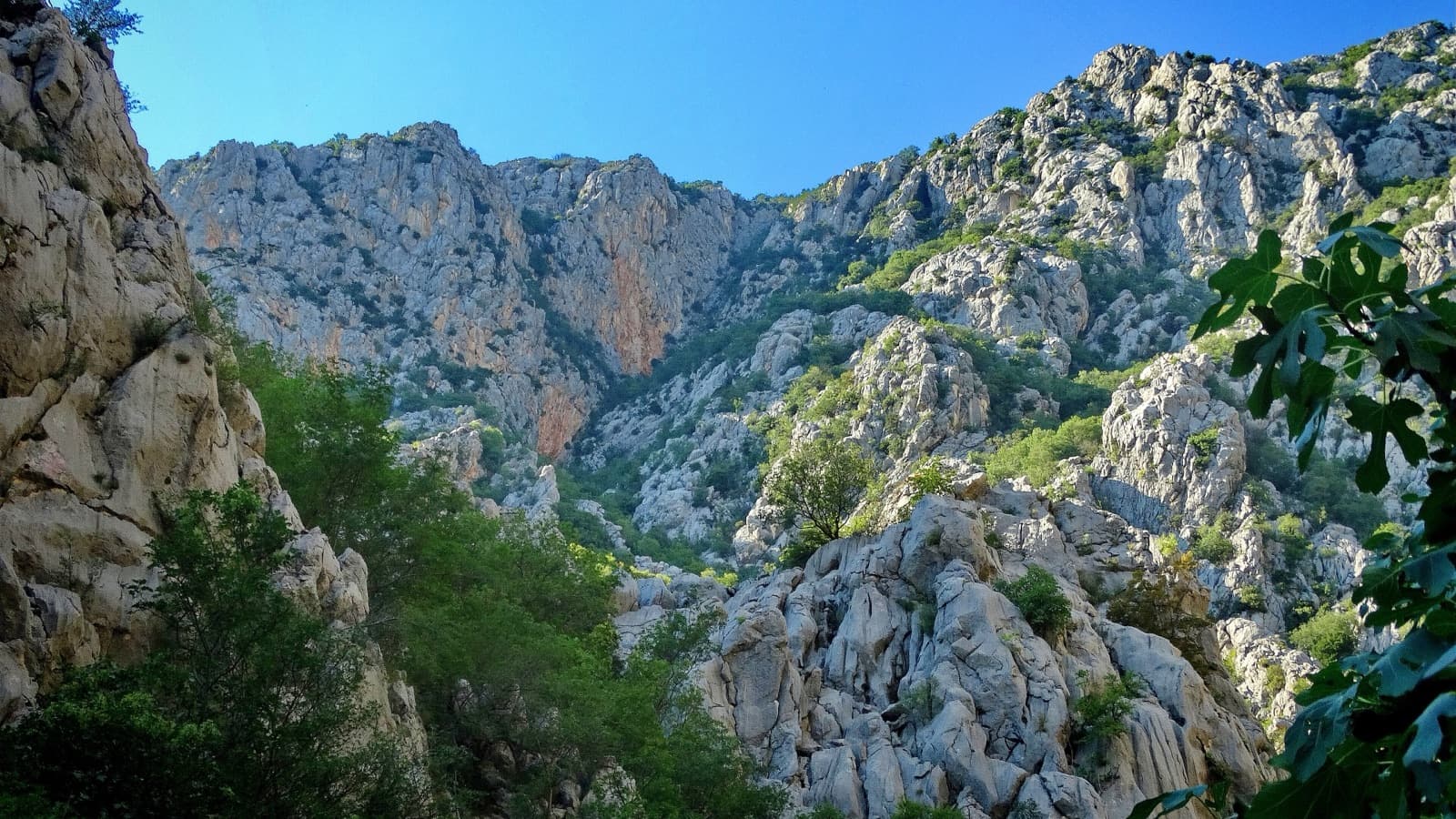
Orange-streaked limestone walls of the Velika Paklenica canyon seen from the opposite side; Debeli kuk is one of the walls of this canyon, but the source does not name the face shown.

Croatia · Paklenica

Big Wall Speed Climbing (Tinin raz)

The line used for Paklenica's annual Big Wall Speed Climbing competition: steep, direct and on very rough rock that has stayed unpolished. A sustained 45 m 6c+ pitch on small holds is the crux, followed by sharp runnels, a big corner and three overhangs to finish. Fifteen minutes from the car.

6c+6 pitches200 m

A view of the region, not this route's wall. The limestone gate of the Cetina at Omiš, seen across the river mouth; the town's crags, Stomorica among them, are on cliffs like these.

Croatia · Omiš

Pipeline

A 2024 line up the detached needle, nicknamed the Salami, on the south flank of Kula in the Cetina canyon behind Omiš. Five sustained pitches of 6b to 6c+ on excellent rock, split by a short walk across a ledge: crack-seamed slab, water grooves, an airy corner crack and steep technical wall climbing on the headwall. The obligatory grade is high.

6c+6 pitches220 m

Read the cautions

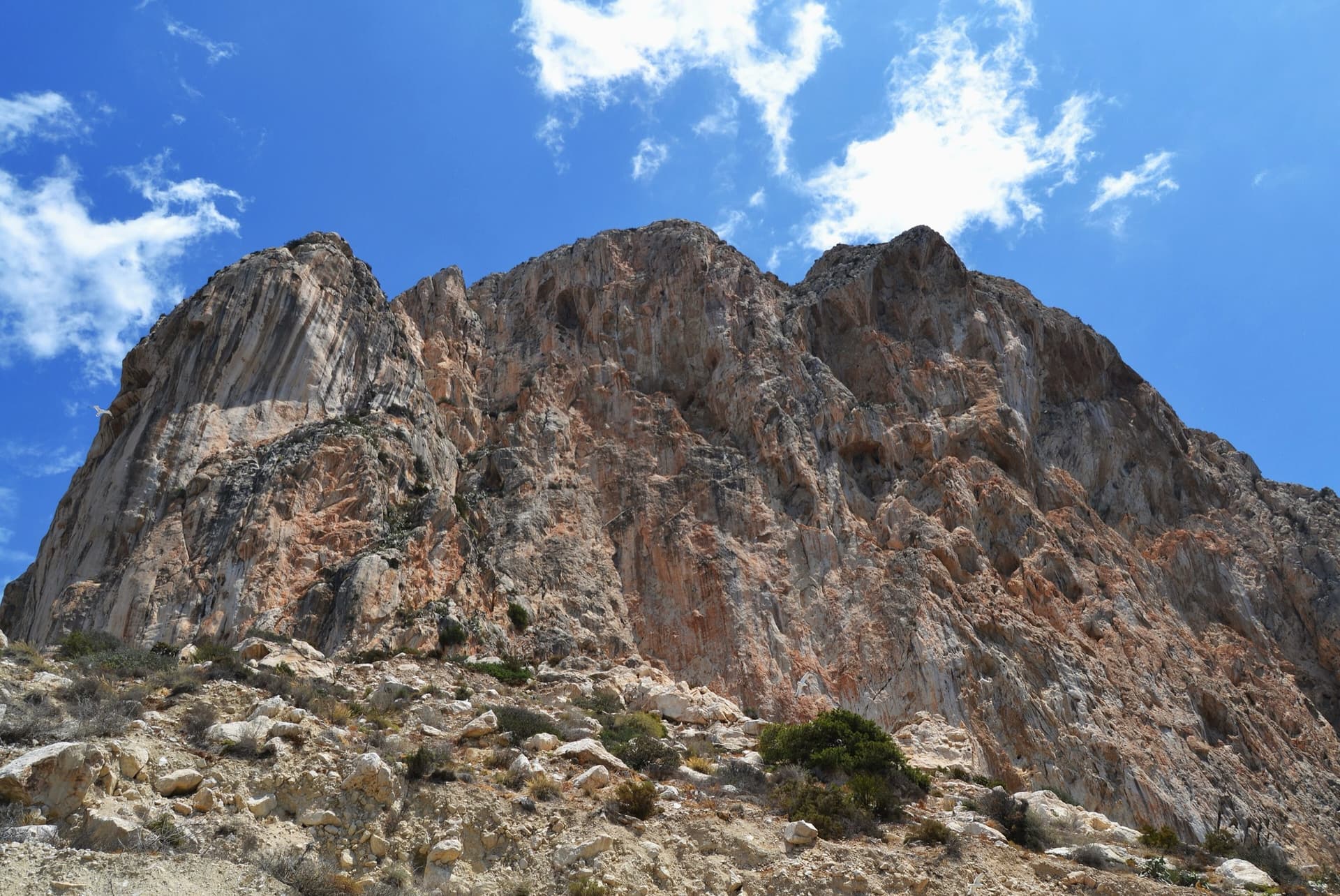
The south face of the Peñón de Ifach from the path below the cliffs, Calpe: 300 m of orange and grey limestone. Costa Blanca climbs this wall.

Spain · Costa Blanca (Peñón de Ifach)

Costa Blanca

The sport classic of the Peñón: a thin slab, a corner crack that steepens into an overhang, a pillar, then a wild exit from a big cave 200 m above the sea. Sustained at 6b with a 6c fifth pitch on polished slopers and a 6c+ last pitch whose crux can be pulled through on a bolt.

6c+7 pitches220 m

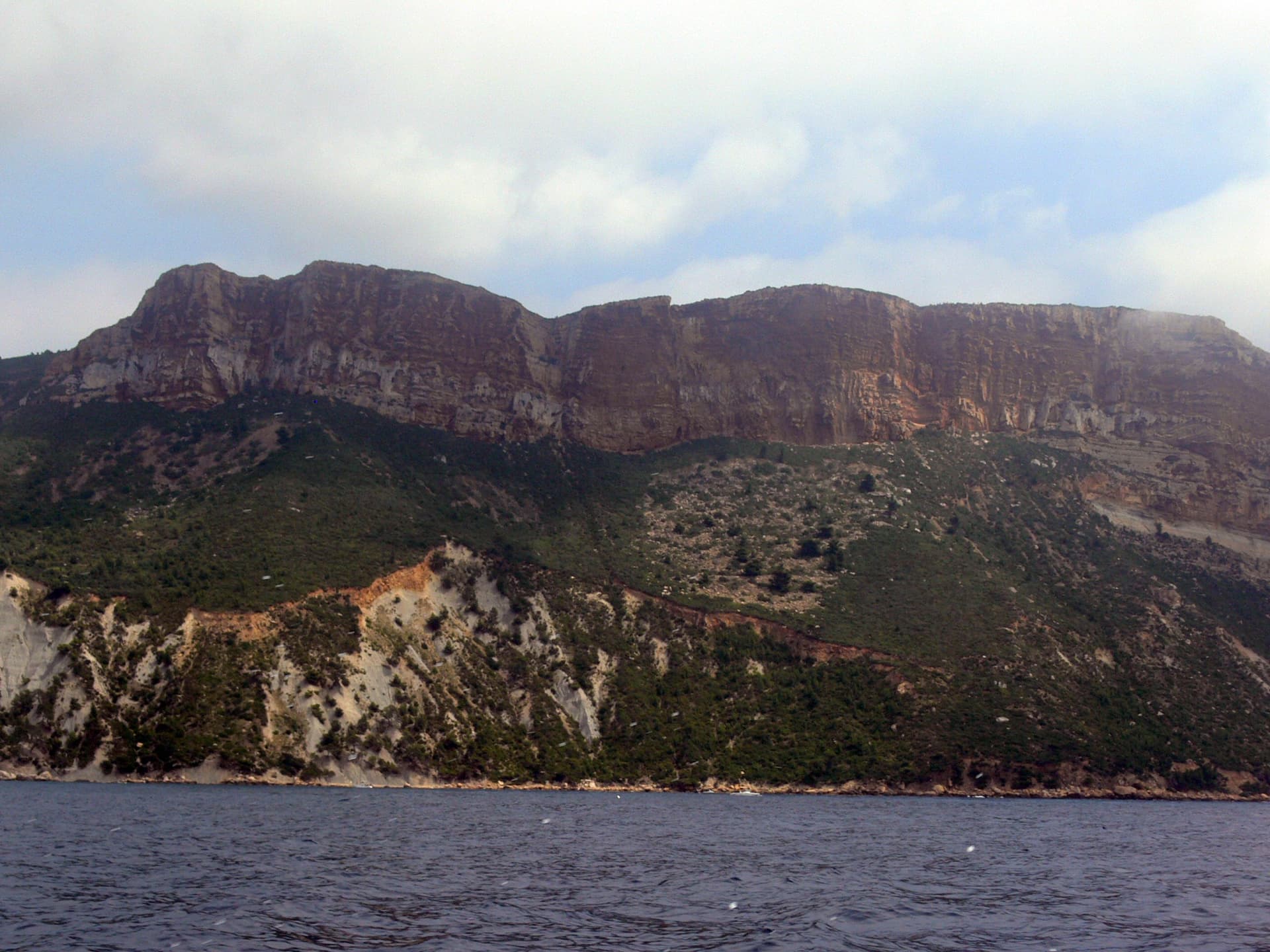
The cliffs of Cap Canaille seen from the sea, Cassis end; the Sémaphore sector is further south-east on the same line of cliffs

France · Calanques

Sables émouvants

Seven short, steep pitches up the ochre sea cliff of Cap Canaille, through three kinds of rock: overhanging jugs low down, a leftward traverse on huge fragile holds into a cave, a big roof and a thin wall of sandstone, then vertical conglomerate where you choose your cobble. Homogeneous at 6b to 6b+ with one harder move leaving the roof. The lower two pitches are sandy and friable.

6c+7 pitches150 m

Read the cautionsCommitting

Compiled from published sources, last verified October 2026. Bolts, anchors and access change: check a current topo and read the disclaimer.