Multipitch Atlas

Vipère au pied

Barberine (Vallorcine) · Chamonix valley · France

Bail with caveatsBolting confidence: high

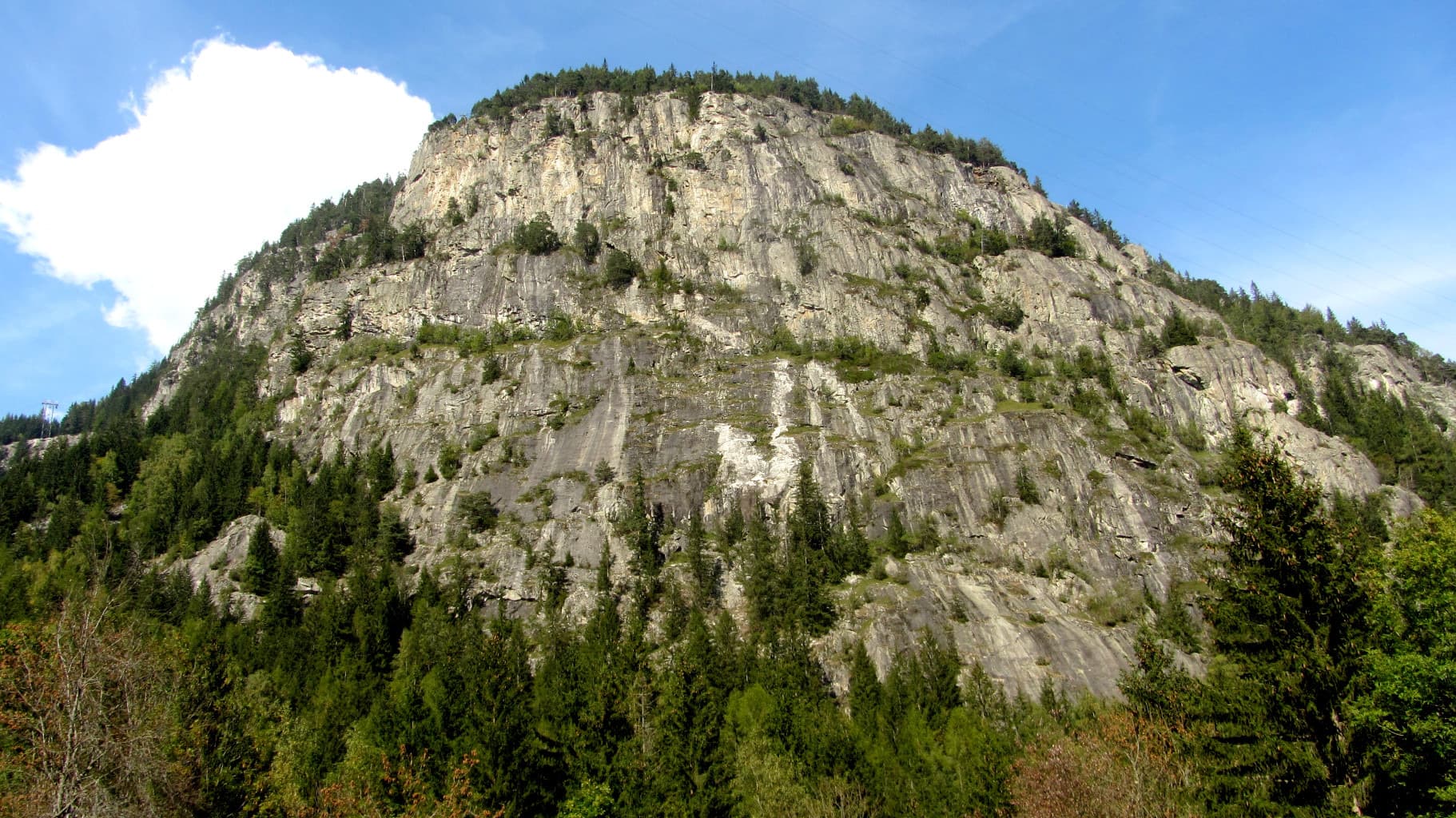
The original line on the Barberine wall: four pitches of fine, delicate slab above a bouldery first move, then steeper and more athletic climbing through the upper tier, with a superb 6b layback-and-wall pitch near the top. Ledges cut it into sections, so it never feels very exposed, but it is sustained at 6a to 6a+ throughout.

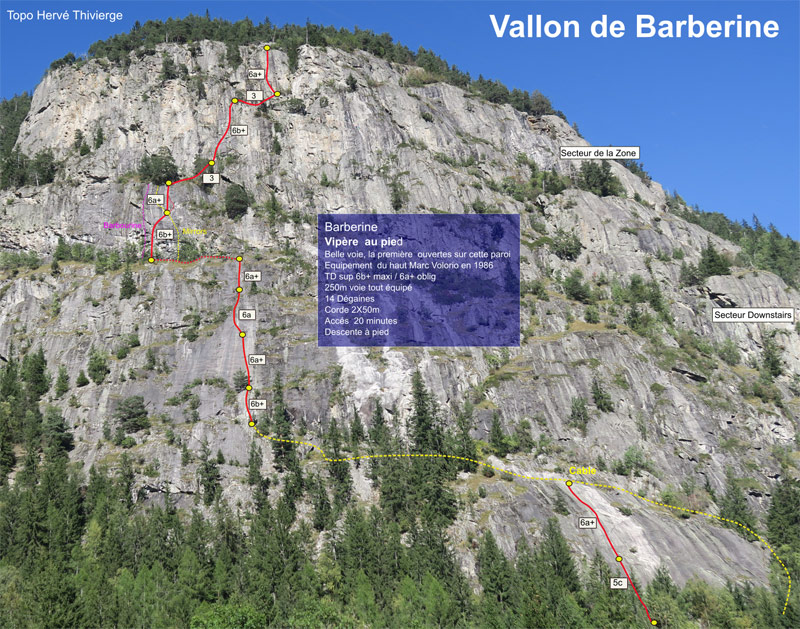
Photo-topo of Vipère au pied on the Barberine wall, with the belays numbered and the two approach pitches up the lower slabsPhoto: Herve Sergeraert · CC BY-SA 3.0

Topo

Photo-topo of Vipère au pied on the Barberine wall, with the belays numbered and the two approach pitches up the lower slabsPhoto: Herve Sergeraert · CC BY-SA 3.0
Hardest pitch
6b+
Pitches
10
Length
250 m
Approach
20 min
Aspect
S
South-facing
Rope
1×50 m
walk-off

The route

Overview

Vipère au pied was the first route on the Barberine half-dome and is still one of its best at the grade. The lower tier gives four slab pitches on compact, grippy rock; a 20 m walk left along a ledge leads to the upper tier, where a slightly overhanging pitch, a steep wall, a sustained 6b layback and a curving final wall follow, separated by two easy linking pitches. Recent parties rate pitches 6, 8 and 10 highest. Lines are close together here and several cross, so carry a good topo and follow the gold hangers. Most parties reach the start by climbing two single pitches on the lower slabs.

The climbing

Pitch by pitch

Pitches of Vipère au pied
PitchGradeBoltsNotes
P16b+–A boulder problem off the ground, then a short pitch. Parties find the move easier the further right of the bolt you start. It links with pitch 2 on a 50 m rope. Starting up the first four pitches of La Barbourine avoids it.
P26a–A fairly thin slab. Do not follow the grey fixed bolts to the right.
P35c–More slab, slanting left and finishing up a steeper wall.
P46a–Trending left, then straight up to the ledge. Walk 20 m left along the ledge to a blue paint mark, 3 m past the belay of La Barbourine. Two lines on gold hangers start here; the left one is La Barbourine.
P56a+–A slight overhang on good holds, then sustained vertical climbing and a traverse right to a hanging belay in a vague niche. A 2025 party, following Piola's topo, thought it a solid 6b to 6b+.
P66a–A steep wall with the difficulty just above the belay. Links well with pitch 7.
P732 boltsUp and right in a grassy chimney to a good platform.
P86b–The best pitch: a layback, then a steep, varied and sustained wall. The exit from the layback is the hard part.
P933 boltsGo round the big block on the right (blue marks), descend 2 to 3 m and climb 5 m above an old dead tree. Camptocamp warns of a large unstable block on the belay terrace and says the dead tree is close to toppling.
P106a+–A steep, sustained wall curving from left to right, with a slab exit that is not obvious.

Getting there

Approach

To the parking

Barberine is at the Swiss border, 400 m before the Le Châtelard customs post when coming from Chamonix and Vallorcine. Turn left (north) towards the hamlet of Barberine and park in the small car park at the bottom of the descent, before the bridge (about 15 to 20 places; the road beyond is for residents). Do not park in the hamlet. By train, the Mont-Blanc Express stops hourly at Le Châtelard-Frontière, a short walk away. The cliff itself is just across the border in Switzerland.

On foot · about 20 min

Walk through the hamlet and take the path on the right that crosses a footbridge (the border) and climbs through the wood, past a long chalet used as a holiday centre, to the foot of the lower slabs. Then either climb two pitches on the lower slabs (5a to 6a, the leftmost being the hardest) to reach a ledge with a cable, or take the descent path up and right for about 50 m of height and traverse left to the cable. From the cable follow the obvious rising path, pass a 2 m rock step with a handline and a metal rung, and reach a platform with the belays of several routes. Go left along the wall past Bon Voyage and Le Magicien d'Oz. After a little under 10 m without bolts you reach the unlinked belay of Méduse (matt silver hangers); 5 m further left is that of Mirrors on the Ceiling (matt grey-white Fixe hangers). Between them stands a small block with one gold bolt: that is the start. Allow 20 to 25 minutes plus the slab pitches.

Map of the walk-in

  • Crag
  • Parking

Loading map

The point marks the crag, not the exact start of the route.

Coordinates · crag

46.05347, 6.94289

Parking

46.05027, 6.94166

Barberine car park before the bridge (camptocamp waypoint 104221)

Point from camptocamp waypoint 41521 (Barberine)

For your phone or watch

Download GPX

Contains the route point and parking. Opens in most mapping apps and GPS watches.

Points are compiled from published sources, with the precision stated above. They were not surveyed on the ground: check them against a current topo.

Getting down

Descent

The belays are equipped for abseiling, but in dry conditions it is simpler to walk. From the top scramble up about 20 m to find the path that leads right (the access path to the Gietroz sectors). It passes under several crags, descends an easy gully with a fixed rope and curves back to pass near the starts of Cacao Girls and Autoroute Blanche. Turn right at the beehives and right again, past the holiday buildings, to the path to the border footbridge. About 30 minutes on a good but steep path, marked with blue then red dots.

Retreat

Bailing off the route

Bail with caveats

Camptocamp states that the belays are equipped for abseiling, so retreat is possible from anywhere, but you need two ropes and the line is offset: a 20 m walk along the ledge after pitch 4 and a traverse to a hanging belay on pitch 5. From the big ledge above pitch 4 the lower tier is four straight slab pitches.

Retreat from
Any belay; the ledge after pitch 4 is the natural place to decide.
Point of no return
Not documented. Above the hanging belay of pitch 5 the abseils do not follow the climbing line exactly, and from the platform after pitch 7 finishing may be quicker than descending.
Carry
Two 50 m ropes for the abseils (camptocamp's English text).
Basis
Part stated, part inferredBelays rigged for abseil and the two-rope requirement are stated on camptocamp; the remarks about the offset line are inferred from the pitch descriptions.

Partly inferred from the route facts

Safety

Hazards

  • A large unstable block on the terrace at the belay before the last pitch, and a dead tree about to fall (camptocamp).
  • Rockfall of 6 August 2022: camptocamp still asks parties to report any damaged hangers or belays on Vipère and its neighbours. Reports from 2024 to 2026 mention none.
  • Neighbouring routes run very close. Follow the gold hangers; the grey bolts right of pitch 2 and the left-hand gold line after the ledge are other routes.
  • The moves between bolts are obligatory in places; 6a+ is the stated obligatory grade.
  • The descent path is steep and should not be used when wet.

Sun and weather

Conditions

South facing between about 1200 m and 1450 m. The lower slabs were in the sun by 11:00 in March 2026, and parties have climbed here from February to October. It is hot in summer: several 2025 reports mention sore feet in the heat. A March party found the route dry with no seepage and no snow in the descent gully.

Usual season · Apr to Jun, Sep to Oct

Sun on the wall · S-facing

Working out the sunlit hours for this month.

  • January: not yet worked out
  • February: not yet worked out
  • March: not yet worked out
  • April (usual season): not yet worked out
  • May (usual season): not yet worked out
  • June (usual season): not yet worked out
  • July: not yet worked out
  • August: not yet worked out
  • September (usual season): not yet worked out
  • October (usual season): not yet worked out
  • November: not yet worked out
  • December: not yet worked out

Sun on the wallDaylight, wall in shade● Usual season

Estimated from the wall's aspect only. Ignores surrounding terrain, gullies and the wall's exact shape. Clock times are local to the wall (Central European time), for the 15th of each month.

Monthly climate averages for Chamonix valley, 1991-2020
MeasureJanFebMarApr (usual season)May (usual season)Jun (usual season)JulAugSep (usual season)Oct (usual season)NovDec
Mean daily high °C−4−31481315151281−4
Mean daily low °C−12−11−8−5−04663−1−7−11
Rain days 1 mm or more131213141919181715131414

● marks the usual climbing season. Averages for 1991-2020 at about 2011 m. Area climate from Open-Meteo reanalysis. Temperatures are adjusted to the height of the crag; rain comes from a grid cell of about 10 to 25 km, and summer highs on sea cliffs can read a few degrees low. The wall and valley can differ. Data: Open-Meteo, CC BY 4.0.

What to carry

Gear

12 quickdraws and a 50 m rope according to camptocamp; the Thivierge topo says 14 quickdraws and 2×50 m. Take two ropes only if you intend to abseil.

Checklist

Quickdraws
12
Rope
1×50 m (walk-off)
Helmet
One each
Abseil device and prusik
The descent or the retreat involves abseiling

Derived from the route data; check it against a current topo

From climbers

Reader reports

Reader reports are not being collected yet. Until they are, check a current topo and the local club or guidebook publisher for recent changes to Vipère au pied.

Worth knowing

Tips

  • Climbing two pitches on the lower slabs (about 5b and 6a) is the recommended warm-up and approach.
  • Linking pitches 1 and 2, and 6 and 7, works on a 50 m rope.
  • The Barbourine start makes a more even route by missing out the boulder move.
  • Parties report 3.5 to 5 hours on the route.

Open questions

Where sources disagree

  • Pitch grades: camptocamp (French) gives 6b+, 6a, 5c, 6a, 6a+, 6a, 3, 6b, 3, 6a+. The Thivierge photo-topo gives 6b+, 6a+, 6a, 6a+, then 6b+, 6a+, 3, 6b+, 3, 6a+. A 2025 party says Piola's topo, which they found more accurate, has 6b for pitch 1 and 6b+ for pitch 5. The camptocamp grades are used.
  • First ascent year: 1986 on camptocamp and the Thivierge topo, 1980 on Vertical Pirate.
  • Quickdraws: 12 (camptocamp) or 14 (Thivierge). Obligatory grade: 6a+ (camptocamp, Thivierge) or 6a (Vertical Pirate).
  • Rock: the atlas lists Barberine as gneiss; camptocamp's crag page and Vertical Pirate call it granite.

Provenance

Sources

Same area

More in Chamonix valley

All routes in Chamonix valley
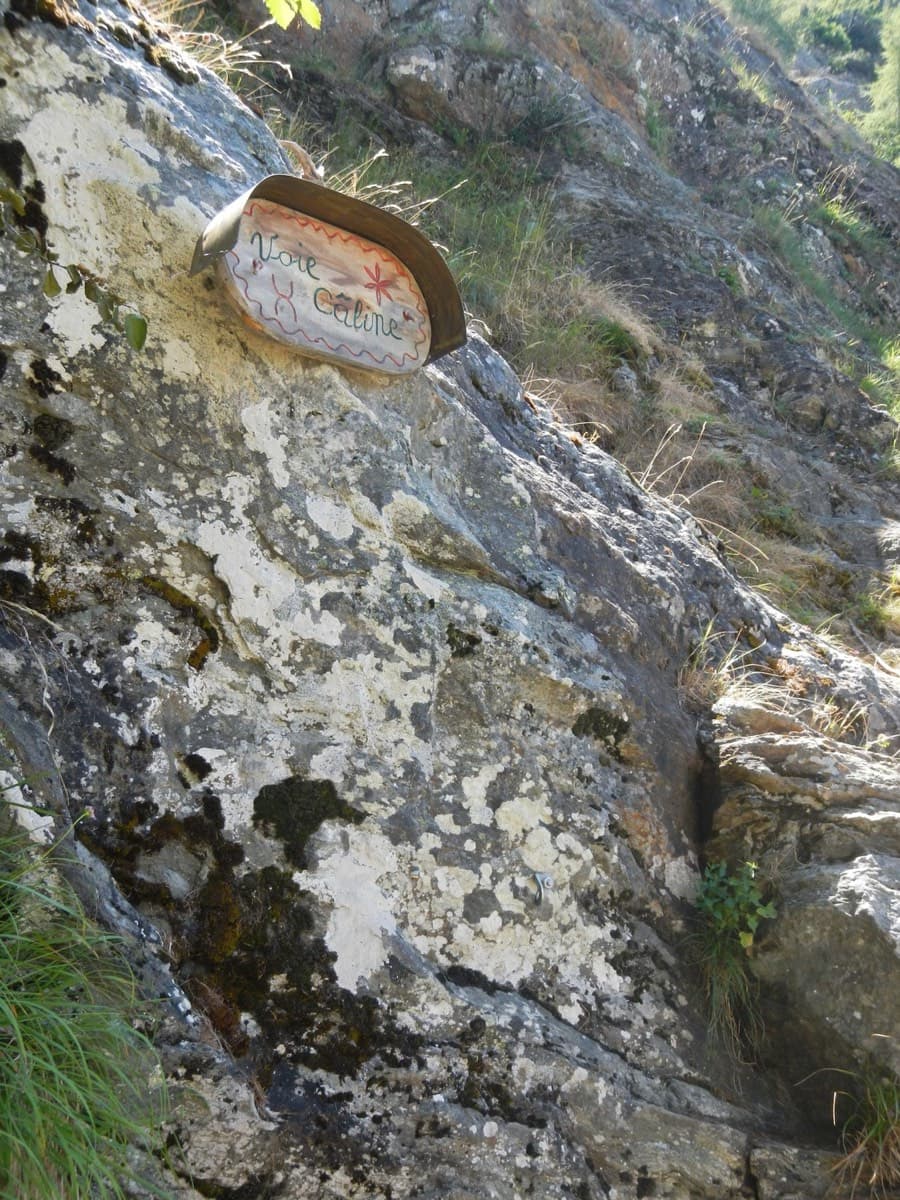
The painted sign marking the start of the Voie Câline on the Rocher des Mottets

France · Chamonix valley

Voie Câline

Nineteen very short pitches of easy slab above Les Bois, never harder than 4b and bolted like a climbing school. It is the standard first multipitch of the Chamonix valley, long enough to feel like a real outing and finishing at a mountain café with a view of the Mer de Glace.

4b19 pitches260 m
The gneiss slabs of Les Chéserys beside the Lac Blanc path, with the pinnacle of the Aiguillette d'Argentière and the village of Argentière below; the Voie Jaune is on these slabs, its exact position is not marked.

France · Chamonix valley

Voie Jaune

A short, friendly slab route on the sunny gneiss of the Chéserys, facing the Mont Blanc range. Five pitches with one vertical step of 4c, chain belays and an abseil descent make it a standard introduction to multipitch climbing.

4c5 pitches150 m

The summit of Le Brévent and the rock face beneath its cable-car station, seen from the Chamonix valley; the Voie Frison-Roche climbs this south-east face, the exact line is not marked.

France · Chamonix valley

Voie Frison-Roche

The great classic of the Aiguilles Rouges: six varied pitches of gneiss, ten minutes downhill from the Brévent cable car and finishing at its top station, with Mont Blanc opposite. The crux is a short, physical corner crack and the last pitch is a long, clean corner. It is extremely popular.

6a+6 pitches200 m

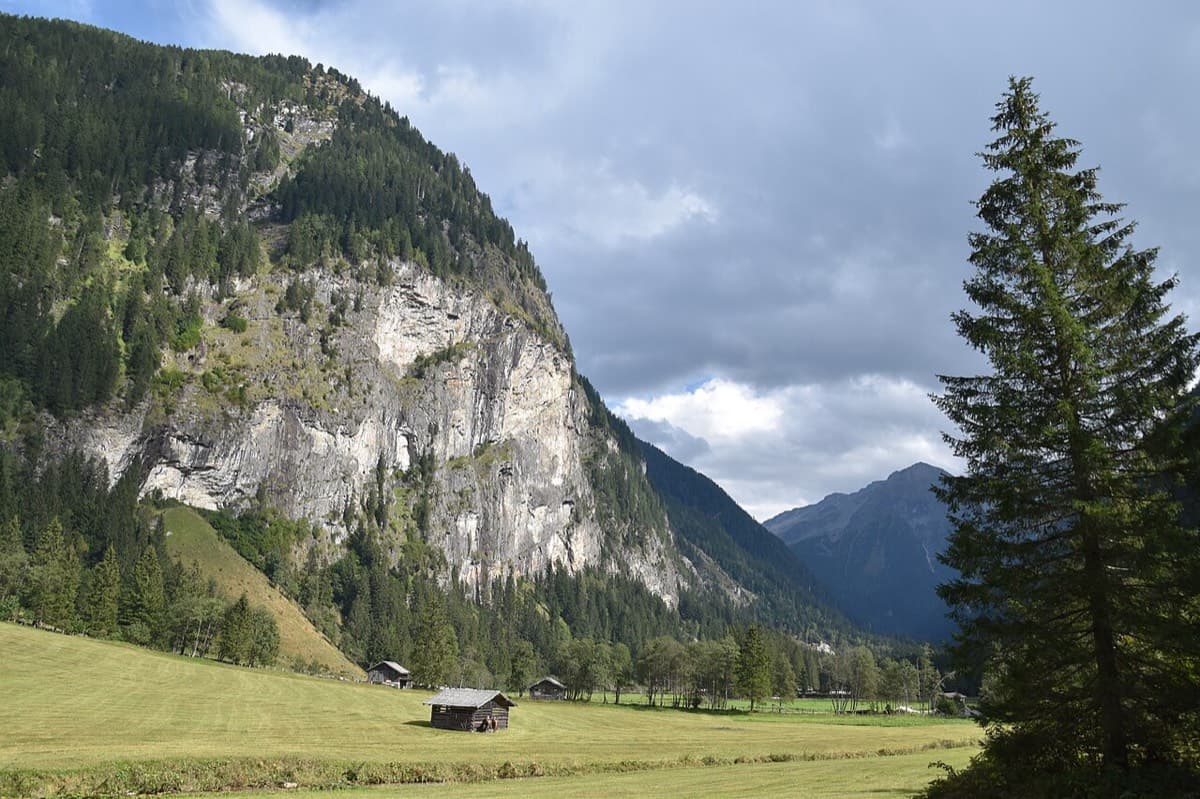
The Barberine cliff above the spruce forest at Vallorcine; Méduse climbs this wall, the line is not marked.

France · Chamonix valley

Méduse

A direct line up the big south-facing slabs of Barberine: three pitches of friction slab to warm up, then steeper, technical walls on small holds. The two top pitches are graded 6b+ and 6c+ if you step round the bolts and 7a if you climb straight up them; 6c is obligatory.

7a7 pitches230 m

Around 6b+ · about 10 pitches

Similar elsewhere

The north-west face of Anića kuk in evening light; the route is not marked.

Croatia · Paklenica

Besmrtnici

A modern line by B. Čujić and I. Matković up the full height of the Trapez sector of Anića kuk: ten pitches, 360 m, steady between 5c and 6b+. It starts right of the classic Mosoraški, crosses it in the upper middle part and finishes to its left. Slabs low down, then a vertical crack, superb vertical slab pitches, a huge corner with a chockstone and an exposed traverse.

6b+10 pitches360 m

The orange limestone of the Paroi des Sources at Taghia, with climbers on its routes.

Morocco · Taghia

Belle et Berbère

Ten pitches of even 6b and 6b+ on compact rock ten minutes from the gîtes, mostly technical slab and wall climbing on your feet, with a 50 m sixth pitch on vertical edges that everyone singles out. It is among the most accessible long routes at Taghia, in the shade for most of the day, and a little polished low down.

6b+10 pitches330 m

Read the cautions

The Himmelwand in the Kötschachtal near Bad Gastein; the Kleine Himmelwand lies beyond the main wall

Austria · Gastein (Hohe Tauern)

Father and Son

Ten pitches of varied climbing on good rock, mostly slabs with some cracks and steeper passages. Largely UIAA 5 with a few moves of 6 and three spots of 7 that go at 6+ A0. A short walk-in and a rigged abseil line.

6b+10 pitches350 m

The north-west face of the Pointe Percée rising above the limestone pavement of the Gramusset plateau, seen from the Col des Annes side; Heididoune climbs this face to the summit, the exact line is not marked.

France · Aravis

Heididoune

A ten-pitch line to the summit of the Pointe Percée, the high point of the Aravis, following green hangers up the cool north-west face. Seven long pitches, mostly easy with a 6a+ wall, reach the notch of the Arête du Doigt; three independent pitches finish it, including a memorable slab traverse of 6b+ that can be aided on the bolts.

6b+10 pitches400 m

Read the cautions

Compiled from published sources and last verified October 2026. Bolts, anchors and access change. Climbing is dangerous and you are responsible for your own decisions: check a current topo and read the disclaimer.