Multipitch Atlas

Abert Project

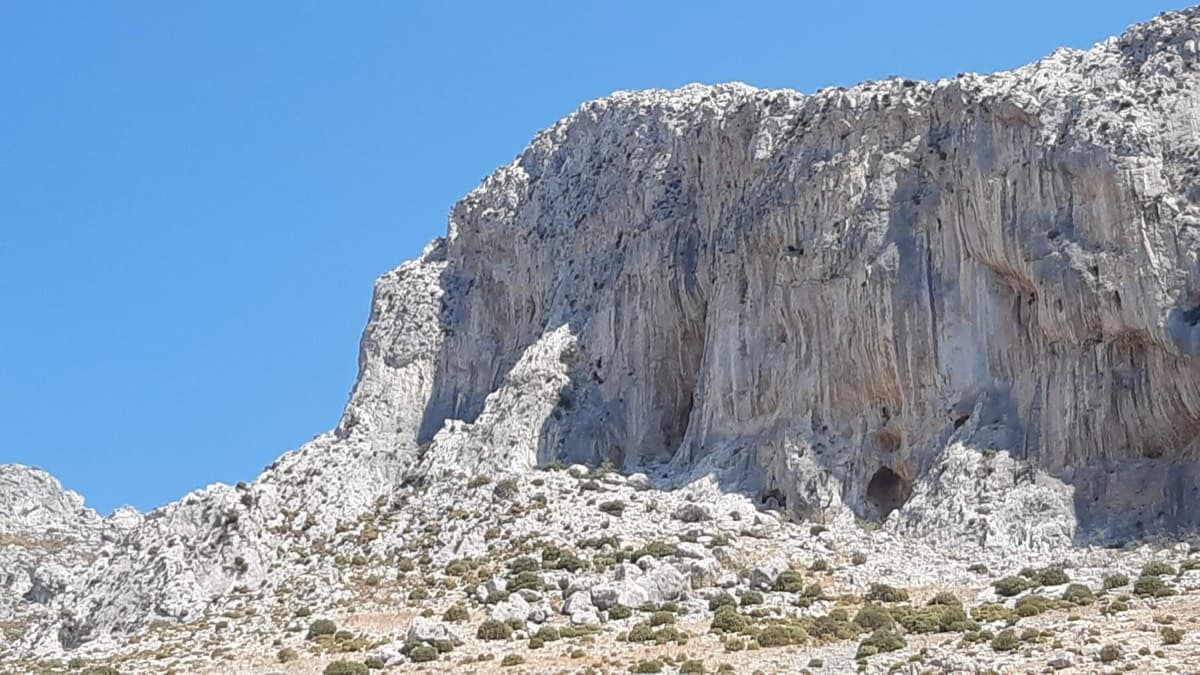
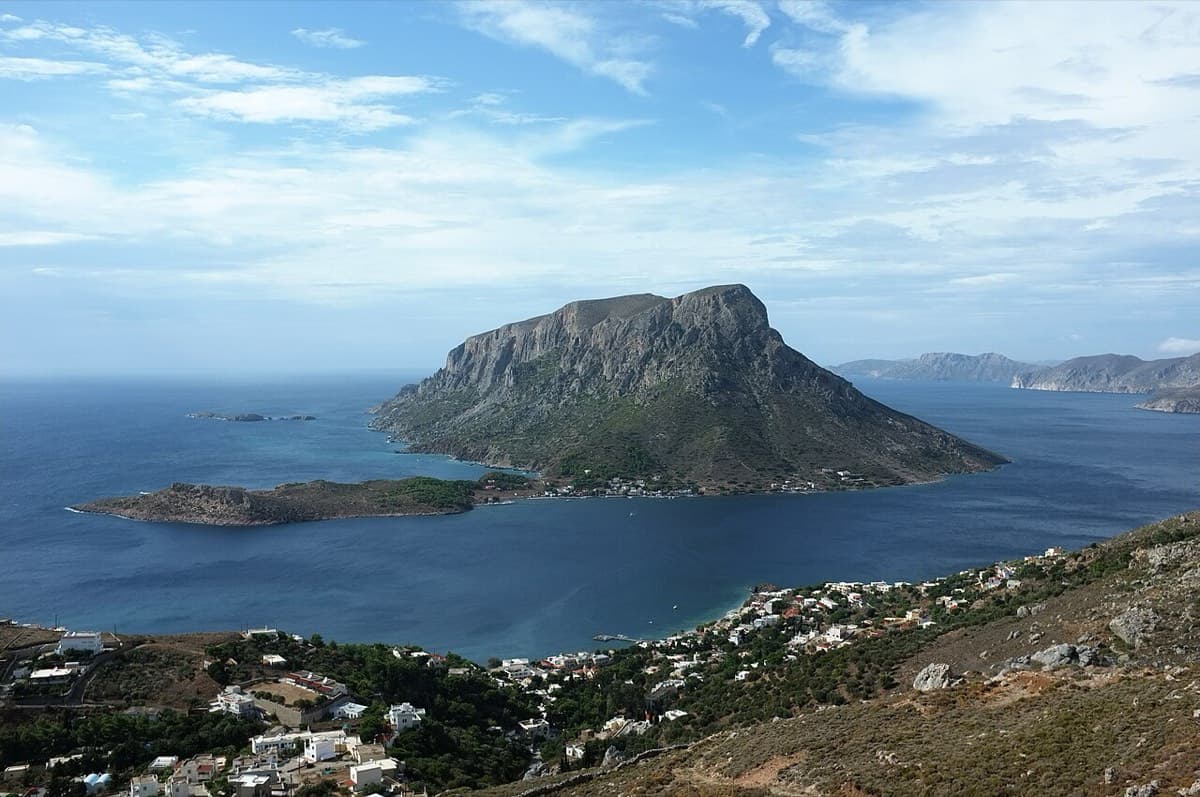
Kalymnos – Ocean Dream (left end) · Kalymnos & Telendos · Greece

Bail not documentedBolting confidence: medium

A pretty route up the grey and orange walls of Ocean Dream to the summit plateau. The crux is a thin, sustained 6a+ slab on P3 where you must free the moves, and the line finishes on a vertical pillar. It is in the shade in the morning.

Hardest pitch
6b
Pitches
5
Length
150 m
Approach
40 min
Aspect
SW
South-west-facing
Rope
–

The route

Overview

A five-pitch sport route up the grey and orange walls of Ocean Dream, the quiet sector above Odyssey, finishing on the summit plateau. The first two pitches are easy sculpted slab; the upper three are thin, technical 6a+ to 6b wall and pillar climbing on rock that trip reports call perfect. You top out to wide views and walk off down a goat gully. Parties report having the sector to themselves. Published information is thin: everything here comes from one camptocamp route page and two trip reports on the same site.

The climbing

Pitch by pitch

Pitches of Abert Project
PitchGradeLengthNotes
P15a30 mSculpted slab. The belay is slightly to the right. Do not climb straight up to the foot of the orange wall.
P25b30 mRising traverse to the right. The belay is in a niche, where a fixed handline leads off to the right (2021 report).
P36a+30 mThe crux pitch according to the route page. A technical start out of the niche, then a thin, sustained slab on water-drop pockets. The moves between bolts have to be climbed.
P46b30 mA long vertical wall, steady at first, then thinner and more technical on the final pillar. Sustained route-reading and footwork.
P56b30 mVaried and more athletic, with a few 6b moves and easier ground between them. Bouldery moves at the exit. Some bolts are hidden by vegetation, so look carefully.

Getting there

Approach

To the parking

Ocean Dream is on the west coast of Kalymnos, above the road between Massouri and Arginonta. The path starts from that road level with Kasteli and is the shared access path for the Odyssey, Iliada, Olympic Wall and Ocean Dream sectors. Sources read give no parking or bus details.

On foot · about 40 min

From the Massouri to Arginonta road at Kasteli, take the access path signed for Odyssey / Iliada / Olympic Wall / Ocean Dream and climb to the foot of Ocean Dream. Allow 40 to 45 min. The wall is easy to pick out from the road. The route starts at the far left end of the sector. You can also start up one of the single-pitch routes of the 'Lower wall' sector: a 2021 party climbed 'Giuliana' (about 5c/6a), which goes straight to the second belay in one pitch.

Finding the route · 3 photos

Approach photo

Map of the walk-in

  • Crag

Loading map

The point marks the crag, not the exact start of the route.

Coordinates · crag

37.01308, 26.94707

Point from camptocamp waypoint 1018691

For your phone or watch

Download GPX

Contains the route point. Opens in most mapping apps and GPS watches.

Points are compiled from published sources, with the precision stated above. They were not surveyed on the ground: check them against a current topo.

Getting down

Descent

Walk off. From the top, follow the ridge south (right as you top out), then go down the big gully that separates Ocean Dream from Olympic Wall. It is obvious: a series of large ledges and rock steps with a few moves of easy down-climbing. It brings you back to the foot of the face. A 2021 party took 45 min.

Retreat

Bailing off the route

Bail not documented

Retreat is not documented. Camptocamp describes only the walk-off down the gully from the top and does not say how the belays are equipped. A 2021 report mentions a fixed handline leading right from the niche belay at R2, but nobody says where it goes or what state it is in.

Retreat from
Not documented. The first two pitches are easy slab (5a, 5b) above a sector of single-pitch routes, which makes an early retreat plausible, but pitch 2 is a rising traverse and no source confirms it.
Carry
Not documented; no source gives a rope length. All five pitches are listed as 30 m, so a 60 m rope would only just reach belay to belay. The bolts date from 2004, so carry maillons and cord and inspect any anchor before abseiling from it (inference).
Basis
Part stated, part inferredCamptocamp and its trip reports state the walk-off, the pitch lengths, the handline at R2 and the 2004 equipment; nothing is stated about abseiling, and the remarks about an early retreat and rope reach are inferences only.

Partly inferred from the route facts

Safety

Hazards

  • Goats on the plateau and in the descent gully knock stones down; a 2021 report says a helmet is indispensable in this sector.
  • On P5 some bolts are hidden by vegetation (2021 report). Read the line carefully.
  • P3 is thin and sustained, and the route page marks it as obligatory climbing. The page gives 6a as the obligatory grade for the route.
  • The descent gully has rock steps and a few easy down-climbing moves, and you share it with goats.
  • The route was equipped in 2004. None of the sources read comments on the present state of the bolts.

Sun and weather

Conditions

Faces south to south-west. In the shade in the morning, so in the sun from the middle of the day. Reports describe the sector as always empty. The two reports read were from May and September, both in fine weather.

Usual season · Mar to May, Sep to Nov

Sun on the wall · SW-facing

Working out the sunlit hours for this month.

  • January: not yet worked out
  • February: not yet worked out
  • March (usual season): not yet worked out
  • April (usual season): not yet worked out
  • May (usual season): not yet worked out
  • June: not yet worked out
  • July: not yet worked out
  • August: not yet worked out
  • September (usual season): not yet worked out
  • October (usual season): not yet worked out
  • November (usual season): not yet worked out
  • December: not yet worked out

Sun on the wallDaylight, wall in shade● Usual season

Estimated from the wall's aspect only. Ignores surrounding terrain, gullies and the wall's exact shape. Clock times are local to the wall (Greek time), for the 15th of each month.

Monthly climate averages for Kalymnos & Telendos, 1991-2020
MeasureJanFebMar (usual season)Apr (usual season)May (usual season)JunJulAugSep (usual season)Oct (usual season)Nov (usual season)Dec
Mean daily high °C131315172124262725211815
Mean daily low °C101011141721232421181512
Rain days 1 mm or more121185300025813

● marks the usual climbing season. Averages for 1991-2020 at about 136 m. Area climate from Open-Meteo reanalysis. Temperatures are adjusted to the height of the crag; rain comes from a grid cell of about 10 to 25 km, and summer highs on sea cliffs can read a few degrees low. The wall and valley can differ. Data: Open-Meteo, CC BY 4.0.

What to carry

Gear

Sources give no rope length or quickdraw count. Every pitch is listed as 30 m and the descent is on foot. Take a helmet: a 2021 report calls it essential because of goats.

Checklist

Quickdraws
Number not given in the sources
Rope
Length not given in the sources
Helmet
One each
Maillons or spare karabiners
To leave behind if you retreat
Cord
Mentioned for retreat

Derived from the route data; check it against a current topo

From climbers

Reader reports

Reader reports are not being collected yet. Until they are, check a current topo and the local club or guidebook publisher for recent changes to Abert Project.

Worth knowing

Tips

  • Starting up 'Giuliana' (5c/6a) on the Lower wall replaces P1 and P2 with one better pitch that is closer in difficulty to the rest of the route (2021 report).
  • A 2021 party took 3 h for the route, plus 45 min each for approach and descent.
  • At R1, belay to the right rather than continuing straight up under the orange wall.

Open questions

Where sources disagree

  • Approach time: the route page says 40 min, the crag record and a 2021 report say 45 min.
  • The route page calls P3 (6a+) the crux, but grades P4 and P5 6b. The 2021 report describes P4 as the most sustained pitch.
  • First ascensionist spelled 'Albert' on camptocamp; the linked topo site belongs to Guy Abert, so 'Abert' is followed.
  • The topo link on Guy Abert's site (abert.fr) no longer resolves, so the original topo could not be checked. No second independent site describing the route was found.

Provenance

Sources

Same area

More in Kalymnos & Telendos

All routes in Kalymnos & Telendos
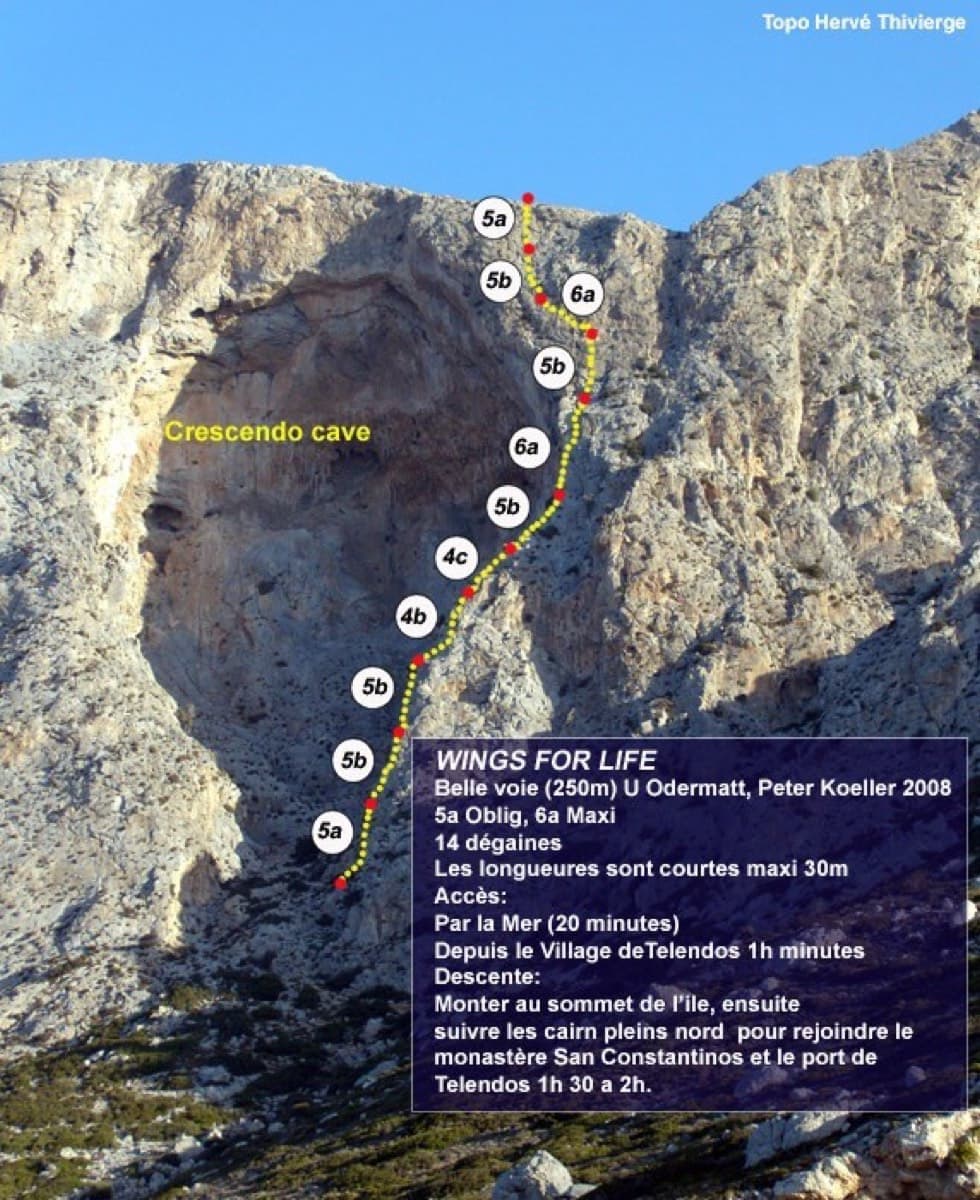
Topo of Wings for Life, right of the Crescendo cave, Telendos south face

Greece · Kalymnos & Telendos

Wings for Life

The first route on the wall (Odermatt and Keller, 2008), climbing a long, exposed line on sharp, grippy rock right of the huge roof. The lower pitches are easy for the grade. The two 6a cruxes are a short odd corner over a small roof and a traverse high up, and they come with big exposure. Pitches are short, so you can link them with long draws.

6a11 pitches250 m
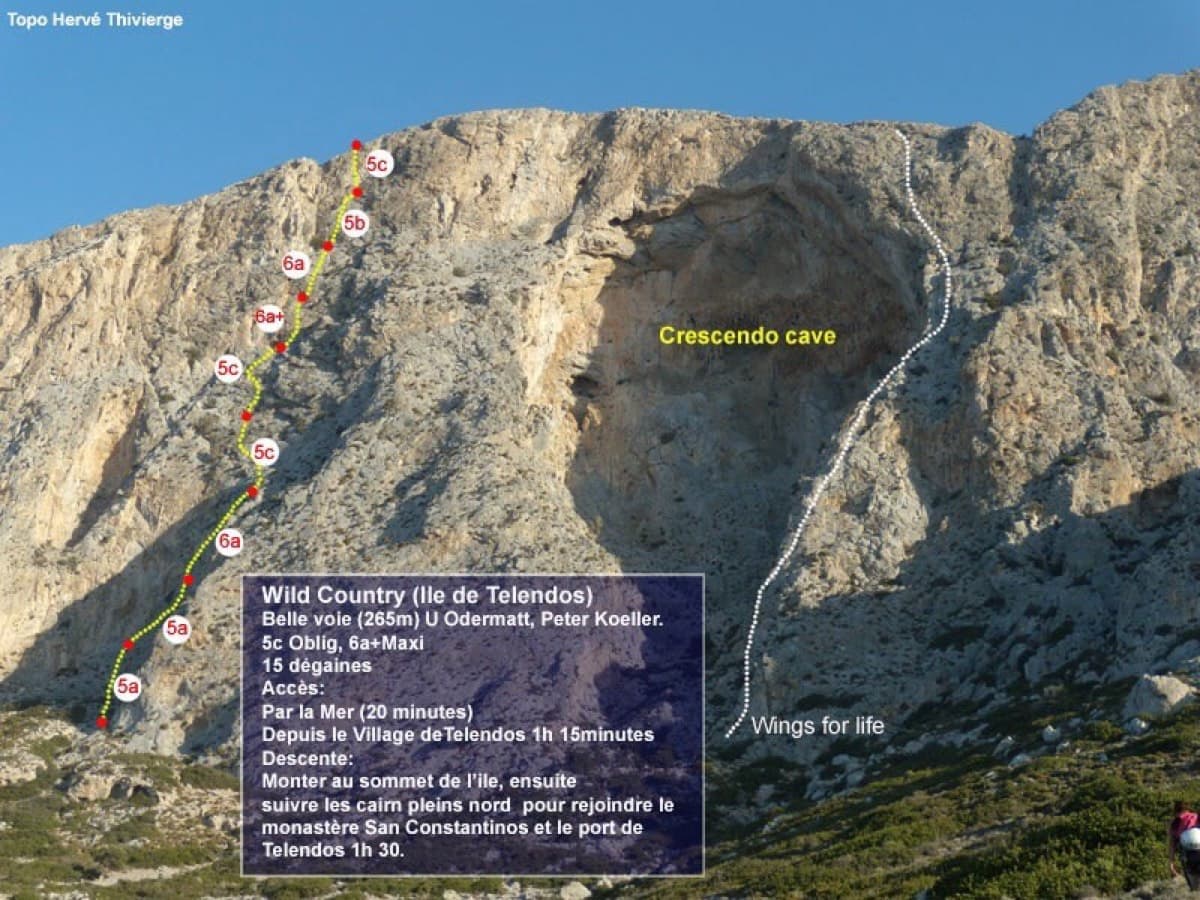
Topo of Wild Country, left of the Crescendo cave, Telendos south face

Greece · Kalymnos & Telendos

Wild Country

A sustained, varied line on sculpted limestone. It starts with an easy slab and builds to slightly overhanging jugs with huge exposure on the top pitch. Mountain Project and camptocamp grade the crux 6a+ (Rockfax says 6a). With a 70 m rope you can link several pairs of pitches.

6a9 pitches265 m

The cliff above the Grande Grotta: 3 Stripes starts on the second-to-last spur on the left and finishes up the shaded wall

Greece · Kalymnos & Telendos

3 Stripes

Kalymnos's best-known introduction to multi-pitch: a series of steps and slabs, always with plenty of holds, finishing on top of the Grande Grotta. The upper pitches feel very exposed. Real pitch lengths are shorter than the guidebook says (20–25 m).

5c+6 pitches175 m

Committing

Telendos island seen from above Kamari on Kalymnos

Greece · Kalymnos & Telendos

Rita Telendos

Thin moves over small bulges, stemming and big jugs on 'cauliflower' limestone. The crux is P6, which ends at a hanging belay. Mountain Project gives the pitches in YDS only (5.8–5.10b), so French pitch grades are not listed; the overall grade is 5.10b (6a+), and some listings give 6b. You can link P3–P4 and P5–P6.

6a+7 pitches152 m

Read the cautions

Around 6b · about 5 pitches

Similar elsewhere

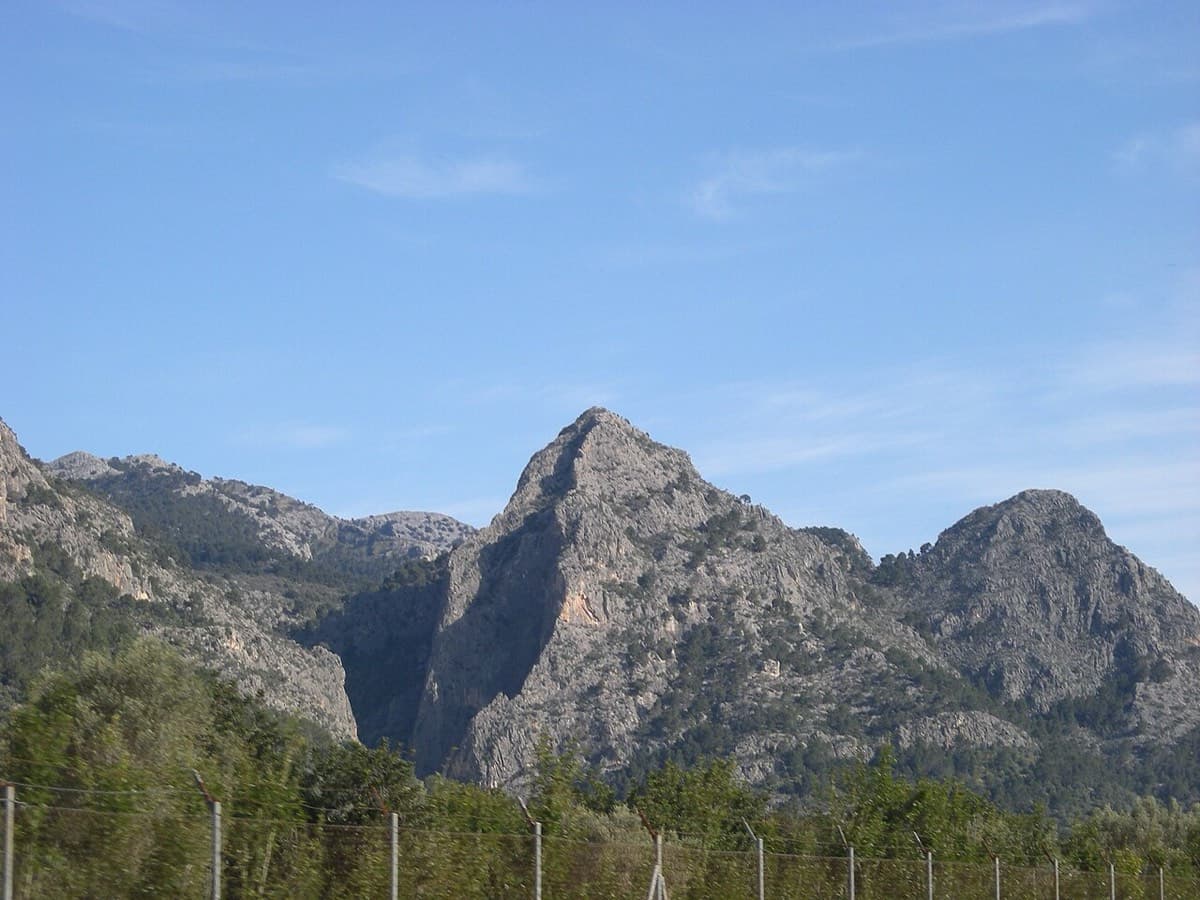
Sa Gubia seen from the Sóller road, Mallorca

Spain · Mallorca (Sa Gubia)

Via Llum de Lluna

Technical, sustained wall climbing on positive holds up the left side of the Princesa wall, ending in a memorable powerful finish.

6b5 pitches216 m

Read the cautions

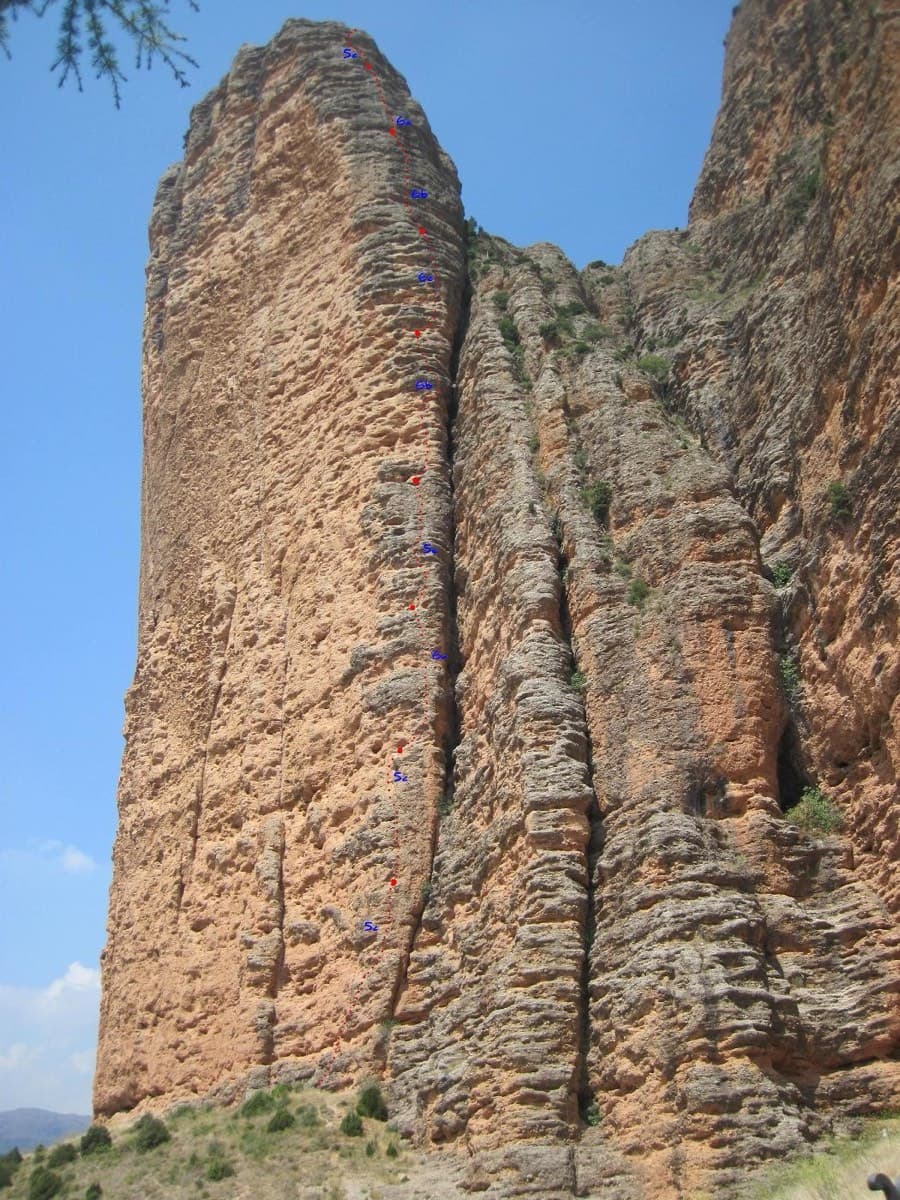
Line of Chopper / Chooperior marked on Mallo Pisón, Riglos

Spain · Riglos & Agüero (Mallos)

Chopper

A fine short route on the right edge of the Pisón, ending on a big terrace at half height. A vertical wall on small holds on pitch 3 and two hard moves on the last pitch.

6b5 pitches150 m

Read the cautions

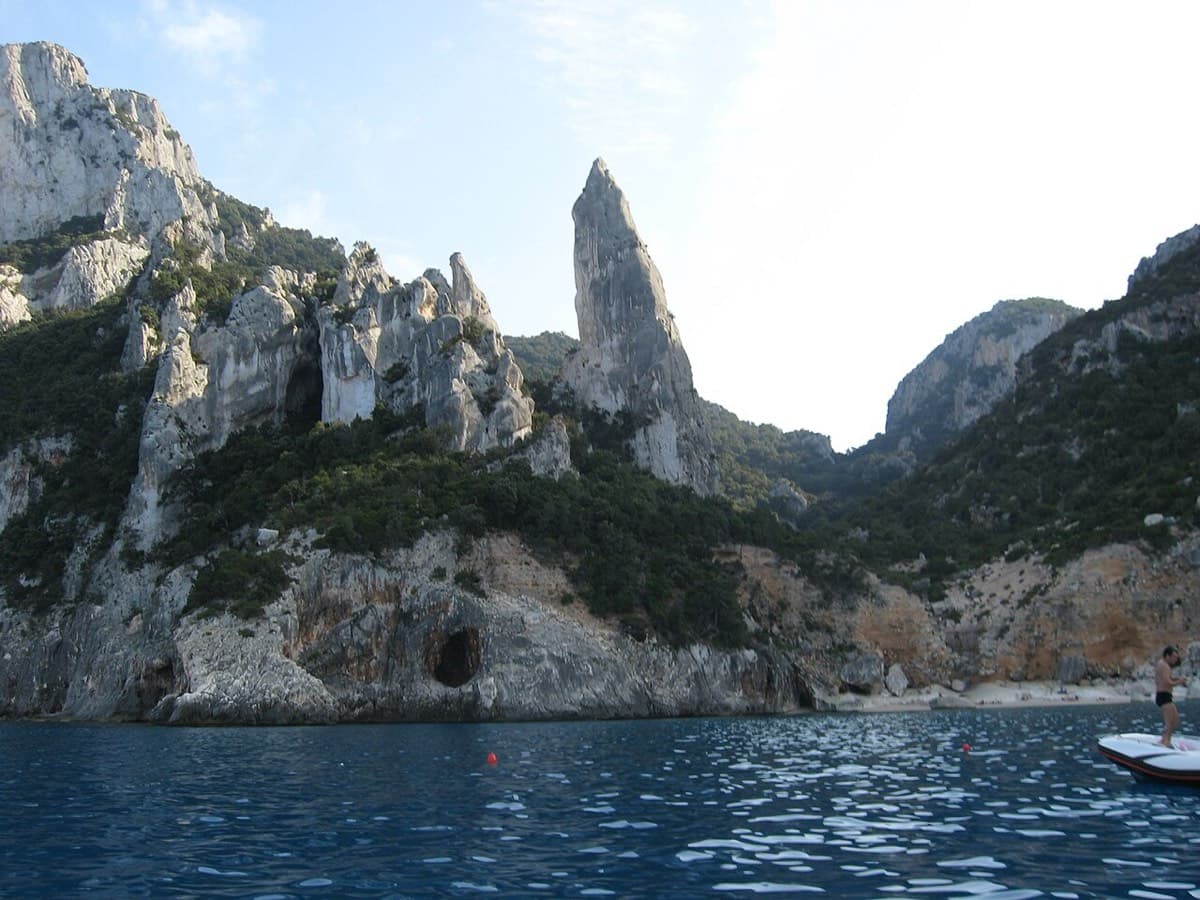
The Aguglia di Goloritzè above Cala Goloritzè, seen from the sea

Italy · Sardinia

Easy Gymnopédie

This is the easiest way to the top of Sardinia's iconic 140 m pinnacle above Cala Goloritzè. Short technical bulges and walls lead to a fine slab finish, and the harder overhangs can be aided. Gulliver splits it into 4 pitches; camptocamp gives 5. Check seasonal access rules for Cala Goloritzè before going.

6b5 pitches150 m

Read the cautions

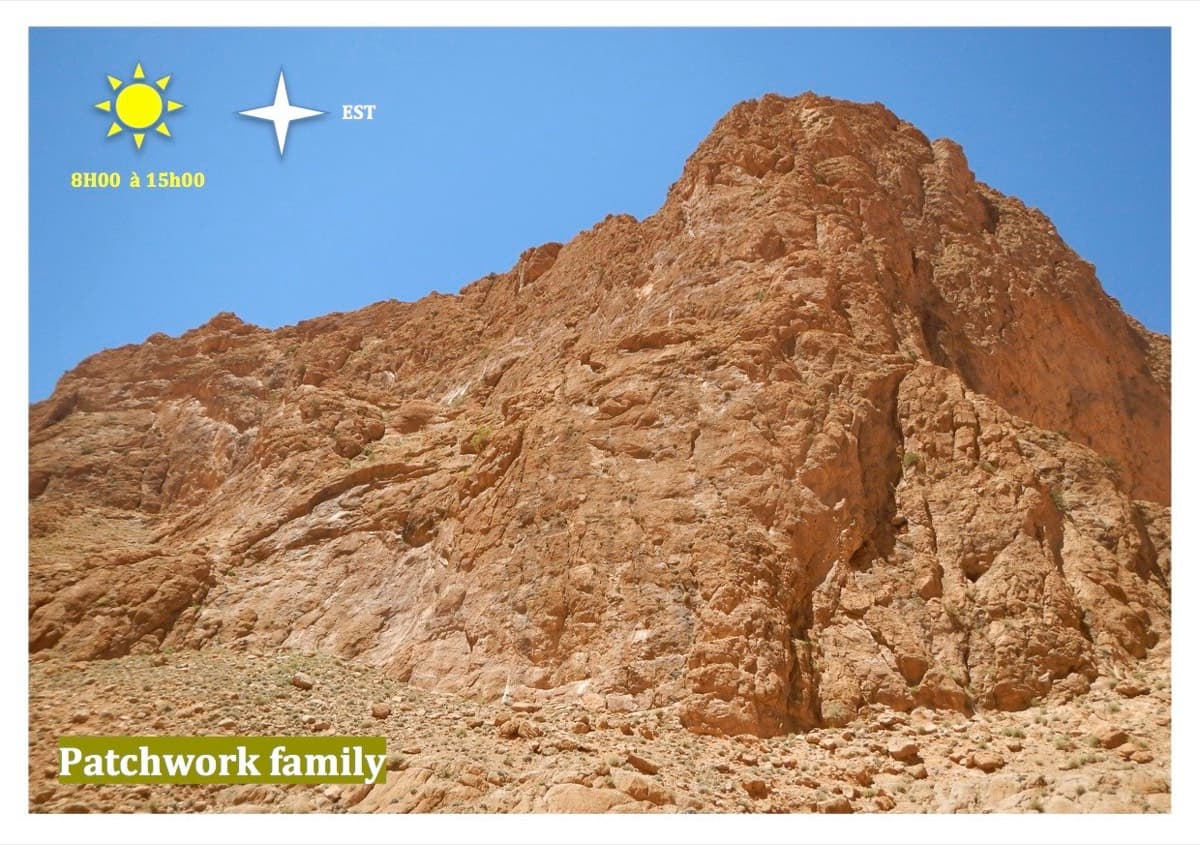
Patchwork Family sector, Todra Gorge

Morocco · Todra Gorge (Todgha)

Polo del Sol

The only multipitch on a pillar about 800 m up the road from the gorge exit. Sustained at 6a+/6b on new, very abrasive rock, with a walk between pitches 2 and 3.

6b5 pitches210 m

Read the cautions

Compiled from published sources and last verified October 2026. Bolts, anchors and access change. Climbing is dangerous and you are responsible for your own decisions: check a current topo and read the disclaimer.