Multipitch Atlas

Código Vertical

Pared Negra · Vega Baja (Orihuela & Callosa) · Spain

Bail with caveatsBolting confidence: medium

A popular modern four-pitch classic on Pared Negra's compact grey limestone, around UIAA 6/6+ (about French 6a). Best on cool, sunny winter days.

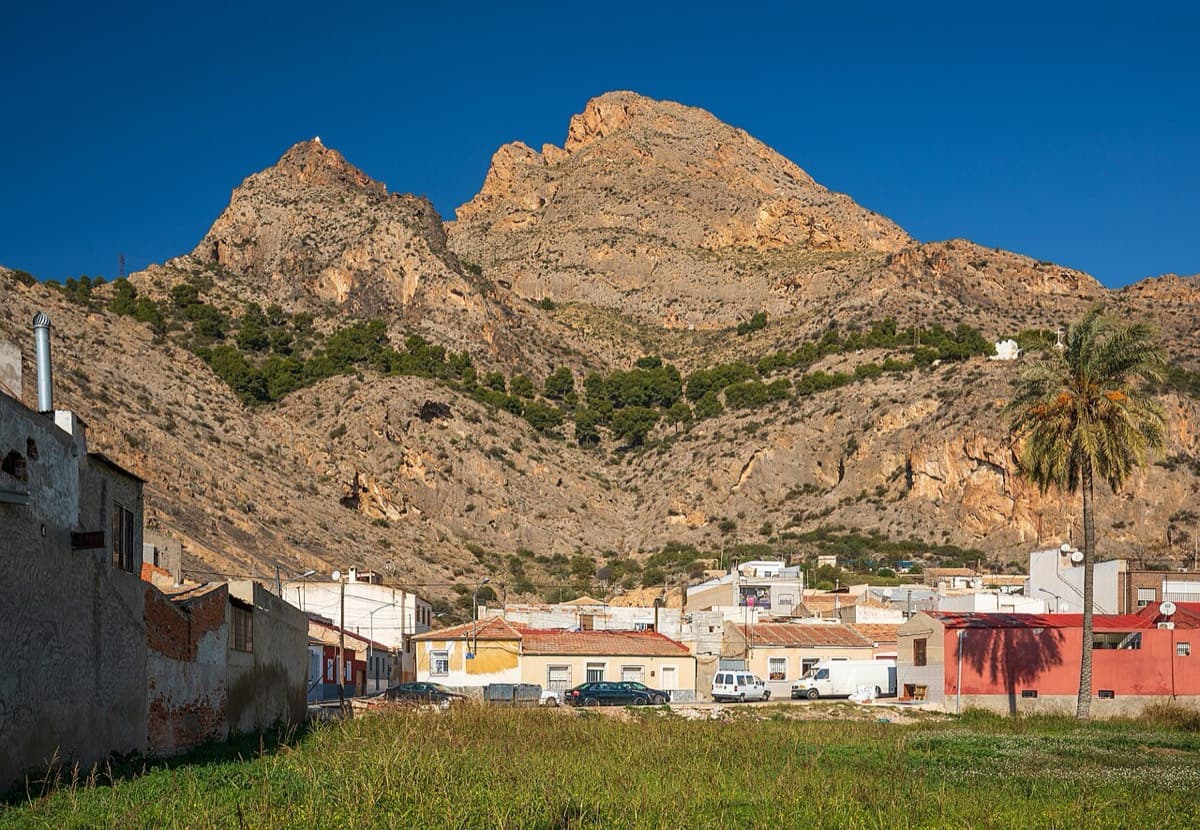
Pared Negra, Orihuela (red line marks the neighbouring route Derecha del Espolón, green the descent)Photo: M4N · CC BY-SA 3.0

Photo

Pared Negra, Orihuela (red line marks the neighbouring route Derecha del Espolón, green the descent)Photo: M4N · CC BY-SA 3.0
Hardest pitch
6a
Pitches
4
Length
150 m
Approach
20 min
Aspect
S
South-facing
Rope
1×70 m

The route

Overview

Código Vertical is a four-pitch bolted line of about 150 m on the Espolón sector of Pared Negra, the dolomitic limestone wall above the N-340 tunnel at Orihuela. Three pitches of 5/5+ slab, crack and corner climbing lead to a 45 m 6a finish that crosses the capping roofs from right to left. The local guide points out that it is really a variation: only about a pitch and a half is independent, and from part-way up pitch 2 it follows the older María Ángeles line. It is a short, sunny winter outing with a 15-20 minute walk-in; the main things to get right are picking the correct line of bolts on a wall crowded with routes, and the descent.

The climbing

Pitch by pitch

Pitches of Código Vertical
PitchGradeLengthNotes
P15+35 mStart just left of the spur after the small gully; name plaque at the first bolt. Follow a crack, then a slab with a few technical moves. Belay on 3 bolts. Given V+ by both the local guide and the bergsteigen.com topo.
P25+45 mLeave the belay towards a small, obvious corner directly above and pass it on the left. Trend slightly left onto easier-angled slabs to the belay. From here to the top the line is shared with María Ángeles. Belay on 2 bolts (shared). Graded V+.
P35a25 mSlab then a crack to the reddish band. Belay on 2 bolts. Graded V; the local guide gives 25 m, the bergsteigen.com topo 30 m.
P46a45 mStraight up from the belay, then slightly right to pick up the bolt line leading to the roof. Cross the roofs from right to left; the last move is the hardest. One report says it is less hard than it looks. Belay on 2 bolts on the final ledge.

Getting there

Approach

To the parking

Orihuela (Alicante province). Leave the A-7 Murcia-Alicante motorway at exit 741 Orihuela-Benferri (from Murcia) or exit 545 (from Alicante), follow the CV-930 for about 4 km to the 'Orihuela Centro-Murcia' exit, join the N-340 and follow signs for Murcia. After about 1.3 km the Mirador del Palmeral car park is on your left, just left of the tunnel entrance, but the left turn is prohibited: drive through the tunnel, turn round at the next roundabout and come back. Bergsteigen.com gives the parking at 38.097099, -0.946584, about 70 m above sea level. No public transport information was found.

On foot · about 20 min

From the Mirador car park cross the road and take the path (marked with green paint) that follows a dry stream bed up to the cave/mine opening at the foot of the wall, then go right along the base to the sectors. Allow 15-20 minutes. Código Vertical starts just left of the spur (the Espolón), reached by scrambling up a small gully; there is a plaque with the route name at the first bolt. For orientation, the classic Espolón starts about 20 m above and right of the mine hole (now covered by steel netting) and is marked 'espolón GD'.

Map of the walk-in

  • Route base
  • Parking

Loading map

The point marks the base of the route.

Coordinates · route base

38.09979, -0.94664

Parking

38.09710, -0.94658

Parking marked on bergsteigen.com

Point from bergsteigen.com touren/klettern/codigo-vertical-pared-negra

For your phone or watch

Download GPX

Contains the route point and parking. Opens in most mapping apps and GPS watches.

Points are compiled from published sources, with the precision stated above. They were not surveyed on the ground: check them against a current topo.

Getting down

Descent

Three sources describe the traditional descent on the right-hand side of the wall (the guide's 'Option 1'), also used for the Espolón: from the top go up and right, follow the fixed steel cable to its end, then a cairned path and a steep descent to the small saddle that closes the wall on the right and the abseil platform. Abseil 1 is 25-30 m to a terrace. Walk down the terrace to a handrail cable that leads to the second anchor at its west end; abseil 2 is 30-35 m to the foot of the wall, with a little downclimbing at the end. Bergsteigen.com allows 1 h. The local guide instead lists 'Option 3' for this route: the abseil line down the Nuria route on the left, which lands on the ledge where Blanca and Piti start, from where a small chimney leads down to the mine. That line uses the Nuria belays, needs two ropes, and its second abseil has two possible landing stations (see hazards).

Retreat

Bailing off the route

Bail with caveats

Probably, but no source describes it, so this is a judgement from the facts. The belays are bolted (three bolts at the top of P1, two at the others) and the first three pitches are slab, crack and corner in a fairly direct line, so abseiling from them looks feasible if you leave gear. The 45 m pitches mean one 70 m rope does not reach from stance to stance.

Retreat from
From the belays at the top of P1, P2 and P3, by abseiling from the bolts (inferred). The belay above P1 is 35 m up, which a 70 m rope just covers; P2 is 45 m and needs two ropes or an intermediate anchor. The established Nuria abseil line lies further left on the wall, but no source describes reaching it from this route.
Point of no return
Not documented. Once you are established on P4, which is 45 m and crosses the capping roofs from right to left, finishing the pitch is likely simpler than reversing it (inferred).
Carry
Two ropes of 50 to 60 m for a retreat, since P2 and P4 are 45 m. Maillons or karabiners and cord, because no source says the belay bolts are linked or have rings.
Basis
Inferred from the route factsThe local guide and bergsteigen.com state the belay bolts and pitch lengths, and camptocamp describes only the normal descent; that you can abseil from the belays and what you need for it are inferred.

Partly inferred from the route facts

Safety

Hazards

  • Route finding: Pared Negra has many overlapping bolted lines and variations (the local guide calls the wall 'a puzzle'). Mountain Project warns that going the right way on the adjacent Espolón is tricky because of multiple bolted options.
  • Rock: the wall is made of large dolomitic limestone blocks; the local guide tells you to check carefully that blocks are well seated.
  • Nuria abseil line (Option 3): on the second abseil there are two landing stations. With 60 m ropes use the first one (cord and tape), because the ropes end slightly above the better station; downclimbing to it is described as dangerous. All anchors are belays of Nuria, so watch for parties below.
  • Option 1 descent involves an exposed cable section, steep ground down to the saddle and some downclimbing below the abseils.

Sun and weather

Conditions

South to south-west facing and in full sun. The local guide gives late autumn to early spring as the season and says the wall is unbearable in summer unless you start very early. Bergsteigen.com recommends sunny, cooler days.

Usual season · Jan to Apr, Oct to Dec

Sun on the wall · S-facing

Working out the sunlit hours for this month.

  • January (usual season): not yet worked out
  • February (usual season): not yet worked out
  • March (usual season): not yet worked out
  • April (usual season): not yet worked out
  • May: not yet worked out
  • June: not yet worked out
  • July: not yet worked out
  • August: not yet worked out
  • September: not yet worked out
  • October (usual season): not yet worked out
  • November (usual season): not yet worked out
  • December (usual season): not yet worked out

Sun on the wallDaylight, wall in shade● Usual season

Estimated from the wall's aspect only. Ignores surrounding terrain, gullies and the wall's exact shape. Clock times are local to the wall (Central European time), for the 15th of each month.

Climate figures for Vega Baja (Orihuela & Callosa) are not available yet

What to carry

Gear

12-13 quickdraws (bergsteigen.com and camptocamp say 12). Bergsteigen.com lists 1×70 m rope, which covers the 45 m pitches and the Option 1 abseils; take two 60 m ropes if you plan to use the Nuria abseil line. Helmet. The route itself is described as fully equipped; a few cams are suggested by other sources only for the neighbouring Espolón routes.

Checklist

Quickdraws
12
Rope
1×70 m
Helmet
One each
Abseil device and prusik
The descent or the retreat involves abseiling
Maillons or spare karabiners
To leave behind if you retreat
Cord
Mentioned for retreat

Derived from the route data; check it against a current topo

From climbers

Reader reports

Reader reports are not being collected yet. Until they are, check a current topo and the local club or guidebook publisher for recent changes to Código Vertical.

Worth knowing

Tips

  • A popular combination is the first three pitches of the classic Espolón (V, V+, IV+; 55, 45, 30 m) with the 6a top pitch of Código Vertical, as described on camptocamp.
  • The free PDF guide 'Escaladas en la Pared Negra de Orihuela' has a photo-topo of every line and a descent diagram; download it before you go.
  • A camptocamp contributor says the grades in the English-language Costa Blanca guidebook are unreliable for this wall and prefers the local guide.

Open questions

Where sources disagree

  • Pitch 3 length: 25 m in the local guide, 30 m on the bergsteigen.com topo. Guide followed.
  • Descent: the local guide assigns the Nuria abseils (Option 3) to this route; bergsteigen.com and camptocamp use the traditional cable and two-abseil descent on the right (Option 1). Both are given.
  • Abseil lengths on Option 1: 25 m + 35 m (bergsteigen.com, or 30 m plus a fixed rope), 30 m + 35 m (camptocamp), 25 m + 30 m (local guide diagram), about 20 m + 30 m (Mountain Project). Treat the second as 35 m.
  • Aspect: south on bergsteigen.com and Mountain Project, south-west on camptocamp.
  • Bergsteigen.com gives the overall grade as UIAA 6/6+ with 5+/6- obligatory; the Spanish sources give 6a.

Provenance

Sources

Same area

More in Vega Baja (Orihuela & Callosa)

All routes in Vega Baja (Orihuela & Callosa)
Sierra de Callosa above Redován

Spain · Vega Baja (Orihuela & Callosa)

Espolón P.D.P.

A long, steady V+ spur to the summit of the Sierra de Callosa on exceptional rock. Many terraces allow a safe retreat, which makes it good mileage for building multipitch experience. Check local seasonal climbing restrictions in the Sierra de Callosa.

5+9 pitches500 m

Read the cautions
No photo yet

Spain · Vega Baja (Orihuela & Callosa)

Botri

The classic of Redován: ten pitches and 300 m of steady grade 5 with three steeper pitches on red rock. The eighth pitch, a traverse right into an overhanging corner above the orange cliffs, is the one people remember. Closed from January to June for nesting eagles.

6a+10 pitches300 m

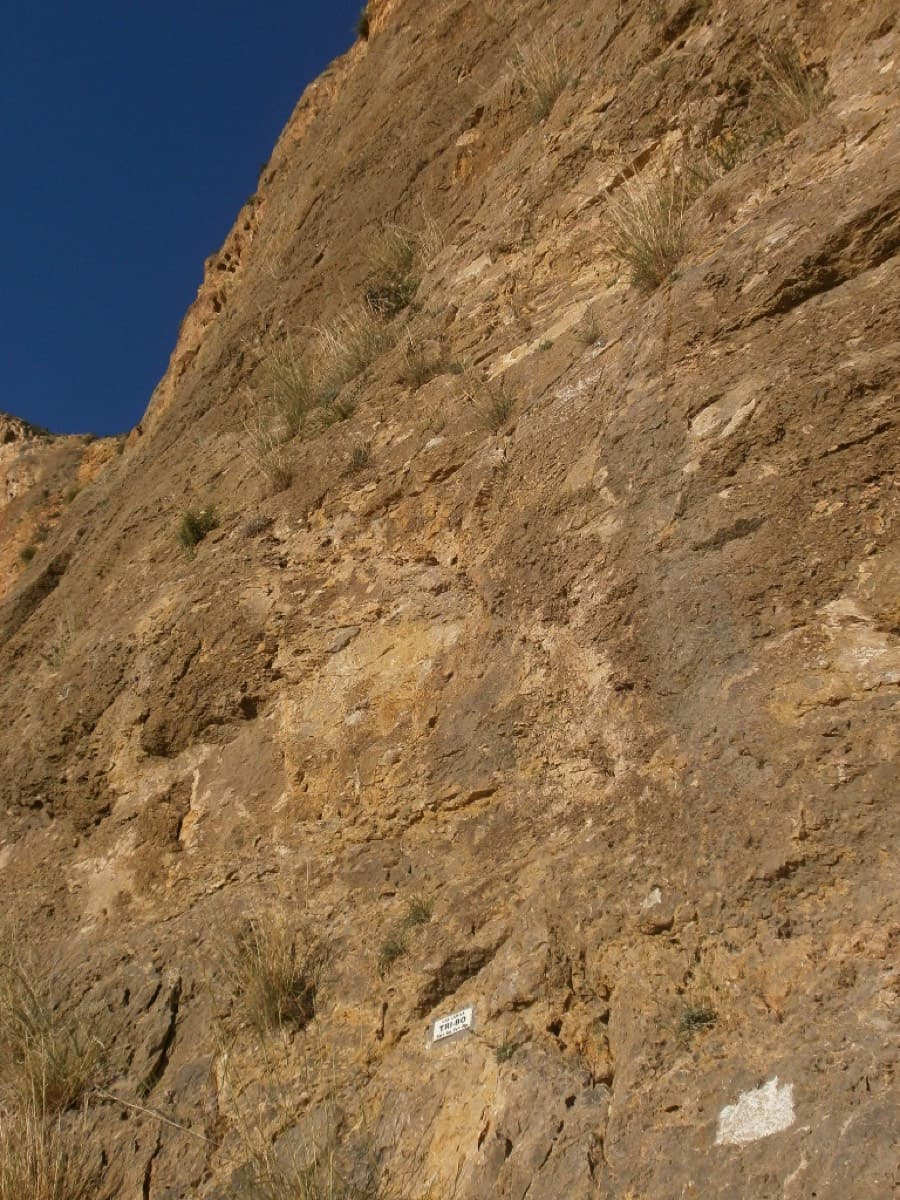
The foot of Tribo on La Pancha, Redován, with the route's name plate on the rock.

Spain · Vega Baja (Orihuela & Callosa)

Tribo

Five pitches up the centre of La Pancha, the main wall above Redován. The second pitch climbs the middle of a red pillar with a polished crux on flat holds; the 40 m last pitch is an elegant slab that looks much harder than it is. Outside the bird closure that affects Botri.

6b+5 pitches150 m

Around 6a · about 4 pitches

Similar elsewhere

Gorra Frígia and Magdalena Superior seen from the south-west, Montserrat

Spain · Montserrat

98 Octanos

An exposed, airy line with unusually good holes and jugs for Montserrat, shaded in the afternoon. The 6a pitch is a sustained vertical 20 m. Going straight up instead of following the line is closer to 6b+.

6a4 pitches140 m

The Masua sea cliffs seen from the water

Italy · Sardinia

L'Italia Liberata

A short but superb sea-cliff route on beautifully sculpted limestone in an incredible setting near Pan di Zucchero. Corners and an airy pillar lead to a steep, rounded 6a wall. Camptocamp rates it 'great'.

6a4 pitches120 m

The Frontales cliffs above El Chorro

Spain · El Chorro

Valentine's Day

A popular, sunny short multipitch in one of the easier Frontales sectors. Mostly 5/5+, with a brief 6a crux.

6a4 pitches130 m

Looking down the lichen-covered granite slab of Bügeleisen towards the forest at Handegg

Switzerland · Grimsel

Bügeleisen

A short, varied granite route up a pale, smooth pillar across the valley from the Handegg slabs: a corner crack, then friction and edge slabs that get harder pitch by pitch. Grades are stiff, and the last pitch is sustained and tricky. A good half day or uncertain-weather route with a 15-minute approach.

6a5 pitches200 m

Compiled from published sources and last verified October 2026. Bolts, anchors and access change. Climbing is dangerous and you are responsible for your own decisions: check a current topo and read the disclaimer.