Menu

Paradis Perdus

Cirque du Bout du Monde (Pochette Surprise sector) · Saint-Guilhem-le-Désert · France

Read the cautionsEasy to bail

A short, sustained and very steep limestone line at the back of the Cirque du Bout du Monde. Four pitches of technical, hard-to-read wall climbing on sharp, grippy rock, with the crux on the third pitch. The grades on the local topo are widely considered stiff.

Climbing mode: Big type, screen kept awake, tick pitches as you go.

The Cirque du Bout du Monde above Saint-Guilhem-le-Désert, where Paradis Perdus climbs (the route is not marked)Photo: Isasza · CC0
Hardest pitch
6c6c
Pitches
4
Length
120 m
Approach
–
Aspect
SE
South-east-facing
Rope
Not stated
abseil descent

Highest point 350 m above sea level (camptocamp route 1040241).

Rock
limestone
Season
Mar to May, Oct to Nov
Bolting confidence
Medium
Last verified
October 2026 · Aggregated by AI from published sources
Read before you go

Well bolted and abseilable, but the bolting date is unknown, a 2023 party found a rusty bolt and loose hangers, and the site is only tolerated.

Photo

Climbing modeBig type, screen kept awake, tick pitches as you go.

Overview

Paradis Perdus is a four-pitch, 120 m route at the head of the Cirque du Bout du Monde, on the Pochette Surprise sector of the right bank. Every pitch is steep and sustained, on rock that grips well but is sharp on the fingers. The local topo grades the crux pitch 6b+; the camptocamp author thinks 6c is the minimum, and a 2023 party called the topo grades very stiff and advised having climbed 7th grade first. The bolting is good, if sometimes oddly placed, and the route can be abseiled from every belay.

Worth knowing

  • Allow about four hours on the route; the 2023 party took 13:00 to 17:00.
  • Starting is confusing: several lines of hangers leave the same ledge. Follow the dark grey hangers slightly left.
  • There is no recent paper topo for Saint-Guilhem; topo-thaurac.com has the route descriptions.

Pitch by pitch

The atlas doesn't show topos: they are the work of the people who bolt and document these routes. See the topo at Topo Thaurac – Paradis Perdus, Topo Thaurac – Saint-Guilhem-le-Désert introduction, or in Guide des escalades en Pays d'Oc, Falaise de St Guilhem le Désert.

Pitches of Paradis Perdus
PitchGradeNotes
P16aStraight up, then left at the end to the belay. Very vertical and sustained for the grade. The 2023 party thought it 6a+ and found the start confusing: the gold hangers nearby probably belong to Yellow Diamond. Go past the first ledge with a chained belay (marked Yellow Diamond), trend up left and belay on two bolts with a maillon next to a tree.
P26aGo left to find the first bolt, then trend up right, with a short traverse just below the belay. A little easier than pitch 1 (5c with one 6a move according to the 2023 party). Watch the rope drag if it catches in the trees; the belay is not very comfortable.
P36cThe crux, rated 6b+ on the local topo but at least 6c according to camptocamp. The first few bolts wander, then a fine slab on water-worn pockets leads into a corner of slopers, compression moves, jugs and crimps, steepening to a final boulder move. Hard to read but well bolted. A 2023 party noted one rusty bolt. Comfortable chained belay.
P46bUnder-graded on the topo according to camptocamp (6b rather than the topo grade; the 2023 party gave 6a+). Start right with a boulder move at a small roof, then sustained, thin climbing on pockets and crimps to a final mantel. Clip the left-hand line of bolts; the bolts on the right belong to the 6c of Dominus Vobiscum. Hangers needed tightening in 2023.

Approach

To the parking

Drive to Saint-Guilhem-le-Désert in the Hérault gorges and use the paid car park at the top of the village, parking as far up as you can. Parking is paid all year and spaces are limited.

On foot

From the village follow the path up the Verdus stream towards the back of the cirque. Shortly before the end, turn right at a large oak, climb two metres of easy rock and traverse a narrow ledge to the stream bed (usually dry). Cross back left, pass below the Africaine sector along a narrow ledge, then climb a short step with a fixed rope to the broad, vegetated ledge at the foot of the sector. The section between Africaine and the start is awkward and overgrown, so take care. The route shares its start with Pochette Surprise, with Dominus Vobiscum to the right and the vegetated 3c first pitch of Fissure Dainat to the left. The approach time is not given in any source.

Map of the walk-in

For your phone or watch

Download GPX

Contains the route point and parking.

Points from published sources, not surveyed.

Descent

Abseil the line of the route (the topo site describes an abseil line in the route). Alternatively walk off: from the top, follow the path behind the cliff to the GR 74 below the Roc de la Bissone and back down to the village. The 2023 party found the walk-off overgrown and needed some scrambling to reach the path, going round to the right after the last belay towards a notch.

Bailing off the route

Easy to bail

The topo site gives abseiling the route as both the escape and a normal descent, so you can retreat from any belay. The belays are bolted, with chains at R3.

Retreat from
Any belay; R1 is two bolts with a maillon, R3 is chained.
Point of no return
None documented.
Carry
Ropes long enough for the pitches; lengths are not published.
Basis
Stated in the sourcestopo-thaurac lists abseiling the route as the escape and the descent; belay details from the 2023 outing.

France

In an emergency

In an emergency · France

112Emergency; sends PGHM or CRS mountain rescue

Call 112

Emergency; sends PGHM or CRS mountain rescue

Position of the crag

43.73915, 3.52953

Marks the crag, not the route: give route and pitch.

Say what happened, how many are hurt, and where you are. Checked October 2026 (source).

Hazards

  • Climbing is banned on the left bank of the Verdus; this route is on the right bank, where climbing is tolerated but not covered by a federation agreement. Keep to the paths.
  • The approach includes a narrow ledge, a fixed-rope step and an awkward, overgrown section just before the start.
  • The grades are stiff; parties used to the topo grade have struggled on pitches 3 and 4.
  • In 2023 one bolt on pitch 3 was rusty and some hangers on pitch 4 were loose.
  • The rock is sharp and wears the fingers.

Gear

Quickdraws only: the topo site lists no specific gear. Neither source gives the number of quickdraws or a rope length; plan ropes for abseiling the route.

Checklist

Quickdraws
Not given
Rope
Not stated (abseil descent)
Helmet
One each
Abseil device and prusik
For abseiling

Conditions

Reader reports

No reports yet.

Report a problem with this route

Say what and where. Reports are checked before they appear; no name or email is stored.

Bolts and history

Bolting
Bolted throughout on 10 mm expansion bolts with bolted belays (two bolts with a maillon at R1, chains at R3); the local topo site calls it well re-equipped and lists no extra gear. A 2023 party found the bolting good and never exposed, but reported one rusty bolt on pitch 3 and loose hangers on pitch 4.
History
Opened by G. Bataïa and P. Feuillet; the date is not given. The topo site says it has been well re-equipped, without a date.
Guidebook
No current paper guidebook; descriptions on topo-thaurac.com. Free topo.

Where sources disagree

  • Grades: the topo site grades pitch 3 at 6b+; the camptocamp route page gives 6a, 6a, 6c, 6b; the 2023 party gave 6a+, 5c/6a, 6b+ and 6a+ while calling every grade very stiff. The camptocamp grades are used.
  • Length: 120 m on both sources; no pitch lengths or bolt counts are published.

Sources

Around 6c · about 4 pitches

Similar elsewhere

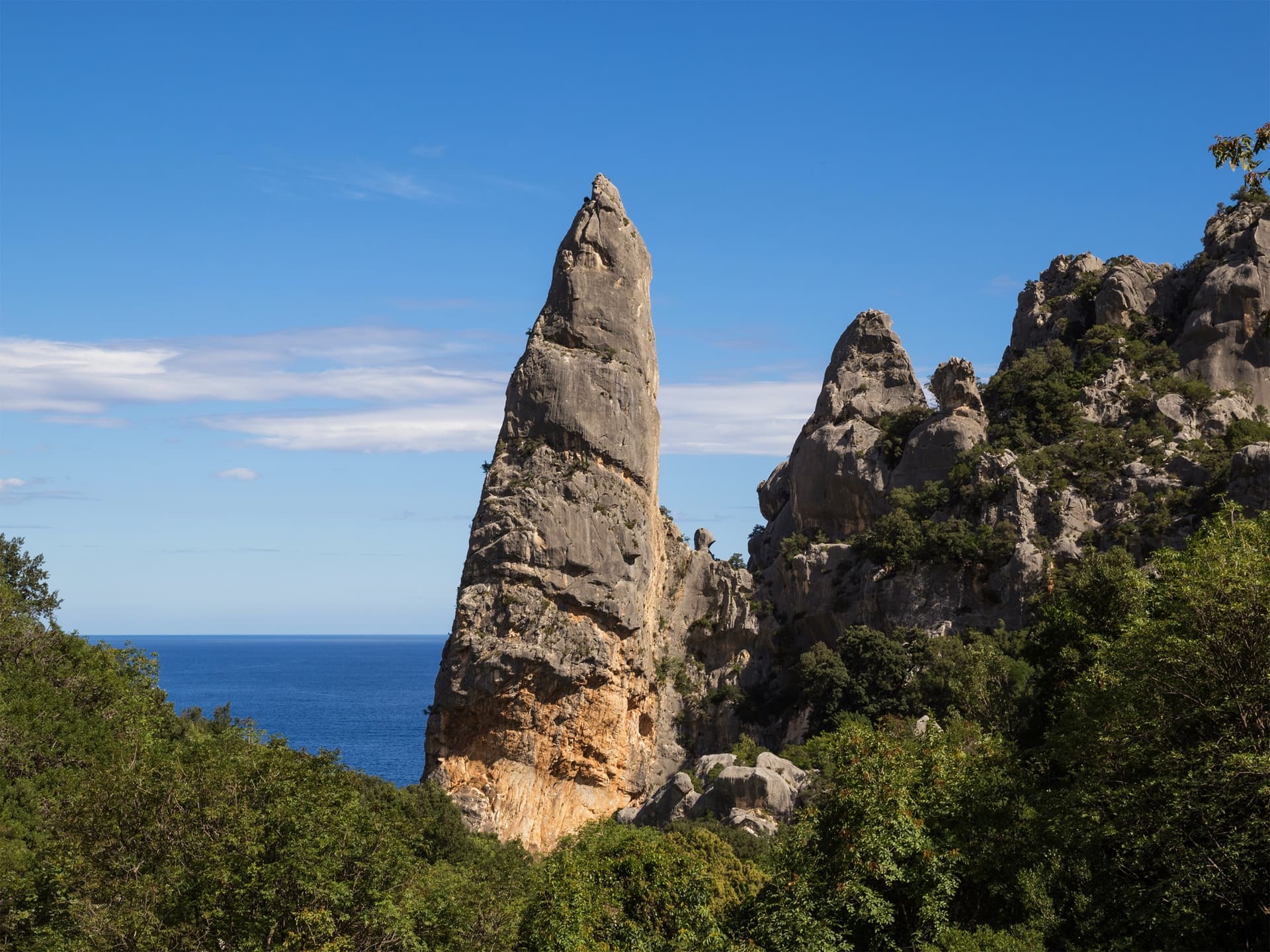
The Aguglia di Goloritzè, the 140 m limestone spire above Cala Goloritzè, seen from the approach path with the Gulf of Orosei behind.

Italy · Sardinia

Sole Incantatore

The harder classic on the Goloritzè spire: compact grey walls and smooth water-drop slabs at 6b to 6b+, then a 6c scoop and an airy finish to a tiny summit above the turquoise bay. Shaded, technical and on the feet.

6c6c4 pitches135 m

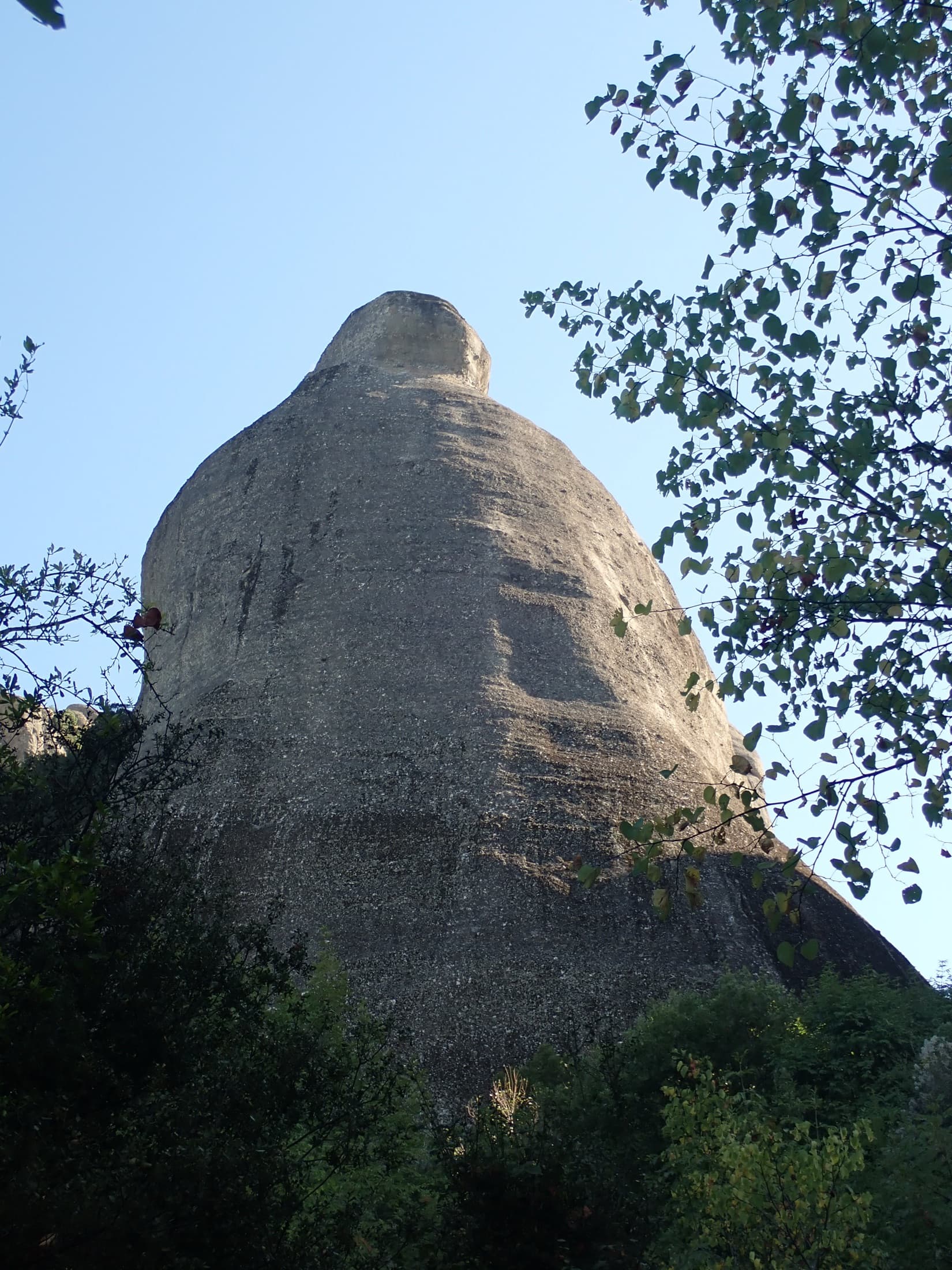
Glocke (The Bell) at Meteora from the foot of the wall; Interamerica climbs the middle of the face

Greece · Meteora

Interamerica

A short, steep and very well-protected line up the middle of The Bell's smooth south-west wall, on typical Meteora cobbles. Three sustained pitches of 6a to 6a+ lead to a short 6c bulge that goes at A0. An unusually reassuring introduction to Meteora conglomerate.

6c6c4 pitches100 m

Read the cautions

No photo yet

Spain · Liébana (Peña Cigal)

Sicigias

Long, sustained 6a pitches of slab, cracks and corners, then a technical 6c wall of small crimps on the third pitch, on the left side of the Peña Cigal wall. Stainless bolts and ringed belays throughout. Above the first pitch it is an autumn-only route because of nesting vultures.

6c6c4 pitches150 m

Read the cautions

No photo yet

Bosnia and Herzegovina · Spijonik (Visočica)

Chasing a Dream

A new four-pitch sport route on the tallest section of a remote limestone wall high on the Visočica range, with corners, cracks, small roofs and bulges. It is sustained in the 6a to 6b+ range, and the last pitch has a 6c crux: an overhanging, wide block that you pass with slaps and a knee bar.

6c6c4 pitches100 m

Read the cautions

Researched and aggregated by AI from published sources, last compiled October 2026. It can be wrong, and bolts, anchors and access change: check a current guidebook and read the disclaimer.