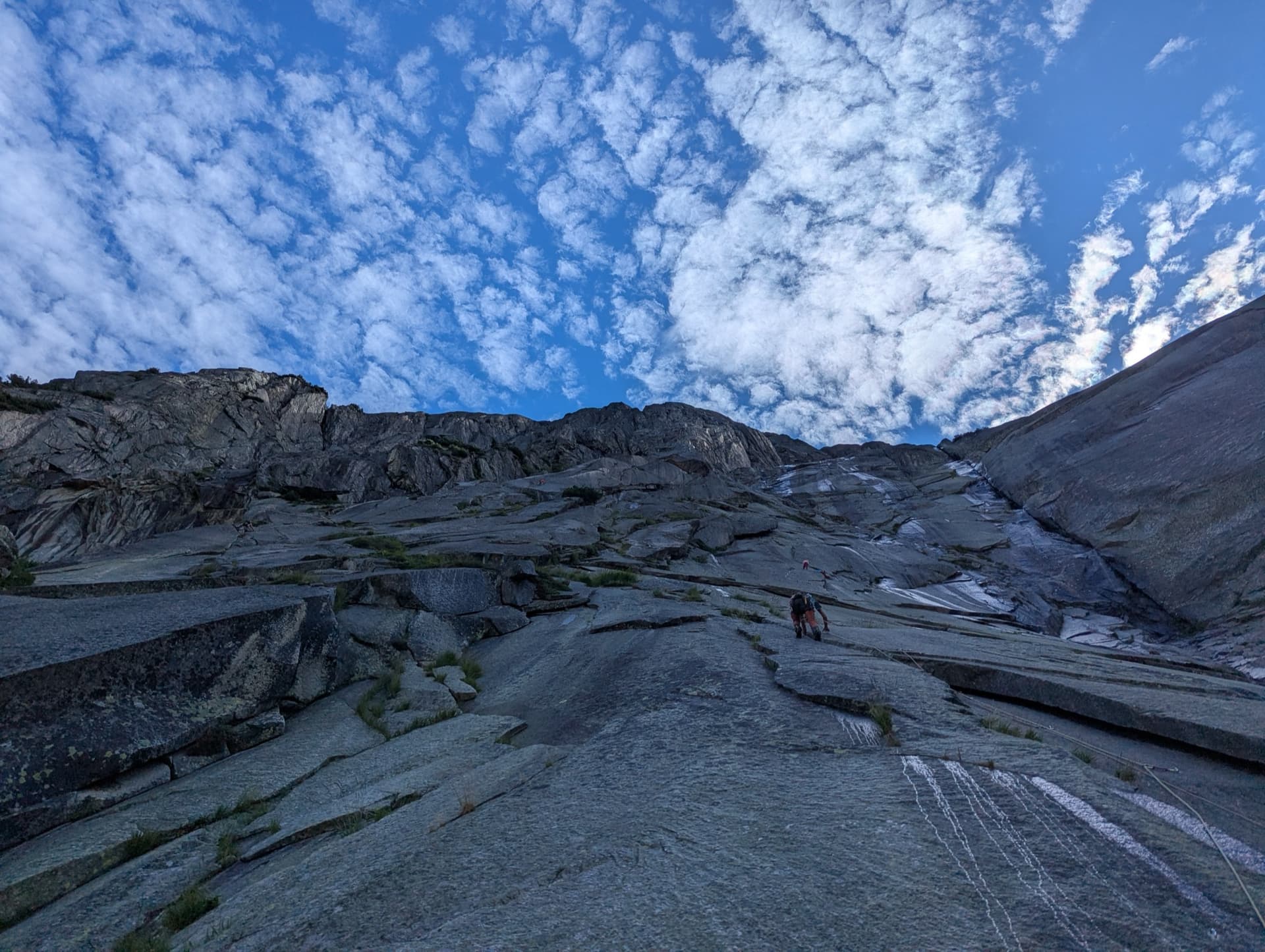
Switzerland · Grimsel
Sagittarius
A Grimsel granite classic: low-angle slabs lead to the famous 6a+ crack pitches and a thin 6b traverse, then steeper, sculpted ground. Sustained at 5c/6a throughout.
6b13 pitches400 m
Gerstenegg – Fliegender Teppich slab (Chüenzentennlen) · Grimsel · Switzerland
Bail with caveatsBolting confidence: medium
The 'flying carpet': nine long pitches of sweeping, immaculate granite slab at the left end of the Gerstenegg, with a superb layback crack on pitch 4 and two short steeper steps. Very popular, quick and never strenuous; the difficulty is all in trusting your feet. The 5b step on pitch 1 goes at 4c with a pull on a bolt.
The route
Fliegender Teppich is the left-most route on the lower Gerstenegg slabs, a few minutes above the Chüenzentennlen car park. It runs for nine pitches of 40 to 50 m up a clean sheet of granite, mostly at 4b to 5a, with one 5b step low down (4c with aid) and another on pitch 6. The middle pitches, the 'carpet' itself, are the ones people remember. It forms the first third of the Grimsel-Marathon link-up and is the usual first route for anyone new to the area. Expect several parties on a fine weekend.
The climbing
| Pitch | Grade | Length | Notes |
|---|---|---|---|
| P1 | 5b | 47 m | Slab, then a short vertical step that is not friction climbing and feels odd, then slab. 4c with one pull on a bolt. |
| P2 | 4b | 45 m | Gentle slab. |
| P3 | 3c | 23 m | Short slab; follow the right-hand bolts. The belay is on a single bolt. |
| P4 | 5a | 48 m | The start of the carpet: slab with a superb layback crack. |
| P5 | 4c | 50 m | More of the carpet. One non-trivial move, then easy padding with long gaps between bolts and some rope drag below the belay. |
| P6 | 5b | 45 m | A short, nearly vertical wall, then slab. |
| P7 | 4b | 38 m | Easy slab. |
| P8 | 5a | 41 m | Slab. |
| P9 | 4b | 48 m | Slab and cracks to the top. Camptocamp labels this stretch 'pitches 9 to 10'. |
Getting there
The Gerstenegg and Räterichsbodensee slabs lie beside the Grimsel pass road, between Guttannen and the pass, reached from Meiringen and Innertkirchen on the Bernese side or over the pass from the Valais. The road is open roughly from May or June to October or November, depending on snow. There are car parks at Chüenzentennlen (1596 m), about 1 km below the Räterichsbodensee dam between the hairpins and the tunnel, and at the dam itself (1767 m). A PostBus runs from June to October and stops at both. Hotel Handeck, a few kilometres down the valley, has rooms and a dormitory; discreet bivouacs are tolerated at best.
From Chüenzentennlen follow the path towards the slabs, joining the path from the Räterichsbodensee, and cross a bridge. About 20 m after the bridge a track goes left through the scrub to the foot of the slab. Fliegender Teppich is the left-most route and starts from a small ledge. 15 minutes; one party took an hour after looking for it on the slab near Foxie.
Loading map
The point marks the crag, not the exact start of the route.
Parking
Chüenzentennlen (camptocamp waypoint 183010)
Point from camptocamp waypoint 180392 (Grimsel, Gerstenegg, the group of slabs; the route is at its lower left end)
Contains the route point and parking. Opens in most mapping apps and GPS watches.
Points are compiled from published sources, with the precision stated above. They were not surveyed on the ground: check them against a current topo.
Coordinates: 46.59531, 8.30986 (crag) · Parking: 46.59839, 8.32478
Getting down
The practical way is on foot: from the top a well-marked track leads to the Azalée Beach sector, from where a good footpath returns to the car park. Allow about an hour car to car after the top. You can also abseil the route with 2×50 m ropes.
Retreat
Bail with caveats
Camptocamp gives abseiling the route as an alternative descent with 2×50 m ropes, so retreat by abseil is feasible. Two caveats: the pitch 3 belay is a single bolt, and the pitches are 40 to 50 m long, so a party on one 50 m rope cannot abseil them.
Partly inferred from the route facts
Safety
Sun and weather
East facing between about 1600 m and 1900 m, in the sun in the morning. It needs dry rock. A 2021 party learned that the pink streaks of the granite are slick and the rest grips. Climbable from June to October while the pass road and bus are running.
Sun on the wall · E-facing
Working out the sunlit hours for this month.
Sun on the wallDaylight, wall in shade● Usual season
Estimated from the wall's aspect only. Ignores surrounding terrain, gullies and the wall's exact shape. Clock times are local to the wall (Central European time), for the 15th of each month.
| Measure | Jan | Feb | Mar | Apr | May | Jun (usual season) | Jul (usual season) | Aug (usual season) | Sep (usual season) | Oct (usual season) | Nov | Dec |
|---|---|---|---|---|---|---|---|---|---|---|---|---|
| Mean daily high °C | −3 | −1 | 2 | 5 | 9 | 14 | 17 | 17 | 13 | 8 | 2 | −2 |
| Mean daily low °C | −8 | −8 | −5 | −2 | 2 | 6 | 8 | 9 | 5 | 1 | −4 | −8 |
| Rain days 1 mm or more | 14 | 12 | 15 | 15 | 18 | 19 | 20 | 18 | 15 | 14 | 15 | 15 |
● marks the usual climbing season. Averages for 1991-2020 at about 1777 m. Area climate from Open-Meteo reanalysis. Temperatures are adjusted to the height of the crag; rain comes from a grid cell of about 10 to 25 km, and summer highs on sea cliffs can read a few degrees low. The wall and valley can differ. Data: Open-Meteo, CC BY 4.0.
What to carry
11 quickdraws plus what you need for belays; a 50 m rope if you walk down or 2×50 m to abseil. Pitches are up to 50 m, so a single rope must be a full 50 m. No cams or nuts needed. Helmet.
Derived from the route data; check it against a current topo
From climbers
Reader reports are not being collected yet. Until they are, check a current topo and the local club or guidebook publisher for recent changes to Fliegender Teppich.
Worth knowing
Open questions
Provenance
Same area
Switzerland · Grimsel
A Grimsel granite classic: low-angle slabs lead to the famous 6a+ crack pitches and a thin 6b traverse, then steeper, sculpted ground. Sustained at 5c/6a throughout.
6b13 pitches400 m
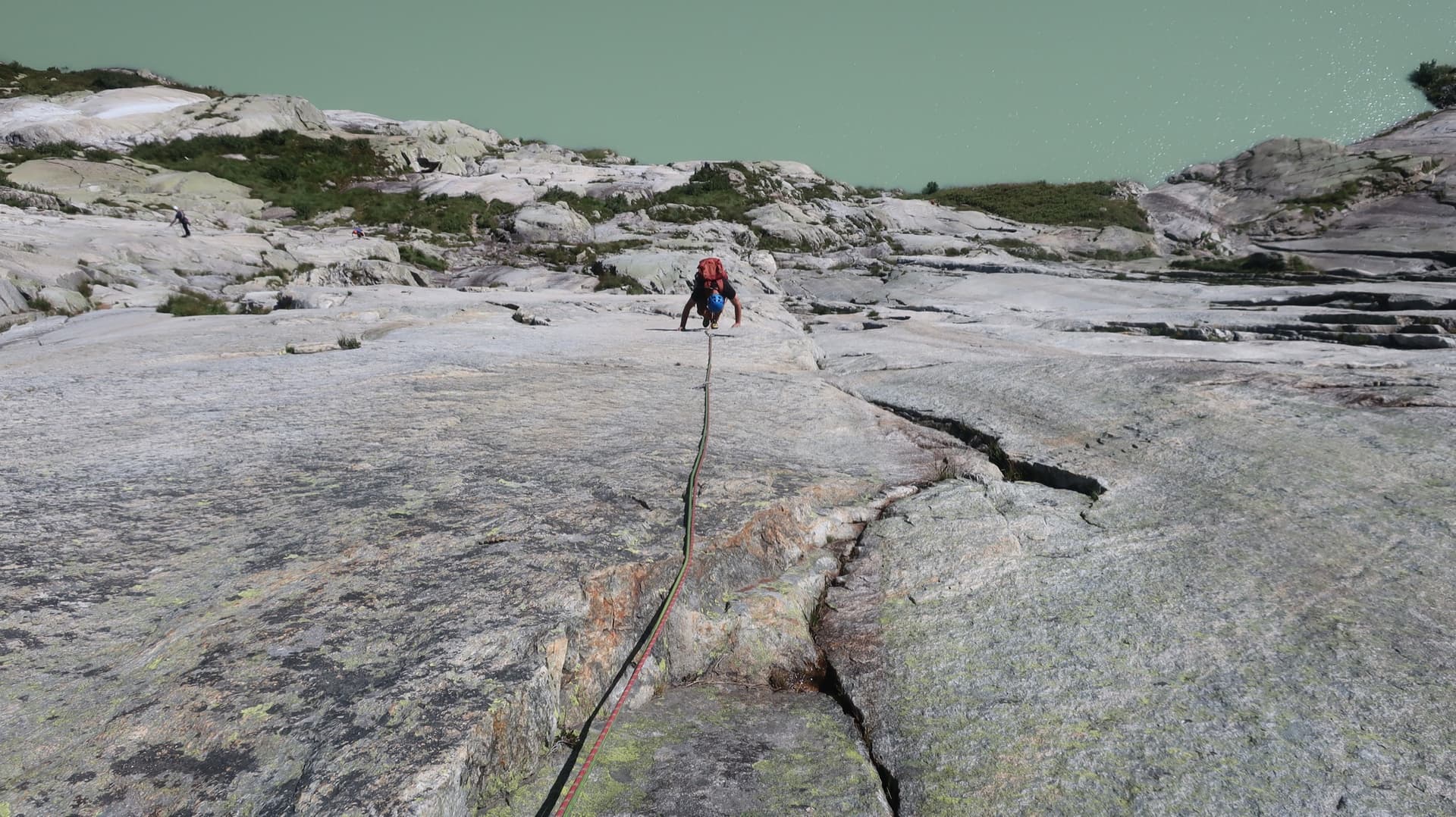
Switzerland · Grimsel
Glacier-polished slabs straight above the Räterichsboden dam. Four warm-up pitches lead to sustained 5b–5c slab and a short fissured roof (6a or A0).
6a11 pitches220 m
Read the cautions
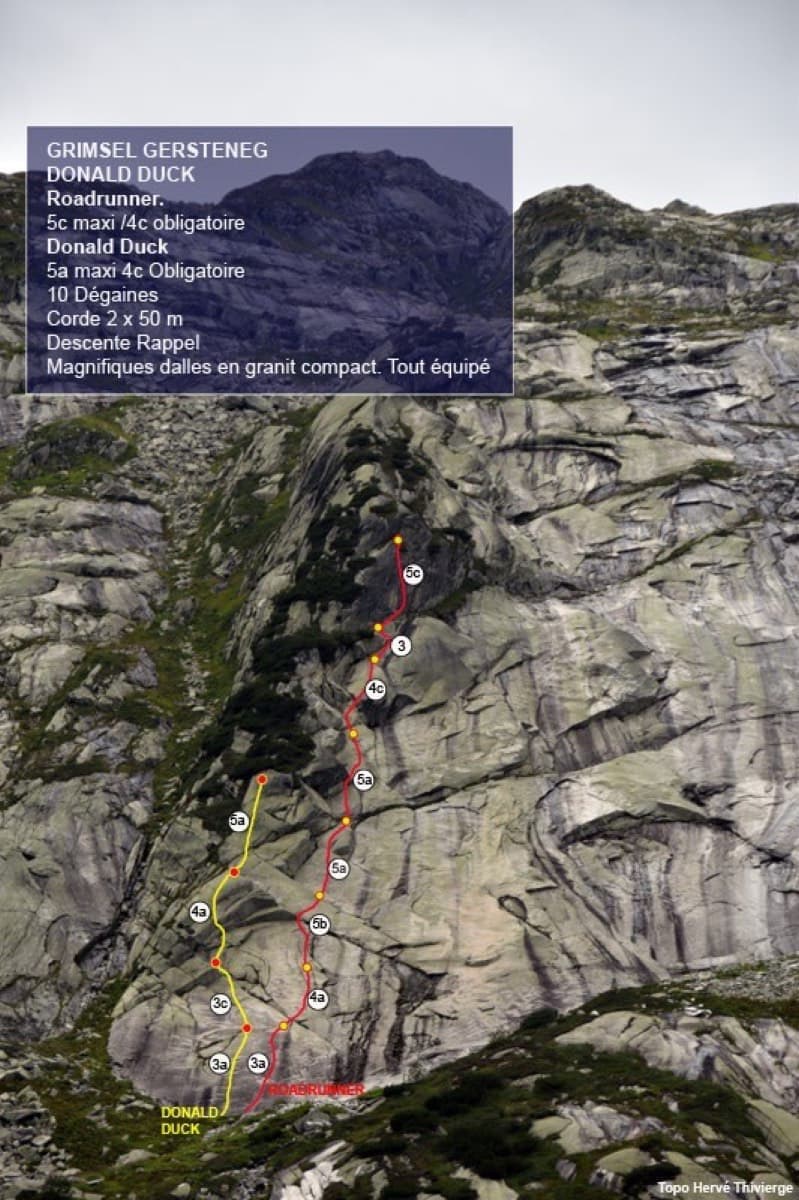
Switzerland · Grimsel
Seven pitches of smooth, low-angle Grimsel granite, almost all pure friction, with two short steeper steps. Technically easy, but you have to trust your feet. A gentle introduction to Grimsel slab and to multipitch rope work.
4c7 pitches200 m
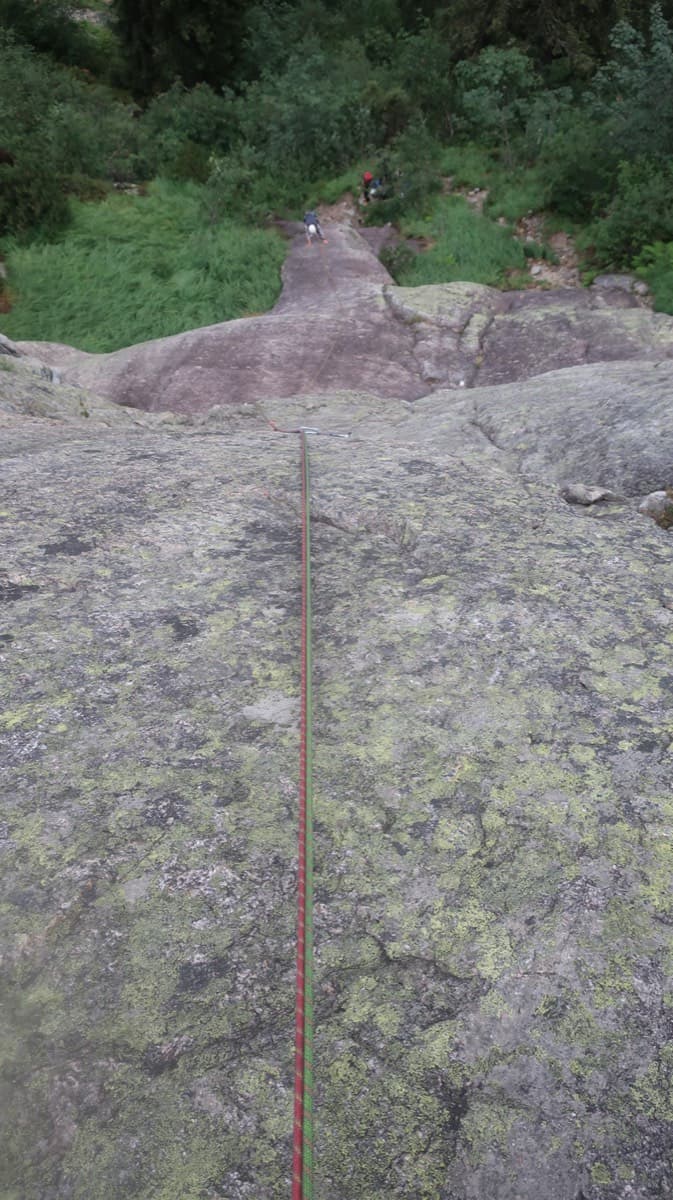
Switzerland · Grimsel
A short, varied granite route up a pale, smooth pillar across the valley from the Handegg slabs: a corner crack, then friction and edge slabs that get harder pitch by pitch. Grades are stiff, and the last pitch is sustained and tricky. A good half day or uncertain-weather route with a 15-minute approach.
6a5 pitches200 m
Around 5b · about 9 pitches
Switzerland · Orny (Champex, Mont Blanc massif)
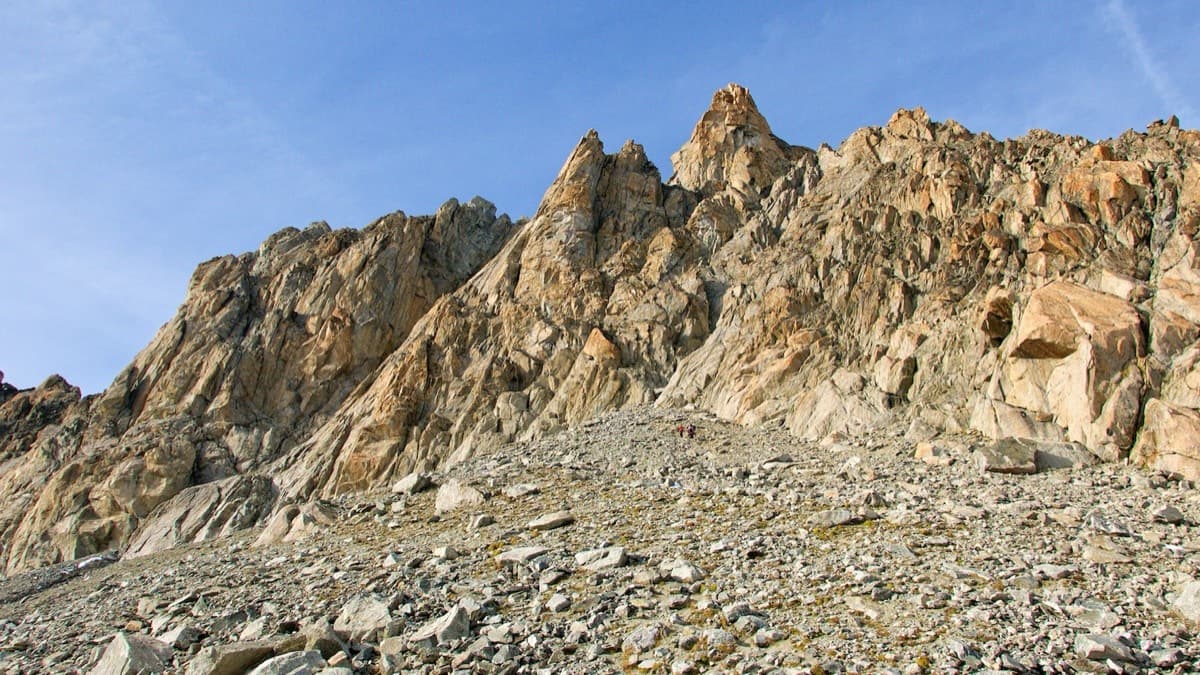
Nine pitches up a granite spur and the final tower of the Aiguille d'Orny to a 3150 m summit, on rough, cracked rock with superb friction. Two moves of 5b, the rest 4b and 4c, closely bolted since 2016 and easy enough to climb in boots. The three steep pitches on the summit tower are the highlight.
5b9 pitches250 m
France · Dentelles de Montmirail
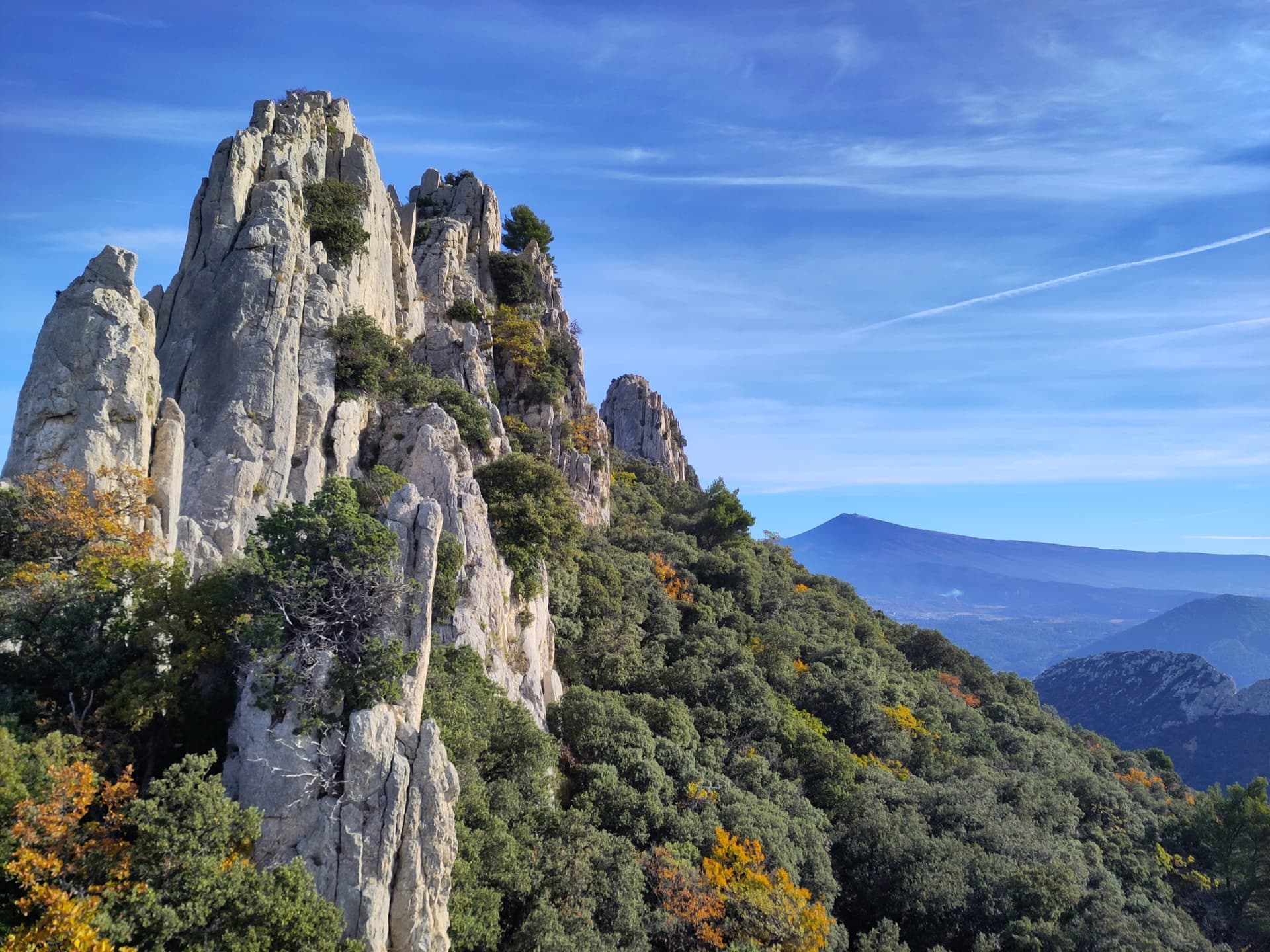
A west-to-east traverse of the six towers of the Florets crest, alternating short pitches with five short abseils and ending on a knife-edge. First climbed in 1928, it is the classic introduction to ridge climbing in Provence. The moves of 5 are short but polished and cannot be avoided, and all the rope work makes it slower than its length suggests.
5b9 pitches120 m
Italy · Lecco & Valsassina
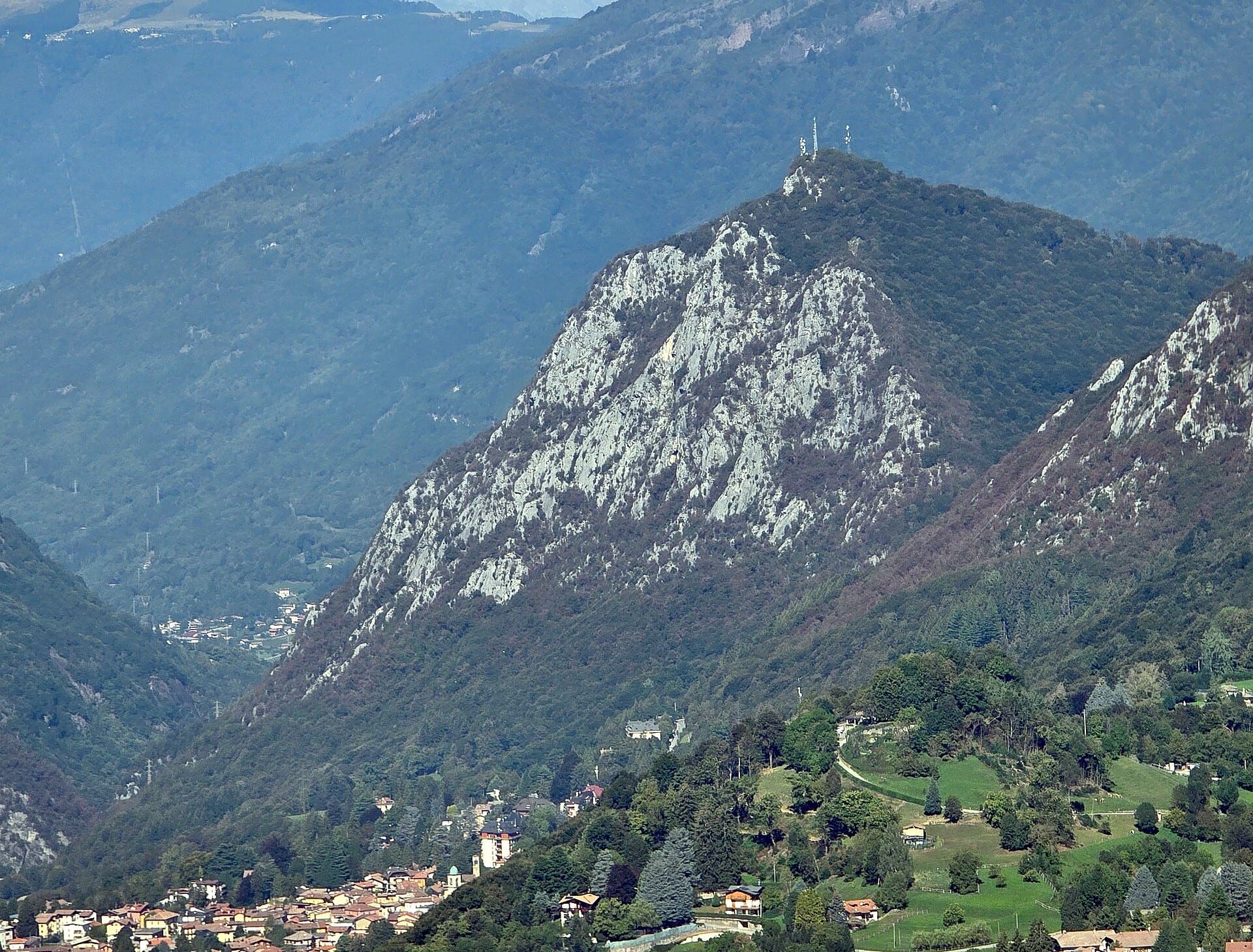
The first route opened on the Zucco dell'Angelone, following the natural line of the fourth spur by corners, cracks, a chimney and friction slabs. Eight varied pitches at 5a to 5b with an easy crest to finish. Never hard but never trivial either.
5b8 pitches220 m
Switzerland · Wiwanni (Baltschiedertal)
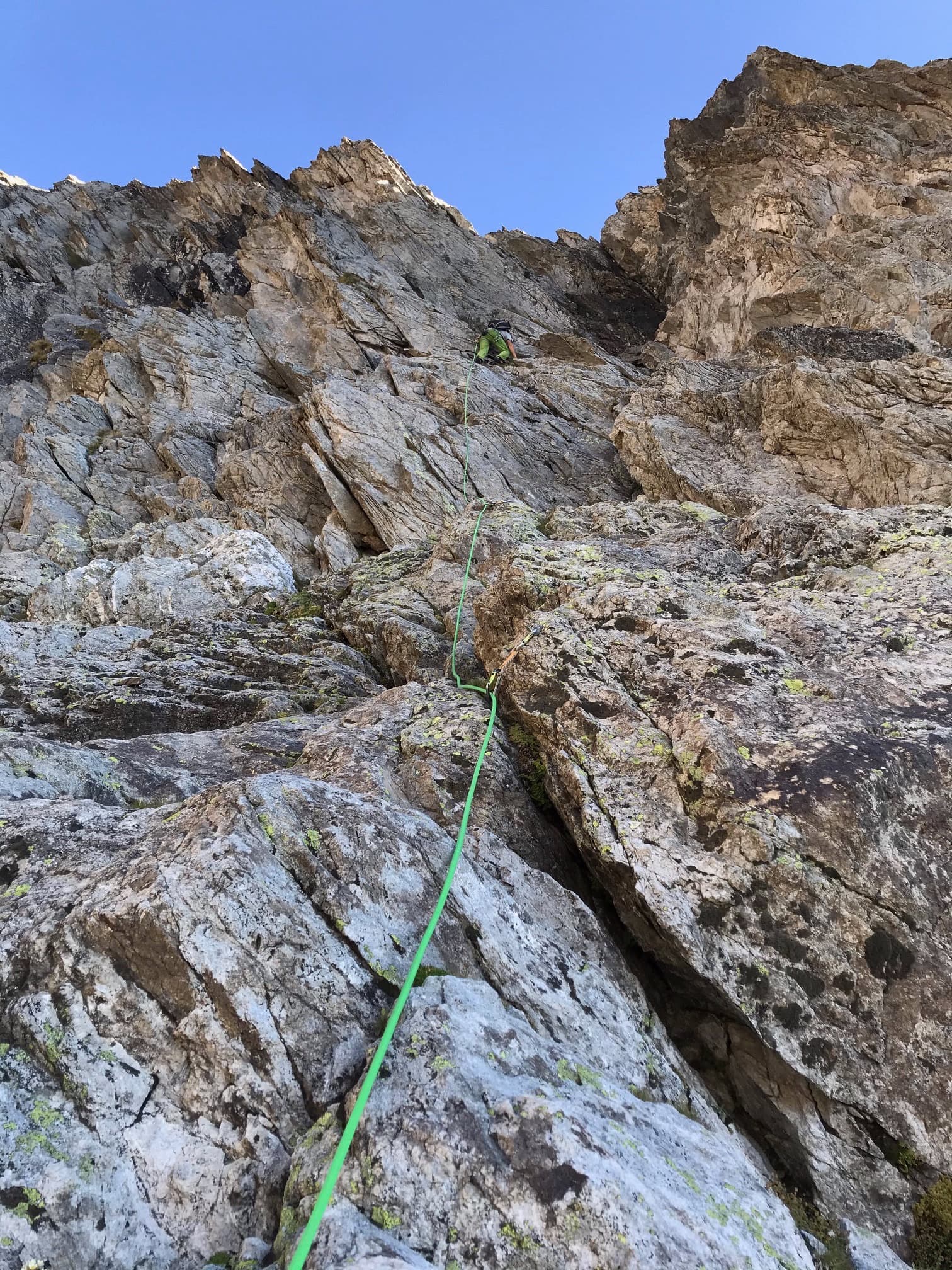
A popular eight-pitch line straight up the south-west face to within minutes of the 3001 m summit. Most of it is grade 4 on good gneiss, with two short 5b steps that are closely bolted; the upper one can be avoided on the left. It stays in the shade well into the morning and feels a little more like a mountain route near the top.
5b8 pitches250 m
Compiled from published sources and last verified October 2026. Bolts, anchors and access change. Climbing is dangerous and you are responsible for your own decisions: check a current topo and read the disclaimer.