Multipitch Atlas

Greatime

Les Montons – Pointe Maurice Brandt · Sanetsch · Switzerland

Read the cautionsBail with caveatsBolting confidence: medium

An adventurous line that weaves between the roofs of the Pointe Maurice Brandt, at the far left end of the Montons. It improves with height: the lower pitches have some friable rock, the last two are on exceptional grey, sculpted limestone. Lots of traversing and a memorable free-hanging final abseil.

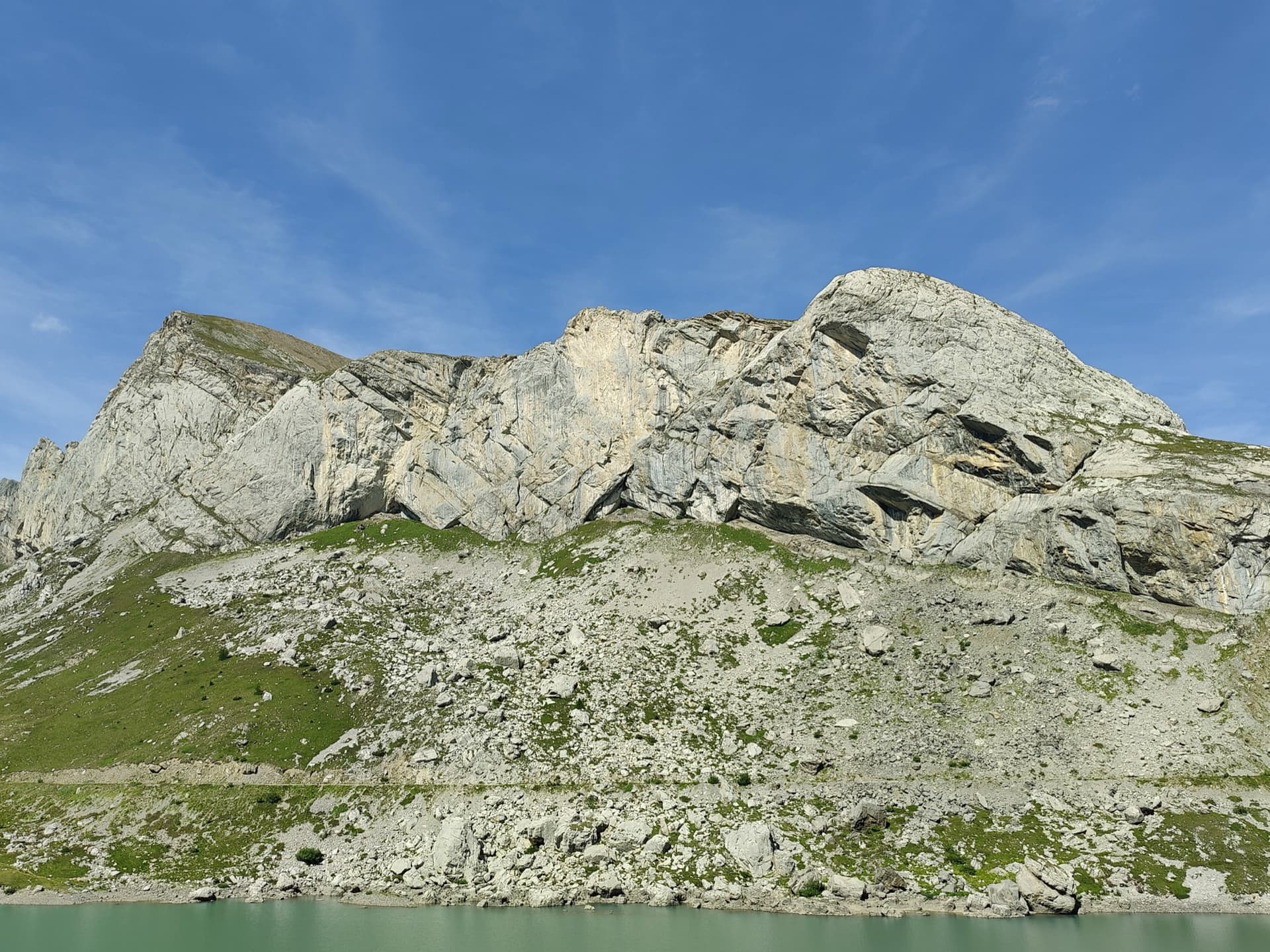
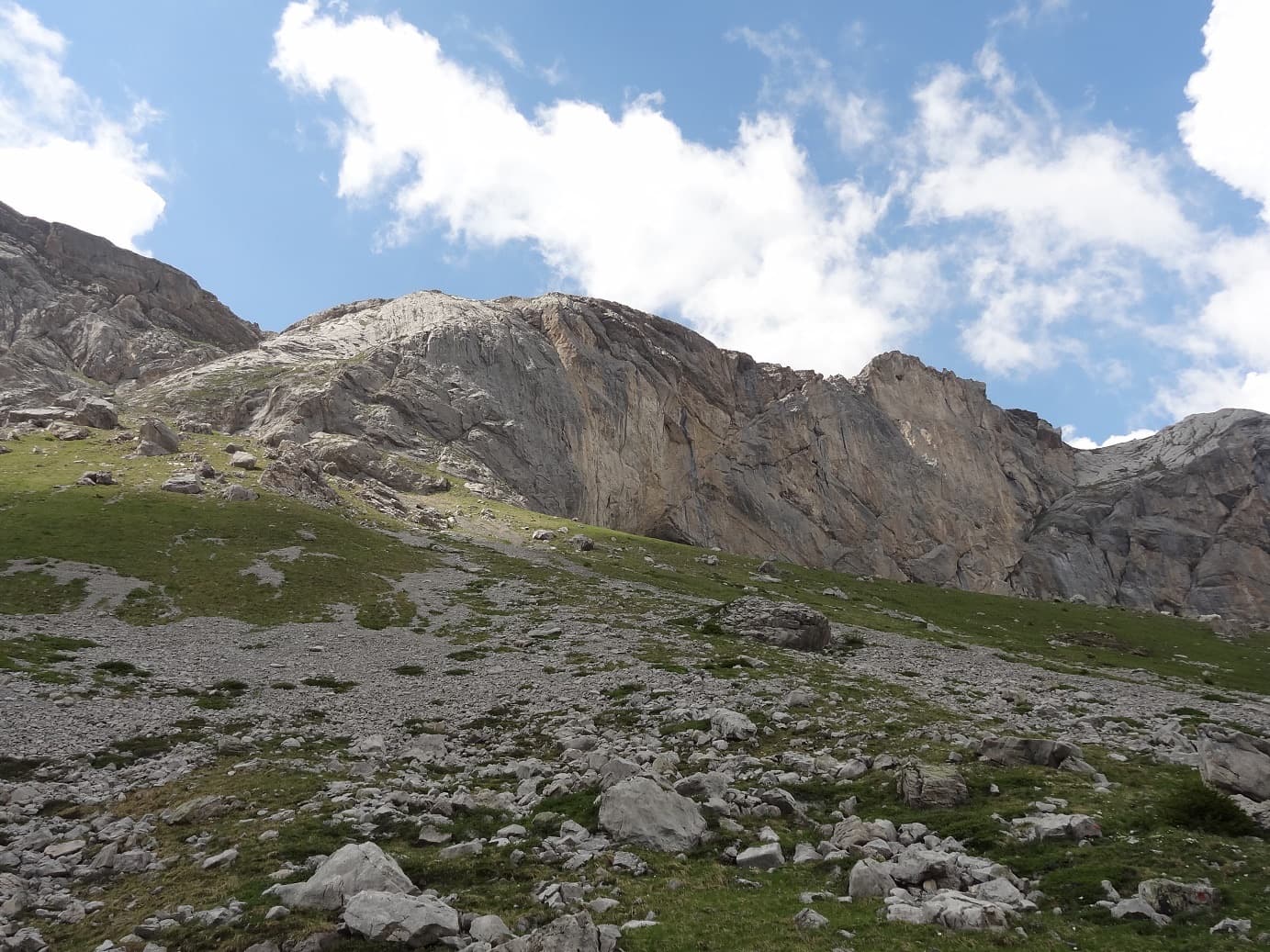
The Pointe Maurice Brandt at the left end of the Montons; Greatime threads its way between the roofs. The line is not markedPhoto: alexduchablais · CC BY-SA 3.0

Photo

The Pointe Maurice Brandt at the left end of the Montons; Greatime threads its way between the roofs. The line is not markedPhoto: alexduchablais · CC BY-SA 3.0
Hardest pitch
6a+
Pitches
7
Length
180 m
Approach
40 min
Aspect
S
South-facing
Rope
2×50 m
Read before you go

Refurbished in 2023 and climbable on quickdraws, but with spaced bolts, some loose rock low down and a committing free-hanging abseil descent.

The route

Overview

Greatime is the last route at the western end of the Montons, well beyond the other sectors, on the roofed wall of the Pointe Maurice Brandt. The Remy brothers opened it in 1982 and it was last refurbished in 2023. Seven pitches lead through the roofs by slabs and traverses, with two pitches of 6a+ and an obligatory grade of 5c. Camptocamp rates the exposure E3, the atmosphere is serious for the grade and a 2024 party stresses that it is not a route for a first multipitch. The descent is by abseil.

The climbing

Pitch by pitch

Pitches of Greatime
PitchGradeNotes
P15cA vertical wall with a small overhang three metres up, then a slab rising rightwards. The start is often wet but goes anyway. A hold under the overhang was loosening in 2023.
P25cA slab straight above the belay, with the first bolt a long way up, then a friable section, then a fine rising traverse right across a slab. The Remy topo gives 5b. The belay is awkward and sits below ground prone to stonefall.
P36a+Straight up a slab to a vertical, fractured passage with hollow-sounding holds, then a more physical short crack and a compact slab. The belayer is directly below, so take care with the exit holds.
P45aA traverse right, then round the corner and up a slab with a large hollow flake. The belay is beside a red arrow that points to the abseil line.
P55cFollow the first four bolts, shared with Génie du bal, up a vertical wall on good holds, then make sure you traverse right after the step. Straight on is Génie du bal (6c, then 6b).
P65cA succession of walls on more compact limestone with runnels, to a comfortable ledge.
P76a+A technical start above the belay, then straight up exceptional grey rock. A 2026 party could not find the final belay and used the abseil station 4 m to the left.

Getting there

Approach

To the parking

From Sion drive up through Savièse to the Col du Sanetsch (2252 m) and on down towards the Lac de Sénin, about 26 km from Sion; the road is long and narrow and opens in June. A bus runs from Sion in season. From the Bernese side a cable car climbs from Gsteig to the lake. Wild camping near the lake is common, and there is an inn by the dam.

On foot · about 40 min

From the parking by the Lac de Sénin, about 30 m after the Chalet de la Lé, take a rising cairned track that zigzags through the boulders towards the Montons. Shortly before the wall bear left and follow its foot for a good ten minutes or more, past the Follomi sector. Greatime is the last route. The name, in red paint, was almost invisible in June 2023 and legible later that year. 40 minutes.

Map of the walk-in

  • Crag

Loading map

The point marks the crag, not the exact start of the route.

Coordinates · crag

46.35343, 7.27946

Point from camptocamp waypoint 43146 (Sanetsch – Les Montons)

For your phone or watch

Download GPX

Contains the route point. Opens in most mapping apps and GPS watches.

Points are compiled from published sources, with the precision stated above. They were not surveyed on the ground: check them against a current topo.

Getting down

Descent

By abseil, starting a few metres to one side of the exit and following red dots. Camptocamp describes five abseils: the third is diagonal, and the fifth leaves a hanging stance on the lip of a large roof for a 45 m free-hanging drop to the ground. Do not skip stations, especially on the diagonal abseil, where you could not climb back up if the rope jammed. An October 2024 party retreated from belay 4 in three abseils and found the hanging station sound, on two pegs and an added bolt.

Retreat

Bailing off the route

Bail with caveats

A party retreated from belay 4 in October 2024 in three abseils, joining the normal abseil line, which passes there. Any retreat ends with the 45 m free-hanging abseil from the suspended stance. Above belay 4 the route traverses and the descent is from the top.

Retreat from
Belay 4, where a red arrow points to the abseil line.
Point of no return
After belay 4 the simplest option is to finish the last three pitches and use the full abseil line.
Carry
Two 50 m ropes are essential. The diagonal abseils need care to reach the next station, and the rope cannot be re-climbed if it jams.
Basis
Stated in the sourcesAn October 2024 camptocamp trip report describes the retreat from belay 4; the abseil line is described on the route page.

Safety

Hazards

  • Stonefall at the foot of the wall; wear a helmet from the moment you reach the cliff.
  • Friable rock on pitches 2 and 3, with the belayer in the line of fire.
  • Bolts are spaced by sport standards (2023 report), and the first bolt of pitch 2 is high.
  • The abseil line is committing: a diagonal abseil and a 45 m free-hanging one from a suspended stance. Knot the rope ends and do not skip stations.
  • Easy to continue by mistake into Génie du bal (6c) on pitch 5.

Sun and weather

Conditions

South to south-east facing limestone between about 2050 m and 2500 m, in the sun from early morning. The season runs from the opening of the pass road in June to October. Seeps under the roofs stay wet for days after heavy rain, and snow can lie in the boulder field in early June. The base of pitch 1 stays wet after storms. Stones fall regularly along the foot of the wall.

Usual season · Jun to Oct

Sun on the wall · S-facing

Working out the sunlit hours for this month.

  • January: not yet worked out
  • February: not yet worked out
  • March: not yet worked out
  • April: not yet worked out
  • May: not yet worked out
  • June (usual season): not yet worked out
  • July (usual season): not yet worked out
  • August (usual season): not yet worked out
  • September (usual season): not yet worked out
  • October (usual season): not yet worked out
  • November: not yet worked out
  • December: not yet worked out

Sun on the wallDaylight, wall in shade● Usual season

Estimated from the wall's aspect only. Ignores surrounding terrain, gullies and the wall's exact shape. Clock times are local to the wall (Central European time), for the 15th of each month.

Monthly climate averages for Sanetsch, 1991-2020
MeasureJanFebMarAprMayJun (usual season)Jul (usual season)Aug (usual season)Sep (usual season)Oct (usual season)NovDec
Mean daily high °C−8−6−3049111184−3−8
Mean daily low °C−17−16−12−9−5−122−2−6−12−16
Rain days 1 mm or more131214141919191715131313

● marks the usual climbing season. Averages for 1991-2020 at about 2482 m. Area climate from Open-Meteo reanalysis. Temperatures are adjusted to the height of the crag; rain comes from a grid cell of about 10 to 25 km, and summer highs on sea cliffs can read a few degrees low. The wall and valley can differ. Data: Open-Meteo, CC BY 4.0.

What to carry

Gear

10 to 12 quickdraws, two 50 m ropes and a helmet. Nuts and cams are of no use.

Checklist

Quickdraws
12
Rope
2×50 m
Helmet
One each
Abseil device and prusik
The descent or the retreat involves abseiling

Derived from the route data; check it against a current topo

From climbers

Reader reports

Reader reports are not being collected yet. Until they are, check a current topo and the local club or guidebook publisher for recent changes to Greatime.

Worth knowing

Tips

  • Belay 4 is the bail-out point if the weather turns.
  • Save it for a settled day once you know the rock at Sanetsch; Hara qui pleure or Silence bavard are friendlier introductions.

Open questions

Where sources disagree

  • Pitch 2: 5c on camptocamp, 5b on the Remy topo as quoted by a 2024 party; the same party quotes pitch 4 as grade 4 against camptocamp's 5a.
  • Bolting: 'well equipped' (2026) against 'you cannot say the bolts are close together' (June 2023); the 2023 refurbishment may fall between the two reports.
  • Pitch lengths are not published; 180 m is camptocamp's height of the difficulties.
  • Only one detailed source (camptocamp and its trip reports) was found for this route.

Provenance

Sources

Same area

More in Sanetsch

All routes in Sanetsch
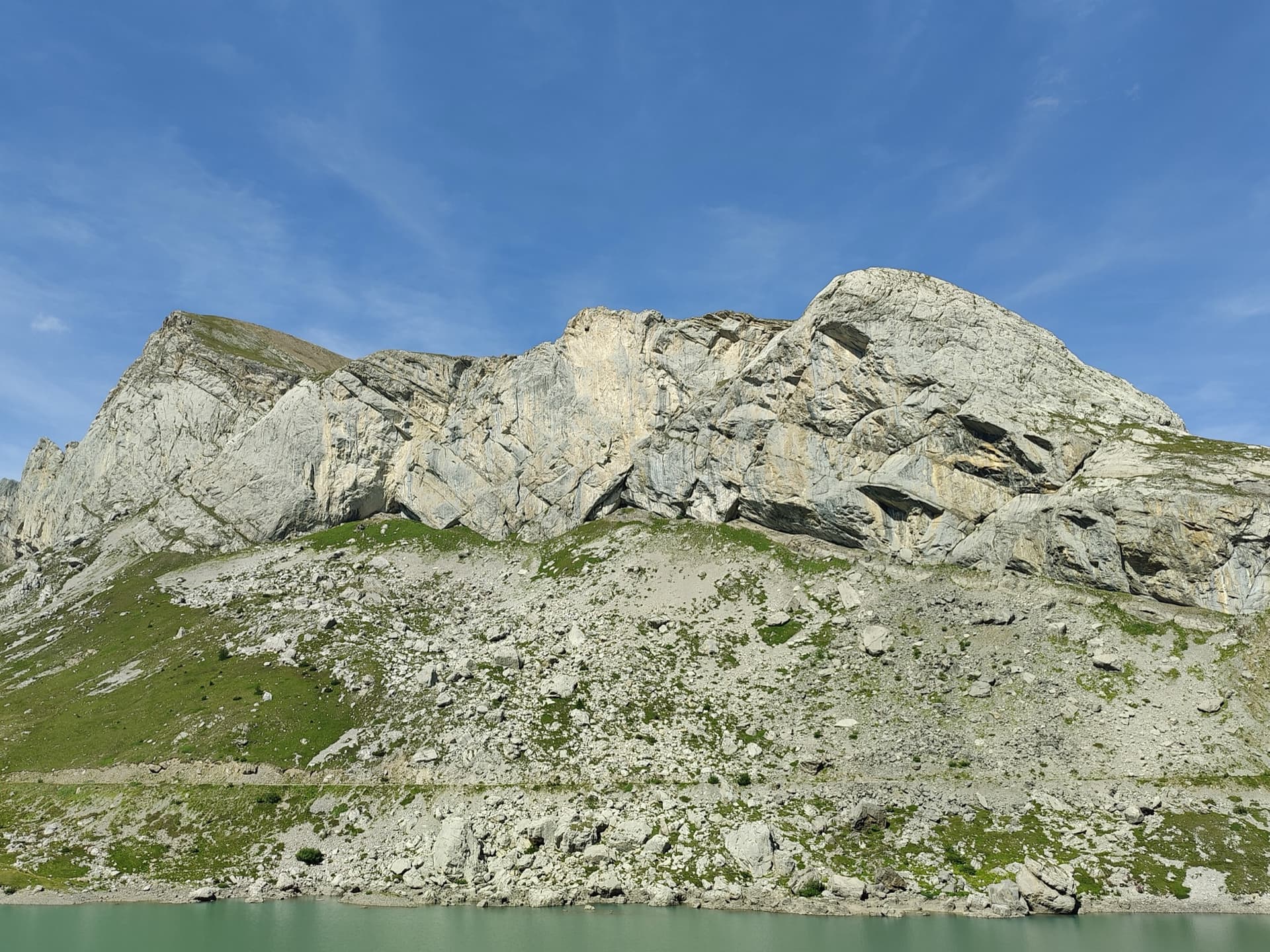
The limestone wall of Les Montons above the Lac de Sénin at the Sanetsch.

Switzerland · Sanetsch

Follomi

The classic introduction to the Sanetsch at 6c: eight varied pitches up a pillar of superb rough limestone, with the hard climbing packed into a few well-bolted metres on each pitch. A steep corner mantel, a balancy wall, a fine slab and an airy exit from a niche. Tops out on grassy slopes with a walk-off.

6c8 pitches250 m
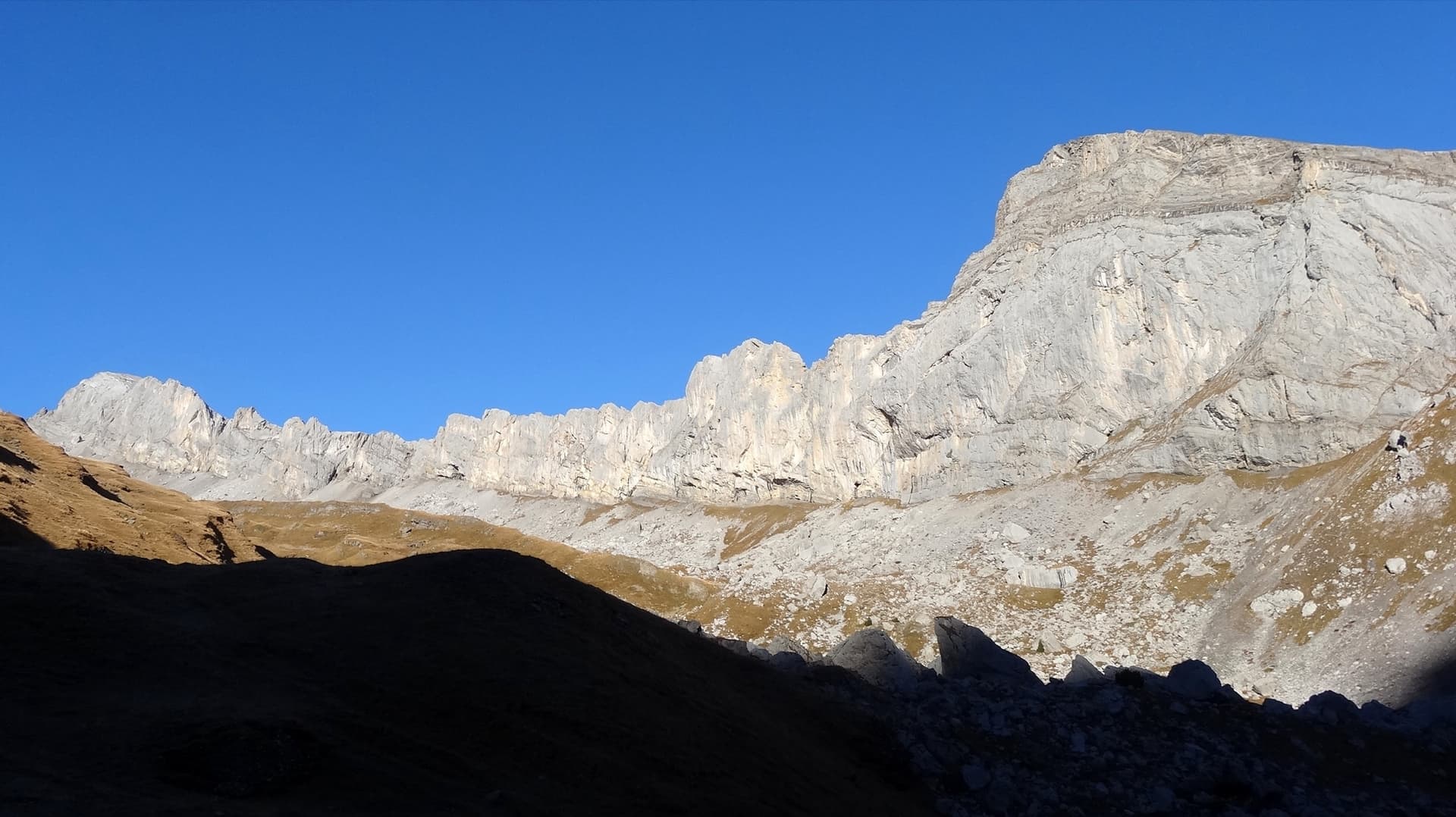
The Montons wall at Sanetsch from the south, from the Pointe Maurice Brandt on the left to the main Montons face; the line is not marked

Switzerland · Sanetsch

Hara qui pleure

A varied, approachable route on the sculpted grey limestone of the Montons: a flake and corner first pitch that wakes you up, runnels and a carved wall in the middle, and a short athletic overhang near the top. Well bolted since 2015 and quick, with a walk-off.

6a+5 pitches180 m

The Petit Monton dome above the Lac de Sénin; Silence bavard climbs the lower tier and then the compact upper wall. The line is not marked

Switzerland · Sanetsch

Silence bavard

Two tiers ten minutes from the road: a lower plinth of easier, less memorable pitches, then a splendid compact dome where the route climbs 6a, 6b and a 50 m 5c. Nine routes share the upper wall, so you can pick a different finish. Well bolted since 2016.

6b7 pitches250 m

The sector of Les Montons climbed by Pas Perdus and its neighbours, seen from the approach; the line is not marked

Switzerland · Sanetsch

Pas Perdus

A Remy classic from 1985 on very compact, abrasive limestone: a fine straight-up 6a wall, a superb 5c+ pitch and a 6a pitch up a big water groove, followed by two easy pitches of runnels. Every pitch is different. Technical for the grade.

6a6 pitches160 m

Read the cautions

Around 6a+ · about 7 pitches

Similar elsewhere

Pedra Longa, the 128 m limestone tower on the Baunei coast, seen from the shoreline rocks at its foot.

Italy · Sardinia

Marinaio di Foresta

An airy, mostly left-rising traverse that spirals round the Pedra Longa sea stack to its summit, on water-runnelled grey walls and pocketed white rock right above the sea. It has become one of the most popular routes in Sardinia, so expect queues.

6a+7 pitches190 m

Committing

The water-worn runnels of the second pitch of Die Namenlose

Switzerland · Glarus (Brüggler)

Die Namenlose

The hardest of the Brüggler plaisir routes: an overhanging start on big holds, then smooth runnelled slabs, with a very blank 6a+ slab on pitch 3 that feels hard for the grade. The hardest moves there can be avoided by weaving left or right while still clipping the bolts. The top three pitches are easier.

6a+7 pitches200 m

Committing

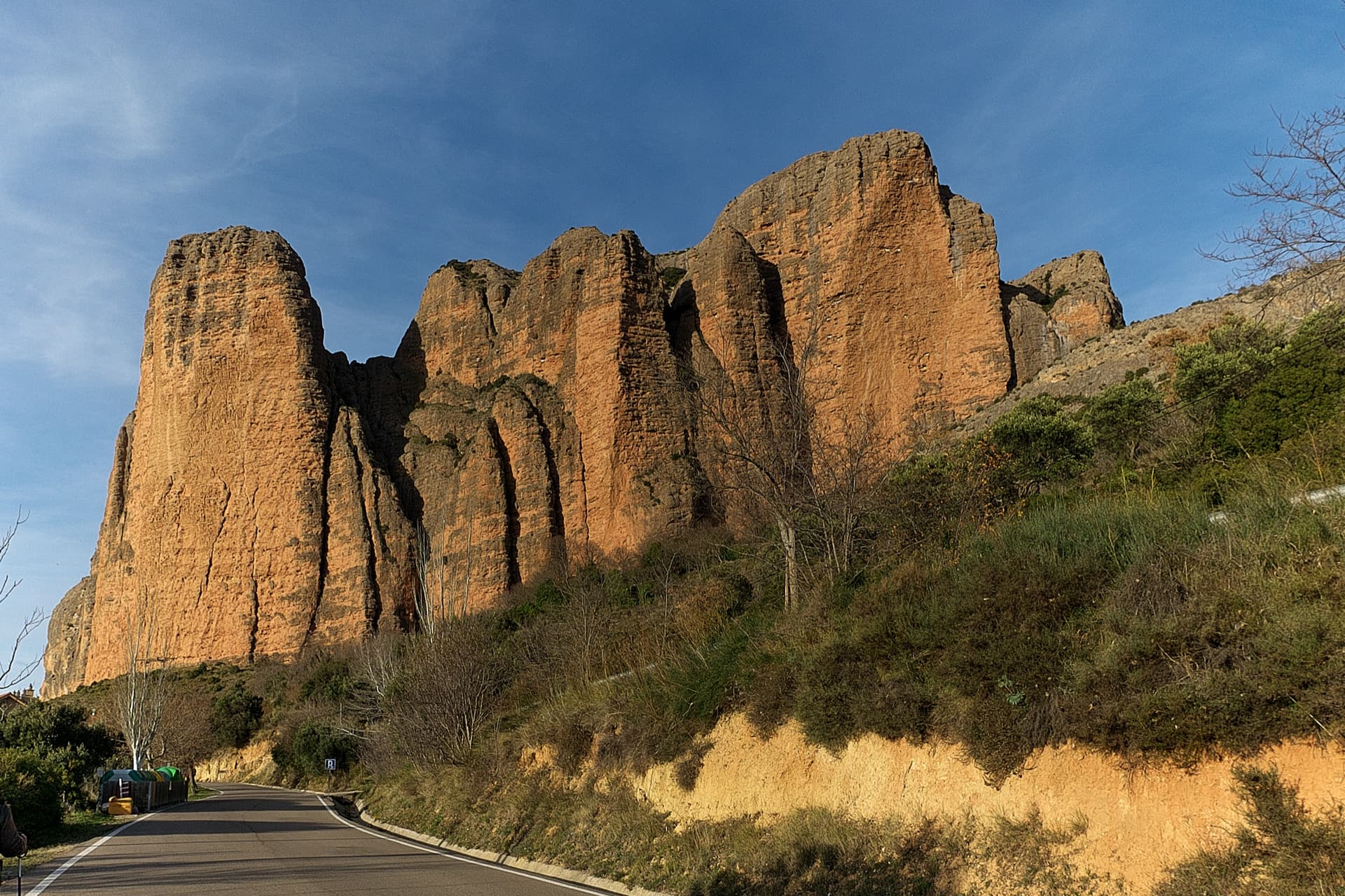
The south faces of the main Riglos wall in low sun, seen from the road into the village: Mallo Pisón on the left and the wall running right towards Mallo Frechín and La Visera at the right-hand end.

Spain · Riglos & Agüero (Mallos)

José Antonio Sanz

A good first route at Riglos: seven sustained 6a pitches on the spur of the Frechín, with a grandstand view of the Visera. Manage rope drag on the wandering first pitch.

6a+7 pitches180 m

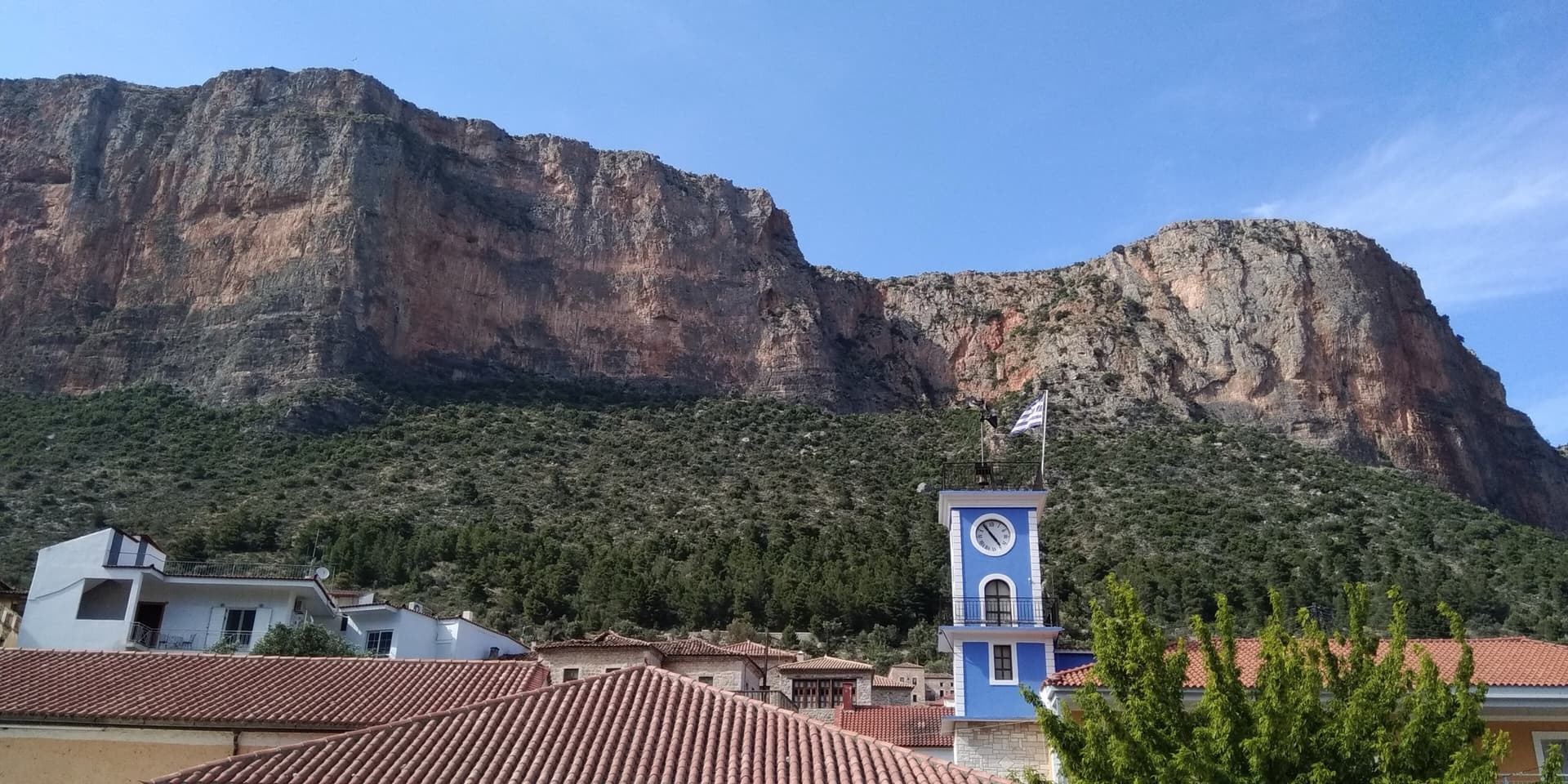
The red limestone wall of Kokkinovrachos rising directly above the rooftops and clock tower of Leonidio. Kapi Reborn is on the south-east face of this cliff; the exact line is not marked.

Greece · Leonidio & Kyparissi

Kapi Reborn

A newer pillar line with a pretty 45 m slab to start, a single interesting 6a+ crux on P4, and a final orange corner. It makes a good step up from Mignonette.

6a+7 pitches180 m

Compiled from published sources and last verified October 2026. Bolts, anchors and access change. Climbing is dangerous and you are responsible for your own decisions: check a current topo and read the disclaimer.