Multipitch Atlas

Kaiser Max Spätlese

Martinswand – Vorbau (Zirl) · Karwendel (Innsbruck Nordkette) · Austria

Bail with caveatsBolting confidence: medium

Easy slab climbing straight up the plate zone below the 'Ostrisswald' on the Martinswand plinth, broken by a few ledges. Mostly UIAA 4 to 5, with an overhang on pitch 2 and the 6a crux on the long last pitch.

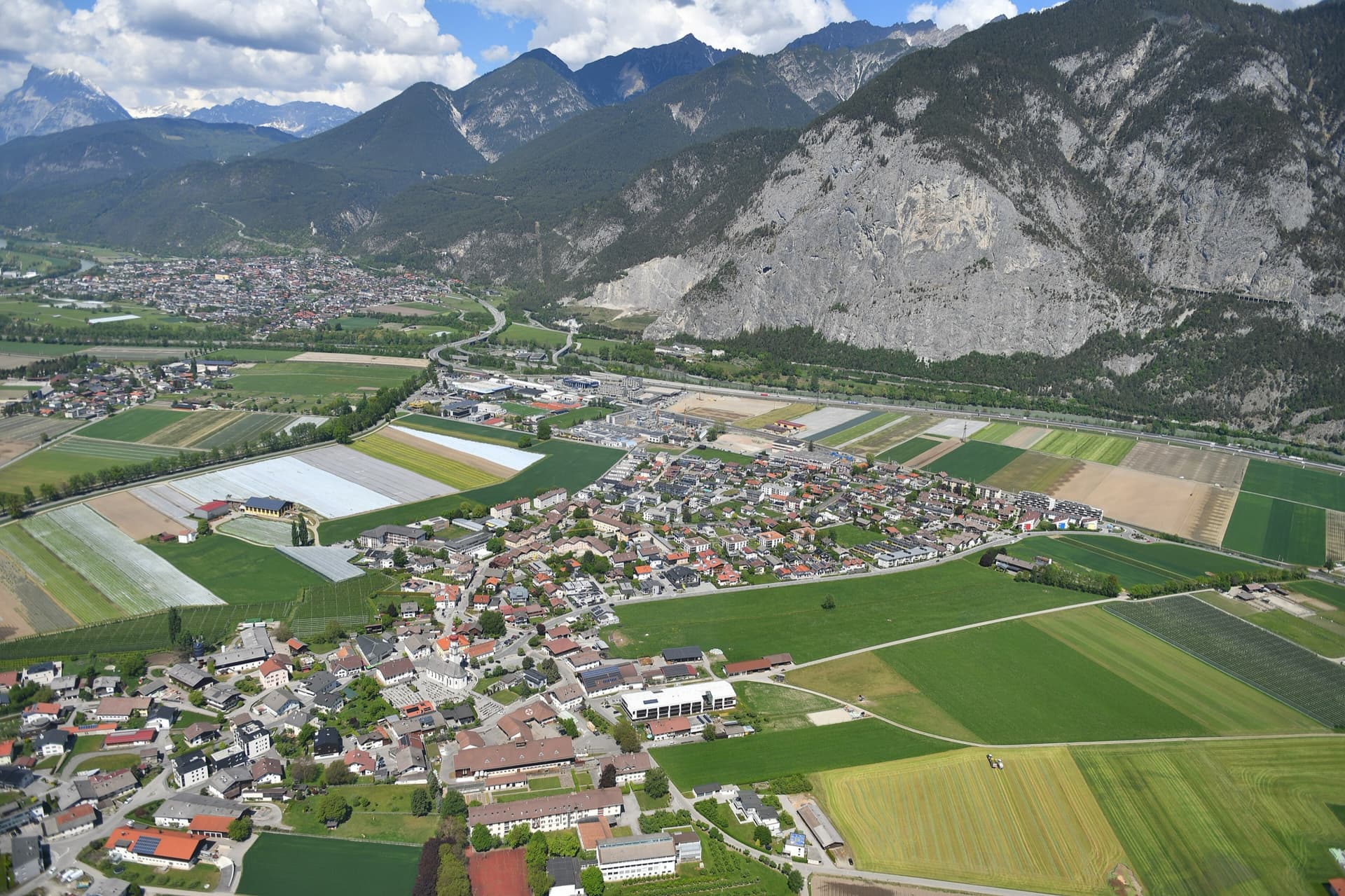
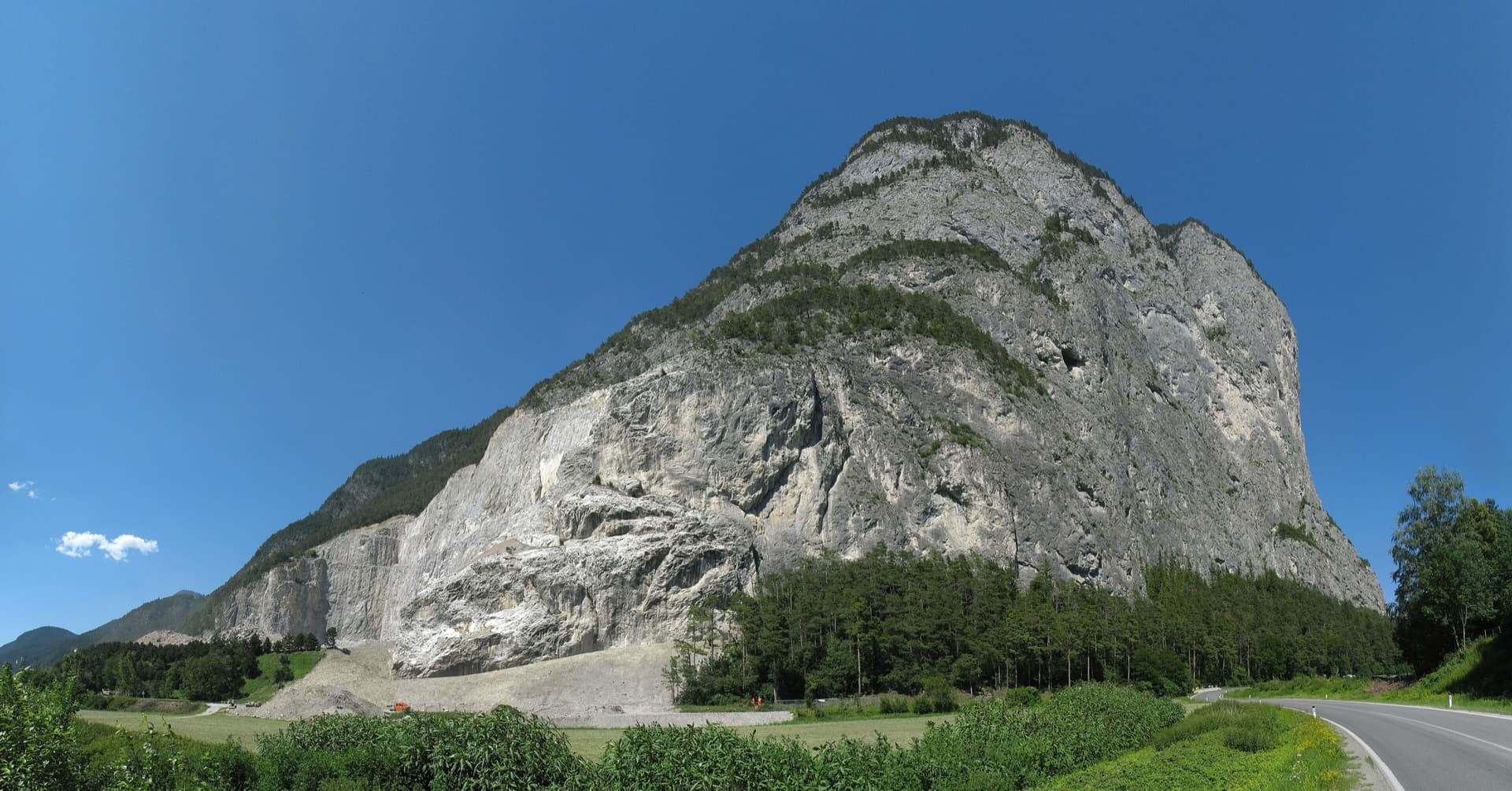
The Martinswand above the Inn valley near Zirl, seen from the south-west. The Vorbau routes climb the slabby plinth at the right-hand (eastern) end of the wall; the line is not marked.Photo: KlausFoehl · CC BY-SA 3.0

Photo

The Martinswand above the Inn valley near Zirl, seen from the south-west. The Vorbau routes climb the slabby plinth at the right-hand (eastern) end of the wall; the line is not marked.Photo: KlausFoehl · CC BY-SA 3.0
Hardest pitch
6a
Pitches
6
Length
200 m
Approach
20 min
Aspect
S
South-facing
Rope
1×50 m

The route

Overview

A popular plinth route that mixes pleasant limestone slabs with a few ledgy, broken sections. Most of it is easy, but the second pitch has an overhang and the final 40 m pitch carries the 6a crux, so it is a step up from Rucola next door. It can be extended by Maxl's Krone (6a+, five pitches) on the wall above for a full day. The route is south-facing and ten to twenty minutes from the car.

The climbing

Pitch by pitch

Pitches of Kaiser Max Spätlese
PitchGradeLengthNotes
P14c25 mNo pitch description in the free sources; the grade and length are from the Climbers Paradise table.
P25c30 mIncludes an overhang (bergsteigen.com photo caption).
P34b30 mNo pitch description in the free sources; the grade and length are from the Climbers Paradise table.
P44c25 mNo pitch description in the free sources; the grade and length are from the Climbers Paradise table.
P54a35 mNo pitch description in the free sources; the grade and length are from the Climbers Paradise table.
P66a40 mThe crux pitch (UIAA 6+ on bergsteigen.com). From the last belay go up right to a fixed rope and on to the shared descent.

Getting there

Approach

To the parking

Leave the A12 Inn valley motorway at Zirl-Ost and follow the road to the Kematen (Sellrain) turn-off. After the exit, pass the quarry and drive back towards Innsbruck along the foot of the Martinswand to the parking by a ramp, signed P1 (Alpenverein climbing garden, 615 m). By public transport, take the train to Innsbruck and a bus to the Martinswand/Zirl stop.

On foot · about 20 min

From P1 walk towards the Alpenverein climbing garden as far as the toilet block, pass it heading towards Zirl and follow the path gently uphill until you are close to the wall. Take the track to a scree gully, cross it (passing the start of Flying Grass) and continue along the wall. Where the track touches the slab wall, before it drops away again, scramble straight up the broken plinth to the belay bolts at the start. About 20 minutes.

Map of the walk-in

  • Route base
  • Parking

Loading map

The point marks the base of the route.

Coordinates · route base

47.26791, 11.27689

Parking

47.26670, 11.28090

P1, Alpenverein climbing garden car park below the Martinswand (bergsteigen.com map marker)

Point from bergsteigen.com map marker (route start, approximate)

For your phone or watch

Download GPX

Contains the route point and parking. Opens in most mapping apps and GPS watches.

Points are compiled from published sources, with the precision stated above. They were not surveyed on the ground: check them against a current topo.

Getting down

Descent

Walk off: from the last belay go up right to a fixed rope, then follow the lightly marked ledges right (grade 1 to 2 scrambling) to the Martinswand descent path, about 45 minutes. Alternatively abseil the route: 7 × 35 m, or with 50 m double ropes. On two pitches you have to swing or walk along a ledge to reach the belay, and on the traversing pitches it helps to clip a bolt or two on the way down.

Retreat

Bailing off the route

Bail with caveats

bergsteigen.com describes abseiling the route as an alternative descent: seven abseils of 35 m, or fewer with 50 m double ropes. Two of the abseils need a swing or a walk along a ledge to reach the belay, and the traverses are awkward. Stonefall is a risk if other parties are on the route.

Retreat from
Any belay, following the abseil arrows on the bergsteigen.com topo.
Point of no return
None documented.
Carry
A single rope of at least 70 m, or 50 m double ropes.
Basis
Stated in the sourcesAbseil option, number of abseils and the pendulum caveat are from bergsteigen.com (description dated 2004).

Safety

Hazards

  • Stonefall. There is a lot of scree above the plinth, chamois knock stones down, and in strong Föhn wind stones fall without any help. Wear a helmet from the approach onwards.
  • The walk-off crosses exposed ledges with grade 1 to 2 scrambling; it needs some alpine experience and is delicate when wet.
  • The Vorbau is popular and other parties are often above and below you.

Sun and weather

Conditions

South-facing, with the start at about 800 m. bergsteigen.com says the Vorbau routes can be climbed all year except when there is snow. The low altitude and full sun make midsummer days hot (inferred from aspect and altitude, not stated by the sources).

Usual season · Mar to Jun, Sep to Nov

Sun on the wall · S-facing

Working out the sunlit hours for this month.

  • January: not yet worked out
  • February: not yet worked out
  • March (usual season): not yet worked out
  • April (usual season): not yet worked out
  • May (usual season): not yet worked out
  • June (usual season): not yet worked out
  • July: not yet worked out
  • August: not yet worked out
  • September (usual season): not yet worked out
  • October (usual season): not yet worked out
  • November (usual season): not yet worked out
  • December: not yet worked out

Sun on the wallDaylight, wall in shade● Usual season

Estimated from the wall's aspect only. Ignores surrounding terrain, gullies and the wall's exact shape. Clock times are local to the wall (Central European time), for the 15th of each month.

Monthly climate averages for Karwendel (Innsbruck Nordkette), 1991-2020
MeasureJanFebMar (usual season)Apr (usual season)May (usual season)Jun (usual season)JulAugSep (usual season)Oct (usual season)Nov (usual season)Dec
Mean daily high °C−7−5−22711131395−2−6
Mean daily low °C−17−15−11−8−3133−1−5−11−15
Rain days 1 mm or more131315162121212016141313

● marks the usual climbing season. Averages for 1991-2020 at about 2267 m. Area climate from Open-Meteo reanalysis. Temperatures are adjusted to the height of the crag; rain comes from a grid cell of about 10 to 25 km, and summer highs on sea cliffs can read a few degrees low. The wall and valley can differ. Data: Open-Meteo, CC BY 4.0.

What to carry

Gear

11 quickdraws, a 50 m single rope, helmet. For abseiling take 50 m double ropes (or accept seven short abseils). Approach shoes for the walk-off.

Checklist

Quickdraws
11
Rope
1×50 m
Helmet
One each
Abseil device and prusik
The descent or the retreat involves abseiling

Derived from the route data; check it against a current topo

From climbers

Reader reports

Reader reports are not being collected yet. Until they are, check a current topo and the local club or guidebook publisher for recent changes to Kaiser Max Spätlese.

Worth knowing

Tips

  • Maxl's Krone starts from the ledges above and makes a logical extension.
  • Two traversing pitches appear in the bergsteigen.com photos and topo notes; they are also the awkward part of the abseil.
  • Allow about 2.5 hours.

Open questions

Where sources disagree

  • Grade: 6a on Climbers Paradise, UIAA 6+ (5 obligatory) on bergsteigen.com.
  • Length: 200 m on bergsteigen.com, 225 m on Climbers Paradise (its pitches add up to 185 m).
  • Protection: the bergsteigen.com header says 'very good' while its text says 'relatively well protected with bolts'.
  • Rope: the bergsteigen.com data field says 2 × 50 m, its gear line says a 50 m single rope.

Provenance

Sources

Same area

More in Karwendel (Innsbruck Nordkette)

All routes in Karwendel (Innsbruck Nordkette)
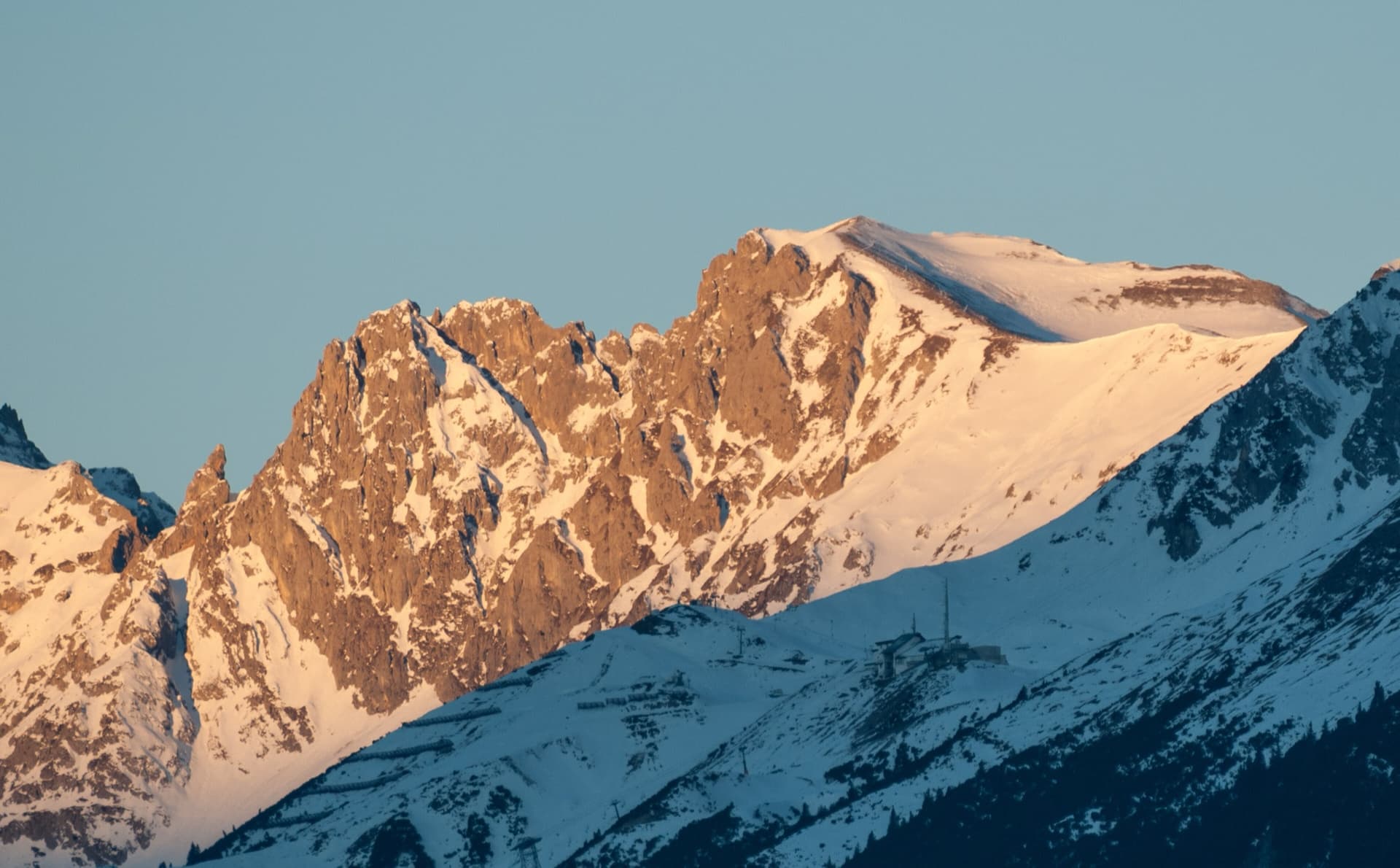
Evening light on Frau Hitt and the Westliche and Östliche Sattelspitze on the Innsbruck Nordkette, seen from the east above the Seegrube; the exact line is not marked.

Austria · Karwendel (Innsbruck Nordkette)

Mit Vergnügen – avec plaisir

A plaisir line straight above Innsbruck, reached by cable car. Two pitches are UIAA 6-/6 (5+/A0) and the rest is mostly grade 4–5. The upper pitches are grassy, so avoid it when wet.

6a9 pitches300 m
The Martinswand above the Inn valley near Zirl, seen from the south-west. The Vorbau routes climb the slabby plinth at the right-hand (eastern) end of the wall; the line is not marked.

Austria · Karwendel (Innsbruck Nordkette)

Flotter Dreier

One of the most popular routes on the Martinswand plinth: five short pitches of limestone slab that get better with height. The crux is a traverse right on pitch 3, hard from the first move, followed by a friction slab on pitch 4.

5b5 pitches135 m

The Martinswand above the Inn valley near Zirl, seen from the south-west. The Vorbau routes climb the slabby plinth at the right-hand (eastern) end of the wall; the line is not marked.

Austria · Karwendel (Innsbruck Nordkette)

Rucola

A popular plaisir route up the slabs of the Martinswand plinth: seven pitches, mostly UIAA 4, with only about three harder metres in a short steep corner on pitch 5. Often combined with a route on the wall above.

5c7 pitches225 m

Aerial view over Kematen to the south face of the Martinswand, with Zirl on the left. The Vorbau routes are on the lower slabs at the right-hand (eastern) end of the wall; the line is not marked.

Austria · Karwendel (Innsbruck Nordkette)

Flying Grass

The original Martinswand plinth classic: six pitches of limestone slab, well bolted but polished by traffic, so the grade feels stiff. The crux comes on pitch 3 and a fine 45 m slab finishes the route.

6a+6 pitches150 m

Around 6a · about 6 pitches

Similar elsewhere

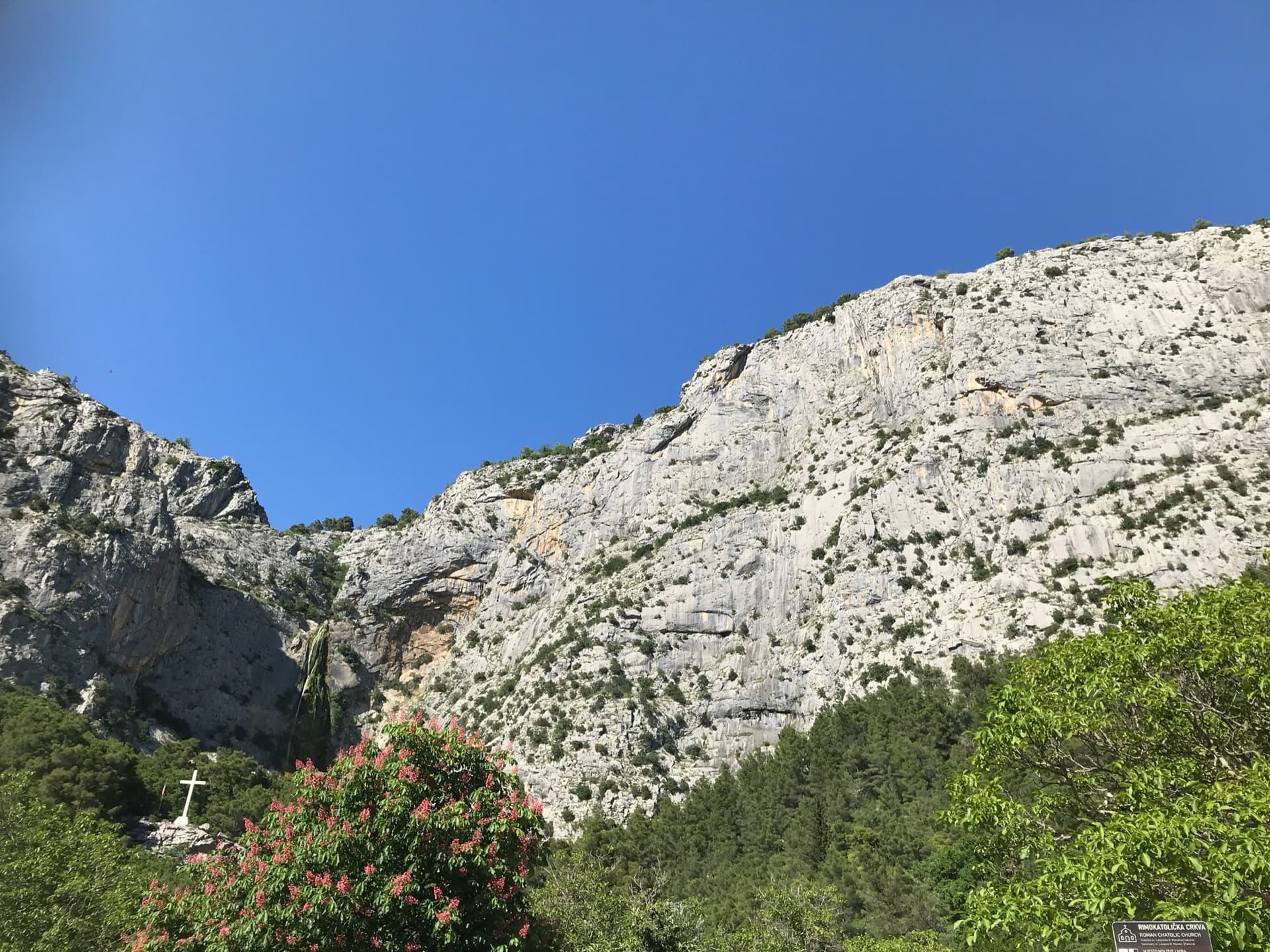
The Ilinac wall above the Cetina just upstream of Omiš, seen from the roadside chapel car park; Rambo takes the centre of the face, but the line is not marked.

Croatia · Omiš

Rambo

Omiš's signature moderate: long, slabby pitches on knobbly grey limestone with big views over the Cetina mouth and the Adriatic. The crux is a short crack on the final pitch.

6a6 pitches230 m

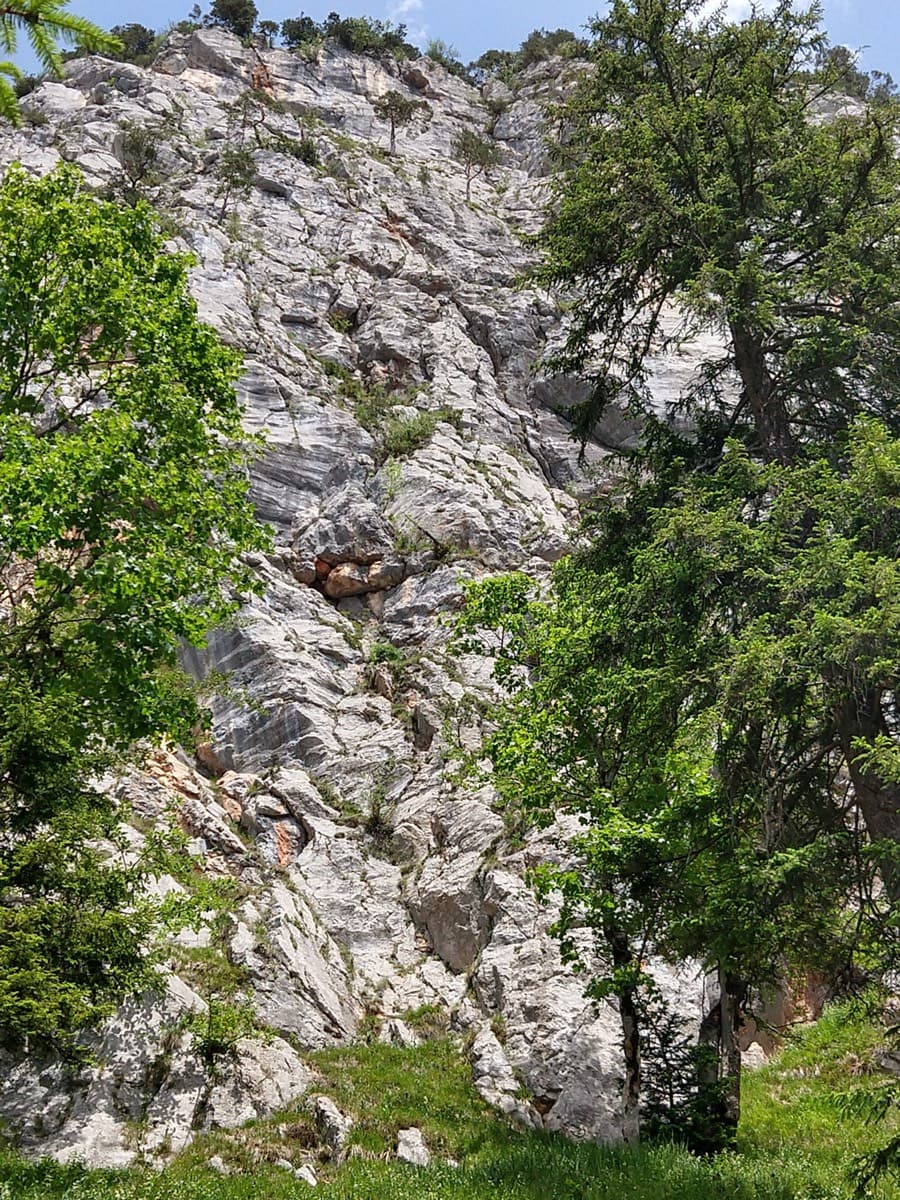
The Rabensteinhorn wall climbed by Die Schönheitskönigin von Schneizlreuth, seen from its foot

Germany · Berchtesgaden & Bad Reichenhall

Die Schönheitskönigin von Schneizlreuth

Six pitches on excellent grippy limestone with views to the Watzmann, established 2012. Pitch grades are converted from the UIAA topo (6-, 6, 6, 5+, 5+, 6); 5 is obligatory.

6a6 pitches165 m

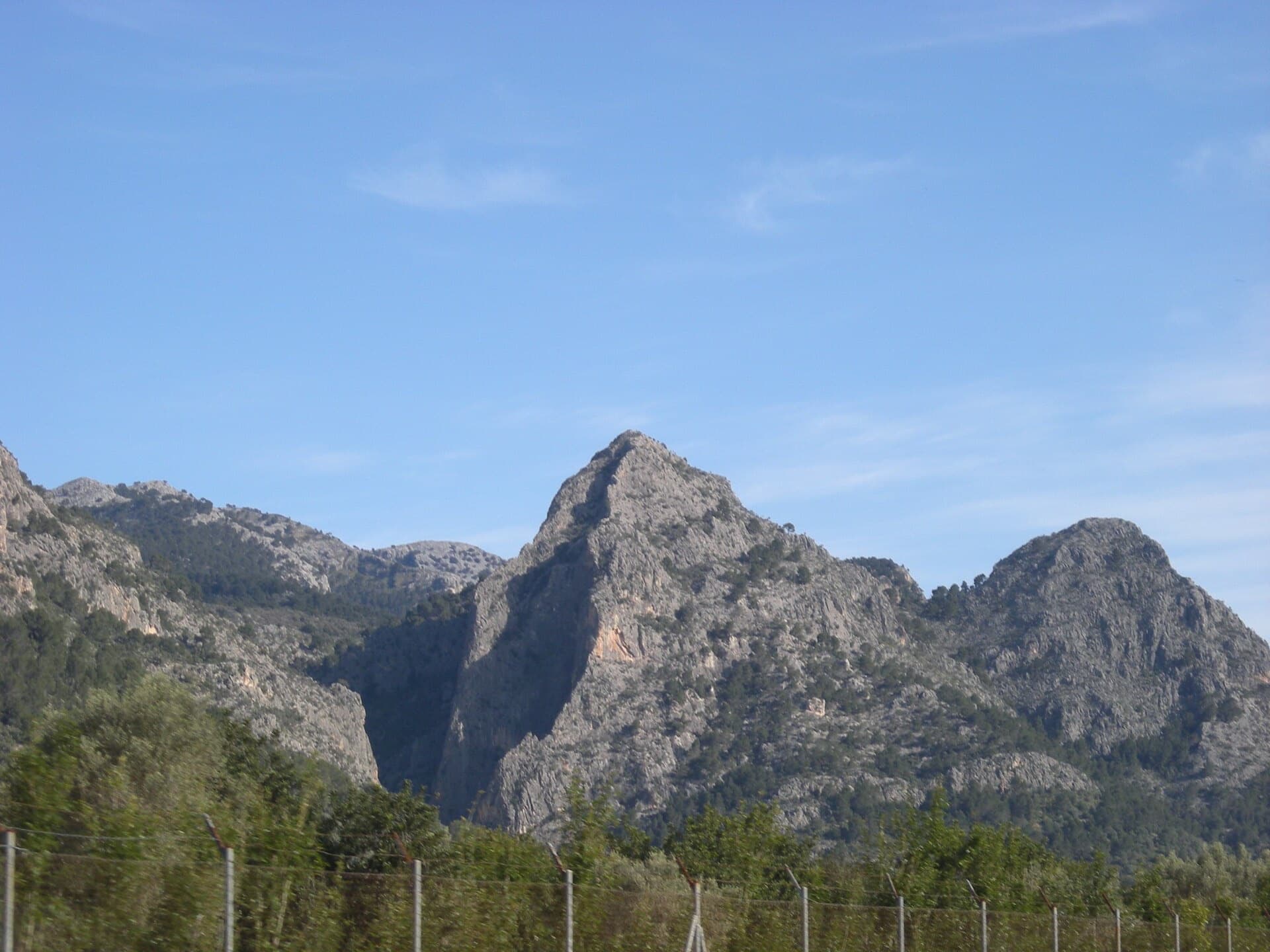
Sa Gubia seen from the Palma to Sóller road: the pointed Puig de s'Alqueria and the gorge that splits it, whose walls hold the multipitch sectors. The exact line is not identifiable at this distance.

Spain · Mallorca (Sa Gubia)

La Ley del Deseo

A steady 6a sport line, the first bolt line right of the open-book corner on the Bomberos wall. A harder P2 variation ('Sonrisa Vertical') is available.

6a6 pitches152 m

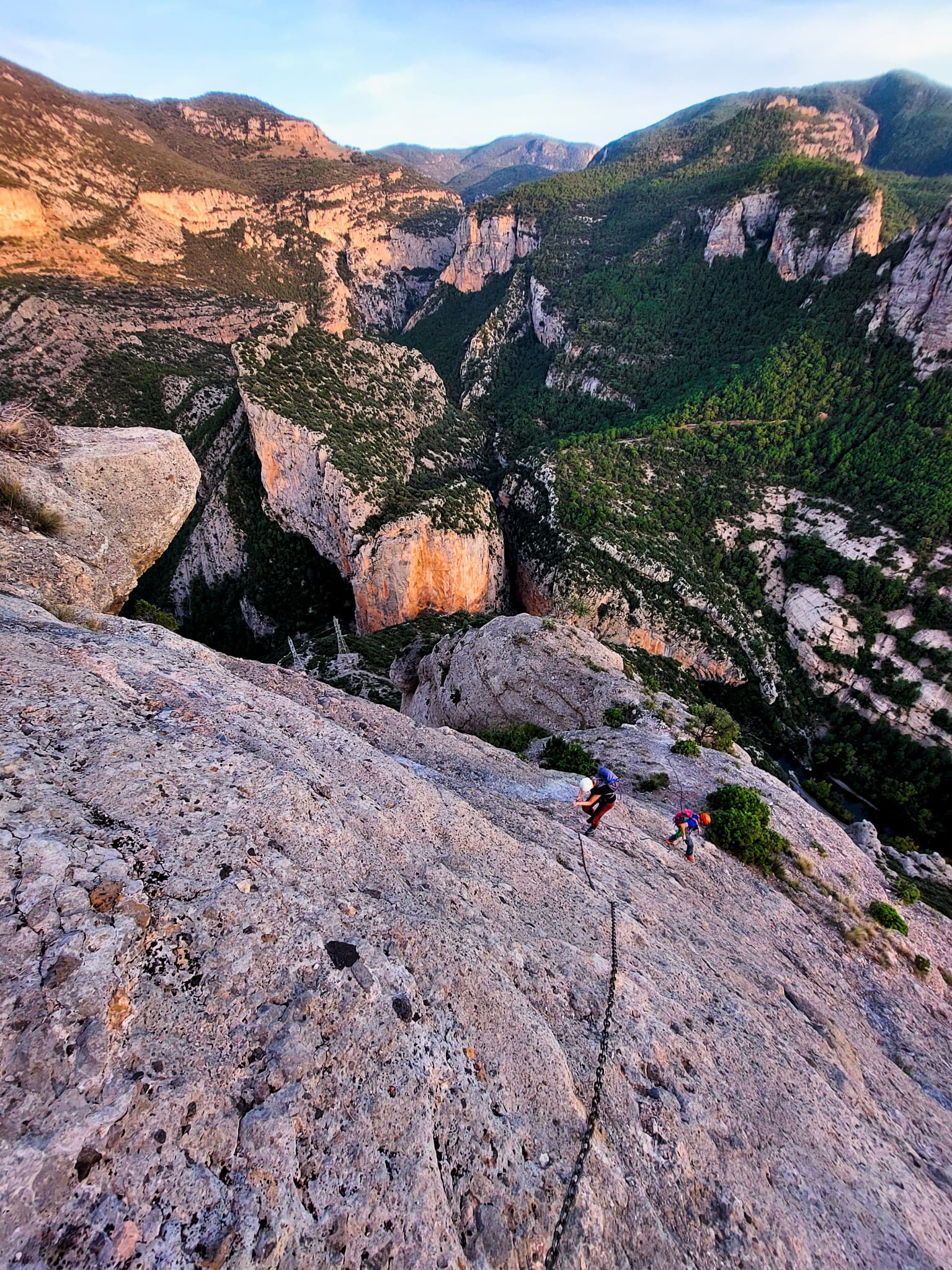
Looking down the grey conglomerate slabs of Performance on the Moles del Pessó, with two climbers below and the Collegats gorge behind

Spain · Collegats

Performance

The friendly long route of Collegats: steep but juggy grey conglomerate above the Barranc de Sant Pere, with close bolts. It starts by squeezing between the wall and a leaning 50 m pinnacle, and saves its best for a sustained 40 m 6a wall at the top. A short garden pitch breaks the line before the finish.

6a6 pitches205 m

Compiled from published sources and last verified October 2026. Bolts, anchors and access change. Climbing is dangerous and you are responsible for your own decisions: check a current topo and read the disclaimer.