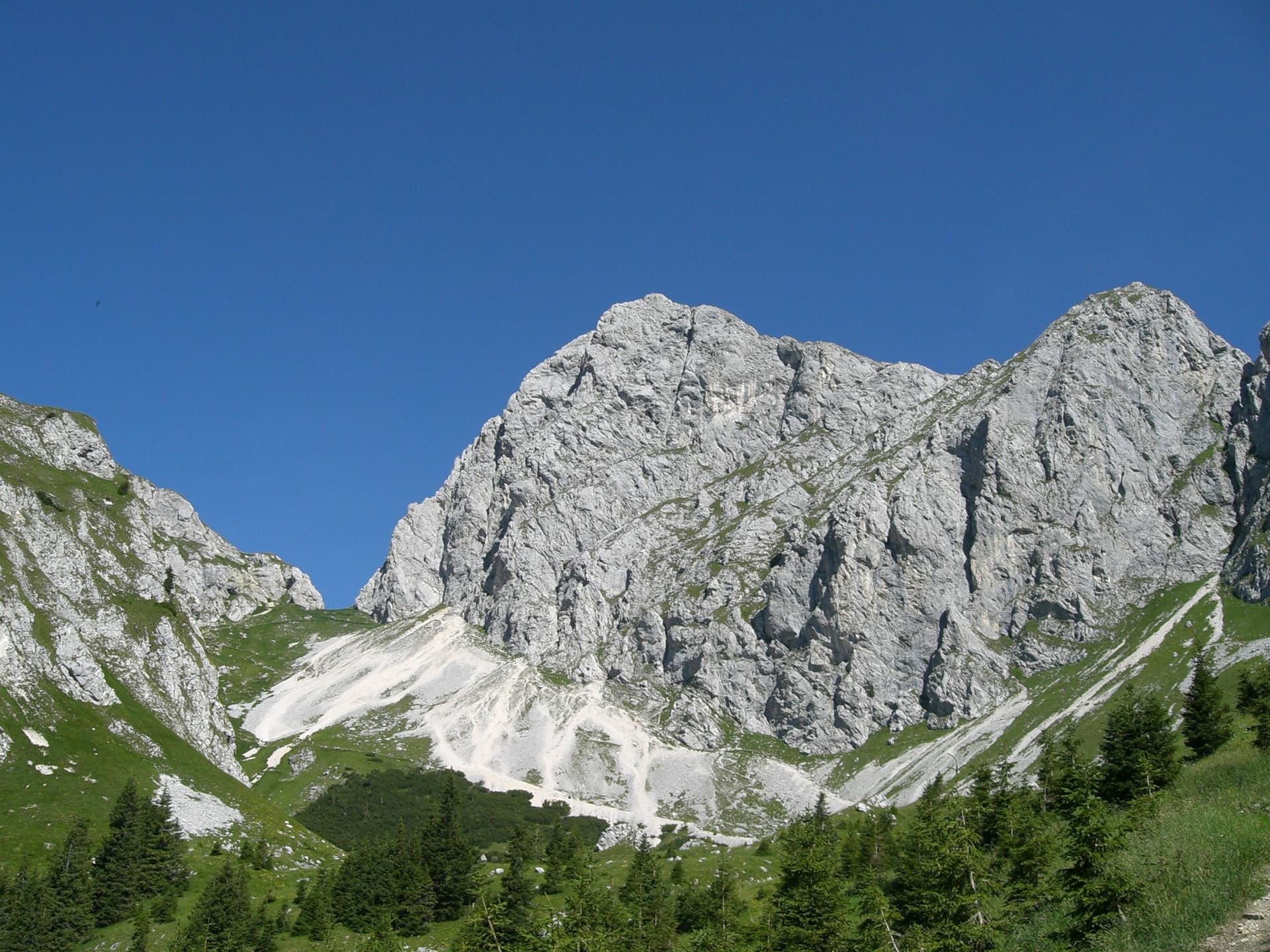
Short, steep pitches on rough, pocketed rock: a fine layback crack, a traverse on shrinking pockets and a thin slab crux. Sustained at UIAA VI to VI+, with two bolt-ladder sections you can pull through. bergsteigen.com calls it perhaps the finest route of its grade in the area.
Climbing mode: Big type, screen kept awake, tick pitches as you go.
Climbing modeBig type, screen kept awake, tick pitches as you go.
Overview
Kuschelrock climbs the steep, pocketed rock just left of Wirklich oben bist du nie on the Gimpel's south-east buttress. It is short and sustained: six pitches of UIAA VI and VI+ with a VII traverse on pitch 2 and a short VIII slab on pitch 5. Both hard sections are bolted so closely that you can aid them; the obligatory grade is then UIAA VII- (about 6b), and on the pitch 5 slab you still have to climb between the bolts unless you are tall. The abseil descent is easy to find.
Worth knowing
Pitches are short (15 to 35 m), so it is quick for a party moving well.
If the VIII slab on pitch 5 is too much, clip and pull: bergsteigen.com says both hard sections can be aided.
Pitch by pitch
The atlas doesn't show topos: they are the work of the people who bolt and document these routes. See the topo in Kletterführer Allgäu, inklusive Tannheimer Berge.
6a+6b+ (A0)6a+6a+7a+/7b (A0)5c
Pitches of Kuschelrock
Pitch
Grade
Length
Bolts
Notes
P1
6a+VII-5.10b
35 m
10 bolts
Straight up the fine layback crack (UIAA VI+, VI), briefly easier (V), then right onto a slab (VI/VI+) to a belay on a ledge under a yellow wall. UIAA VI+.
P2
6b+ (A0)VII+ (A0)5.10d (A0)
15 m
6 bolts
Briefly straight up (VI+), then a rising traverse left on ever smaller pockets (VII, or VII-/A0) until big jugs (V+) lead left to the belay. A direct variant from the first belay goes at VII+ (about 25 m, 10 bolts).
P3
6a+VII-5.10b
15 m
6 bolts
Pushy moves straight up (VI+) and an airy, juggy traverse right into a small hollow below a crack (V+). UIAA VI+.
P4
6a+VII-5.10b
35 m
8 bolts
Steep and exposed up the crack above the belay, sustained at VI+; easy only at the very top, then a short loop left to a belay under a prominent slab. The second anchor of the abseil line is a little to the right.
P5
7a+/7b (A0)
15 m
5 bolts
Into the slab from the right and up on ever tinier pockets: UIAA VIII free, or about VII-/A0 pulling on the bolts, though unless you are tall you still have to climb between them.
P6
5cVI5.9
20 m
4 bolts
Trending right over two bulges (VI-) to the belay shared with Morgenstund. You can carry on right about 10 m to the fixed rope and the first anchor of the abseil line. UIAA VI-.
Approach
To the parking
Drive into the Tannheimer Tal from Reutte, Pfronten or Bad Hindelang and go to Nesselwängle; the large paid Gimpelhaus car park is at the west end of the village. By public transport take the train to Pfronten or Reutte and the bus on to Nesselwängle. You can also stay at the Gimpelhaus or the Tannheimer Hütte, which cuts out the walk up.
On foot · about 90 min
From the paid car park at the west end of Nesselwängle follow the signed path up to the Gimpelhaus (about 1 h). Behind the hut keep on the path towards the Gimpel, then turn left into the Gimpelkar and follow it close under the south-east walls of the Gimpel; climbers' paths lead right to the foot of the south-east buttress (Gimpelvorbau). Allow about 1:30 h from the car park, or 30 to 40 min from the Gimpelhaus or the Tannheimer Hütte. Follow the paths along the foot of the wall almost to the gully that comes down from the Gimpelgrätle, then go left along a comfortable grass band to the shared first bolt of Wirklich oben bist du nie (the steep ramp going right) and Kuschelrock (the obvious layback crack a little further left). The start is at about 1910 m.
Point from bergsteigen.com start marker (shared first bolt of Kuschelrock and Wirklich oben bist du nie); OpenStreetMap node 2887435999 (Paradies) lies about 70 m away on the same buttress
Either go right along the grass band to a fixed rope and follow it to the abseil line: three abseils of 35, 50 and 40 m back to the start. Or traverse across to the Gimpel normal route (short sections of I, steep grass) and walk down into the Gimpelkar, which also lets you add a route such as the Weihnachtsweg.
Bailing off the route
Bail with caveats
The route lies right beside the equipped abseil line, whose second anchor is just right of the top of pitch 4, so you can get onto it from part-way up. Abseiling the route itself is not described, but the belays are bolted and the pitches short.
Retreat from
Top of pitch 4 (abseil-line anchor a little to the right); lower belays by abseiling the route on the bolted belays (inferred).
Point of no return
None documented.
Carry
Double ropes; maillons if you abseil from belays not set up for it.
Basis
Part stated, part inferredThe abseil-line anchor beside pitch 4 is stated by bergsteigen.com; retreat from other belays is inferred.
Say what happened, how many are hurt, and where you are. Checked October 2026 (sourceofficial sources).
Hazards
The grass band and the fixed-rope section to the abseil line are slippery when wet.
Several routes share the abseil line; watch for falling stones and ropes.
Gear
10 quickdraws (bergsteigen.com), 2×60 m ropes, helmet. bergsteigen.com leaves the nuts and cams fields empty and calls the route completely bolted at short intervals; Climbers Paradise lists the gear simply as 'Bohrhaken'.
Checklist
Quickdraws
10
Rope
2×60 m
Helmet
One each
Abseil device and prusik
For abseiling
Maillons or spare karabiners
To leave behind if you retreat
Conditions
South-east facing at about 1900 to 2000 m; morning sun. Climbing season roughly June to October once the Gimpelkar is clear of snow.
Forecast · next 7 days · 2050 m
Loading the forecast.
Weather forecast for Tannheimer Tal at 2050 m, today and the next 6 days
Measure
– –
– –
– –
– –
– –
– –
– –
High °C
–
–
–
–
–
–
–
Low °C
–
–
–
–
–
–
–
Rain mm
–
–
–
–
–
–
–
Chance of rain %
–
–
–
–
–
–
–
Strongest gusts km/h
–
–
–
–
–
–
–
Model forecast for 2050 m. It cannot tell you whether the rock is dry. Data: Open-Meteo, CC BY 4.0.
Time plan · 6 pitches
Working out sunrise and sunset.
Approach
1 h 30 min
Climbing
3 h 35 min to 5 h 40 min20% quicker to 25% slower.
Total on the way up
5 h 5 min to 7 h 10 min
Sunrise
–
Sunset
–
Start walking by
–
Descent
Not included: add time for the way down.
An estimate. Queues and route finding cost time, and shaded walls go dark before sunset. Local time (Central European time), flat horizon.
Sun on the wall · SE-facing
Working out the sunlit hours for this month.
Jan
–January: not yet worked out
Feb
–February: not yet worked out
Mar
–March: not yet worked out
Apr
–April: not yet worked out
May
–May: not yet worked out
Jun ●
–June (usual season): not yet worked out
Jul ●
–July (usual season): not yet worked out
Aug ●
–August (usual season): not yet worked out
Sep ●
–September (usual season): not yet worked out
Oct ●
–October (usual season): not yet worked out
Nov
–November: not yet worked out
Dec
–December: not yet worked out
060912151821
Sun on the wallDaylight, wall in shade● Usual season
From the aspect alone; terrain is ignored. Local time, 15th of each month.
Monthly climate averages for Tannheimer Tal, 1991-2020
Measure
Jan
Feb
Mar
Apr
May
Jun ● (usual season)
Jul ● (usual season)
Aug ● (usual season)
Sep ● (usual season)
Oct ● (usual season)
Nov
Dec
Mean daily high °C
−5
−4
−0
3
8
12
14
14
10
6
1
−4
Mean daily low °C
−14
−13
−10
−7
−2
2
4
4
1
−3
−9
−13
Rain days 1 mm or more
13
13
16
16
22
22
21
20
17
13
13
15
● usual season. 1991-2020 averages at about 1956 m; rain is for a 10–25 km grid cell. Weather and climate data: Open-Meteo, CC BY 4.0.
Completely bolted with closely spaced, good-quality bolts (bergsteigen.com calls it plaisir climbing at a higher grade), 4 to 10 bolts per pitch. The two hard sections, a VII traverse and a short VIII slab, are closely bolted and can be aided, so the obligatory grade is about UIAA VII- (6b).
History
First climbed by Pat Schwarzmann and Eugen Huber on 17 July 2005.
Guidebook
Panico 'Alpinkletterführer Allgäu'; free topo on climbers-paradise.com (Tannheimer Tal, Gimpel, route 11). Buy from kletterfuehrer.net.
Where sources disagree
Pitch grades: Climbers Paradise lists pitches 1, 3 and 4 as French 6a; bergsteigen.com gives them as UIAA VI+ (about 6a+). bergsteigen.com is used.
Length: 135 m (bergsteigen.com) against 130 m (Climbers Paradise).
The card's max grade is the obligatory grade (UIAA VII-, 6b) with the two bolt-ladder sections aided; free, the route is UIAA VIII (about 7a+/7b).
Obligatory grade: Climbers Paradise gives 8 [7-], matching bergsteigen.com's VII-/A0 for both hard sections.
Six short, sustained pitches of steep pocket climbing on the best rock of the Gimpelvorbau, almost all at UIAA VI+. Big pockets let you clip comfortably, so it is less fierce than it looks. One of the most popular sport routes above the Gimpelhaus.
Steep, juggy climbing on excellent rock in the left-hand part of the Gimpelvorbau, sustained between UIAA V+ and VI with a short VI+. Short enough to add to another route on the buttress.
One of the longest routes in the gorge and the line that names its sub-sector: six varied pitches with a steep grey wall of holds at 6a and a slabbier 6b where the holds thin out at the top. Grades are stiff and you climb between the bolts.
The easiest line on the Pilastro Lomasti and still a serious step up from the neighbouring Paretone: six pitches of steep, technical slab on pockets and small edges, never below 6a. The fourth pitch follows a fine diagonal crack. The rock is exceptional and the grades are firm.
Technical and sustained, with five varied climbing pitches of 6a+ to 6b: a pocketed slab, a surprising chimney hidden behind a pillar, a thin vertical pillar and a long steepening wall to a bulge. Quiet compared with the single pitches below, and in shade until about 12:30.
A good continuation above Nitti. Highlights are a short, thin 6b slab on P4 and a pumpy steep start to the final 6a+ pitch.
6bVII5.10c6bVII5.10c6 pitches138 mTop▲ ~650 m★★★
Read the cautions
Researched and aggregated by AI from published sources, last compiled October 2026. It can be wrong, and bolts, anchors and access change: check a current guidebook and read the disclaimer.