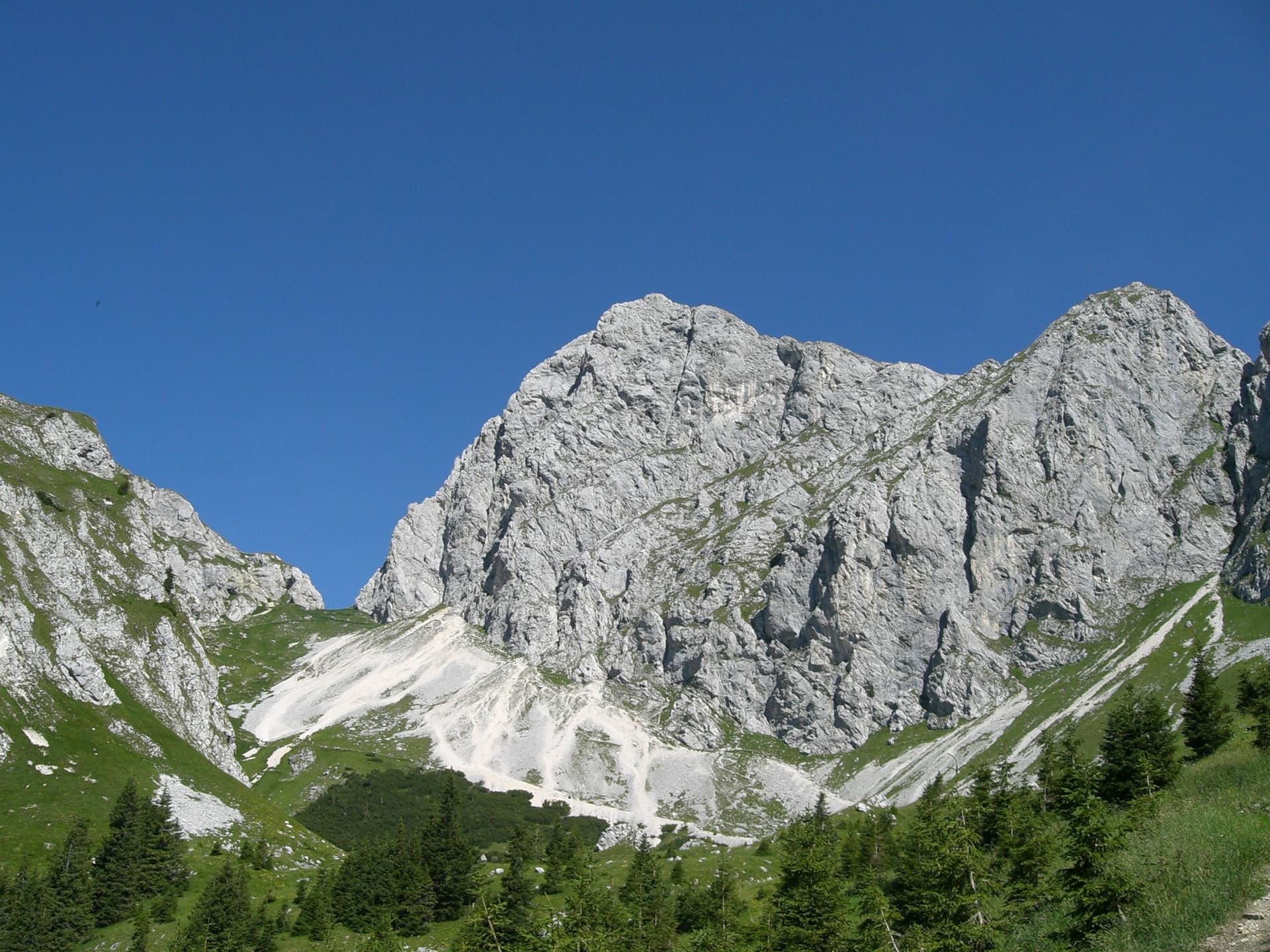
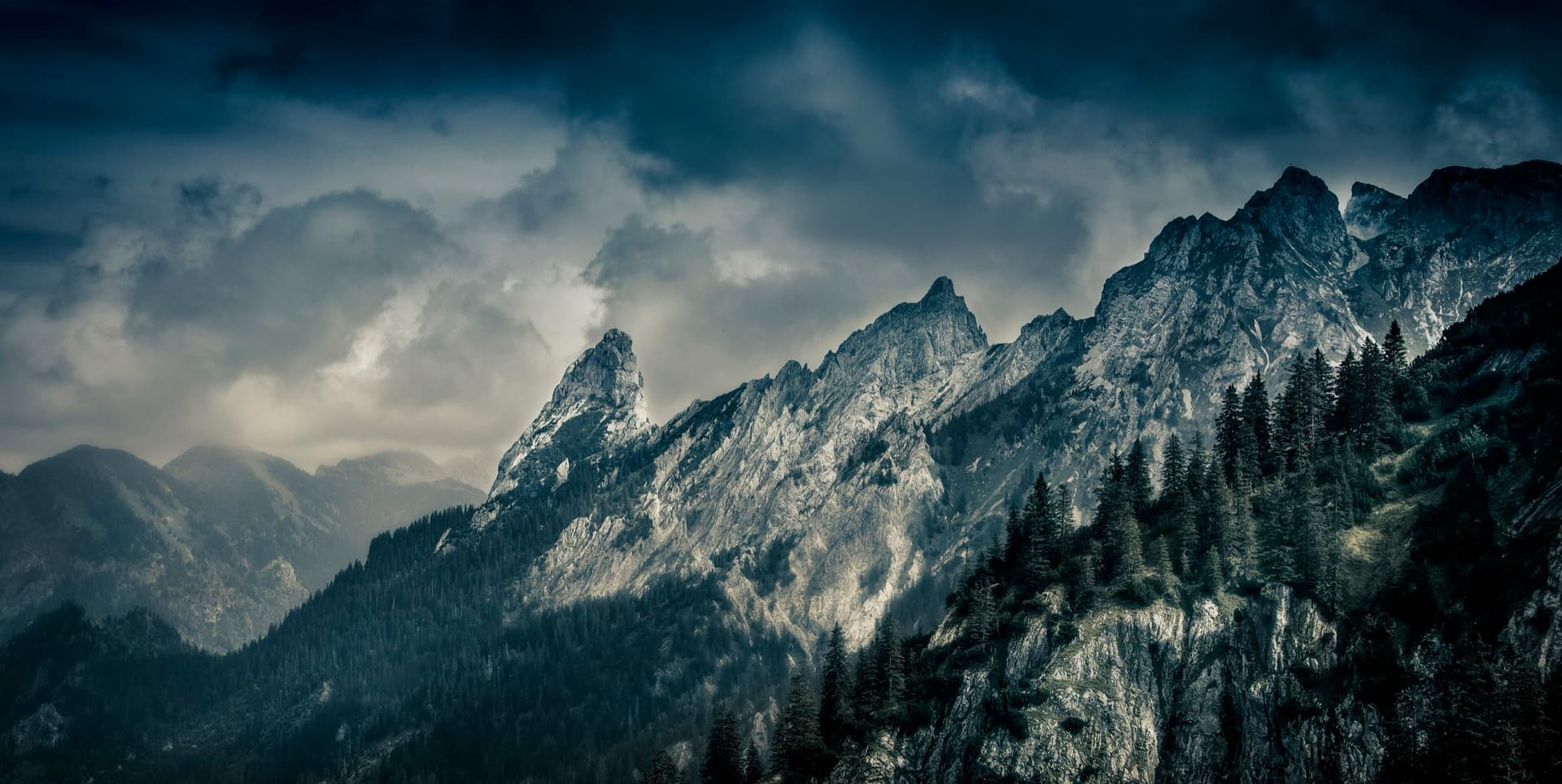
Steep, juggy climbing on excellent rock in the left-hand part of the Gimpelvorbau, sustained between UIAA V+ and VI with a short VI+. Short enough to add to another route on the buttress.
Climbing mode: Big type, screen kept awake, tick pitches as you go.
Climbing modeBig type, screen kept awake, tick pitches as you go.
Overview
Paradies takes the steep left-hand part of the Gimpel's south-east buttress on big holds in excellent limestone. Apart from the exit it is steep jug-pulling, sustained between UIAA V+ and VI with one short VI+ move. It is quick to reach and quick to get down, so it makes a good second route of the day.
Worth knowing
A good add-on after Kuschelrock, Wirklich oben bist du nie or Morgenstund on the same buttress.
Pitch by pitch
The atlas doesn't show topos: they are the work of the people who bolt and document these routes. See the topo in Kletterführer Allgäu, inklusive Tannheimer Berge.
6a6a+5b6a6a
Pitches of Paradies
Pitch
Grade
Length
Notes
P1
6aVI+5.10a
25 m
Steep climbing on good holds. UIAA VI.
P2
6a+VII-5.10b
25 m
The short VI+ crux. Stays damp for a while after rain.
P3
5bVI-5.8
35 m
UIAA V+.
P4
6aVI+5.10a
5 m
A very short link of UIAA VI (5 m on the Climbers Paradise topo).
P5
6aVI+5.10a
35 m
UIAA VI, easing at the exit, where the bolts are a little further apart.
Approach
To the parking
Drive into the Tannheimer Tal from Reutte, Pfronten or Bad Hindelang and go to Nesselwängle; the large paid Gimpelhaus car park is at the west end of the village. By public transport take the train to Pfronten or Reutte and the bus on to Nesselwängle. You can also stay at the Gimpelhaus or the Tannheimer Hütte, which cuts out the walk up.
On foot · about 90 min
From the paid car park at the west end of Nesselwängle follow the signed path up to the Gimpelhaus (about 1 h). Behind the hut keep on the path towards the Gimpel, then turn left into the Gimpelkar and follow it close under the south-east walls of the Gimpel; climbers' paths lead right to the foot of the south-east buttress (Gimpelvorbau). Allow about 1:30 h from the car park, or 30 to 40 min from the Gimpelhaus or the Tannheimer Hütte. The start is at about 1880 m. If you plan to walk down, leave your sacks on the path about 15 m below the start so you do not have to climb back up for them.
Abseil: the quickest way down is the line of Zeit zum Fädeln, one 35 m and one 60 m abseil (bergsteigen.com). Check first that nobody is climbing below. Or traverse right to Jedem Tierchen sein Plaisirchen, climb its last pitch, cross left to the Gimpel normal route and descend it (sure-footedness needed, moves of II) into the Gimpelkar.
Bailing off the route
Easy to bail
Abseiling is the normal way down and is only two abseils from the top via Zeit zum Fädeln, so retreating from part-way up the five short pitches should be simple from the bolted belays.
Retreat from
Any belay (inferred); the descent abseils are on the neighbouring line.
Point of no return
None documented.
Carry
2×60 m ropes for the 60 m abseil.
Basis
Part stated, part inferredThe abseil descent is stated by bergsteigen.com and Climbers Paradise; retreat from intermediate belays is inferred.
Bolted throughout; bergsteigen.com says nuts and cams are neither needed nor really placeable, with slightly wider spacing only at the very end, where the climbing eases. Climbers Paradise notes the hard moves can be aided on the bolts.
History
Bolted by Pat Schwarzmann and Uwe Schneider in 2005 (bergsteigen.com).
Guidebook
Panico 'Alpinkletterführer Allgäu'; free topo on climbers-paradise.com (Tannheimer Tal, Gimpel, route 7). Buy from kletterfuehrer.net.
Where sources disagree
Length: 170 m (bergsteigen.com) against 130 m (Climbers Paradise).
Grade: UIAA 6+/7- overall on bergsteigen.com, 6+ on Climbers Paradise.
Pitch 4 is only 5 m on the Climbers Paradise topo and may be a short link rather than a full pitch; bergsteigen.com's topo is not public.
Bolt counts per pitch are not published in a free source.
Six short, sustained pitches of steep pocket climbing on the best rock of the Gimpelvorbau, almost all at UIAA VI+. Big pockets let you clip comfortably, so it is less fierce than it looks. One of the most popular sport routes above the Gimpelhaus.
Short, steep pitches on rough, pocketed rock: a fine layback crack, a traverse on shrinking pockets and a thin slab crux. Sustained at UIAA VI to VI+, with two bolt-ladder sections you can pull through. bergsteigen.com calls it perhaps the finest route of its grade in the area.
Five sustained pitches on the left side of the Hannibalturm, never easier than 5c+ and never much harder than 6a+. A smooth friction slab leads to steep wall climbing, a pillar, a flake and a corner, and the route finishes up a ladder of huge quartz knobs. Many parties rate it the best line on the tower and find the second pitch the hardest.
A modern linkup over two pinnacles on excellent conglomerate. Overhanging 6a and 6a+ walls alternate with easy 'potato-field' slabs. The new bolting makes it one of the most reassuring long lines in the massif.
A 1985 classic of the Escalès, a grade harder and noticeably bolder than Les Dalles Grises next door. Five pitches on pockets and slabs, starting with polished rising traverses and finishing up a sculpted wall of vertical flutings, an overhanging crack and a bulge at 6a+. You need to be solid at 6a to enjoy it.
The popular sport line of the Geiselstein south face, straight up to the summit cross. Long, steep pitches on excellent rough limestone, sustained at UIAA 6- to 6 with two short passages of 6+ and one easier pitch on less reliable rock. Never easy and never crowded with bolts: you climb between them.
Researched and aggregated by AI from published sources, last compiled October 2026. It can be wrong, and bolts, anchors and access change: check a current guidebook and read the disclaimer.