Morocco · Amellago
8anus
Seven pitches on very abrasive limestone beside the oued, with swimming holes below. An athletic start to the 6b second pitch; a couple of doubtful flakes on pitches 3 and 4.
6b7 pitches140 m
Read the cautions
Imiter wall (Tizzarouine), above Aït Slimane · Amellago · Morocco
Bail with caveatsBolting confidence: medium
The first long route on the big south-east wall above the village: eight pitches on rough red limestone, with a hard crux on the fourth pitch that goes free at 6c or with aid on the bolts at 6a obligatory. The last pitch is 50 m of even 5c. Pitch grades are not published; the topo lives with Mimoun at the gîte.
The route
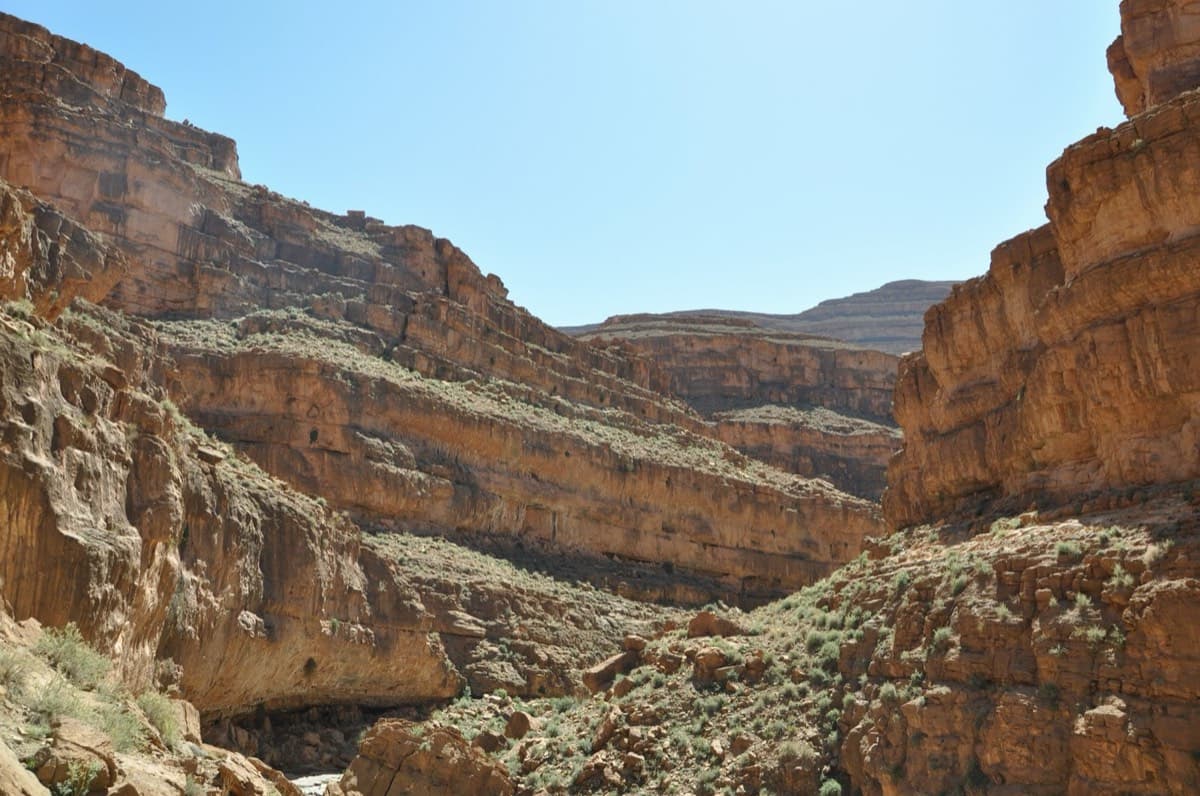
Le Berbère Ardéchois climbs the 200 to 250 m south-east wall north of the hamlet of Aït Slimane, at the mouth of the Imiter gorge near Amellago. It was the first route on the wall and is one of the handful of long lines there that are bolted from bottom to top; most of its neighbours are only partly equipped. Camptocamp's crag page grades it TD, 6c free with 6a obligatory and aid on the bolts. The one detailed trip report, from 2018, describes eight pitches, very good cleaning and bolting, grades less demanding than on the neighbouring Le puits, l'hôtel et le flouze, and long stretches of fine red rock. No pitch-by-pitch topo is published online.
The climbing
| Pitch | Grade | Length | Notes |
|---|---|---|---|
| P1 | – | 20 m | A gentle warm-up on very rough rock. The 2018 party found it harder than the grade 4 they had been told and easier than the 6a quoted elsewhere. |
| P2 | – | 20 m | More delicate and technical. |
| P3 | – | – | A forceful move off the belay (a fist jam, or a sit on the block), then a long, weaving pitch on fine red rock. |
| P4 | – | – | The crux pitch: a first wall leads to rounded, slightly sandy white rock and then a roof, after which it eases into a long stretch of rough red rock. Seventeen quickdraws if you clip every bolt. |
| P5 | – | – | One more delicate move, again on good red rock. |
| P6 | – | – | Very even and easier; described as superb. |
| P7 | – | – | A short step leading to a good ledge. |
| P8 | 5c | 50 m | Fifty metres of very consistent 5c on rough red rock to the top. |
Getting there
Amellago and Aït Slimane lie in the eastern High Atlas near Er-Rich, Errachidia province. The quickest way is by road from Fès, about 4 to 5 hours; from Tinghir and the Todra Gorge allow about 3 hours on the paved road through Tamtetoucht and Assoul; from Marrakech 8 to 10 hours. Without a car, take a bus to Er-Rich and a taxi from there. Stay with Mimoun Goali at his gîte (L'Oasis Tizzarouine) in Aït Slimane, about 2 km beyond Amellago on the main road: he opened this route with Christophe Bernard, keeps the only topo and briefs every party.
About 30 minutes on foot from Mimoun's gîte to the big south-east wall north of the village (camptocamp's sector page allows 45 minutes). The route starts 20 m right of La Guigne du Perfo. No written description of the path or of the start is published; get it from Mimoun before you leave.
Loading map
The point marks the crag, not the exact start of the route.
Point from camptocamp waypoint 417729 (Amallego - Imiter)
Contains the route point. Opens in most mapping apps and GPS watches.
Points are compiled from published sources, with the precision stated above. They were not surveyed on the ground: check them against a current topo.
Coordinates: 32.01355, -5.05096 (crag)
Getting down
By abseil. The 2018 party, on Mimoun's advice, went down the abseil line of Du moi dans toi, which they had used two days earlier after Le puits, l'hôtel et le flouze: Mimoun considers it less likely to jam ropes than the abseils down Le Berbère Ardéchois itself. A ledge leads from the top to the first anchor; a 2017 party coming off the neighbouring route used five efficient abseils starting from a chain at the back of a corner, about 200 m right of that route's exit, which is probably the same line. Walking off is possible but long (about 1 hour 45 minutes for a 2023 party) and hard to find: you follow the cliff top east and descend a canyon.
Retreat
Bail with caveats
Abseiling this line is established: an older camptocamp description gives the abseils of the Ardéchois as the descent from the neighbouring route, and Mimoun talks of them as an alternative to the Du moi dans toi line. He also says they are more prone to jamming ropes. How each belay is rigged is not described.
Partly inferred from the route facts
Safety
Sun and weather
South-east facing at roughly 1,400 to 1,800 m, so sunny for much of the day. Camptocamp lists September to March as the best period for this wall and a May 2026 party gives the season as September to early May, with south-facing routes already hot by late May. It can be windy and cold at the top even on a warm day. The limestone is extremely abrasive on the skin.
Sun on the wall · SE-facing
Working out the sunlit hours for this month.
Sun on the wallDaylight, wall in shade● Usual season
Estimated from the wall's aspect only. Ignores surrounding terrain, gullies and the wall's exact shape. Clock times are local to the wall (Moroccan time), for the 15th of each month.
| Measure | Jan (usual season) | Feb (usual season) | Mar (usual season) | Apr (usual season) | May | Jun | Jul | Aug | Sep (usual season) | Oct (usual season) | Nov (usual season) | Dec (usual season) |
|---|---|---|---|---|---|---|---|---|---|---|---|---|
| Mean daily high °C | 13 | 14 | 18 | 22 | 26 | 31 | 35 | 33 | 29 | 23 | 17 | 13 |
| Mean daily low °C | 1 | 3 | 6 | 10 | 13 | 18 | 21 | 21 | 17 | 12 | 6 | 3 |
| Rain days 1 mm or more | 3 | 3 | 4 | 4 | 4 | 3 | 1 | 2 | 3 | 4 | 3 | 2 |
● marks the usual climbing season. Averages for 1991-2020 at about 1344 m. Area climate from Open-Meteo reanalysis. Temperatures are adjusted to the height of the crag; rain comes from a grid cell of about 10 to 25 km, and summer highs on sea cliffs can read a few degrees low. The wall and valley can differ. Data: Open-Meteo, CC BY 4.0.
What to carry
17 quickdraws for the crux pitch if you clip everything; the local topo says about 15 cover the equipped long routes. Two 50 m ropes for the abseils, as the local topo recommends for all the long routes. Long slings in case belays are not linked. The 2018 party carried a few cams on local advice and did not place them. Helmet.
Derived from the route data; check it against a current topo
From climbers
Reader reports are not being collected yet. Until they are, check a current topo and the local club or guidebook publisher for recent changes to Le Berbère Ardéchois.
Worth knowing
Open questions
Provenance
Same area
Morocco · Amellago
Seven pitches on very abrasive limestone beside the oued, with swimming holes below. An athletic start to the 6b second pitch; a couple of doubtful flakes on pitches 3 and 4.
6b7 pitches140 m
Read the cautions
Morocco · Amellago
The most accessible multipitch at Amellago: four short pitches broken by a walk along a ledge under the roofs, finishing with an exposed traverse on rough brown rock. Some doubtful rock at the start of pitch 3. In shade from mid-afternoon in winter.
6b4 pitches80 m
Read the cautions
Around 6c · about 8 pitches
Switzerland · Sanetsch
The classic introduction to the Sanetsch at 6c: eight varied pitches up a pillar of superb rough limestone, with the hard climbing packed into a few well-bolted metres on each pitch. A steep corner mantel, a balancy wall, a fine slab and an airy exit from a niche. Tops out on grassy slopes with a walk-off.
6c8 pitches250 m
Croatia · Paklenica
Seven sustained pitches of 6a to 6c on the shady north face of Anića kuk, then an easy scramble out. A poor first pitch gives way to a steep ramp, a slightly overhanging 6c wall, an off-width and a fine finishing slab. The rock improves with every pitch.
6c8 pitches220 m
Austria · Ötztal
Steep, exposed gneiss left of the Reinhard Schiestl via ferrata, finding a way between huge roofs. The cruxes are the steep slabs of pitches 5 and 6 (6c). Stiffly graded, and the abseil descent is not for everyone.
6c8 pitches195 m
Greece · Leonidio & Kyparissi
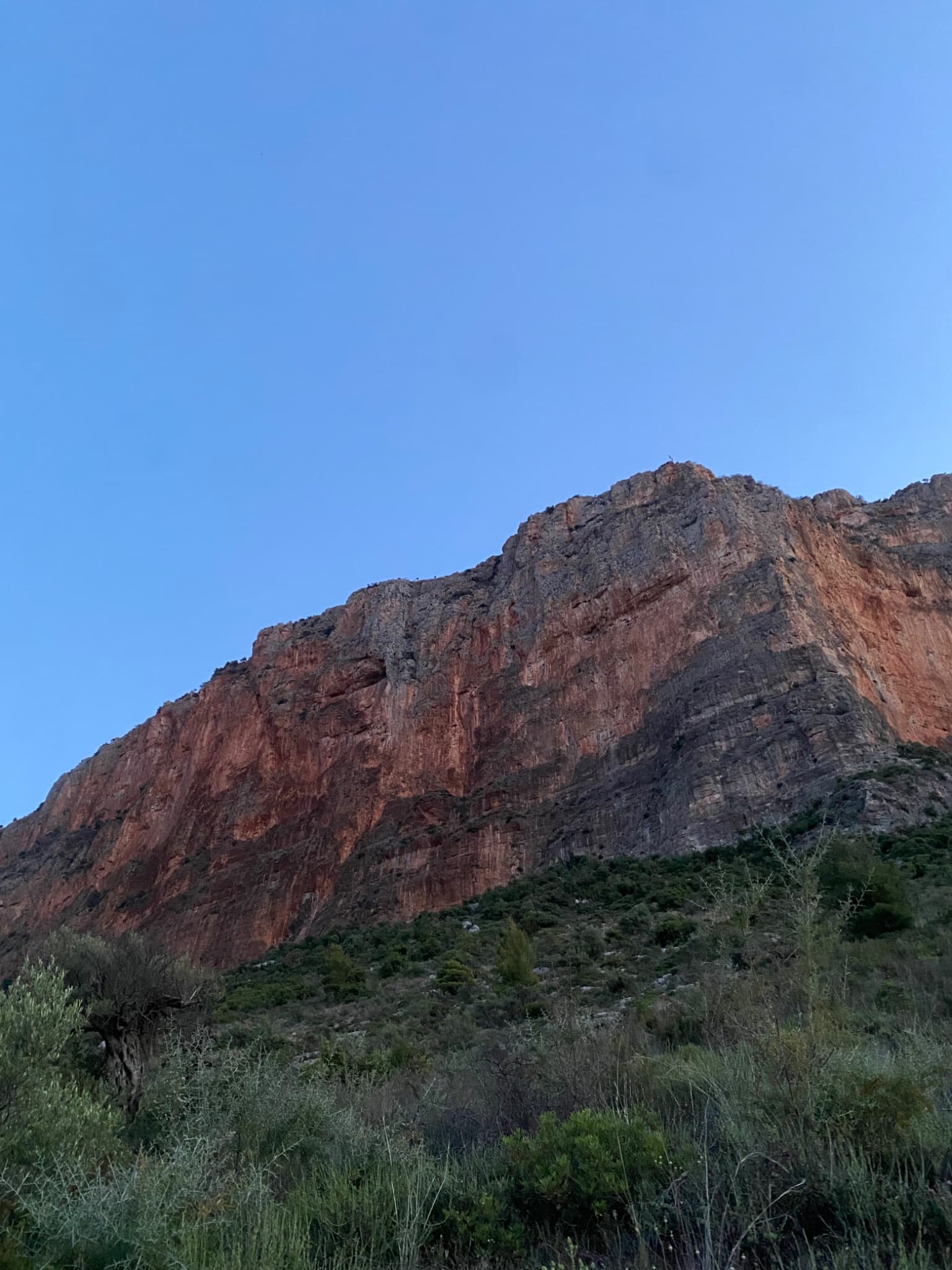
Eight pitches to the top of Kokkinovrachos, seven of climbing and one of scrambling through vegetation. A crack in a corner, slabs of coral-like rock and two short roofs give varied climbing, with three isolated 6c moves. It stays in the shade through the morning, unlike most of the wall.
6c8 pitches200 m
Compiled from published sources and last verified October 2026. Bolts, anchors and access change. Climbing is dangerous and you are responsible for your own decisions: check a current topo and read the disclaimer.