The harder companion to La Dalle à Delphin: two steep, athletic 6b pitches low down, a black wall and a bouldery overhang, then easy ground and two fine short pitches to the top of the Barre de la Lèche.
Climbing mode: Big type, screen kept awake, tick pitches as you go.
Climbing modeBig type, screen kept awake, tick pitches as you go.
Overview
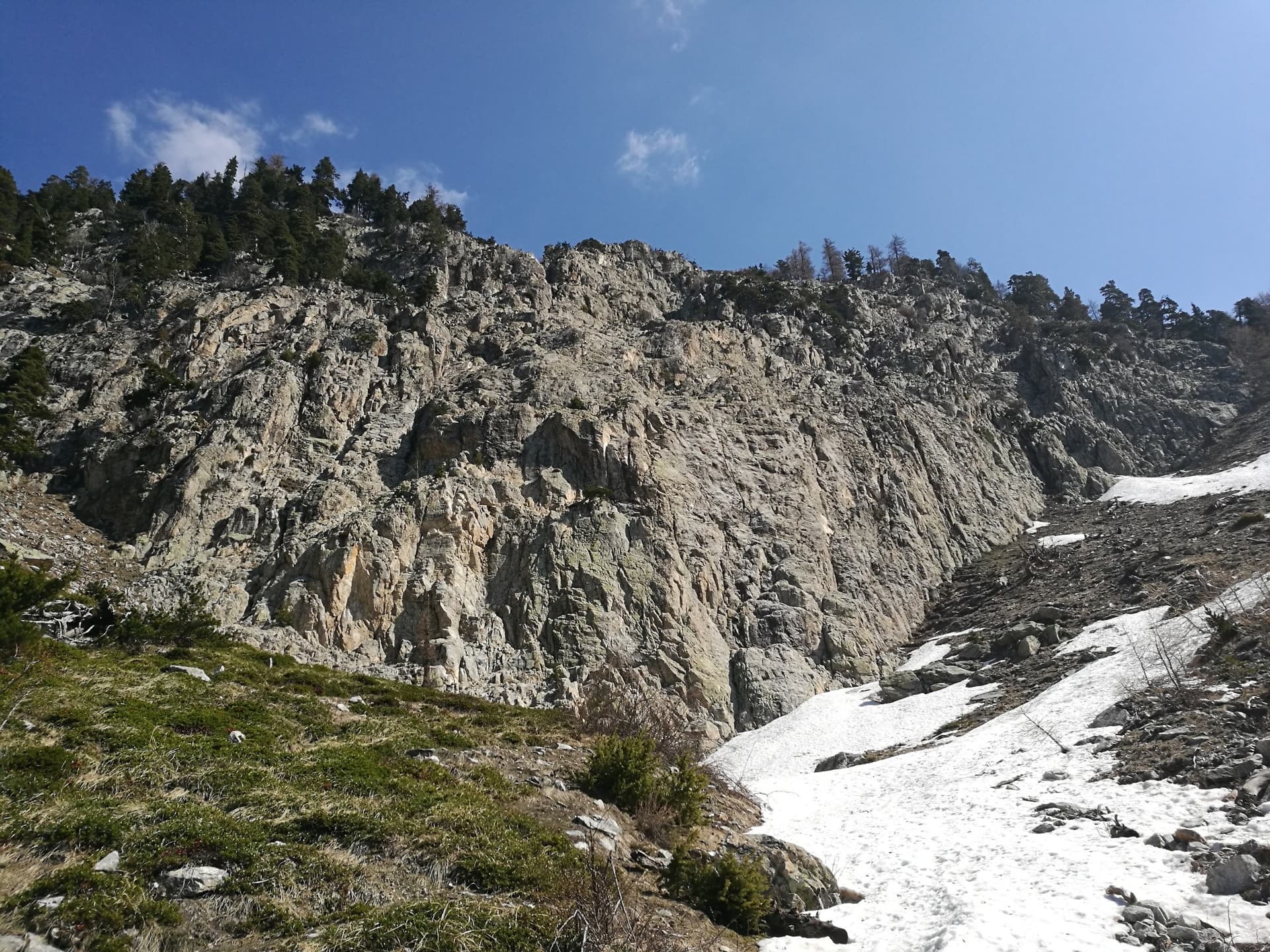
Tomawak starts just right of a bare dead pine on the left side of the Barre de la Lèche. The first pitch follows the left edge of a chimney and exits through a small overhang; the second traverses right and climbs the middle of a steep black wall. Above, the climbing eases to a grassy ledge, and two short pitches with a bouldery move or two finish at the top of the band. Its upper pitches are also used by easier combinations such as the Violettes–Toju–Tomawak link-up.
Worth knowing
A 2018 party found that the topo's pitch 2 line up the black wall may be the neighbouring 6b+; Tomawak itself goes a little further left.
Combine the top two pitches with La Dalle à Delphin or La Maggiore for longer days.
Pitch by pitch
The atlas doesn't show topos: they are the work of the people who bolt and document these routes. See the topo at camptocamp.org, or in La Verticalité en Vésubie-Valdeblore.
6b6b5a25b5c
Pitches of Le Tomawak
Pitch
Grade
Notes
P1
6bVII5.10c
Follow the left edge of a chimney-like feature and exit through a small overhang; a hard final move, especially with a pack. Belay at the exit or 3 m left.
P2
6bVII5.10c
Traverse right (a little down-climbing, passing another belay), then straight up the middle of the steep black wall. Belay after the wall, slightly right.
P3
5aV+5.7
Straight up the bolts; several belays here, take the one directly above.
P4
2
Slightly right, then up following occasional bolts to the grassy ledge; take the left-hand belay (two unlinked bolts). Snow can lie here early in the season.
P5
5bVI-5.8
Up a small chimney, slightly left, and over a small overhang.
P6
5cVI5.9
A boulder move off the belay (protected), then straight up to the top belay.
Approach
To the parking
As for La Dalle à Delphin: Saint-Martin-Vésubie, Le Boréon, then the Col de Salèse road to where it is closed to traffic at the first hairpin (signpost 399).
On foot · about 20 min
About 20 min up the forest track and the cairned path to the foot of the face. The route starts right of a bare dead pine, a little left of centre on the band.
Map of the walk-in
Crag
PParking
Loading map
The point marks the crag, not the exact start of the route.
Abseil from R6 to R4 (exactly 50 m), walk down pitch 4 (stay roped), then make three abseils to the ground. There are many belays on the lower face; choose those that reduce the risk of the rope jamming. The FFME topo also mentions a descent on foot from R4 with protection bolts every 5 m, which camptocamp does not recommend (exposed and slow).
Bailing off the route
Easy to bail
The route is descended by abseil from chained belays, so retreat from any stance is straightforward; between R4 and R3 you down-climb the easy pitch 4.
Retreat from
Any belay.
Point of no return
None.
Carry
Two 50 m ropes.
Basis
Stated in the sourcesAbseil descent described on camptocamp and by parties.
Marks the crag, not the route: give route and pitch.
Say what happened, how many are hurt, and where you are. Checked October 2026 (sourceofficial sources).
Hazards
Rope jams and stonefall during the abseils.
Snow on the central ledge early in the season.
One unstable block was reported on pitch 2 of La Petite Toju nearby in 2022.
Gear
About 12 quickdraws. Two 50 m ropes. Helmet.
Checklist
Quickdraws
12
Rope
2×50 m
Helmet
One each
Abseil device and prusik
For abseiling
Conditions
South-east facing at about 1800 to 1950 m. June to October; early in the season a snow patch can sit on the grassy ledge. Watch for summer thunderstorms.
Forecast · next 7 days · 1950 m
Loading the forecast.
Weather forecast for Vésubie (Le Boréon) at 1950 m, today and the next 6 days
Measure
– –
– –
– –
– –
– –
– –
– –
High °C
–
–
–
–
–
–
–
Low °C
–
–
–
–
–
–
–
Rain mm
–
–
–
–
–
–
–
Chance of rain %
–
–
–
–
–
–
–
Strongest gusts km/h
–
–
–
–
–
–
–
Model forecast for 1950 m. It cannot tell you whether the rock is dry. Data: Open-Meteo, CC BY 4.0.
Time plan · 6 pitches
Working out sunrise and sunset.
Approach
20 min
Climbing
3 h 35 min to 5 h 40 min20% quicker to 25% slower.
Total on the way up
3 h 55 min to 6 h
Sunrise
–
Sunset
–
Start walking by
–
Descent
Not included: add time for the way down.
An estimate. Queues and route finding cost time, and shaded walls go dark before sunset. Local time (Central European time), flat horizon.
Sun on the wall · SE-facing
Working out the sunlit hours for this month.
Jan
–January: not yet worked out
Feb
–February: not yet worked out
Mar
–March: not yet worked out
Apr
–April: not yet worked out
May
–May: not yet worked out
Jun ●
–June (usual season): not yet worked out
Jul ●
–July (usual season): not yet worked out
Aug ●
–August (usual season): not yet worked out
Sep ●
–September (usual season): not yet worked out
Oct ●
–October (usual season): not yet worked out
Nov
–November: not yet worked out
Dec
–December: not yet worked out
060912151821
Sun on the wallDaylight, wall in shade● Usual season
From the aspect alone; terrain is ignored. Local time, 15th of each month.
Monthly climate averages for Vésubie (Le Boréon), 1991-2020
Measure
Jan
Feb
Mar
Apr
May
Jun ● (usual season)
Jul ● (usual season)
Aug ● (usual season)
Sep ● (usual season)
Oct ● (usual season)
Nov
Dec
Mean daily high °C
1
1
4
7
11
16
18
18
14
10
5
1
Mean daily low °C
−7
−7
−5
−2
3
7
10
10
6
3
−3
−6
Rain days 1 mm or more
8
7
9
13
18
18
15
13
11
11
11
9
● usual season. 1991-2020 averages at about 1895 m; rain is for a 10–25 km grid cell. Weather and climate data: Open-Meteo, CC BY 4.0.
Equipped on glue-in bolts as part of the 2015–2016 FFME rebolting of the crag; all belays are chained except R4, which is two unlinked bolts on the grassy ledge. Parties from 2018 to 2025 describe the equipment as faultless, like an indoor wall.
History
Part of the Barre de la Lèche developed by Jean Grinda, Delphin Richier, Charlie Pistone, Pierre Fiorucci and Bernard Duterte; rebolted in 2015–2016 by Pierre Fiorucci, Bernard Duterte and Alexandre Chabot for the FFME Alpes-Maritimes committee.
Pitch 2 line: a 2018 party believes the line described on camptocamp up the middle of the black wall is the neighbouring 6b+ and that Tomawak goes further left.
Pitch numbering: alpes-sud.net's combination topo counts Tomawak's upper section as four pitches (5b, II, 5b, 5c) where camptocamp has three (2, 5b, 5c).
The best easy multipitch at the Barre de la Lèche: eight pitches of slabs and short walls on rough mountain gneiss above Le Boréon, very well bolted. A good first route for newcomers to multipitch climbing, with a stiffer pair of 5c pitches low down.
Short, steep pitches on rough, pocketed rock: a fine layback crack, a traverse on shrinking pockets and a thin slab crux. Sustained at UIAA VI to VI+, with two bolt-ladder sections you can pull through. bergsteigen.com calls it perhaps the finest route of its grade in the area.
One of the longest routes in the gorge and the line that names its sub-sector: six varied pitches with a steep grey wall of holds at 6a and a slabbier 6b where the holds thin out at the top. Grades are stiff and you climb between the bolts.
The easiest line on the Pilastro Lomasti and still a serious step up from the neighbouring Paretone: six pitches of steep, technical slab on pockets and small edges, never below 6a. The fourth pitch follows a fine diagonal crack. The rock is exceptional and the grades are firm.
Technical and sustained, with five varied climbing pitches of 6a+ to 6b: a pocketed slab, a surprising chimney hidden behind a pillar, a thin vertical pillar and a long steepening wall to a bulge. Quiet compared with the single pitches below, and in shade until about 12:30.
6bVII5.10c6bVII5.10c6 pitches160 mTop▲ ~400 m★★★
Researched and aggregated by AI from published sources, last compiled October 2026. It can be wrong, and bolts, anchors and access change: check a current guidebook and read the disclaimer.