Multipitch Atlas

Lilith

La Poltrona (Cala Gonone) · Sardinia · Italy

Easy to bailBolting confidence: high

An easy and popular line on the big amphitheatre above Cala Gonone: three 4c pitches of juggy steps and easy-angled slabs, a short walk left through bushes, then a 35 m wall of heavily sculpted rock at 5a. Expect queues.

The easy-angled slabs low on Lilith, with the main wall of La Poltrona abovePhoto: phill06 · CC BY-NC-ND 3.0

Photo

The easy-angled slabs low on Lilith, with the main wall of La Poltrona abovePhoto: phill06 · CC BY-NC-ND 3.0
Hardest pitch
5a
Pitches
4
Length
120 m
Approach
10 min
Aspect
E
East-facing
Rope
2×50 m

The route

Overview

Lilith climbs the slabs and walls below and left of the main face of La Poltrona, the half-moon amphitheatre that overlooks Cala Gonone. It is four short pitches, never harder than 5a, on excellent rock, and you abseil back down it. Because it is so accessible it is busy: an October 2025 party queued at the start and at every belay. The same party continued up the top pitches of Deutsch Wall (6c, 6b) from the last belay.

The climbing

Pitch by pitch

Pitches of Lilith
PitchGradeLengthBoltsNotes
P14c20 m8 boltsShort walls on big holds to a belay on two unlinked ring bolts.
P24c20 m5 boltsEasy-angled slabs; the bolts are further apart here.
P34c20 m4 boltsMore easy-angled slabs to the belay. From here walk left through the bushes to the foot of the upper wall.
P45a35 m6 boltsA superb wall of very sculpted rock, with spaced bolts, to the top belay.

Getting there

Approach

To the parking

From the obvious roundabout at the entrance to Cala Gonone take the road towards the mountains to the sports grounds and park beside the go-kart track.

On foot · about 10 min

About 10 minutes. Take the path that passes left of the kart track and follow it to its end at the central part of the cliff, where a wide inclined slab about 15 m high sits in front of the wall. Look for a depression low on the left of the wall, just above that slab. Lilith is left of and below the main wall and starts in the middle of a group of single-pitch lines.

Finding the route · 1 photo

  • OverviewLa Poltrona seen from below: the broad grey amphitheatre of slabs above the scrub. Lilith is low on the left side, left of and below the main wall.Photo: alian · CC BY-SA 3.0

Approach photo

Map of the walk-in

  • Crag

Loading map

The point marks the crag, not the exact start of the route.

Coordinates · crag

40.28206, 9.61435

Point from camptocamp waypoint 138654

For your phone or watch

Download GPX

Contains the route point. Opens in most mapping apps and GPS watches.

Points are compiled from published sources, with the precision stated above. They were not surveyed on the ground: check them against a current topo.

Getting down

Descent

Three abseils down the route. The top pitch is 35 m, so the top abseil needs two ropes.

Retreat

Bailing off the route

Easy to bail

Abseiling the route is the normal descent, so you can go down from any belay. The belays are two unlinked ring bolts, and the walk between pitches 3 and 4 means the top abseil ends on a ledge you then cross on foot.

Retreat from
Any of the four belays.
Point of no return
None.
Carry
Two 50 m ropes for the top abseil; one rope is enough below belay 3 (20 m pitches).
Basis
Part stated, part inferredCamptocamp states three abseils down the route and the belay type; rope needs per abseil are inferred from the pitch lengths.

Partly inferred from the route facts

Safety

Hazards

  • Belays are two ring bolts with no chain or cord between them; link them yourself.
  • Six bolts in 35 m on the last pitch and five in 20 m on pitch 2: easy ground, but not close bolting for a nervous leader.
  • Crowding. Parties abseil the line while others climb it, which loads the belays and puts people below falling ropes and stones.
  • The upper cliff is wooded: the 2025 party jammed a rope in a tree abseiling the neighbouring Deutsch Wall.

Sun and weather

Conditions

East facing (so morning sun, by aspect), low above the village, with a sea view. Reports are from April and October; the April party found it windy.

Usual season · Mar to May, Oct to Nov

Sun on the wall · E-facing

Working out the sunlit hours for this month.

  • January: not yet worked out
  • February: not yet worked out
  • March (usual season): not yet worked out
  • April (usual season): not yet worked out
  • May (usual season): not yet worked out
  • June: not yet worked out
  • July: not yet worked out
  • August: not yet worked out
  • September: not yet worked out
  • October (usual season): not yet worked out
  • November (usual season): not yet worked out
  • December: not yet worked out

Sun on the wallDaylight, wall in shade● Usual season

Estimated from the wall's aspect only. Ignores surrounding terrain, gullies and the wall's exact shape. Clock times are local to the wall (Central European time), for the 15th of each month.

Monthly climate averages for Sardinia, 1991-2020
MeasureJanFebMar (usual season)Apr (usual season)May (usual season)JunJulAugSepOct (usual season)Nov (usual season)Dec
Mean daily high °C141417202530343428241815
Mean daily low °C77911151922221916129
Rain days 1 mm or more9910118433771010

● marks the usual climbing season. Averages for 1991-2020 at about 100 m. Area climate from Open-Meteo reanalysis. Temperatures are adjusted to the height of the crag; rain comes from a grid cell of about 10 to 25 km, and summer highs on sea cliffs can read a few degrees low. The wall and valley can differ. Data: Open-Meteo, CC BY 4.0.

What to carry

Gear

10 quickdraws, 2×50 m ropes for the abseils and a sling or cord to link the two bolts at each belay. Helmet.

Checklist

Quickdraws
10
Rope
2×50 m
Helmet
One each
Abseil device and prusik
The descent or the retreat involves abseiling

Derived from the route data; check it against a current topo

From climbers

Reader reports

Reader reports are not being collected yet. Until they are, check a current topo and the local club or guidebook publisher for recent changes to Lilith.

Worth knowing

Tips

  • Go early or on a weekday; the 2025 party took nearly two hours because of queues.
  • HR 85 / India (6a) on the same cliff combines well for a full day, as one 2024 party did.

Open questions

Where sources disagree

  • Pitch lengths on camptocamp add up to 95 m against a stated height of 120 m; the difference is presumably the walk between pitches 3 and 4.
  • Only camptocamp (route page plus two trip reports) documents this route; no second independent site was found.

Provenance

Sources

Same area

More in Sardinia

All routes in Sardinia
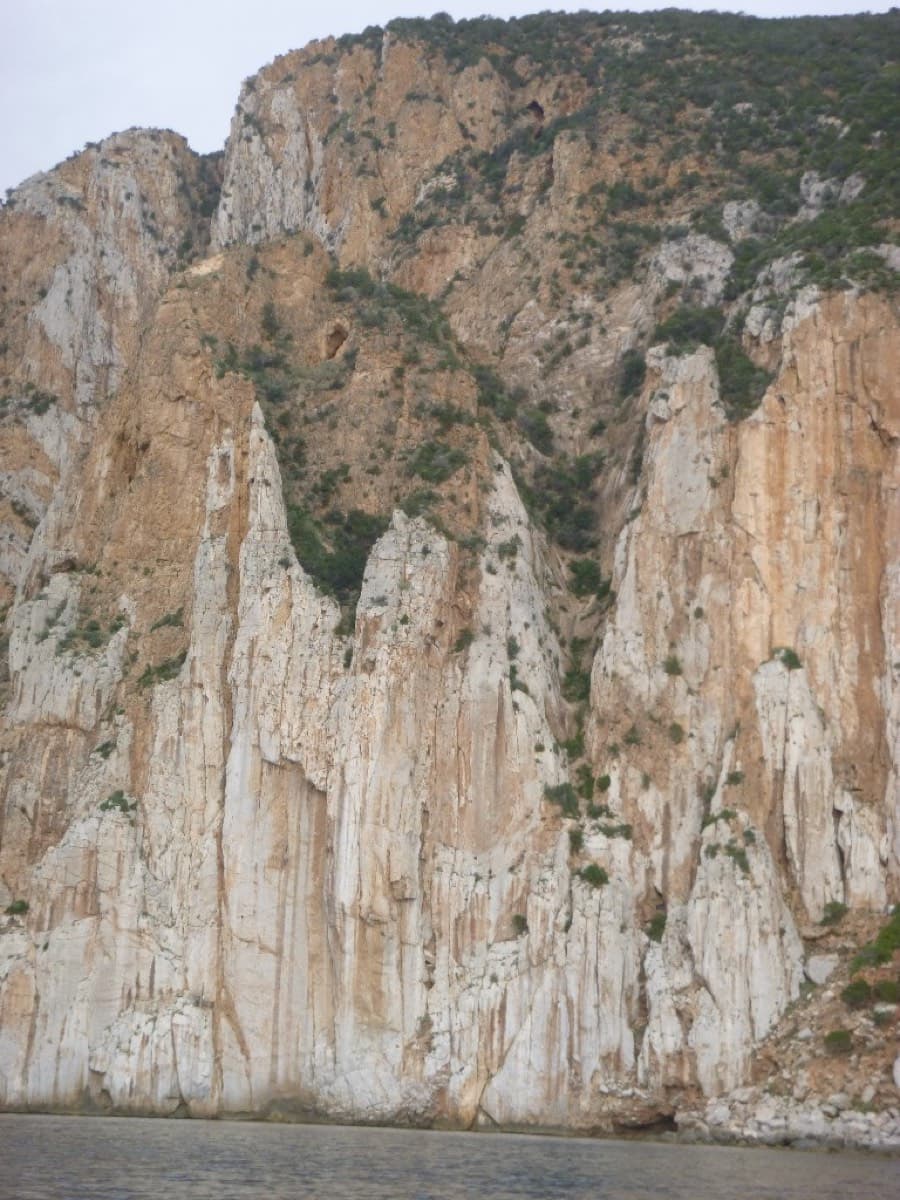
Pedra Longa, Baunei, seen from the sea

Italy · Sardinia

Marinaio di Foresta

An airy, mostly left-rising traverse that spirals round the Pedra Longa sea stack to its summit, on water-runnelled grey walls and pocketed white rock right above the sea. It has become one of the most popular routes in Sardinia, so expect queues.

6a+7 pitches190 m

Committing
The Aguglia di Goloritzè above Cala Goloritzè, seen from the sea

Italy · Sardinia

Easy Gymnopédie

This is the easiest way to the top of Sardinia's iconic 140 m pinnacle above Cala Goloritzè. Short technical bulges and walls lead to a fine slab finish, and the harder overhangs can be aided. Gulliver splits it into 4 pitches; camptocamp gives 5. Check seasonal access rules for Cala Goloritzè before going.

6b5 pitches150 m

Read the cautions

The Masua sea cliffs seen from the water

Italy · Sardinia

L'Italia Liberata

A short but superb sea-cliff route on beautifully sculpted limestone in an incredible setting near Pan di Zucchero. Corners and an airy pillar lead to a steep, rounded 6a wall. Camptocamp rates it 'great'.

6a4 pitches120 m

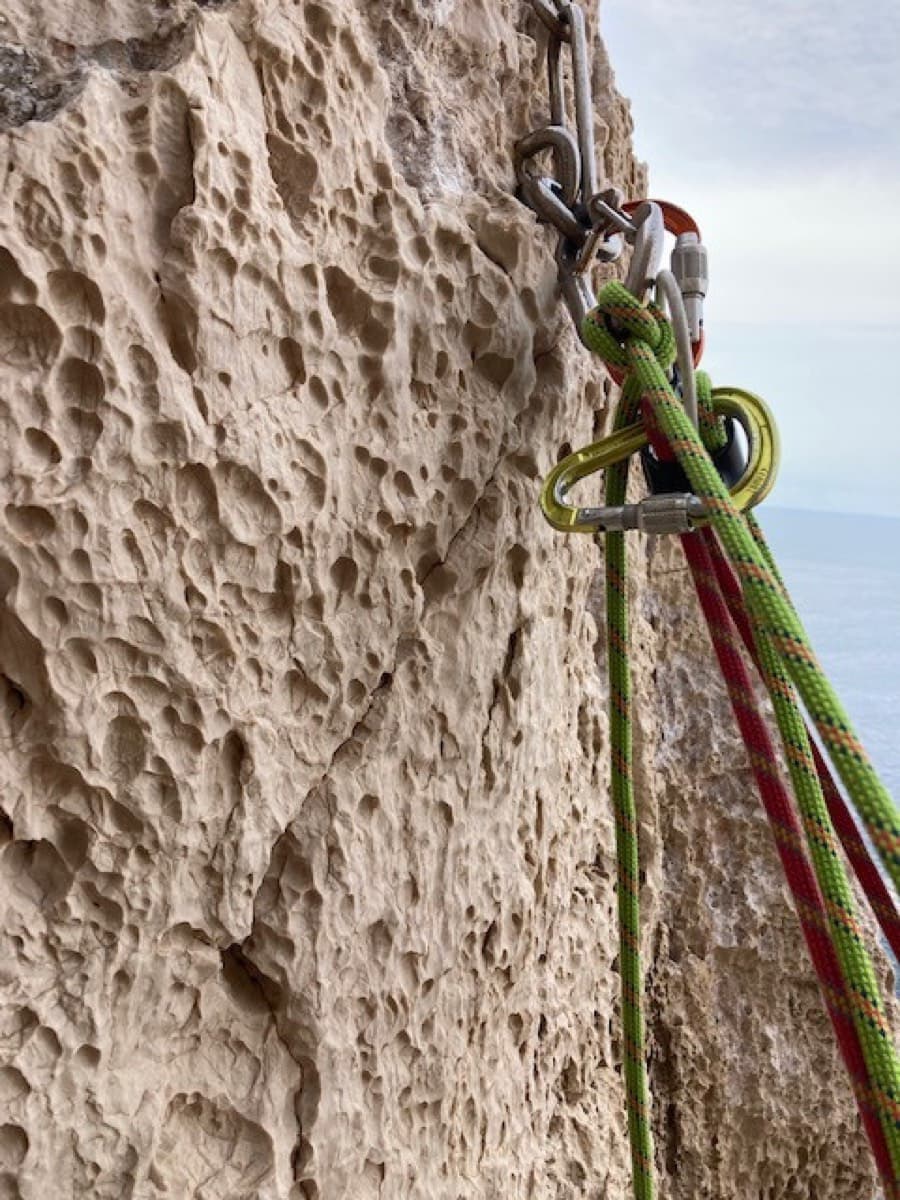
A chained belay on the pocketed limestone of Powaqqatsi, Capo Caccia

Italy · Sardinia

Powaqqatsi

The easiest line on the Capo Caccia sea cliff: six pitches of 4b to 4c on pocketed, sharply sculpted limestone above the open sea. You abseil in from the top and climb out. The first two pitches are vegetated; the climbing proper starts on the pitch 3 slab.

4c6 pitches145 m

Read the cautionsCommitting

Around 5a · about 4 pitches

Similar elsewhere

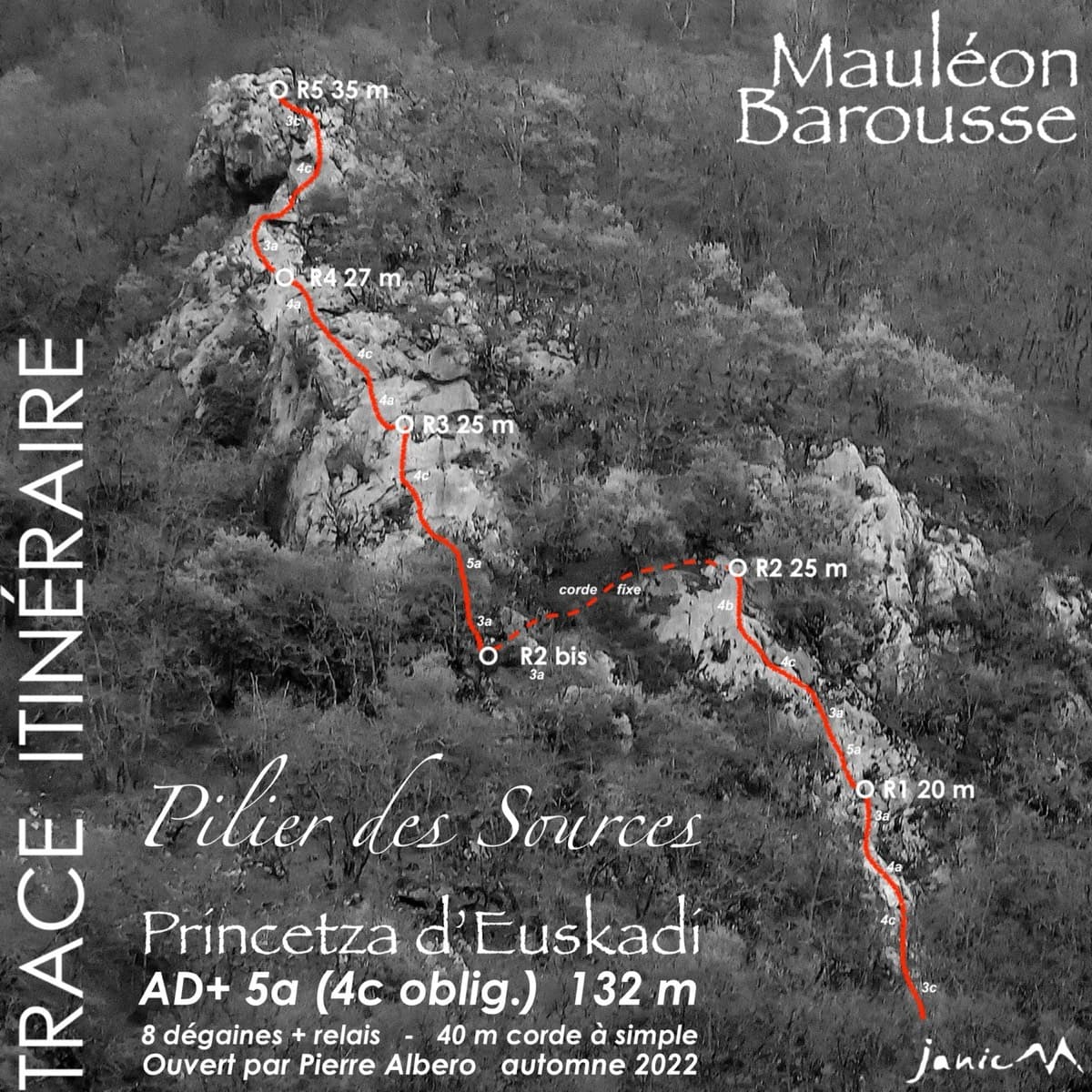
Photo-topo of Princetza d'Euskadi on the Pilier des Sources, Mauléon-Barousse, with belays and pitch lengths

France · Barousse (Central Pyrenees)

Princetza d'Euskadi

A short, friendly pillar of wonderfully rough, sculpted limestone above a Pyrenean village, bolted in 2022 as a first multipitch. Five pitches of grade 3 and 4 with single moves of 5a (4c obligatory), fifteen minutes from the car. Ideal for learning rope work; experienced parties move together and are up in an hour.

5a5 pitches132 m

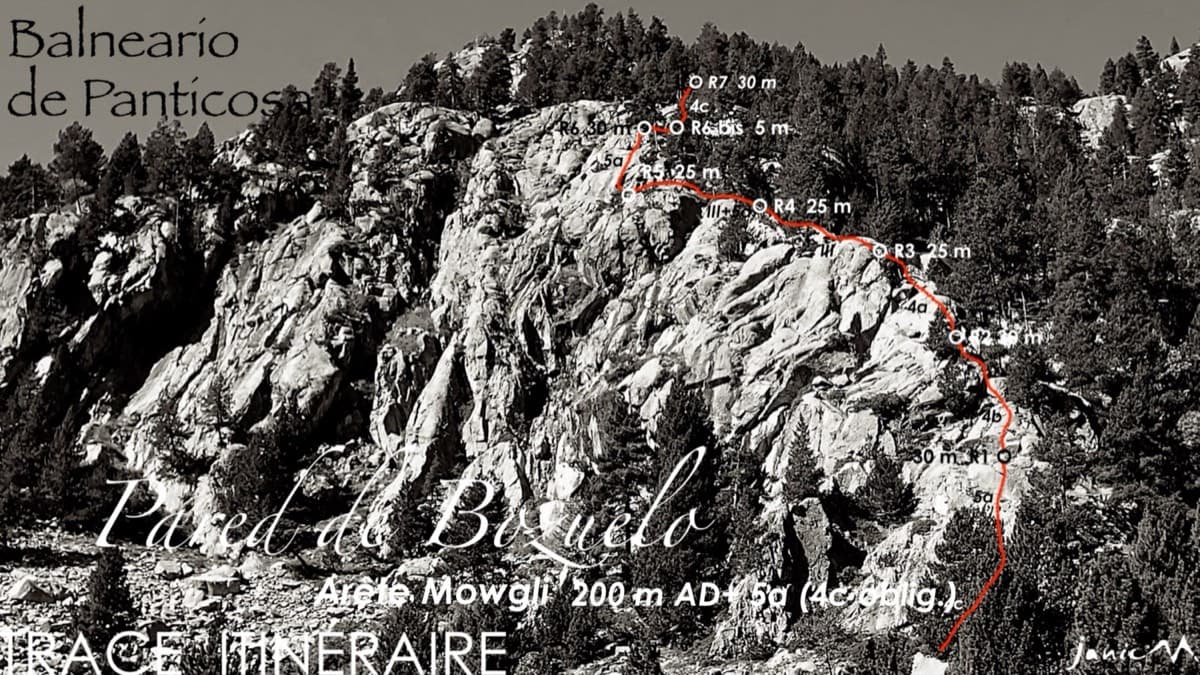
Line of the Arista Mowgli on the Pared de Bozuelo above Baños de Panticosa, with belays marked

Spain · Aragonese Pyrenees (Tena & Canfranc valleys)

Arista Mowgli

An easy granite ridge above the Bozuelo meadows, low-angled and never exposed. Two smooth friction slabs at 5a, on pitches 1 and 6, are the only real difficulties; the rest is steps and short walls at grade 3 to 4. Ideal for a first multipitch, and you can step off rightwards onto ledges almost anywhere.

5a7 pitches200 m

Jardin d'été multi-pitch wall (left) and a climber in the sector (right), Todra Gorge

Morocco · Todra Gorge (Todgha)

Tik Sab

Four pitches of even 5b, five minutes from the road. In the sun all afternoon. A good short first multipitch of a trip.

5b4 pitches125 m

Rujičin kuk, Dabarski kukovi

Croatia · Dabarski kukovi (Velebit)

Velebit Express

The easiest bolted line on the face, up flakes, cracks and water grooves in a wild karst setting. It dries fastest after rain. Pitch grades are from the Čujić topo; camptocamp's ascensionists felt 5b/5c/5b/5b.

5b4 pitches140 m

Read the cautions

Compiled from published sources and last verified October 2026. Bolts, anchors and access change. Climbing is dangerous and you are responsible for your own decisions: check a current topo and read the disclaimer.