Multipitch Atlas

Naqoyqatsi

Capo Caccia (Alghero) · Sardinia · Italy

Read the cautionsCommittingBolting confidence: medium

An abseil-in sea-cliff route next to Powaqqatsi: three abseils to a platform just above the water, then four pitches back out. A steep first step, a fine sustained slab on pitch 2, then easy slabs to the top. Check the park access rules before you go.

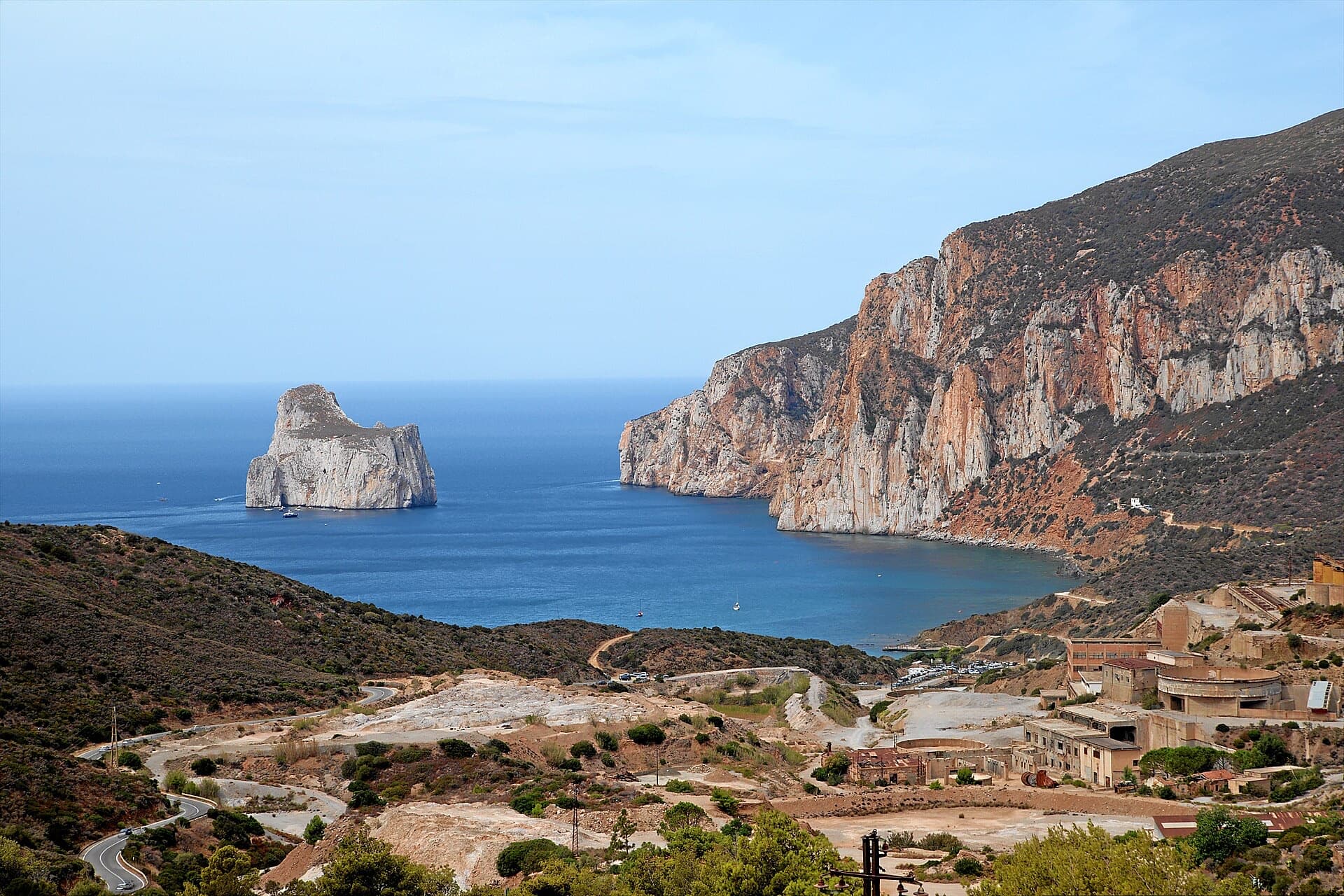
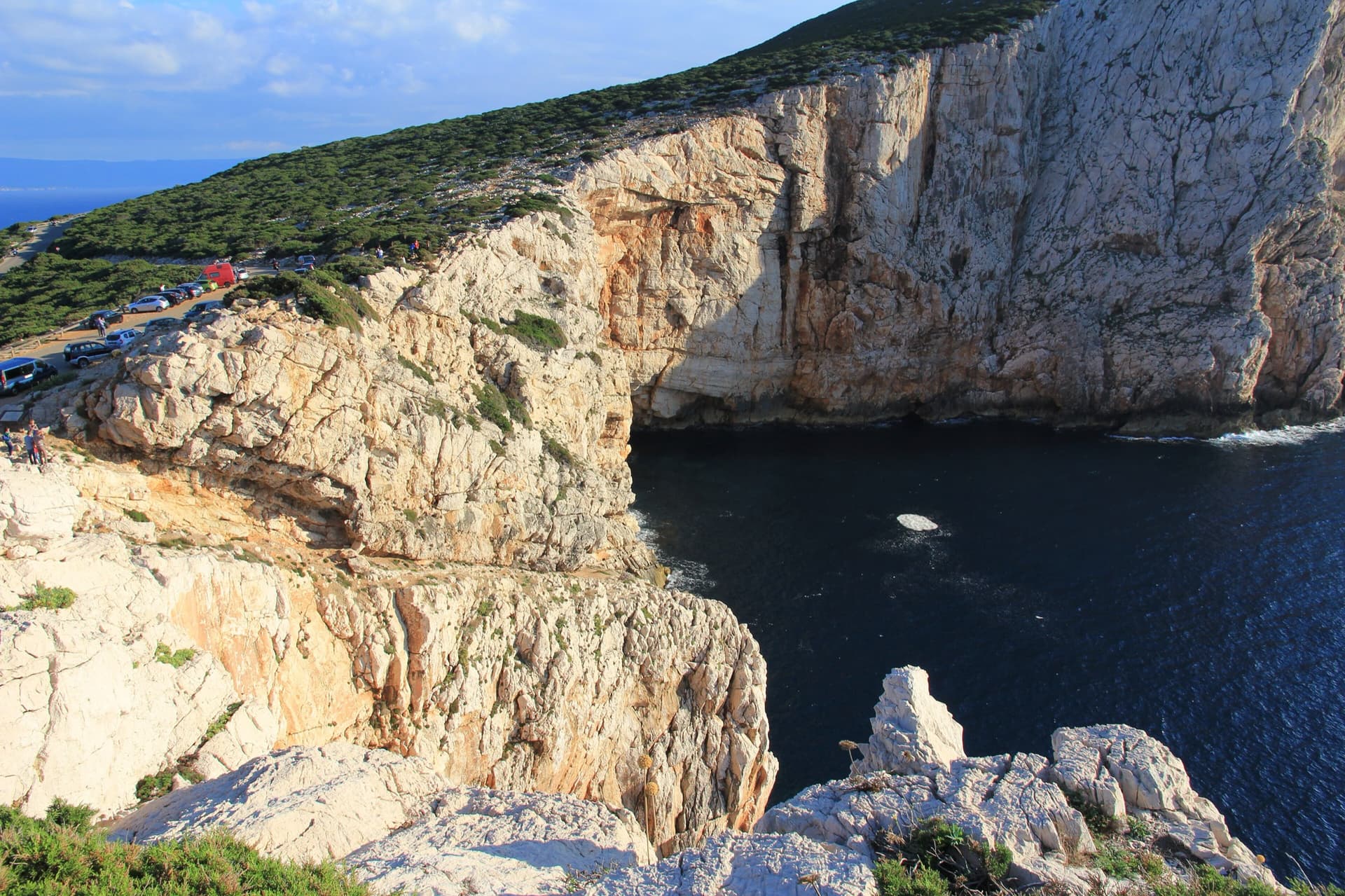
The north-facing sea cliff of Capo Caccia, seen from the cliff topPhoto: AmandineM · CC BY-SA 3.0

Photo

The north-facing sea cliff of Capo Caccia, seen from the cliff topPhoto: AmandineM · CC BY-SA 3.0
Hardest pitch
5b
Pitches
4
Length
130 m
Approach
5 min
Aspect
N
North-facing
Rope
2×50 m
abseil approach
Read before you go

Sound stainless bolts on the pitches, but it is an abseil-in sea cliff with unlinked lower stations, some loose blocks and a park authorisation that you must check.

The route

Overview

Naqoyqatsi is one of Corrado Conca's easy bolted lines on the north face of Capo Caccia, the limestone headland west of Alghero. You abseil about 125 m to a platform a few metres above the sea and climb four pitches back to the top. The line follows the big corner and leaves it on the right; a variant stays in the corner to the top. The climbing is slabby and moderate, with the hardest moves in a 5 m step at the start and on the thin slab of pitch 2. It is a committing setting for the grade, because the only documented way out is to climb.

The climbing

Pitch by pitch

Pitches of Naqoyqatsi
PitchGradeLengthNotes
P15b40 mA steep 5 m step straight off the platform is the technical crux, then easier stepped ground. Climbing Italy also gives 5b.
P25a+40 mA fine, quite thin and sustained slab that trends right near the top. Parties in 2018 and 2024 found it harder than pitch 1 despite the grade. Climbing Italy gives 5a.
P34b25 mSlab. Climbing Italy gives 4.
P44c30 mSlab to a single-pitch lower-off at the top. Climbing Italy gives 4.

Getting there

Approach

To the parking

Capo Caccia is the headland west of Alghero in north-west Sardinia. A 2026 party parked at the Belvedere Foradada viewpoint. The sources read do not describe the road in more detail.

On foot · about 5 min

About 5 minutes from the parking to the cliff top (Climbing Italy). The abseils start from a chained belay in a slab, in a small gully that holds two single-pitch routes about 20 m below the summit. Abseil 1 (45 m): keep to the right as you go down, past a variant belay and the pitch 3 belay, to a big block with several maillons. Abseil 2 (40 m): trend slightly left towards the corner down the pitch 2 slab, to a scoop in the corner with two bolts close together. Abseil 3 (40 m): straight down stepped ground past a first platform about 10 m above the water to a second one about 5 m above it, where two bolts mark the start.

Map of the walk-in

  • Crag

Loading map

The point marks the crag, not the exact start of the route.

Coordinates · crag

40.57424, 8.15914

Point from camptocamp waypoint 674083

For your phone or watch

Download GPX

Contains the route point. Opens in most mapping apps and GPS watches.

Points are compiled from published sources, with the precision stated above. They were not surveyed on the ground: check them against a current topo.

Getting down

Descent

None needed: you finish at the cliff top and walk back to the car.

Retreat

Bailing off the route

Committing

You abseil in and pull the ropes, so the normal way out is to finish the route. No source describes another exit from the sea-level platform. From part-way up you could abseil back to a lower belay, but that only returns you to the bottom of the cliff.

Retreat from
Not applicable in the usual sense: the belays are bolted and the abseil line passes the pitch 2 and pitch 3 belays, but going down does not get you out.
Point of no return
Pulling the ropes after the first abseil.
Carry
If in doubt about the party's ability, leave the abseil ropes in place on the first visit (this needs spare ropes to climb on) or choose a route you can walk away from.
Basis
Inferred from the route factsSources describe the abseil approach and the climb out but never discuss retreat; the assessment follows from the geometry of an abseil-in sea cliff.

Partly inferred from the route facts

Safety

Hazards

  • Abseil approach above the sea. Once the ropes are pulled, climbing out is the only documented way back, so everyone in the party must be able to climb 5b slab.
  • Access rules: in June 2026 two police officers told a party that climbing here needs an authorisation from the park office. The headland is a protected area; ask locally before you climb.
  • Loose blocks on a small ledge near belay 2. In 2018 a block dislodged by the second half-cut one strand of the rope of the climber below.
  • Only the top station is chained. The two lower stations are two unlinked bolts; bring material to join them.
  • Climbing Italy warns that the old routes on this cliff are extremely rusted and should not be started. Several lines run close together; do not count bolt lines to find your way.
  • Go all the way down to the lowest platform. If you start from the one 3 m higher you miss the crux step.

Sun and weather

Conditions

North facing sea cliff. A party in late June 2026 started abseiling at 09:30 and was in shade all morning; Climbing Italy marks the crag as getting sun in the afternoon, sheltered from the scirocco and climbable all year. The lowest platform is sometimes awash: it was half covered by water on a visit in October 2018. A 2024 party took 3 h 40 min car to car.

Usual season · Mar to Jun, Sep to Nov

Sun on the wall · N-facing

Working out the sunlit hours for this month.

  • January: not yet worked out
  • February: not yet worked out
  • March (usual season): not yet worked out
  • April (usual season): not yet worked out
  • May (usual season): not yet worked out
  • June (usual season): not yet worked out
  • July: not yet worked out
  • August: not yet worked out
  • September (usual season): not yet worked out
  • October (usual season): not yet worked out
  • November (usual season): not yet worked out
  • December: not yet worked out

Sun on the wallDaylight, wall in shade● Usual season

Estimated from the wall's aspect only. Ignores surrounding terrain, gullies and the wall's exact shape. Clock times are local to the wall (Central European time), for the 15th of each month.

Monthly climate averages for Sardinia, 1991-2020
MeasureJanFebMar (usual season)Apr (usual season)May (usual season)Jun (usual season)JulAugSep (usual season)Oct (usual season)Nov (usual season)Dec
Mean daily high °C141417202530343428241815
Mean daily low °C77911151922221916129
Rain days 1 mm or more9910118433771010

● marks the usual climbing season. Averages for 1991-2020 at about 100 m. Area climate from Open-Meteo reanalysis. Temperatures are adjusted to the height of the crag; rain comes from a grid cell of about 10 to 25 km, and summer highs on sea cliffs can read a few degrees low. The wall and valley can differ. Data: Open-Meteo, CC BY 4.0.

What to carry

Gear

Two ropes of at least 50 m for the abseils (45, 40 and 40 m). Slings or cord and a couple of maillons or karabiners to link the two lower abseil stations, which you collect on the way back up. The number of quickdraws is not published. Helmet.

Checklist

Quickdraws
Number not given in the sources
Rope
2×50 m (abseil approach)
Helmet
One each

Derived from the route data; check it against a current topo

From climbers

Reader reports

Reader reports are not being collected yet. Until they are, check a current topo and the local club or guidebook publisher for recent changes to Naqoyqatsi.

Worth knowing

Tips

  • Pitches 3 and 4 can be linked without rope drag according to a 2026 party; a 2018 party who tried had to move together for about 10 m, so do it only with a rope of 60 m or more.
  • Powaqqatsi (4c), already in the atlas, is on the same cliff and makes a natural pair.

Open questions

Where sources disagree

  • Grade: Climbing Italy's header shows 6a+ for the route, but its own pitch list is 5b, 5a, 4, 4 and camptocamp gives 5b, 5a+, 4b, 4c. The pitch grades are used.
  • Number of abseils: the guidebook describes two, a 2018 party needed three (or four following the route). Camptocamp now describes three, of 45, 40 and 40 m.
  • Linking the last two pitches: fine without drag according to a 2026 report, not possible on their rope according to a 2018 report.

Provenance

Sources

Same area

More in Sardinia

All routes in Sardinia
Pedra Longa, the 128 m limestone tower on the Baunei coast, seen from the shoreline rocks at its foot.

Italy · Sardinia

Marinaio di Foresta

An airy, mostly left-rising traverse that spirals round the Pedra Longa sea stack to its summit, on water-runnelled grey walls and pocketed white rock right above the sea. It has become one of the most popular routes in Sardinia, so expect queues.

6a+7 pitches190 m

Committing
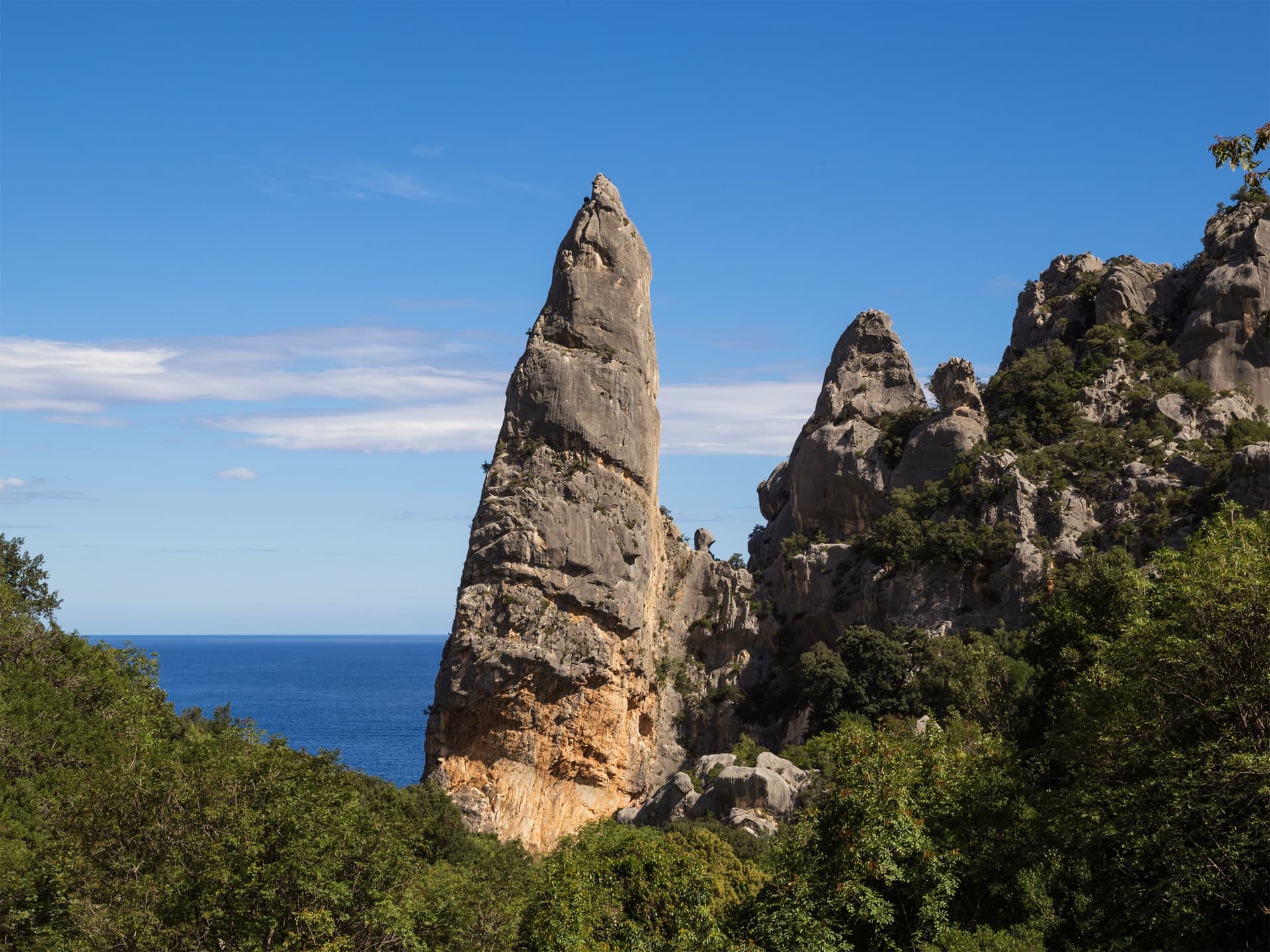
The Aguglia di Goloritzè, the 140 m limestone spire above Cala Goloritzè, seen from the approach path with the Gulf of Orosei behind.

Italy · Sardinia

Easy Gymnopédie

This is the easiest way to the top of Sardinia's iconic 140 m pinnacle above Cala Goloritzè. Short technical bulges and walls lead to a fine slab finish, and the harder overhangs can be aided. Gulliver splits it into 4 pitches; camptocamp gives 5. Check seasonal access rules for Cala Goloritzè before going.

6b5 pitches150 m

Read the cautions

The orange limestone cliffs of Masua (right) above the old mine workings, with the Pan di Zucchero sea stack offshore.

Italy · Sardinia

L'Italia Liberata

A short but superb sea-cliff route on beautifully sculpted limestone in an incredible setting near Pan di Zucchero. Corners and an airy pillar lead to a steep, rounded 6a wall. Camptocamp rates it 'great'.

6a4 pitches120 m

The limestone sea cliffs of Capo Caccia below the Foradada viewpoint car park, dropping straight into the sea.

Italy · Sardinia

Powaqqatsi

The easiest line on the Capo Caccia sea cliff: six pitches of 4b to 4c on pocketed, sharply sculpted limestone above the open sea. You abseil in from the top and climb out. The first two pitches are vegetated; the climbing proper starts on the pitch 3 slab.

4c6 pitches145 m

Read the cautionsCommitting

Around 5b · about 4 pitches

Similar elsewhere

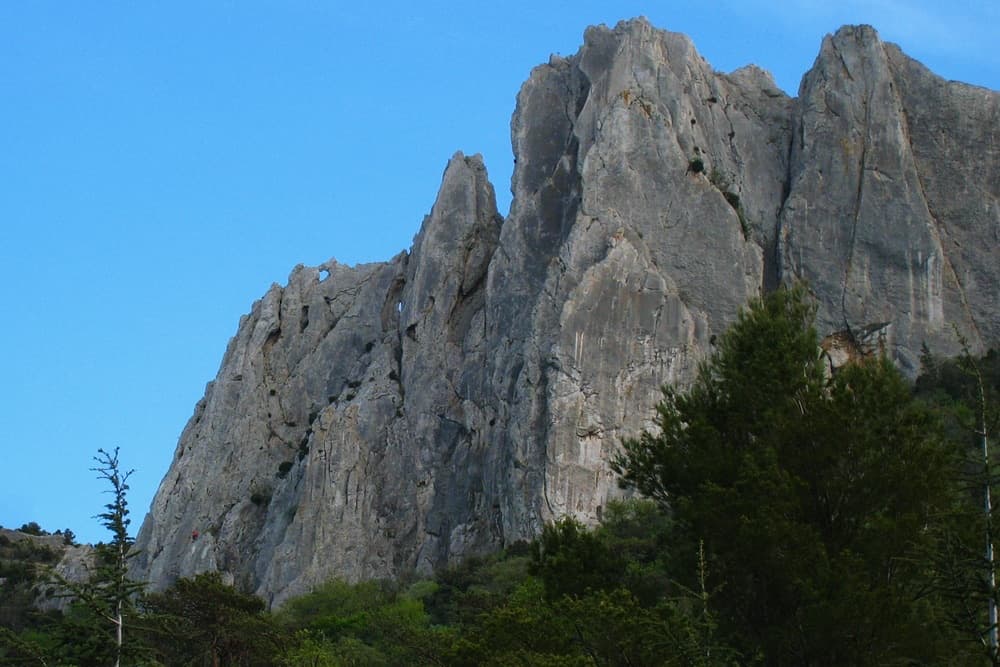
The north face of the Gigondas chain at the Aiguillette Lagarde and Trois Plaques sectors, with a window through the crest visible on the left; Petite Émeline climbs on this side. The line is not marked.

France · Dentelles de Montmirail

Petite Émeline

A short, generously bolted beginner's multipitch on the north face of the Gigondas chain: an easy corner, a fine vertical wall, a rising traverse, and then a squeeze through a natural window in the crest to finish on the sunny south side. Polished from traffic but full of character, and done in an hour or so.

5b4 pitches65 m

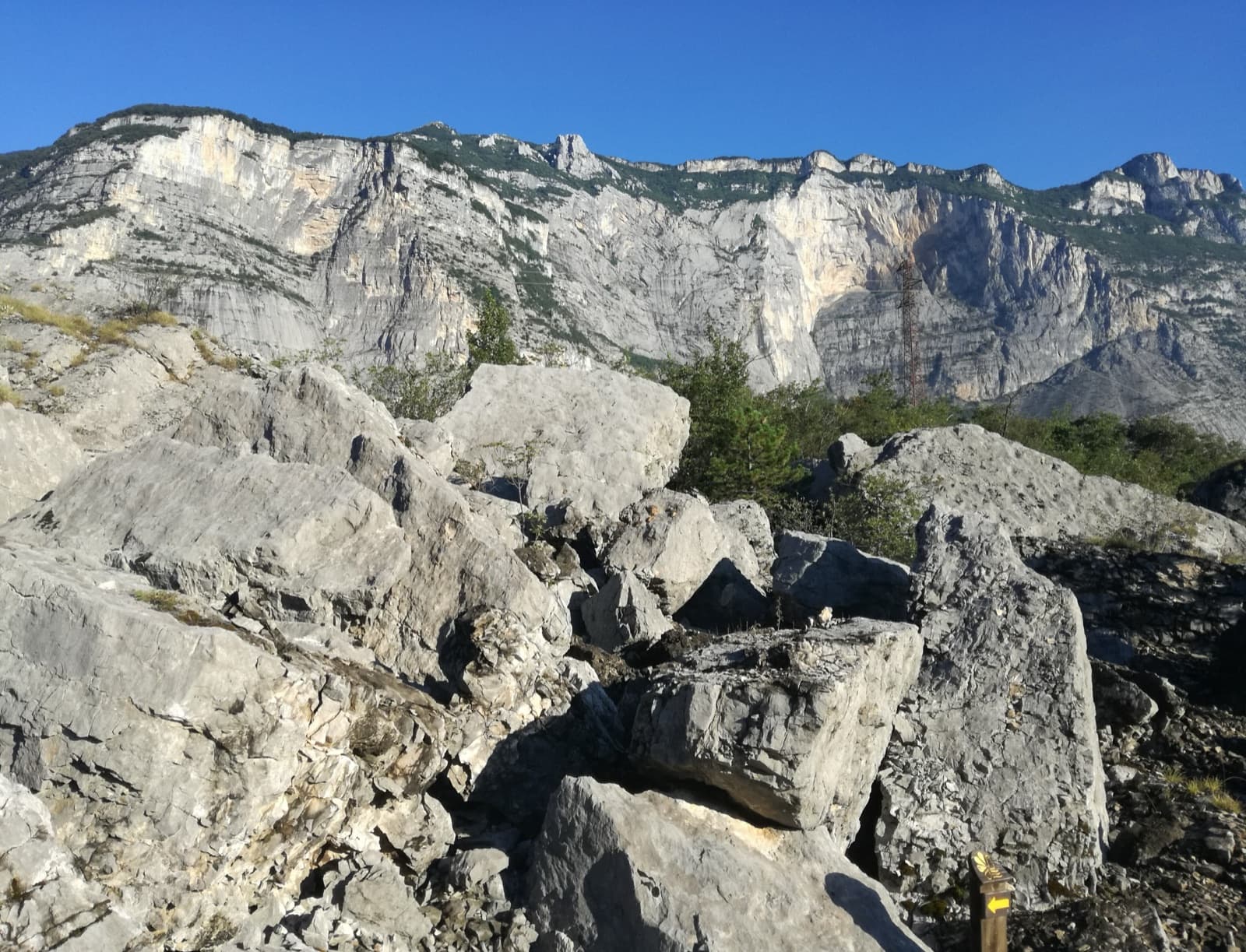
A view of the region, not this route's wall. Limestone blocks of the Marocche di Dro rockfall beneath the upper walls of Monte Brento, the setting of the Placche Zebrate.

Italy · Arco & Valle del Sarca

Via Trento

Four long pitches of easy-angled friction slab on the far left of the Placche Zebrate, a touch harder than its neighbour Via del 46° Parallelo and just as popular. The rock is rough and pleasant almost everywhere, with one smoother section on the second and third pitches where the 5a to 5b moves are. A good first route on these slabs.

5b4 pitches180 m

A view of the region, not this route's wall. The south side of the Aiguille d'Orny above the scree slope of the approach

Switzerland · Orny (Champex, Mont Blanc massif)

Petite fleur

Four pitches on a pillar of orange granite beside the path to the Cabane d'Orny, made to be climbed on the way up to the hut. The rock is cut into big blocks with positive edges. The last two pitches are steeper and more sustained than the grade suggests.

5b4 pitches100 m

Palms and garden terraces on the riverbed just upstream of the Todra narrows, the setting of the Jardin d'été sector.

Morocco · Todra Gorge (Todgha)

Tik Sab

Four pitches of even 5b, five minutes from the road. In the sun all afternoon. A good short first multipitch of a trip.

5b4 pitches125 m

Compiled from published sources and last verified October 2026. Bolts, anchors and access change. Climbing is dangerous and you are responsible for your own decisions: check a current topo and read the disclaimer.