Multipitch Atlas

Roca por un Tubo

Pared de la Tubería, Baños de Panticosa · Aragonese Pyrenees (Tena & Canfranc valleys) · Spain

Read the cautionsBail with caveatsBolting confidence: high

High-mountain granite slabs and dihedrals above the Panticosa spa. Three 6a cruxes mix friction slab with a short flaky roof on pitch 7.

Topo of Roca por un Tubo, Pared de la Tubería (Cerro Gascón), Baños de PanticosaPhoto: janic · CC BY-SA 3.0

Topo

Topo of Roca por un Tubo, Pared de la Tubería (Cerro Gascón), Baños de PanticosaPhoto: janic · CC BY-SA 3.0
Hardest pitch
6a
Pitches
9
Length
300 m
Approach
60 min
Aspect
SW
South-west-facing
Rope
1×60 m
Read before you go

Fully bolted, but the pitch 4 chimney belay has been dismantled, forcing a 40–50 m pitch with heavy drag, and snow can block both descents early in the season.

The route

Overview

A nine-pitch, 300 m bolted route on the granite wall crossed by the hydroelectric pipe above Baños de Panticosa, starting at about 1,950 m. Easy slabs and steps lead to three 6a pitches: a thin vertical slab followed by a bulging corner and a chimney on pitch 4, a steepening slab on pitch 6 and a slightly overhanging roof of solid flakes on pitch 7. The 6a sections are short and closely bolted, and the rest is grade 5 or below. The main complication is that the original belay in the chimney on pitch 4 has been dismantled, which makes that pitch long and awkward. It stays in shade until around midday, so it suits hot summer days.

The climbing

Pitch by pitch

Pitches of Roca por un Tubo
PitchGradeLengthBoltsNotes
P14b40 m6 boltsFrom the starting slab follow a corner rising rightwards, then return to the slab before the belay. 6 bolts and 2 threads. A 2025 party did not find this belay.
P23b35 m2 boltsLeave the belay leftwards and head for a big pine with a sling, below a slab with a bolt; the belay is on a wall to the right above it and is easy to miss. 2 bolts and 1 thread.
P35a40 m10 boltsStraight up a series of steps (3c) to a first wall and a ledge, then a bulging slab (5a) to the belay. This belay has no abseil ring.
P46a40 m9 boltsA thin vertical slab (5b, then 6a, very well protected) up to where it abuts the wall. On the left a corner gives access to a bulging slab with a good crack on the right, which some find harder than the slab. This leads into a chimney. The original belay inside the chimney no longer exists, so continue up the chimney to the belay at its exit. To here the pitch is 40 m at least, about 50 m by one account, with heavy rope drag. 9–13 bolts and 2 threads depending on the source.
P54c35 m8 boltsA fractured, blocky zone trending right, leaving a dead pine on the right, then back left up a slab to the belay. Use long quickdraws. 8 bolts and 1 thread.
P66a40 m12 boltsStep onto a ledge above the belay and go slightly right. Climb a slab split in two by a step, which steepens gradually (4c, 5b, then a thin 6a section in the middle) to a ledge.
P76a30 m14 boltsStraight up to a distinctive rock spike with two slings, then a right-rising corner to an area of slabs. Traverse right and pull through a slightly overhanging roof of solid flakes (6a, physical) to the belay directly above. 14 bolts and 1 thread. This pitch was wet when the rest was dry in one report.
P85a20 m4 boltsLeave the belay on the left in an exposed position, traverse 3 m, then climb an ill-defined corner that lies back onto the final grass.
P9240 m3 boltsEasy rock steps between the grass to a hump with a terrace. One party could not find the final belay and used a block; another belayed on a pine.

Getting there

Approach

To the parking

Base is Baños de Panticosa (Balneario de Panticosa, about 1,665 m) at the head of the Tena valley. Park there and start from the Casa de Piedra refuge. Camptocamp lists no public transport service to the Baños.

On foot · about 60 min

About 1 h (reports range from 40 min to 1 h 30). Leave Casa de Piedra on the Bachimaña path. After the viewpoint cross to the left bank of the Río Caldarés and take the GR11 path towards the Labaza and Bozuelo lakes (Brazato direction). Shortly afterwards turn left onto a well-marked path that leads to the Lumiacha pool. You pass the pipe twice; once it is behind you and on your right, and after a slight descent, you reach a zone of blocks. Take a faint, damp path on the right (cairn) that climbs rightwards through big boulders for about 5 min to a grassy shoulder, from where you see the starting slab. A small orange banner, now faded to white, on the first bolt carries the route name. The route Pa ti es la vía starts to the left, at the lowest point of the wall.

Finding the route · 3 photos

  • OverviewThe Pared de la Tubería with the neighbouring route Pa ti es la vía drawn in from the lowest point of the wall. Roca por un Tubo starts to the right of it.Photo: janic · CC BY-SA 3.0
  • Walk-inBelow the wall (October 2018): the zone of big boulders you cross to reach the start, with the pipe running down the slope behind.Photo: janic · CC BY-NC-ND 3.0
  • Start of the routeThe first bolt with the small banner carrying the route name (October 2018; later reports say it has faded to white).Photo: janic · CC BY-NC-ND 3.0

Approach photo

Map of the walk-in

  • Crag
  • Parking
  • GPS line

Loading map

The point marks the crag, not the exact start of the route.

GPS line: one party's recorded GPS track of the whole day, including the climb and the descent. One party's recorded day in October 2018: walk-in from Casa de Piedra via the Brazato path and the Lumiacha pool (39 minutes), the climb, and the descent by the Brazato lake path back to the Baños. Do not follow it blindly.

GPS line: janic · CC BY-NC-ND 3.0

Coordinates · crag

42.76807, -0.22492

Parking

42.75957, -0.23461

Baños de Panticosa (camptocamp access point)

Point from camptocamp waypoint 1133950

For your phone or watch

Download GPX

Contains the route point, parking and a GPS line. Opens in most mapping apps and GPS watches.

Points are compiled from published sources, with the precision stated above. They were not surveyed on the ground: check them against a current topo.

Getting down

Descent

Walk off. Option 1 (camptocamp, 1 h 20): from the top take the path NNW, as if heading for the Bachimaña refuge, which you can see clearly, then return by the Lumiacha pool path; it is 15–20 min from the top to the junction with the path from Lumiacha. Do not take the longer path towards Labaza. Option 2 (several parties, about 1 h): go right from the top, away from the refuge, and follow the pipe for about 25 min through two tunnels to join the path (GR11 from Brazato) that drops to the car park in a further 35 min. Abseiling the route is possible only as an emergency: camptocamp says the belays have rings except the third, and the original fourth belay is gone.

Retreat

Bailing off the route

Bail with caveats

Yes, but treat it as an emergency option. Camptocamp says the belays have abseil rings except the third, and escapes are noted at the second and fifth belays. One party abseiled the whole route in April 2023 when snow blocked the walk-off. The original belay in the pitch 4 chimney has been dismantled, so that pitch is a 40 to 50 m abseil.

Retreat from
Escapes on foot are noted at the second and fifth belays; the sources do not describe where they lead. By abseil, the ringed belays: R1, R2, the belay at the chimney exit and those above. R3 has no ring, so you leave gear there or pass it.
Point of no return
Entering the chimney on pitch 4. With the old belay gone you must reach the belay at its exit, 40 to 50 m up with heavy drag, and the next noted escape is one pitch higher at the fifth belay. This is inferred.
Carry
Two ropes if you want to be sure of abseiling pitch 4 (40 to 50 m); a single 60 m does not cover it, nor the 40 m pitches listed elsewhere. A maillon and cord for the ringless third belay.
Basis
Part stated, part inferredCamptocamp states the abseil rings except at R3, the escapes at R2 and R5 and the dismantled chimney belay, and the equippers' blog comments report the 2023 abseil retreat; the rope requirement and turning point are inferred from pitch lengths.

Partly inferred from the route facts

Safety

Hazards

  • The original fourth belay, inside the chimney on pitch 4, has had a hanger removed and cannot be used (reported in 2023, 2024 and 2025). You must climb the chimney to the belay at its exit, a 40–50 m pitch with heavy drag and your second out of sight. Extend runners and take two extra quickdraws. A 50 m rope is marginal here.
  • Early season: in April 2023 a party found the first tunnel on the right-hand descent blocked by snow and wet snow slopes on the left-hand descent, and had to abseil the route. The third belay has no abseil ring.
  • The second belay is offset and easily missed, and the first and last belays were not found by some parties.
  • The roof on pitch 7 is strenuous and the equipper's blog warns that a grade-5 climber relying on A0 may struggle there, although slings and cords left on the hard moves help.
  • Seepage after rain on the thin slab moves.

Sun and weather

Conditions

West to south-west facing granite between about 1,950 m and 2,200 m. In shade until 12:00–13:00 in summer, which makes it a good hot-weather route; in late September the sun only arrived at the fifth belay and it was cold. Trip reports run from late June to early October. If it rained the day before, the delicate moves are likely to be wet. Early in the season snow blocks both walk-offs. Popular, with queues reported.

Usual season · Jun to Oct

Sun on the wall · SW-facing

Working out the sunlit hours for this month.

  • January: not yet worked out
  • February: not yet worked out
  • March: not yet worked out
  • April: not yet worked out
  • May: not yet worked out
  • June (usual season): not yet worked out
  • July (usual season): not yet worked out
  • August (usual season): not yet worked out
  • September (usual season): not yet worked out
  • October (usual season): not yet worked out
  • November: not yet worked out
  • December: not yet worked out

Sun on the wallDaylight, wall in shade● Usual season

Estimated from the wall's aspect only. Ignores surrounding terrain, gullies and the wall's exact shape. Clock times are local to the wall (Central European time), for the 15th of each month.

Climate figures for Aragonese Pyrenees (Tena & Canfranc valleys) are not available yet

What to carry

Gear

15 quickdraws including some long ones, plus two extra if you run pitch 4 through to the chimney exit. Camptocamp lists a 50 m rope, but with the chimney belay gone a 60 m rope is the safer choice. Helmet. One party added a cam and a sling in the chimney on pitch 4 to avoid a slide back into it; this is optional.

Checklist

Quickdraws
15
Rope
1×60 m
Helmet
One each
Abseil device and prusik
The descent or the retreat involves abseiling
Maillons or spare karabiners
To leave behind if you retreat
Cord
Mentioned for retreat

Derived from the route data; check it against a current topo

From climbers

Reader reports

Reader reports are not being collected yet. Until they are, check a current topo and the local club or guidebook publisher for recent changes to Roca por un Tubo.

Worth knowing

Tips

  • Easy links: 1+2 (belay at the big pine with the sling, or move together to the second belay) and 8+9 with a 60 m rope.
  • Escapes are noted at the second and fifth belays.
  • The 6a on pitch 4 is thin but very closely bolted; in-situ slings on several hard moves make A0 straightforward.
  • Climbing time is 3–4 h.
  • You can reach the wall by first climbing a route on the Molondro crag below, which cuts the walk between the two walls to about 15 min.
  • Casa de Piedra refuge at the Baños is the obvious base. The equippers' topo is on the Sendero Límite blog, with a Wikiloc track of the approach and descent linked from it.

Open questions

Where sources disagree

  • Rope: camptocamp says 50 m. Pitch 4 to the upper belay is 40 m in the table, '40 m minimum' in a 2023 report and 50 m in a 2018 report. Given the missing chimney belay, 60 m is recommended here.
  • Pitches 8 and 9: the French camptocamp page gives 20 m and 40 m, the Spanish page 40 m and 20 m. A 2023 report agrees with the French page, which this entry follows.
  • Pitch 7 is 30 m on camptocamp and 40 m in a 2023 report.
  • Bolt counts: a 2018 party counted 9 bolts on pitch 1 and 13 on pitch 4 against 6 and 9 in the camptocamp table.
  • Grade: the topo says 6a. A 2020 report calls it slightly overgraded and a 2019 report says the 6a sections are only a few moves; a commenter on the equippers' blog insists pitch 7 is a real 6a. This entry keeps 6a on pitches 4, 6 and 7.
  • Approach time: 39 min to 1 h 30 across reports; Escalando gives 1 h 10 from the car park.
  • Descent: camptocamp recommends going left towards Bachimaña (1 h 20); several parties and blog comments say going right along the pipe is quicker (about 1 h).

Provenance

Sources

Same area

More in Aragonese Pyrenees (Tena & Canfranc valleys)

All routes in Aragonese Pyrenees (Tena & Canfranc valleys)
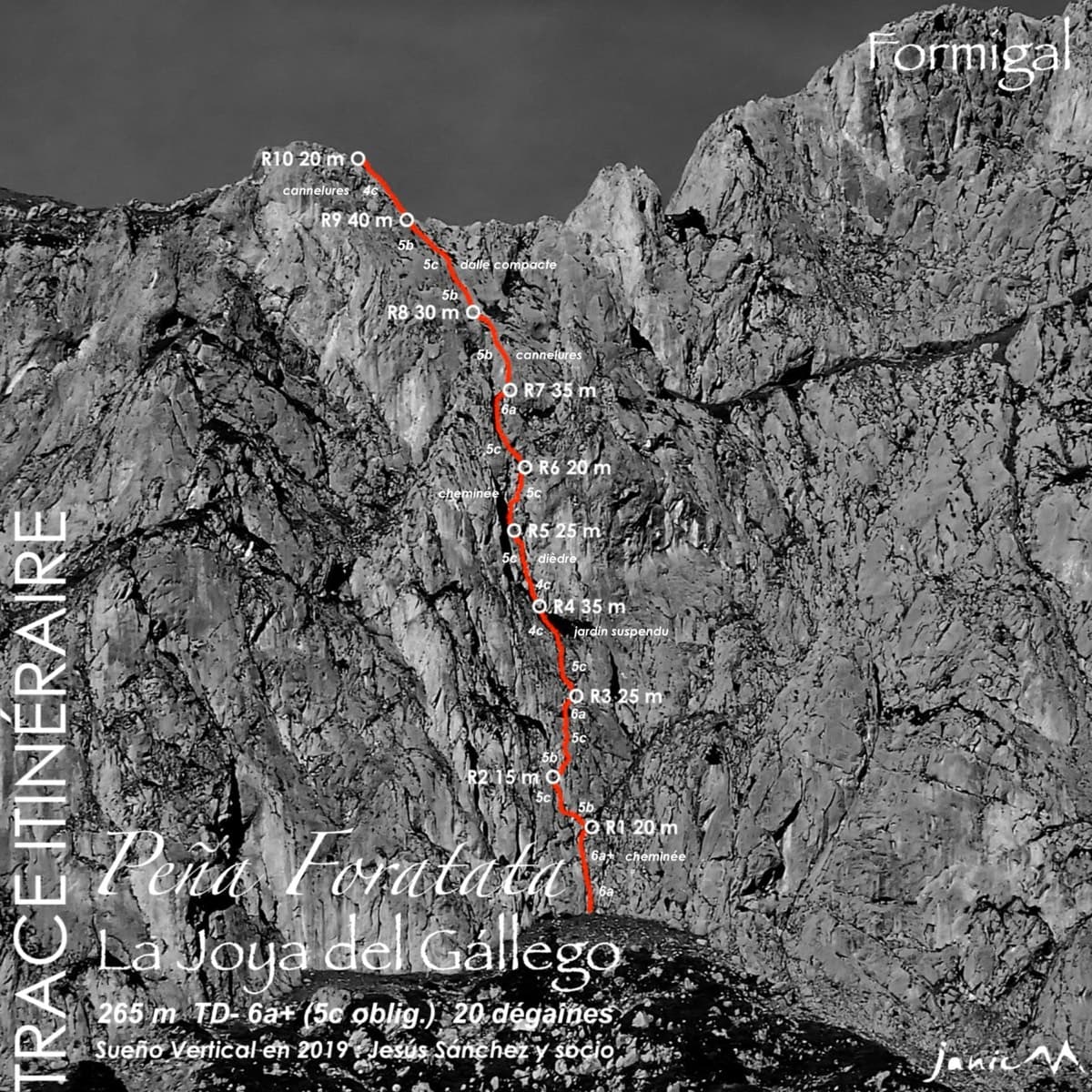
Topo of La Joya del Gállego on the Peña Foratata

Spain · Aragonese Pyrenees (Tena & Canfranc valleys)

La Joya del Gállego

Varied, sustained limestone of chimneys, dihedrals and compact fluted slabs high above the Tena valley. Bearded-vulture nesting closes the face from 1 Dec to 31 Jul unless lifted early, so check montanaregulada.org.

6a+10 pitches265 m

Read the cautions
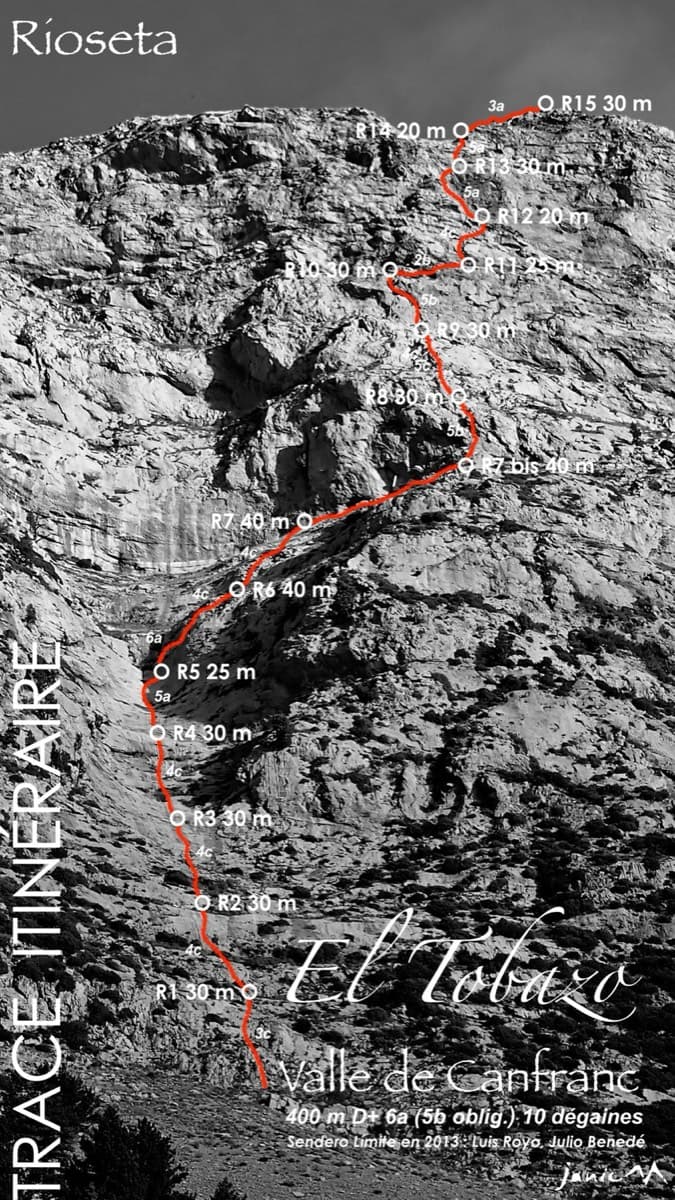
Topo of Valle de Canfranc on the south face of El Tobazo

Spain · Aragonese Pyrenees (Tena & Canfranc valleys)

Valle de Canfranc

A long, mostly easy slab-and-dihedral route with a single 6a slab on pitch 6, in a fine setting facing away from Candanchú. Wait about 30 h after rain because the lower gully drains water.

6a15 pitches400 m

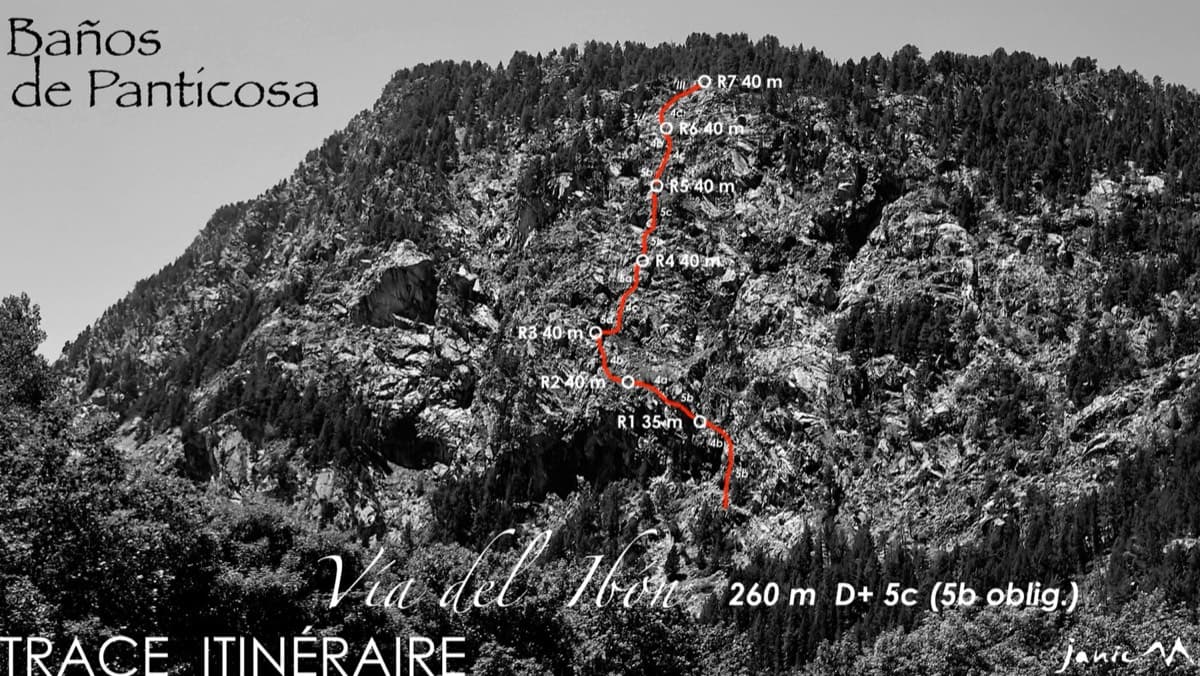
The Pared del Ibón above Baños de Panticosa with the line and belays of Vía del Ibón

Spain · Aragonese Pyrenees (Tena & Canfranc valleys)

Vía del Ibón

A mountain-style line on dark, weathered granite twenty-five minutes above the spa of Baños de Panticosa. It links ramps, a short overhanging break, slabs and a rounded boulder, with one well-bolted 5c move and the rest 4b to 5b. The rock between the good sections is earthy and lichenous, but the friction is excellent and the bolting generous.

5c7 pitches260 m

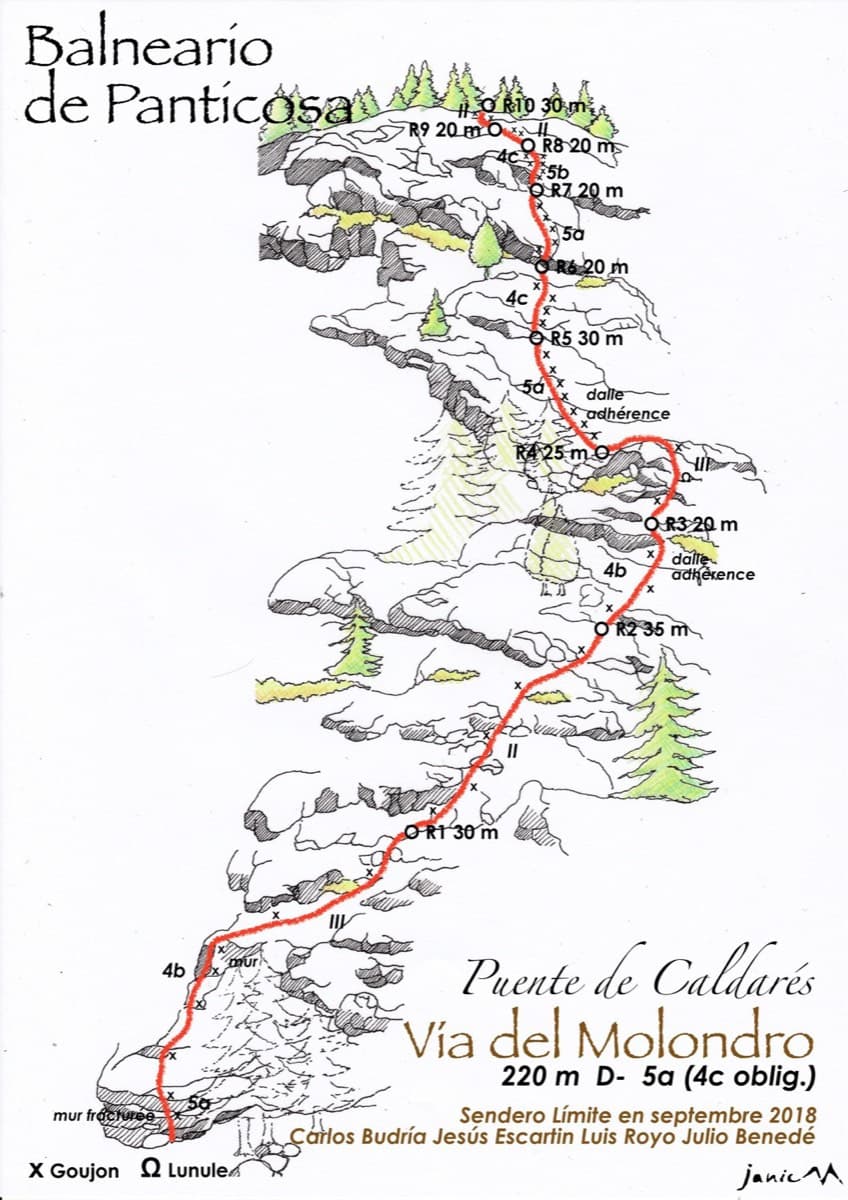
Drawn topo of the Vía del Molondro above the Caldarés bridge, Baños de Panticosa, with bolts and belays marked

Spain · Aragonese Pyrenees (Tena & Canfranc valleys)

Vía del Molondro

Ten short pitches of easy-angled Panticosa granite beside the Caldarés stream, twenty minutes from the car. Mostly friction slabs at 4b to 5a linked by walking-angle ground, with one polished bulge given 5b on the topo. A very gentle first granite multipitch, and a climbing approach to the walls above.

5b10 pitches220 m

Around 6a · about 9 pitches

Similar elsewhere

The Amptrax wall on Frontales, El Chorro

Spain · El Chorro

Amptrax

The absolute El Chorro classic: a physical, sustained line that feels tough for the grade, with a 6a traverse right under the roof. Polished in places from heavy traffic.

6a9 pitches182 m

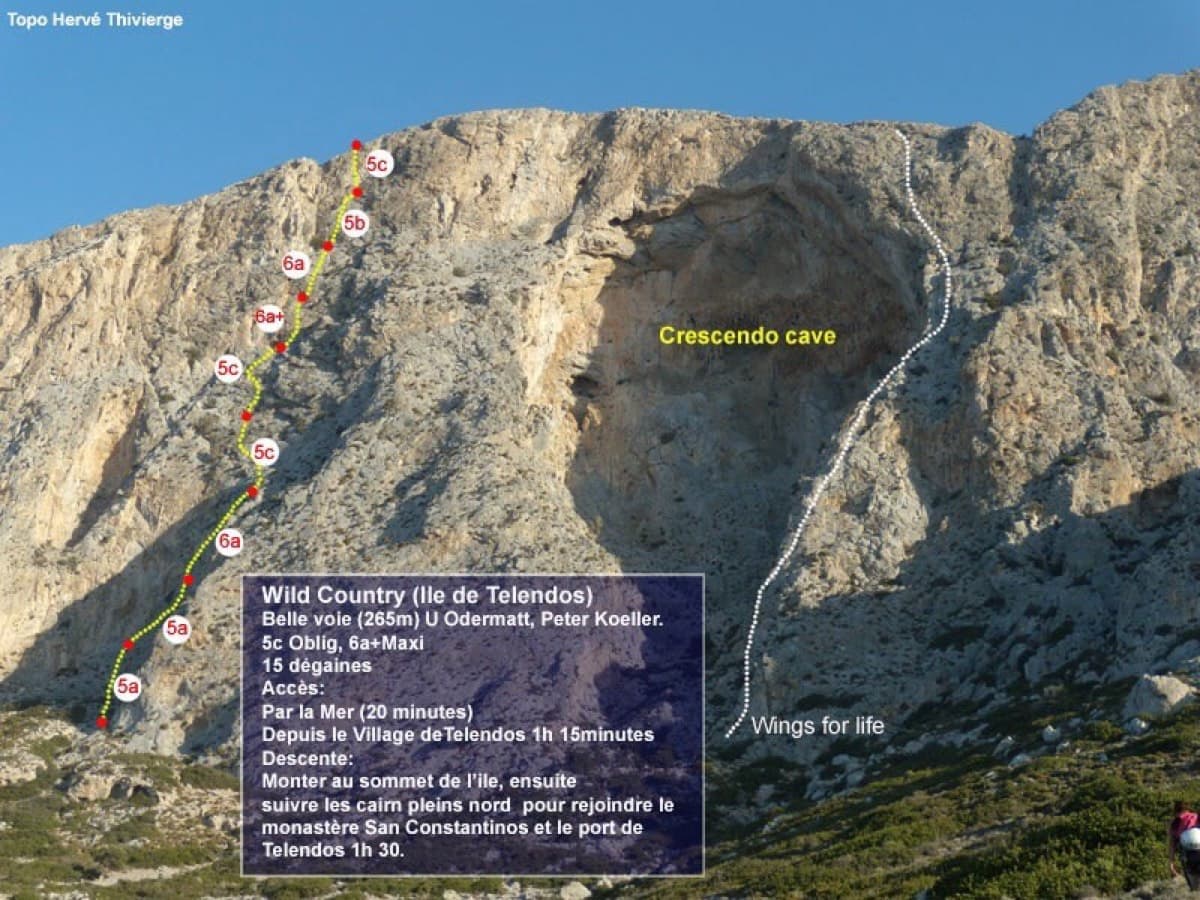
Topo of Wild Country, left of the Crescendo cave, Telendos south face

Greece · Kalymnos & Telendos

Wild Country

A sustained, varied line on sculpted limestone. It starts with an easy slab and builds to slightly overhanging jugs with huge exposure on the top pitch. Mountain Project and camptocamp grade the crux 6a+ (Rockfax says 6a). With a 70 m rope you can link several pairs of pitches.

6a9 pitches265 m

Frau Hitt and the Westliche and Östliche Sattelspitze on the Innsbruck Nordkette, seen from the east

Austria · Karwendel (Innsbruck Nordkette)

Mit Vergnügen – avec plaisir

A plaisir line straight above Innsbruck, reached by cable car. Two pitches are UIAA 6-/6 (5+/A0) and the rest is mostly grade 4–5. The upper pitches are grassy, so avoid it when wet.

6a9 pitches300 m

Compiled from published sources and last verified October 2026. Bolts, anchors and access change. Climbing is dangerous and you are responsible for your own decisions: check a current topo and read the disclaimer.