Multipitch Atlas

Espolón del Adamelo

Macizo del Pisón, Mallos de Riglos · Riglos & Agüero (Mallos) · Spain

Read the cautionsBail with caveatsBolting confidence: medium

This is the gentlest way to sample Riglos. Polished pockets and two bulging 'panzas' lead to a 6a crux that can be pulled through on the bolts (A0). The upper spur is easy, and the Pisón towers loom close by.

The Adamelo spur on Mallo Pisón, RiglosPhoto: Pyrenantes · CC BY-SA 3.0

Photo

The Adamelo spur on Mallo Pisón, RiglosPhoto: Pyrenantes · CC BY-SA 3.0
Hardest pitch
6a
Pitches
7
Length
175 m
Approach
5 min
Aspect
SE
South-east-facing
Rope
2×60 m
Read before you go

Bolted with an aidable 6a crux, but polished, run-out on the easy ground, with an unbolted bush belay at R7, regular stonefall and a two-rope abseil descent.

The route

Overview

The classic first route on the big Mallos: the spur immediately right of the Pisón as seen from the village, climbed in seven pitches to a terrace below the Pisón col. Most of it is IV to V on polished cobbles with bolts well spaced, but pitch 2 has two short bulging 'panzas' at 6a that surprise many people; they are closely bolted and can be aided. The setting beside the Pisón is superb. Expect queues, polish, some wandering route-finding among neighbouring lines, and a descent that is an outing in itself.

The climbing

Pitch by pitch

Pitches of Espolón del Adamelo
PitchGradeLengthNotes
P15a35 mV. Polished pocketed cobbles with well-spaced bolts, around 5 m apart in places. A bolt was added low down (reported 2020); before that the first was nearly 8 m up. Comfortable belay. Other sources give 5b to 5c.
P26a15 mThe crux. Two bulges straight off the belay: the Panza del Cansao (good holds right of the bolt), then the harder Panza del Pijo. Very polished; feet are better if you exit right. Closely bolted and commonly aided with a sling or foot loop (A0+). Belay soon after. Can be linked with pitch 3.
P34c25 mIV+. Easy but run-out, with bolts that are hard to see. Near the top a painted arrow and 'AD'/'Adm' (and a coloured sling on a hanger) send you up left; do not continue straight to the belay under the big bulge (Panza del Cabrón). Belay on a ledge on 2 ringed bolts, with other routes' belays close by.
P45b/5c25 mV+. Climb the bulge trending left, then come back right past a distant bolt to rejoin the crest above the Panza del Cabrón; easier after. Belay on a good ledge just past a bush or tree. Graded V by Komando Kroketa and 6a for the first move by two recent parties.
P54c30 mIV+. A good long pitch. Near the top a blue arrow and 'ADM' point left, where a short steep bulge (about V) guards the belay ledge. Use the belay with yellow rings; a nearby belay belongs to 'La caída de los dioses'.
P64a25 mIV. A stiff start, then the angle drops right off. The line goes close to the gorge on the right before returning to the centre of the spur for a belay on a wide ledge. Spaced bolts. Worth linking with pitch 7 (works with a 50 m rope).
P74a20 mIV. Straight up, then a definite traverse right (2 bolts and a peg) to finish at a clump of bushes, where you build the belay with slings. From here the cabled ledge leads right to the descent. An optional extra pitch (III, 45 m, barely equipped, loose stones, sling the trees) continues to the Pisón col.

Getting there

Approach

To the parking

Riglos is about 45 km north-west of Huesca on the left bank of the Río Gállego. From Huesca take the A-132 through Ayerbe towards Jaca and turn right to the village after a few kilometres; from Pamplona or France come via Puente la Reina de Jaca and the A-132 south, turning left shortly after Murillo de Gállego. You cannot drive into the village: use the pay car parks at the entrance (3 EUR per day in 2024–25; one report says cash only). There is a railway station just below the village. The climbers' refuge is the modern building between the bus and car parks.

On foot · about 5 min

5 minutes from the car park. Walk up through the village towards the church; just before it leave the lane for a path rising leftwards to the base of the spur (alternatively from the church or the last houses). The usual start is a few metres left of the lowest point of the spur. The line that starts at the very toe and follows the crest is the original, harder start (V+), recently re-equipped; both reach the same first belay. Do not start up 'Tarari que te vi', just to the left; one party did by mistake.

Finding the route · 3 photos

  • OverviewRiglos village at the foot of the Mallos, seen from across the valley: El Pisón is the largest tower, on the left, with the village below and to its right.Photo: Christian · CC BY-SA 3.0
  • OverviewEl Pisón from the edge of the village, with the thin spire of El Puro against its left side. The approach walks up through the village to the foot of the tower.Photo: Marc Baysselance · CC BY-NC-ND 3.0
  • Start of the routeLooking up from the base: the Adamelo spur is the rib on the right (photographer's title).Photo: premix · CC BY-NC-ND 3.0

Approach photo

Map of the walk-in

  • Crag

Loading map

The point marks the crag, not the exact start of the route.

Coordinates · crag

42.35077, -0.72759

Point from camptocamp waypoint 136217

For your phone or watch

Download GPX

Contains the route point. Opens in most mapping apps and GPS watches.

Points are compiled from published sources, with the precision stated above. They were not surveyed on the ground: check them against a current topo.

Getting down

Descent

Option 1, via the Pisón descent ('los volaos'): from R7 climb a few easy steps, then follow a ledge rightwards with new cables. It traverses horizontally to join the Pisón descent and the first abseil in the canyon. Then: abseil 25 m; walk and scramble with cables and some old ropes, awkward in places; abseil 30 m, free-hanging; more cabled scrambling (keeping the rope on can help); abseil 40 m, free-hanging; abseil 25 m. A 2025 party took 1 h 40 from the col to the ground. Option 2: abseil the route, which one party found quicker and slightly offset to the right of climbing parties; Camptocamp says a 60 m rope lets you skip the last belay. If you go up to the col, one abseil brings you back to the line of Option 1.

Retreat

Bailing off the route

Bail with caveats

Yes, by abseiling the route, which Camptocamp lists as a descent option and at least one party has used. Take two ropes: pitch 1 is 35 m and other sources ask for 2×60 m or a 70 m. Expect polished rock, other parties below you and regular stonefall on this line. From the top of pitch 6 or 7 it is simpler to finish and traverse the cabled ledge right into the Pisón descent.

Retreat from
The bolted belays of pitches 1 to 6; R3 is described as an abseil belay on two ringed bolts and R5 has yellow rings. From R6 (Spanish Camptocamp text) or R7 you can reach the normal Pisón descent by the cabled ledge on the right. Several other routes' belays sit close by, so check you are on the right anchors.
Point of no return
R7. It is a clump of bushes you sling yourself, reached by a definite traverse right, so from there the way off is the cabled ledge and the canyon abseils, not back down the route.
Carry
2×60 m (or at least a 70 m) and a helmet. Carry a couple of maillons and some cord in case a belay you need is not ringed; the sources only confirm rings at some belays.
Basis
Part stated, part inferredCamptocamp states 'abseil the route' as a descent and that R3 is a ringed abseil belay, and Mountain Project and Komando Kroketa call for two ropes; that every belay below R7 is usable and the choice of R7 as the turning point are inferred.

Partly inferred from the route facts

Safety

Hazards

  • Stonefall: Komando Kroketa warns that stones are regularly knocked down this route and its neighbours, and the canyon descent is also exposed to falling stones. Wear a helmet and take care on the loose final pitch.
  • Bolts are close on the hard moves but well spaced on ground up to V/V+, with gaps of about 5 m on polished rock on pitch 1. A leader fell around 10 m on the penultimate pitch in 2020 without injury.
  • The R7 belay is not bolted: it is a clump of bushes that you must sling yourself. The optional pitch to the col is barely protected.
  • Easy to stray: on pitch 3 follow the painted 'AD' arrow left. Straight up leads to the Panza del Cabrón (6a+ to 6b) or the 6b third pitch of 'Tarari que te vi', where one party snapped two handholds.
  • The 6a moves on pitch 2 are glassy with polish; they were graded V+ in older guides.
  • The descent has free-hanging abseils of 30 m and 40 m and awkward cabled scrambling between them. A single 60 m rope is not enough for the 40 m abseil.
  • Griffon vultures fly very close to the abseil stations.

Sun and weather

Conditions

South-east facing and sheltered from north wind at the base, with sun from early morning; in strong north wind the top and the Pisón col are very exposed and parties have turned back. Riglos is climbed mainly in autumn, winter and spring; it was 30°C on the route in mid-October 2022. One of the busiest routes in Riglos: queues at every belay and on the abseils at weekends and holidays, and one party reported an 8-person jam behind a leader stuck on pitch 2.

Usual season · Feb to May, Oct to Dec

Sun on the wall · SE-facing

Working out the sunlit hours for this month.

  • January: not yet worked out
  • February (usual season): not yet worked out
  • March (usual season): not yet worked out
  • April (usual season): not yet worked out
  • May (usual season): not yet worked out
  • June: not yet worked out
  • July: not yet worked out
  • August: not yet worked out
  • September: not yet worked out
  • October (usual season): not yet worked out
  • November (usual season): not yet worked out
  • December (usual season): not yet worked out

Sun on the wallDaylight, wall in shade● Usual season

Estimated from the wall's aspect only. Ignores surrounding terrain, gullies and the wall's exact shape. Clock times are local to the wall (Central European time), for the 15th of each month.

Climate figures for Riglos & Agüero (Mallos) are not available yet

What to carry

Gear

12 quickdraws are plenty even when linking pitches (10 according to Mountain Project), a few slings for the R7 bush belay and for trees on the optional last pitch. For the descent take two ropes: Komando Kroketa climbed on 2×60 m, and Mountain Project asks for 2×60 m or a 70 m. Helmet is strongly advised. A sling or aider helps if you plan to aid the panzas.

Checklist

Quickdraws
12
Rope
2×60 m
Helmet
One each
Abseil device and prusik
The descent or the retreat involves abseiling
Maillons or spare karabiners
To leave behind if you retreat
Cord
Mentioned for retreat

Derived from the route data; check it against a current topo

From climbers

Reader reports

Reader reports are not being collected yet. Until they are, check a current topo and the local club or guidebook publisher for recent changes to Espolón del Adamelo.

Worth knowing

Tips

  • Link pitches 2+3 and 6+7 to save time.
  • On the Panza del Pijo, step out right for better feet and hands rather than staying in the polished line.
  • The easier alternative for the first four pitches is 'Gripe', just to the right, but it has fewer bolts and sits in the firing line of stones from the Adamelo.
  • Strong parties continue from the col up the normal route of the Pisón (three more pitches to about V+, less well equipped); allow a full day, and skip it in strong wind.
  • Go early or midweek. A party starting at 08:00 topped out at 11:00; with queues, others took 8–9 hours car to car.
  • The Riglos guidebook can be browsed at the refuge, and the refuge serves breakfast.

Open questions

Where sources disagree

  • Crux grade: 6a on Camptocamp, 27crags and the current guidebook; 6a+ on Mountain Project; V+ in older guides. Komando Kroketa says 6a 'at least'.
  • Pitch 1: V (Camptocamp French), 5b (Spanish page), 5c (second Camptocamp page), 5b+/5c (2025 outing). Pitch 4: V+ (Camptocamp), V (Komando Kroketa), 6a for the first move (2022 and 2025 outings).
  • Pitch count and length: Camptocamp gives 7 pitches plus an optional 8th to the col and 150 m; Komando Kroketa counts 6 to the terrace and a 7th to the col; Mountain Project gives 7 pitches and 182 m; 27crags gives 200 m. Camptocamp's own pitch lengths add up to 175 m.
  • Rope: Camptocamp mentions 'a 60 m rope' for abseiling the route, but its own canyon descent has a 40 m abseil and its first pitch is 35 m; Mountain Project and Komando Kroketa call for 2×60 m (or a 70 m). This entry follows the two-rope advice.
  • Aspect: SE on the main Camptocamp page, S on the linked Pisón page.

Provenance

Sources

Same area

More in Riglos & Agüero (Mallos)

All routes in Riglos & Agüero (Mallos)
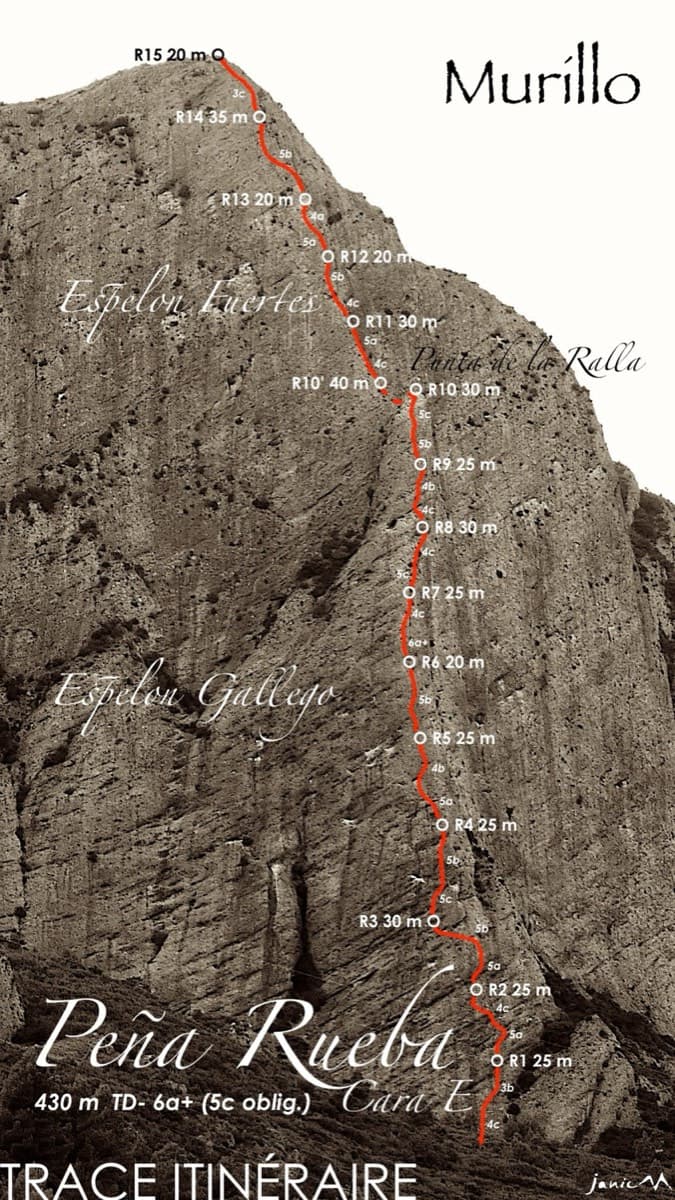
Topo of Sendero Límite on the south face of Peña Rueba (Mallo Común)

Spain · Riglos & Agüero (Mallos)

Sendero Límite

A long beginner's big route on good conglomerate at a moderate angle. Pitches can be linked in pairs with a 60 m rope. A four-pitch headwall with a couple of panzas finishes high above the Gállego valley.

5c14 pitches375 m
Topo of Tierra de Naide, Mallos de Agüero

Spain · Riglos & Agüero (Mallos)

Tierra de Naide

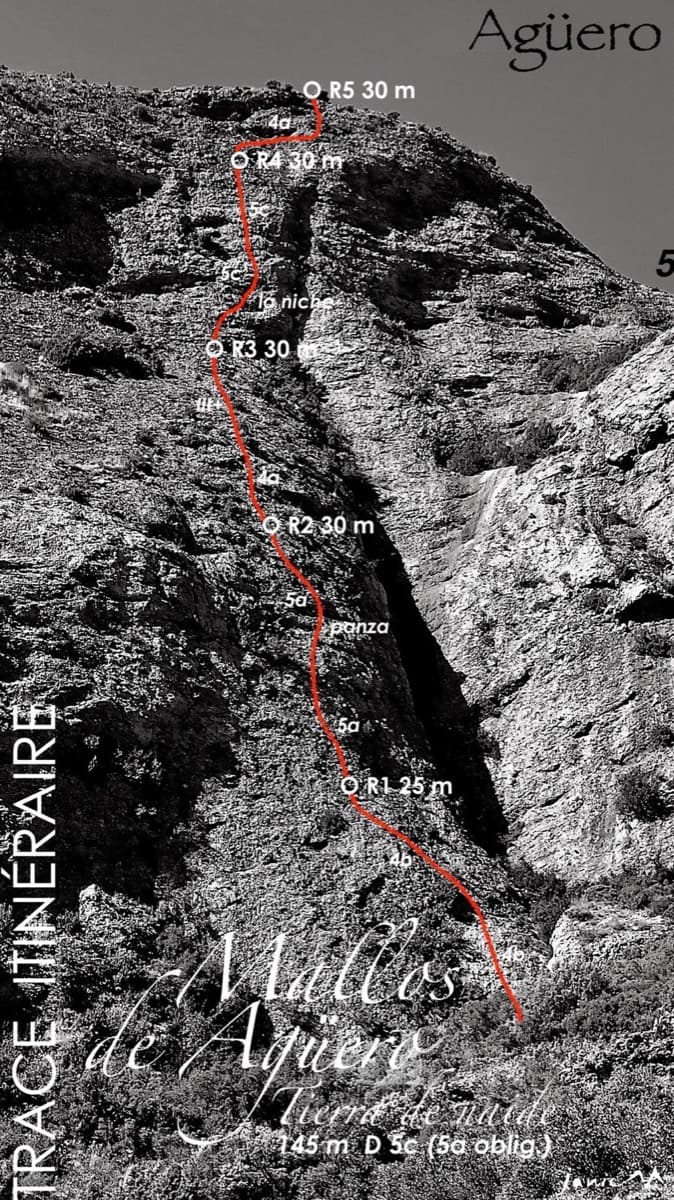
A morning-sun route at the quieter Agüero mallos. Easy slabs separate two fine steep walls, including a superb vertical 5c plaque on pitch 4. Take care with some loose cobbles on the last traverse.

5c5 pitches145 m

Topo of Anorexia on Mallo Colorado, Riglos

Spain · Riglos & Agüero (Mallos)

Anorexia

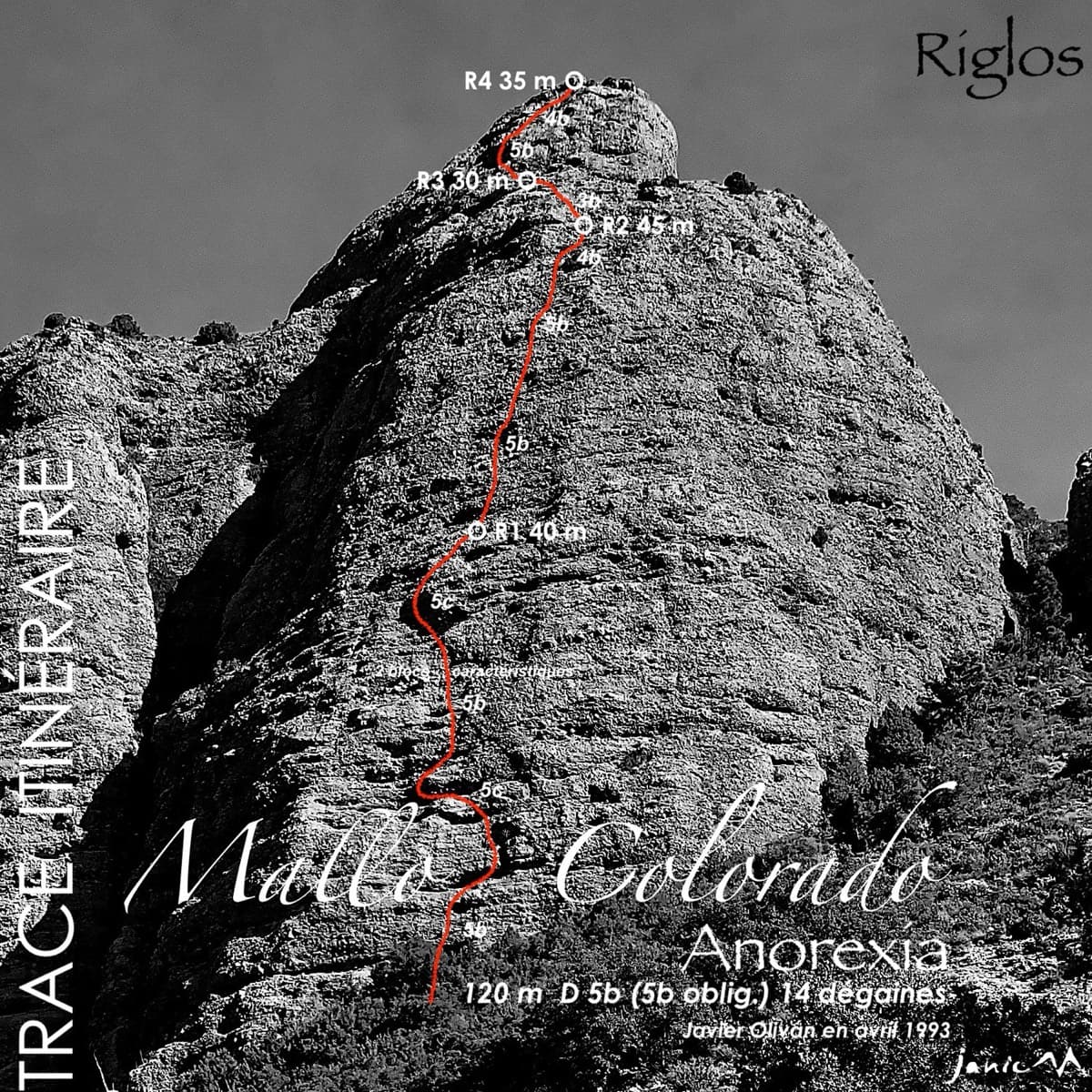
The best-known route on the Mallo Colorado. Two steep, juggy panza pitches have a well-protected boulder move, giving a short taste of real Riglos steepness at a friendly grade.

5c4 pitches150 m

Around 6a · about 7 pitches

Similar elsewhere

Topo of Barabba on the Contrefort de Pré de Bar, Val Ferret

Italy · Aosta Valley

Barabba

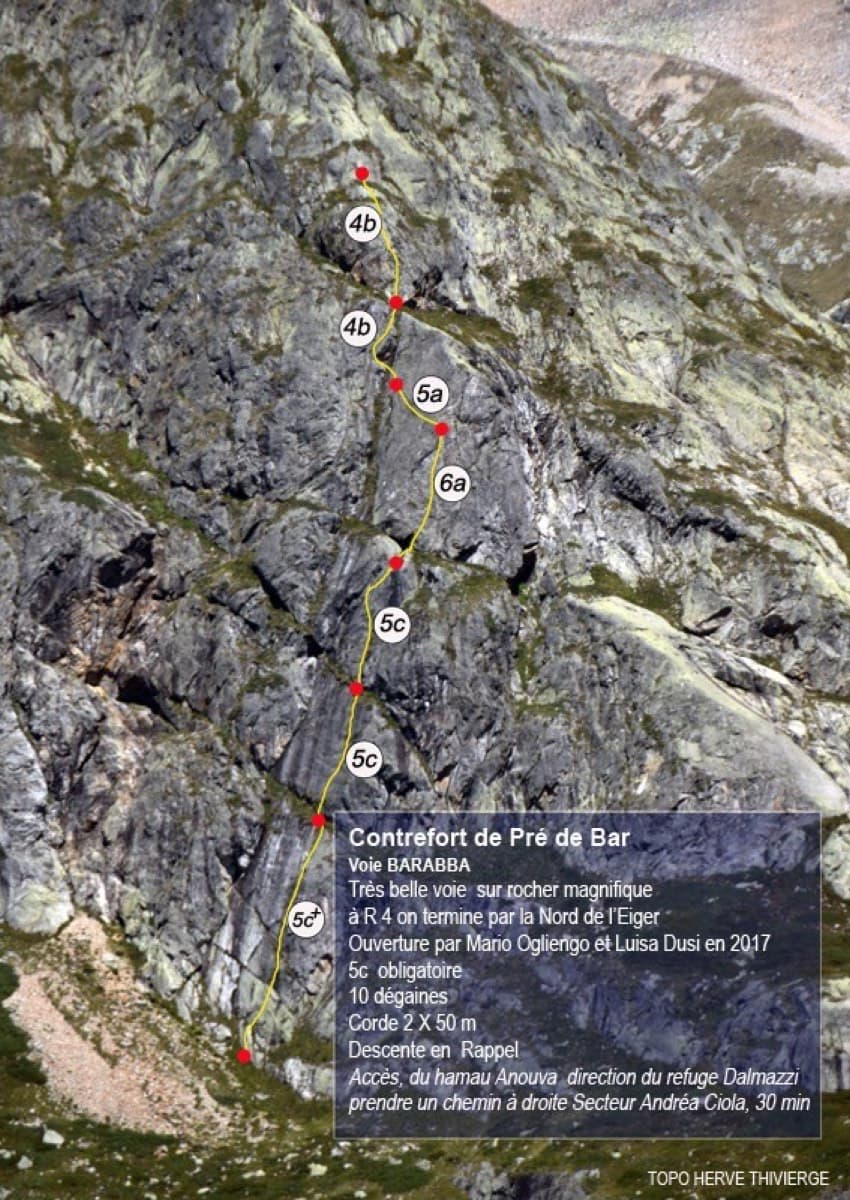
A pretty plaisir route on edgy, quartz-studded granite slabs beneath the Mont Blanc massif. The crux is a short bulge and steep juggy wall on P4. Camptocamp rates it 'great'.

6a7 pitches180 m

Climber on Lost Goat, Olympic Wall, Kalymnos

Greece · Kalymnos & Telendos

Lost Goat

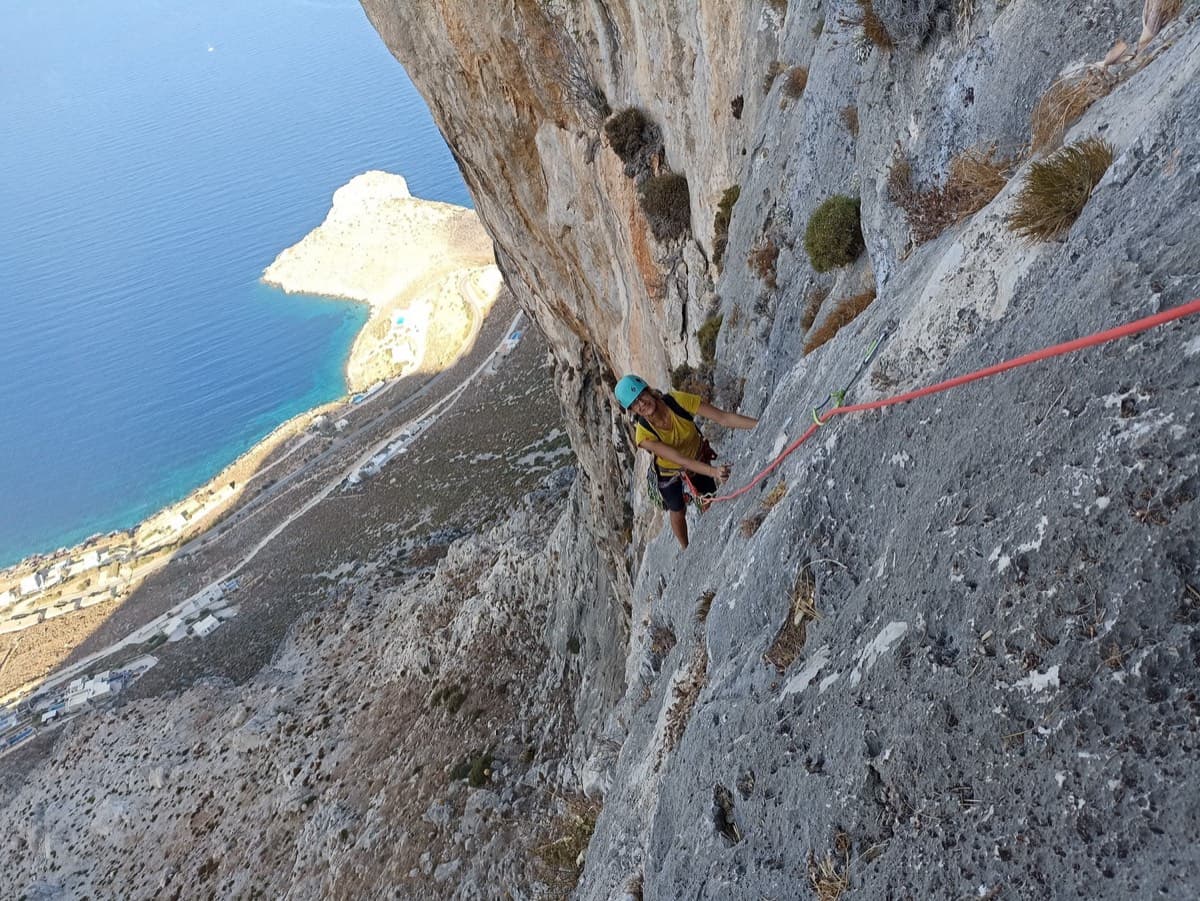
A mountain-style outing high above Masouri, with a delicate traversing 6a on P4 and a lovely final corner. Most pitches feel easy for their grade, but the route is loose in places, so wear a helmet.

6a7 pitches170 m

No photo yet

Italy · Monte Argentario

Spigolo Bonatti

A long arête that seems to drop straight into the sea: a sustained 6a first pitch, then corners, slabs and short walls at 5a to 5b+ separated by easy scrambling, with an exposed traverse out on the open face near the top. The 6a can be aided.

6a7 pitches240 m

Read the cautions

The Ilinac wall above the Cetina near Omiš; Rambo climbs the centre of the face

Croatia · Omiš

Rambo

Omiš's signature moderate: long, slabby pitches on knobbly grey limestone with big views over the Cetina mouth and the Adriatic. The crux is a short crack on the final pitch.

6a6 pitches230 m

Compiled from published sources and last verified October 2026. Bolts, anchors and access change. Climbing is dangerous and you are responsible for your own decisions: check a current topo and read the disclaimer.