
Spain · Collegats
Tanger
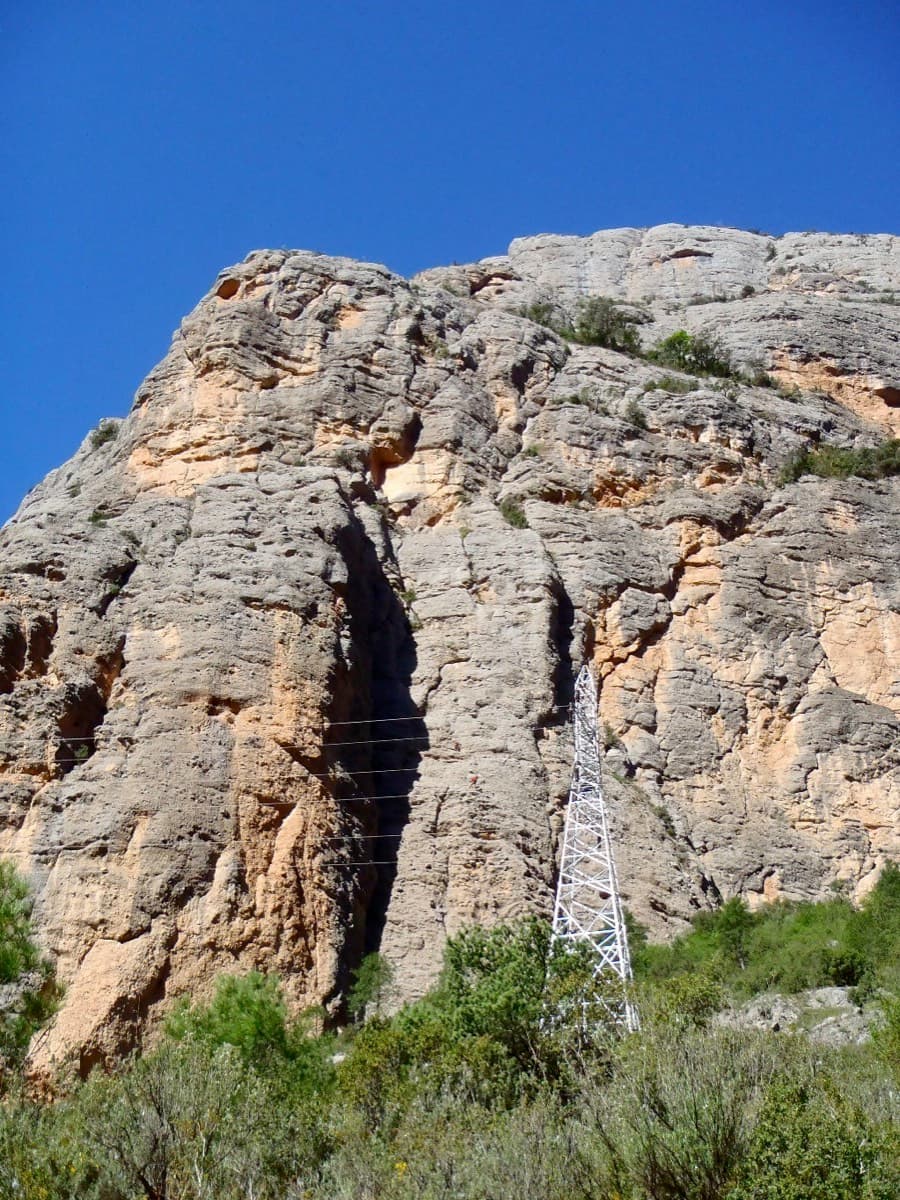
A consistent, well-bolted line starting with a crack under the big pylon. Ten pitches of 5b–6a+ are split by a 100 m scramble through a vegetated 'garden' before the final tier.
6a+10 pitches300 m
Read the cautions
Agulla del Gos (Paret del Pessó) · Collegats · Spain
Read the cautionsBail with caveatsBolting confidence: medium
The right-hand line on the Agulla del Gos: a short, punchy first pitch that is harder than its guidebook 6a+, then a chimney and easier walls to the top of the pinnacle. Best climbed as a pair with Matute.
Bolted and abseilable according to both sources, but documented by a single 2019 report, with stiff grades, an undocumented bolt age and abseil lengths that do not add up.
The route
Poppers climbs the right-hand part of the Agulla del Gos, the 100 m pillar leaning against the foot of the Paret del Pessó five minutes from the road. It is graded 6a+ on camptocamp, but both Luichy's topo (6b/c) and the one party to report on it (nearer 6b+) found the first pitch much harder, and they also thought the old-school chimney on pitch 3 stiff. Above the start the climbing is grade 4 and 5 on bolts. It is thinly documented compared with Matute, so treat the details with some caution.
The climbing
| Pitch | Grade | Length | Notes |
|---|---|---|---|
| P1 | 6b+ | 25 m | A powerful start, then an awkward move left onto the rib. Camptocamp gives 6a+ with 6a obligatory and A0 possible; Luichy's topo gives 6b/c and a 2019 party felt it was close to 6b+. Luichy gives 20 m. |
| P2 | 5+ | 30 m | No description published beyond the grade: V+ on camptocamp, 6a on Luichy's sketch. Luichy gives 40 m. |
| P3 | 4+ | 30 m | Climb a chimney and stay inside it even though you cannot see the bolts from below. Graded IV+ on camptocamp and V by Luichy; the 2019 party called it a stiff V, climbed partly inside and partly outside. |
| P4 | 4+ | 30 m | To the top of the pinnacle. IV+ on camptocamp, V on Luichy's sketch. No further description published. |
Getting there
From La Pobla de Segur take the N-260 north-east towards Sort into the Collegats gorge. About 100 m after the exit of the first tunnel there is a gap in the crash barrier on the left with room for two to four cars, at the sign for the Cova de la Serpent path. If it is full, park just before on the old road that bypasses the tunnel on the outside. There is a campsite at the gorge entrance near La Pobla de Segur, which one party found closing for the season in early November.
Five minutes by the Cova de la Serpent path from the parking, to the foot of the pinnacle where the path comes closest to the wall. Poppers starts on the right-hand part of the pinnacle, right of Matute and of Léon (which starts under the overhang). No source describes the exact start more precisely.
Loading map
The point marks the crag, not the exact start of the route.
Parking
Small pull-in between the tunnels at the Cova de la Serpent path (camptocamp access waypoint 207056, Congost de Collegats)
Point from camptocamp waypoint 697864 (Collegats - Agulla del Gos)
Contains the route point and parking. Opens in most mapping apps and GPS watches.
Points are compiled from published sources, with the precision stated above. They were not surveyed on the ground: check them against a current topo.
Coordinates: 42.28538, 1.03544 (crag) · Parking: 42.28611, 1.03667
Getting down
Camptocamp describes abseiling the route in three abseils: from R4, from R3, and from R2 to the ground. The 2019 party did this and then climbed Matute. Alternatively walk off as for Matute and Léon, which finish on the same pinnacle: go left from the top to the ramp with chains, cables and fixed ropes that leads back to the path.
Retreat
Bail with caveats
Camptocamp states that the route can be abseiled in three from R4, R3 and R2, and the 2019 party descended that way. The caveat is rope length: the last abseil from R2 is 55 to 60 m on the published pitch lengths, and nothing is said about abseiling from R1.
Partly inferred from the route facts
Safety
Sun and weather
East facing: morning sun, afternoon shade. The only dated ascent is from June (hot, with a wind that strengthened through the day). See Matute for reports from other months on the same pinnacle.
Sun on the wall · E-facing
Working out the sunlit hours for this month.
Sun on the wallDaylight, wall in shade● Usual season
Estimated from the wall's aspect only. Ignores surrounding terrain, gullies and the wall's exact shape. Clock times are local to the wall (Central European time), for the 15th of each month.
| Measure | Jan | Feb | Mar (usual season) | Apr (usual season) | May (usual season) | Jun (usual season) | Jul | Aug | Sep (usual season) | Oct (usual season) | Nov (usual season) | Dec |
|---|---|---|---|---|---|---|---|---|---|---|---|---|
| Mean daily high °C | 9 | 10 | 13 | 16 | 20 | 24 | 27 | 27 | 23 | 18 | 12 | 9 |
| Mean daily low °C | −1 | −1 | 2 | 5 | 9 | 13 | 16 | 16 | 12 | 8 | 3 | −0 |
| Rain days 1 mm or more | 7 | 6 | 9 | 12 | 12 | 9 | 7 | 9 | 9 | 9 | 8 | 6 |
● marks the usual climbing season. Averages for 1991-2020 at about 735 m. Area climate from Open-Meteo reanalysis. Temperatures are adjusted to the height of the crag; rain comes from a grid cell of about 10 to 25 km, and summer highs on sea cliffs can read a few degrees low. The wall and valley can differ. Data: Open-Meteo, CC BY 4.0.
What to carry
12 quickdraws plus belay kit. No cams or nuts are mentioned. Camptocamp says the abseils work 'with a 50 m rope' without saying whether that means one rope or two; the published pitch lengths put R2 at least 55 m above the ground, so take two 50 m ropes or walk off (see discrepancies). Helmet.
Derived from the route data; check it against a current topo
From climbers
Reader reports are not being collected yet. Until they are, check a current topo and the local club or guidebook publisher for recent changes to Poppers.
Worth knowing
Open questions
Provenance
Same area
Spain · Collegats
A consistent, well-bolted line starting with a crack under the big pylon. Ten pitches of 5b–6a+ are split by a 100 m scramble through a vegetated 'garden' before the final tier.
6a+10 pitches300 m
Read the cautions
Spain · Collegats
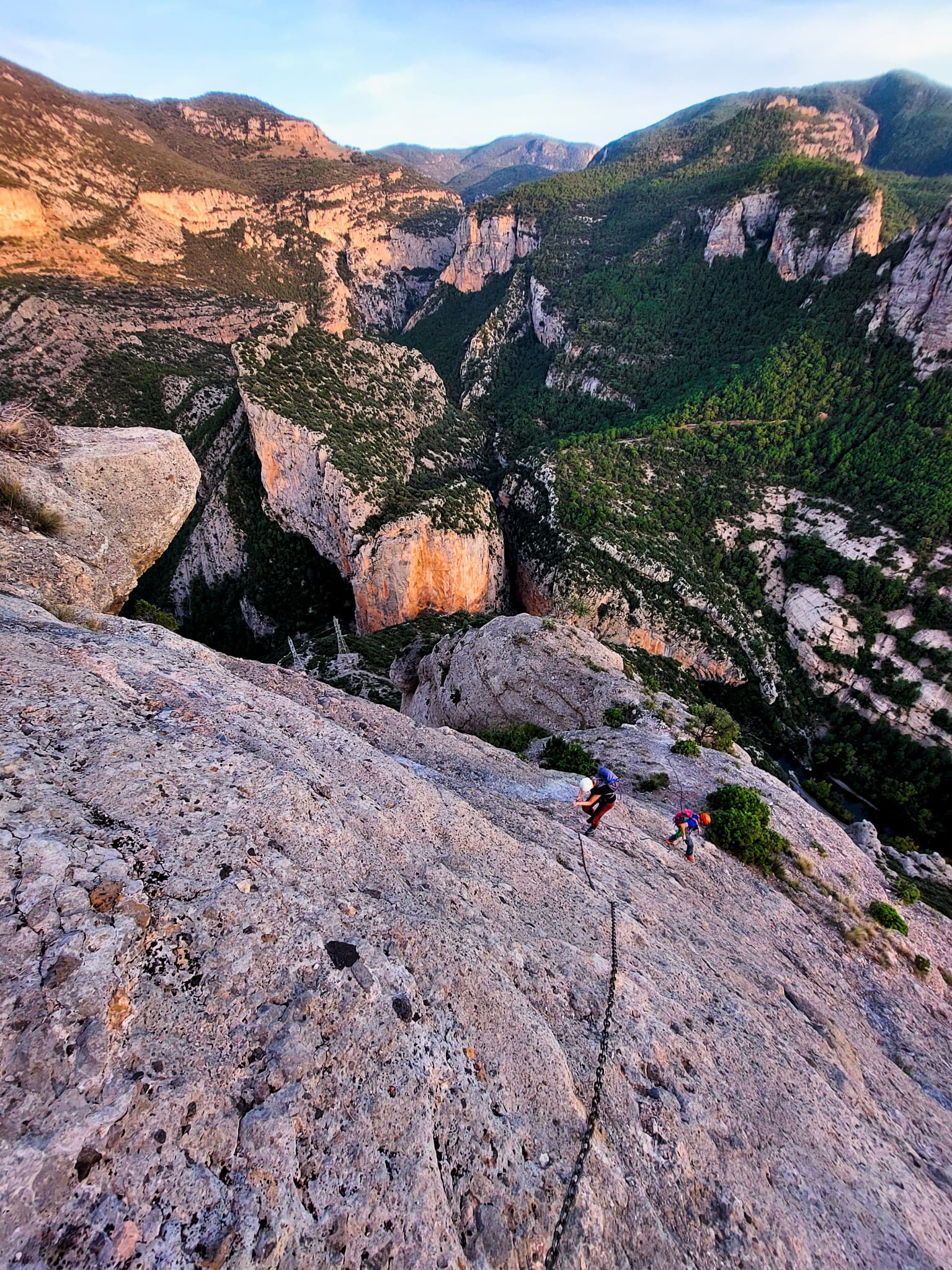
The friendly long route of Collegats: steep but juggy grey conglomerate above the Barranc de Sant Pere, with close bolts. It starts by squeezing between the wall and a leaning 50 m pinnacle, and saves its best for a sustained 40 m 6a wall at the top. A short garden pitch breaks the line before the finish.
6a6 pitches205 m
Spain · Collegats
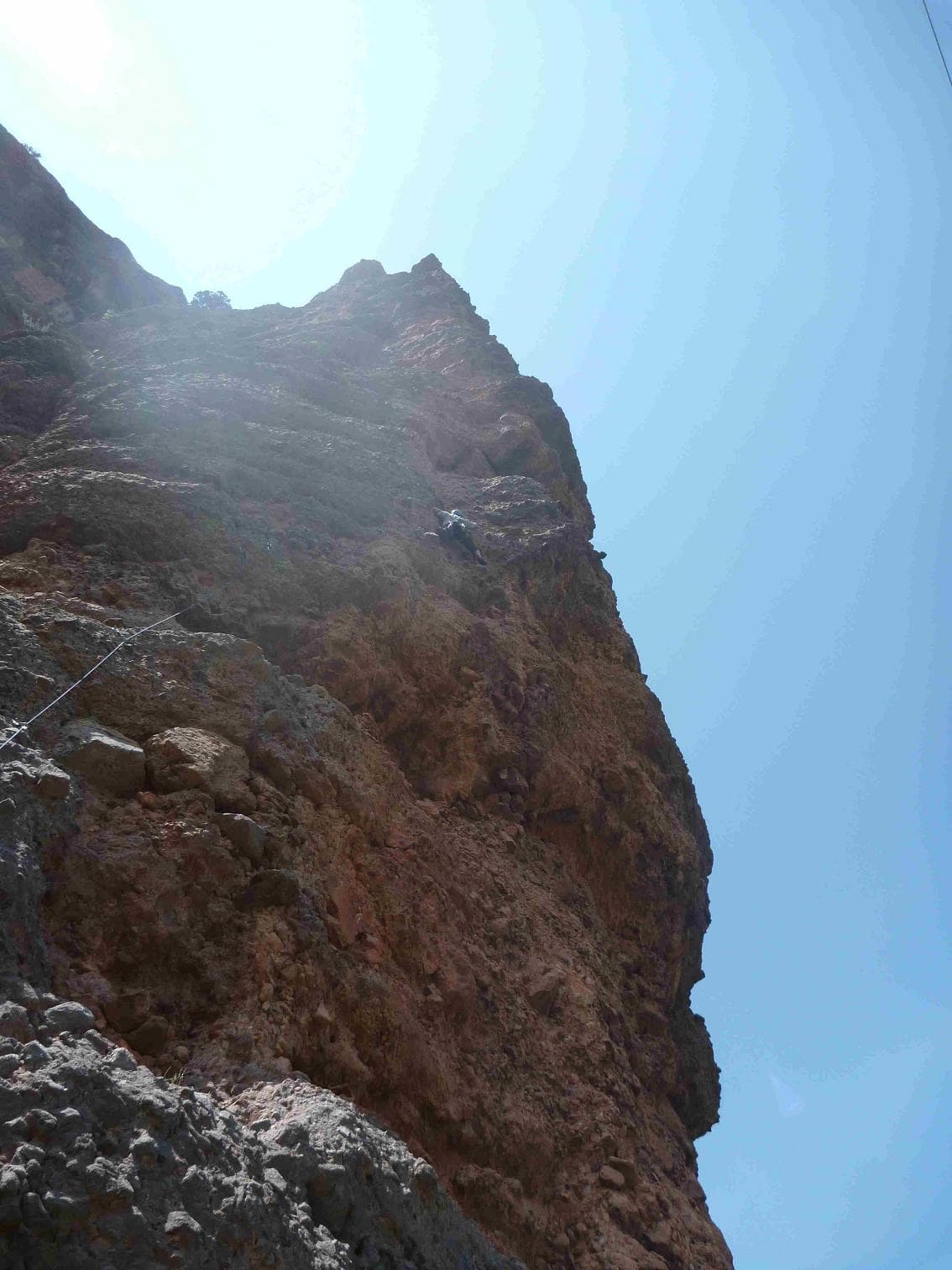
Four steep pitches up the pinnacle that leans against the Paret del Pessó, five minutes from the car. Rounded bulges and big holds in the style of Riglos: an athletic first pitch, an overhanging jug traverse, then easier bellies to the top.
6b4 pitches125 m
Around 6b+ · about 4 pitches
Slovenia · Vršič Pass (Julian Alps)
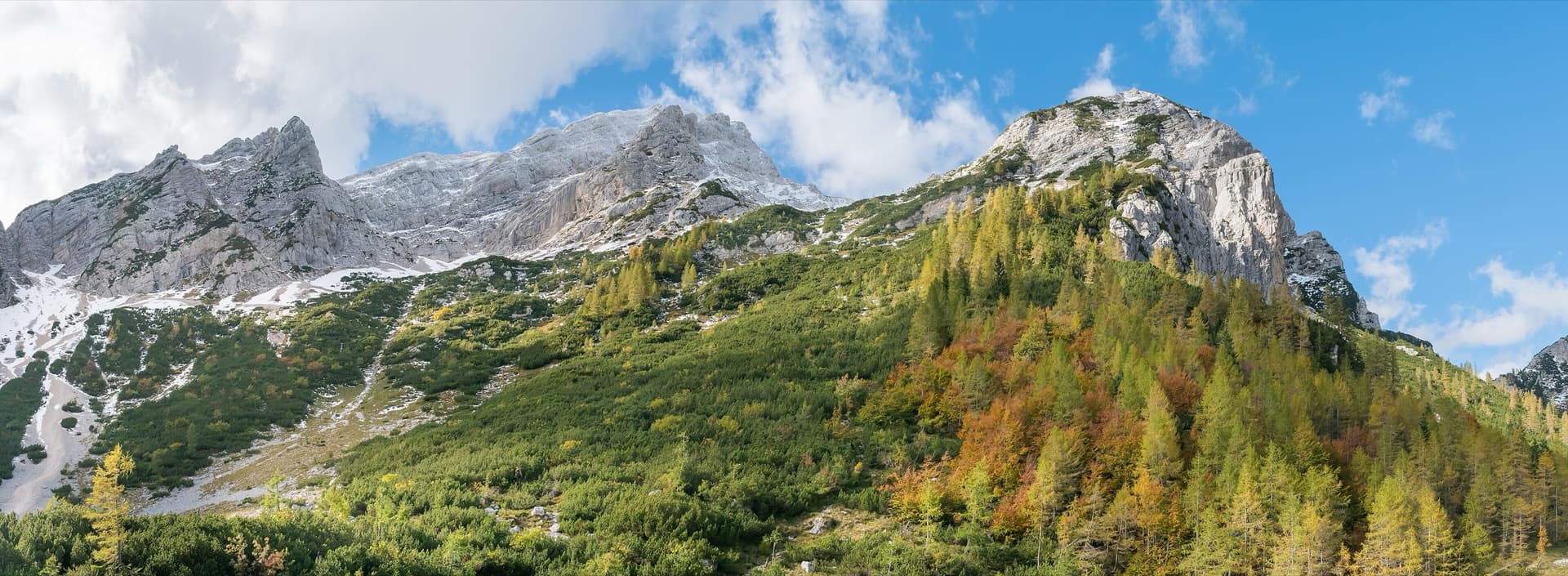
Sustained slab climbing up a striking black streak, clearly visible from the pass, on surprisingly good rock for this face. The crux is a move from slab into a corner on P2.
6b+4 pitches105 m
Read the cautions
Spain · Vilanova de Meià (Roca dels Arcs)
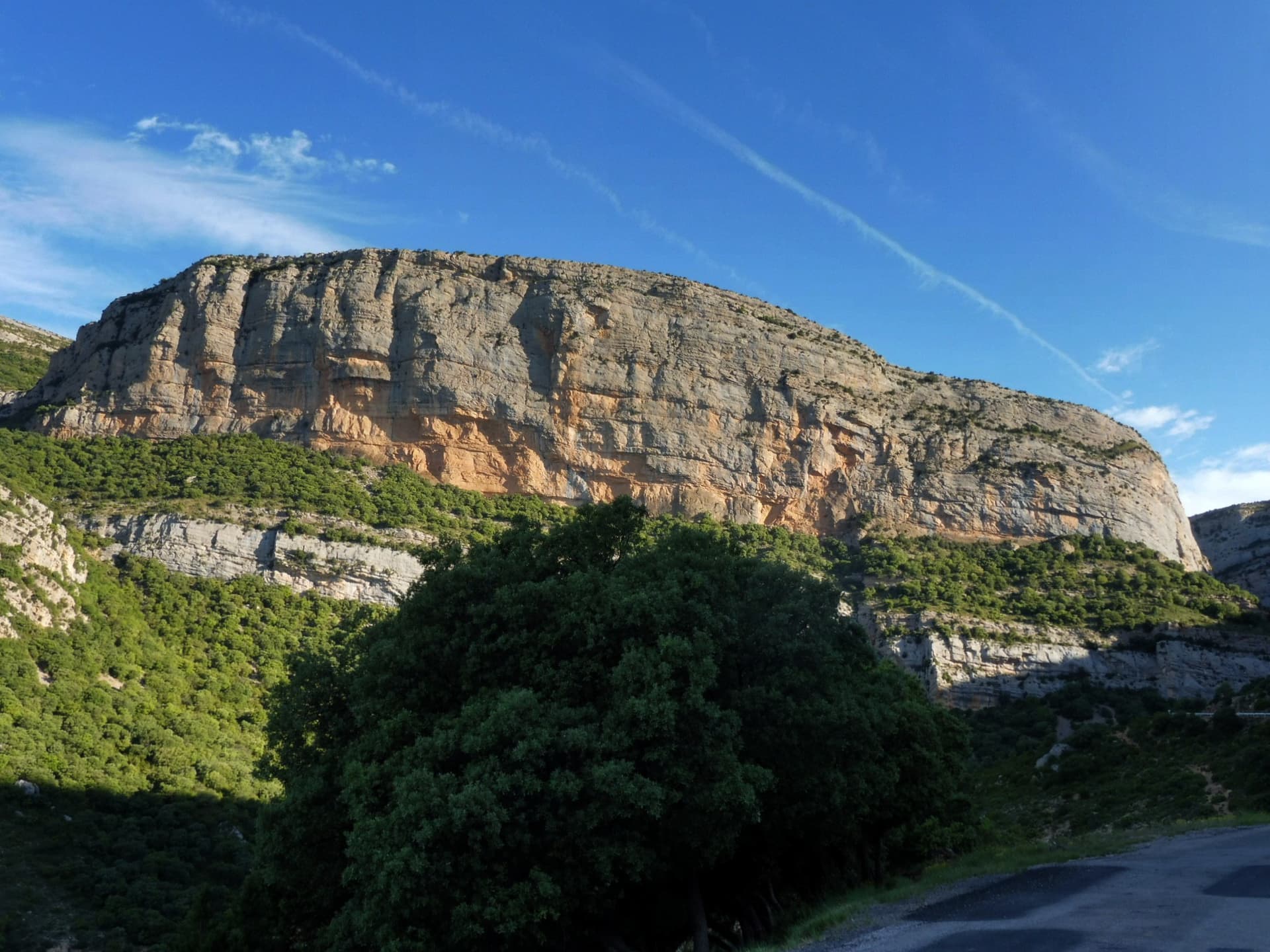
Four long, steep pitches on the left side of the Roca dels Arcs, sustained at 6a on good holds and not yet polished above the first pitch. The third pitch is the event: a reachy bulge to start, 30 m of gently overhanging strata, and a hard boulder move off a ledge to finish that most people grade 6c. That last move can be avoided by belaying on the neighbouring route.
6b+4 pitches160 m
Italy · Lecco & Valsassina
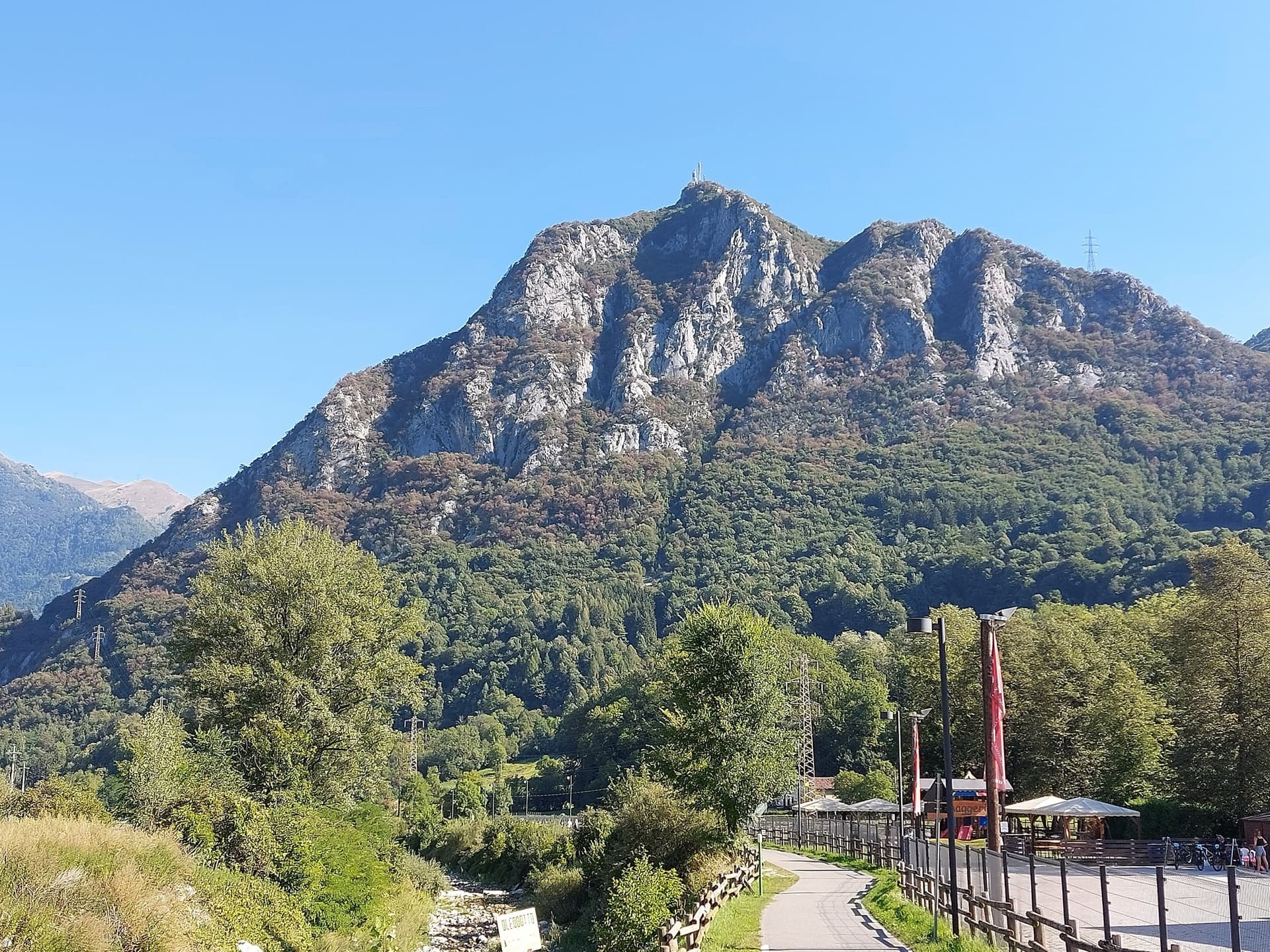
Three friendly pitches up a striking arched flake and compact slabs, then a short wall with one hard, reachy move that most people pull through. A 1980 route by the Savonittos and Alessandro Gogna, and the usual first half of a link-up with Gli Schiavi della Pietra on the spur above.
6b+4 pitches90 m
Read the cautions
Morocco · Todra Gorge (Todgha)
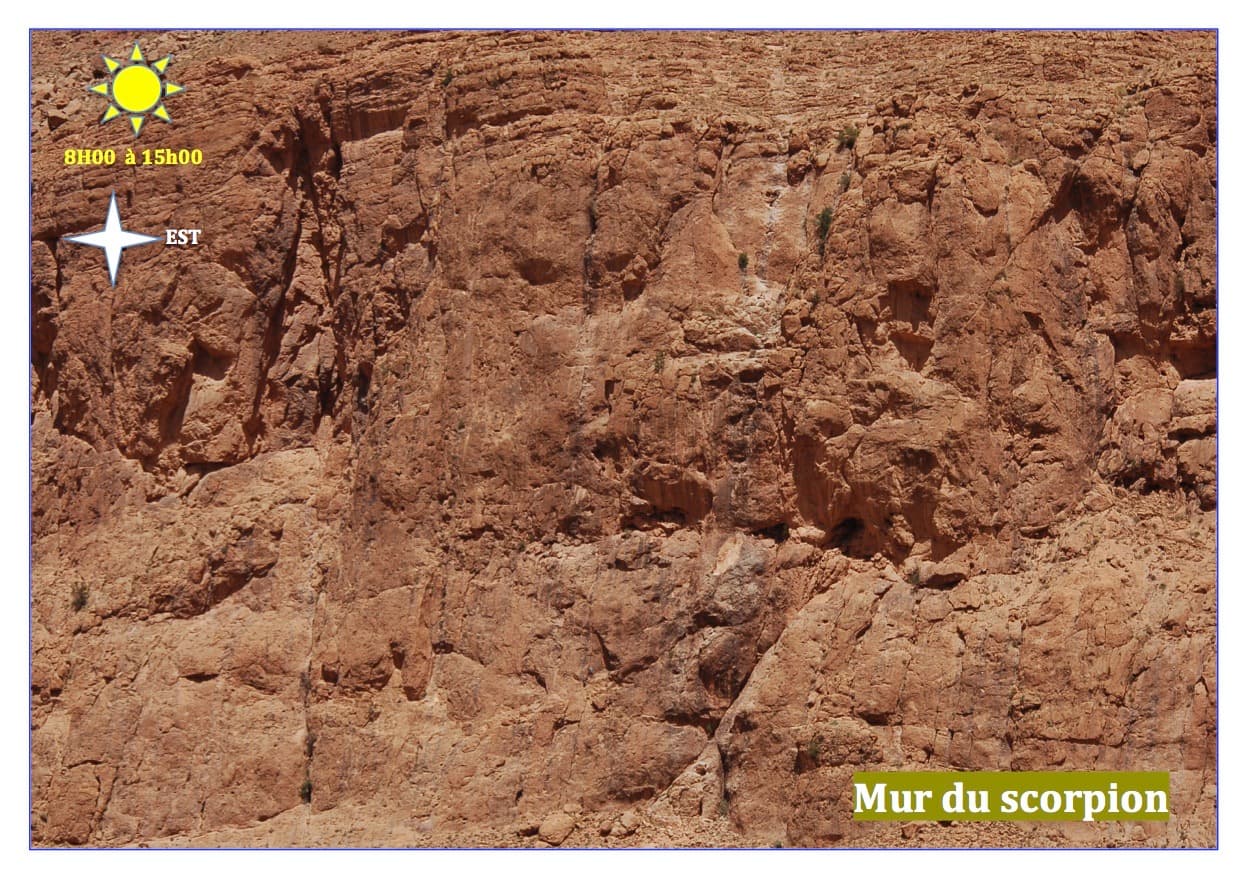
The four-pitch line between Prisa Mata and La voie du Scorpion: three pitches around 6a on walls and a corner, then a fine pillar and a bulge at 6b+. Less homogeneous than its neighbours and with some flaky rock, but a worthwhile third route on the wall.
6b+4 pitches150 m
Read the cautions
Compiled from published sources and last verified October 2026. Bolts, anchors and access change. Climbing is dangerous and you are responsible for your own decisions: check a current topo and read the disclaimer.