Multipitch Atlas

Ramisi Rock

Kokkinovrachos (main wall, left of Mira) · Leonidio & Kyparissi · Greece

Bail not documentedBolting confidence: medium

The route that opened Kokkinovrachos to sport multi-pitch climbing: six long pitches up the centre-right of the red wall, sustained at 6b+ to 6c with one technical 7a crux that can be aided on two bolts. Rated three stars locally and more sustained than Aramis.

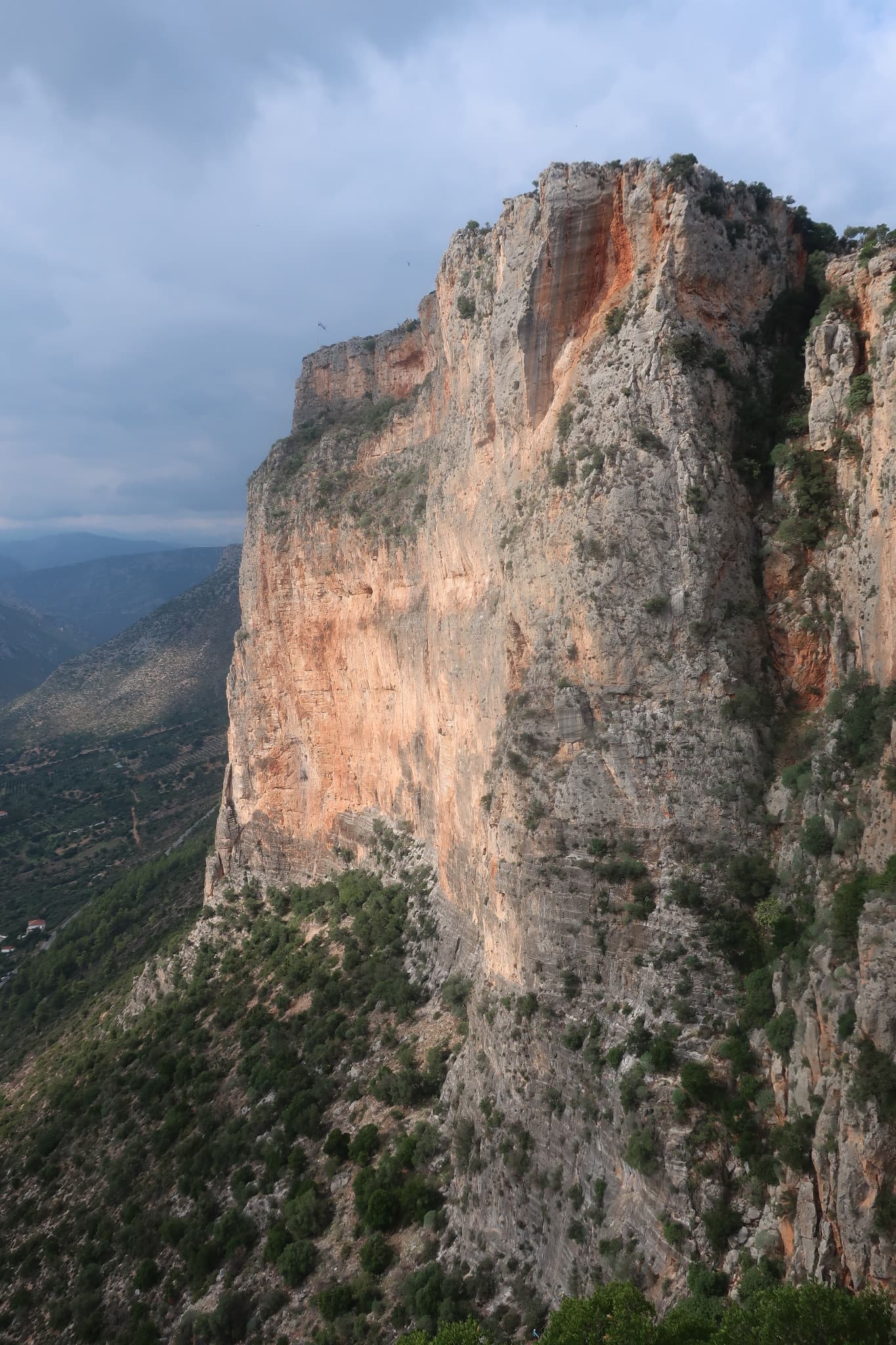
Kokkinovrachos above Leonidio seen from the west; the big sport multi-pitches climb the red wall above the townPhoto: Herbert Ortner · CC BY 3.0

Photo

Kokkinovrachos above Leonidio seen from the west; the big sport multi-pitches climb the red wall above the townPhoto: Herbert Ortner · CC BY 3.0
Hardest pitch
7a
Pitches
6
Length
180 m
Approach
30 min
Aspect
S
South-facing
Rope
2×50 m

The route

Overview

Ramisi Rock dates from the Remy brothers' first visit in 2013 and was the first fully bolted line to the top of the big face; Mira, Aramis, Ura Ka and the rest followed. It gives 180 m in six pitches, three of them 40 m long, and stays at 6b+ to 6c apart from the crux on pitch 2. That crux is 7a free, or 6c with two points of aid, which is what brings the route inside the atlas range. It sits at the hard end of that range: you need to be comfortable on long 6c pitches. It is described in detail by one source only.
The climbing

Pitch by pitch

Pitches of Ramisi Rock
PitchGradeLengthNotes
P16b40 mUp and slightly left on a black and grey wall with a lot of holds to an anchor on a ledge.
P27a35 mA rightward traverse, a technical crux, then straight up. Goes at 6c with two points of aid on the bolts.
P36c30 mStarts hard, then zigzags up to a short bulge.
P46b+40 mA gorgeous vertical wall on good holds.
P56c25 mA rightward traverse over the pillar, then a slab.
P66c40 mA small fingery corner leads to slab climbing and the top. Anchor on the ridge.

Getting there

Approach

To the parking

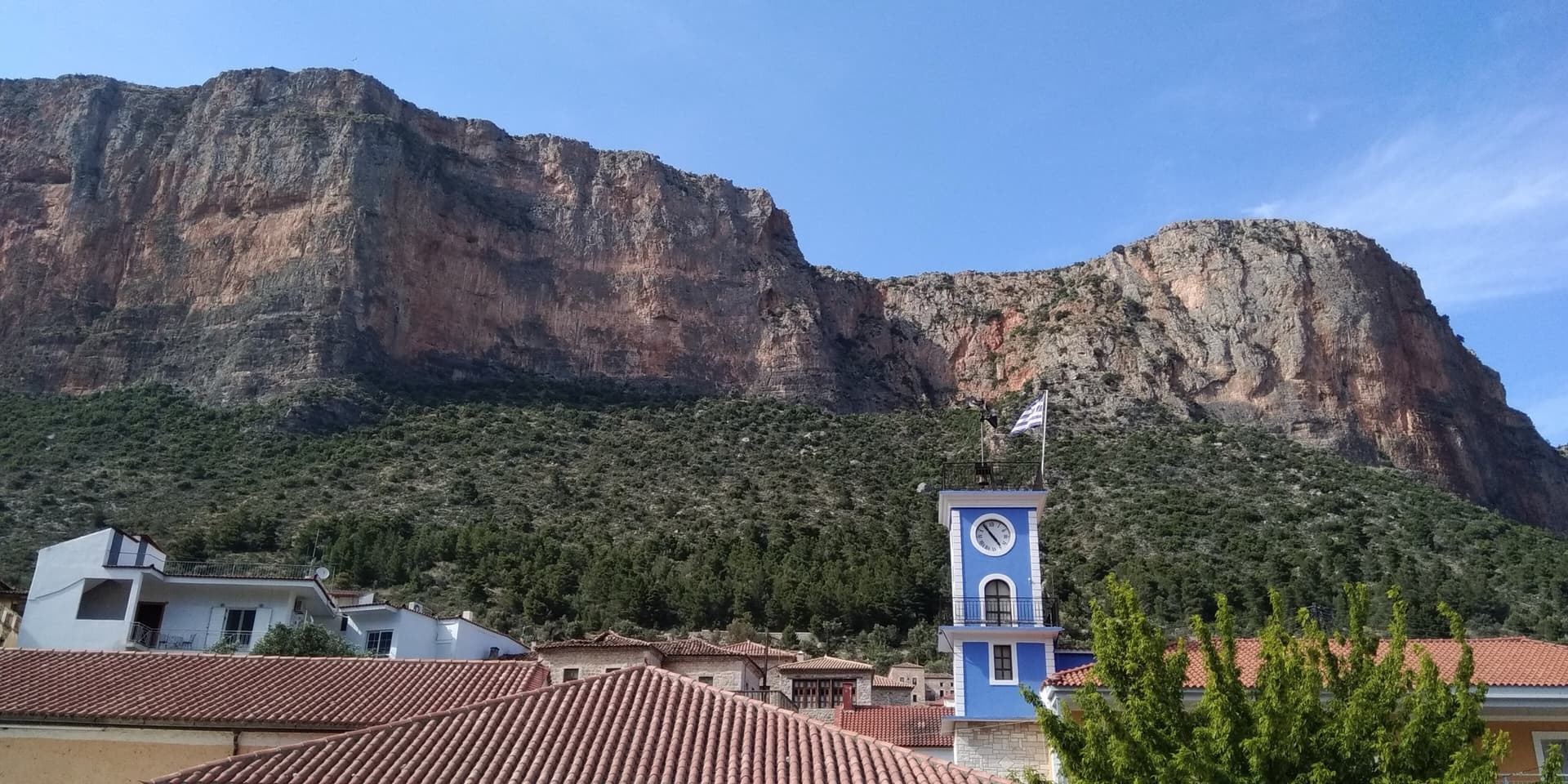
Base yourself in Leonidio on the east coast of the Peloponnese. Kokkinovrachos is the red wall directly above the town.

On foot · about 30 min

Walk from the town following the signs for Kokkinovrachos, or use the Douvari parking on the Vaskina road and traverse right along the foot of the wall. The path reaches the right-hand part of the cliff at the start of Aramis, whose name is painted in red; parties report 20 to 40 min from the village. Mira starts about 20 m right of that point and is described as the first equipped route right of Ramisi Rock, so Ramisi Rock is close by on the same section of wall. No source describes how its start is marked; use the guidebook topo.

Map of the walk-in

  • Crag

Loading map

The point marks the crag, not the exact start of the route.

Coordinates · crag

37.17236, 22.85832

Point from OpenStreetMap node 13450285322 (Ramisi rock, Kokkinovrachos)

For your phone or watch

Download GPX

Contains the route point. Opens in most mapping apps and GPS watches.

Points are compiled from published sources, with the precision stated above. They were not surveyed on the ground: check them against a current topo.

Getting down

Descent

The online listing gives no descent for Ramisi Rock; the guidebook covers return options for the wall on a dedicated page. On the neighbouring routes you either abseil the line with two ropes of at least 50 m, or walk right along the top to a line of two abseils in the gully to the east, the second of which is 40 m, and then a path. A third option is the long walk out to the Vaskina road.

Retreat

Bailing off the route

Bail not documented

Nothing is published about retreating from Ramisi Rock. The rope the guide specifies (one 100 m or two 50 m) suggests the belays can be abseiled, but two pitches traverse and no party has reported doing it.

Retreat from
Probably R1, reached by a fairly direct 40 m pitch (inferred).
Point of no return
Not documented. Pitch 2 traverses right before the crux and pitch 5 traverses over a pillar.
Carry
Two 50 m ropes at least, maillons and cord.
Basis
Inferred from the route factsInferred from the rope requirement and pitch descriptions on the guide site; no descent or retreat is described.

Partly inferred from the route facts

Safety

Hazards

  • Only one detailed source and no trip reports were found.
  • The guide site warns that the multi-pitches numbered 1 to 4 on its topo must not be climbed when climbers are at the single-pitch sectors below, because of loose blocks. The online listing does not say which routes those are, so check the printed topo.
  • Pitches 2 and 5 traverse right, which complicates both seconding and retreat.
  • The bolts date from 2013; no report on their present state was found.
  • The descent is not described for this route; work it out from the guidebook before you leave the ground.
  • The local rescue team (Leonidio Fire Department) is not trained for big-wall rescue, as the local guide site points out.

Sun and weather

Conditions

South facing at about 420 m: a winter-sun wall, best from November to March. Neighbouring routes are reported too hot from late morning even in November on still days.

Usual season · Jan to Apr, Oct to Dec

Sun on the wall · S-facing

Working out the sunlit hours for this month.

  • January (usual season): not yet worked out
  • February (usual season): not yet worked out
  • March (usual season): not yet worked out
  • April (usual season): not yet worked out
  • May: not yet worked out
  • June: not yet worked out
  • July: not yet worked out
  • August: not yet worked out
  • September: not yet worked out
  • October (usual season): not yet worked out
  • November (usual season): not yet worked out
  • December (usual season): not yet worked out

Sun on the wallDaylight, wall in shade● Usual season

Estimated from the wall's aspect only. Ignores surrounding terrain, gullies and the wall's exact shape. Clock times are local to the wall (Greek time), for the 15th of each month.

Monthly climate averages for Leonidio & Kyparissi, 1991-2020
MeasureJan (usual season)Feb (usual season)Mar (usual season)Apr (usual season)MayJunJulAugSepOct (usual season)Nov (usual season)Dec (usual season)
Mean daily high °C111214182227303026211612
Mean daily low °C66810151922231915117
Rain days 1 mm or more1111108744357811

● marks the usual climbing season. Averages for 1991-2020 at about 297 m. Area climate from Open-Meteo reanalysis. Temperatures are adjusted to the height of the crag; rain comes from a grid cell of about 10 to 25 km, and summer highs on sea cliffs can read a few degrees low. The wall and valley can differ. Data: Open-Meteo, CC BY 4.0.

What to carry

Gear

15 quickdraws, and a single 100 m rope or two 50 m ropes (guide site). Helmets.

Checklist

Quickdraws
15
Rope
2×50 m
Helmet
One each
Abseil device and prusik
The descent or the retreat involves abseiling
Maillons or spare karabiners
To leave behind if you retreat
Cord
Mentioned for retreat

Derived from the route data; check it against a current topo

From climbers

Reader reports

Reader reports are not being collected yet. Until they are, check a current topo and the local club or guidebook publisher for recent changes to Ramisi Rock.

Worth knowing

Tips

  • Pull on two bolts at the pitch 2 crux and the route goes at 6c.
  • Mira (6b) next door is the best-protected and easiest long route on the wall and a sensible first visit.

Open questions

Where sources disagree

  • None between sources, because only the guide site describes the pitches. Camptocamp's Mira page and an OpenStreetMap point named 'Ramisi rock' confirm the position on the wall.

Provenance

Sources

Same area

More in Leonidio & Kyparissi

All routes in Leonidio & Kyparissi
The orange pillar at the right end of the main Kokkinovrachos wall, Leonidio.

Greece · Leonidio & Kyparissi

Mignonette

The easiest multi-pitch on Kokkinovrachos, following the easy-angled arête and pillar above Leonidio, with tufas, crimpy walls and a great view of the town. Rock is good apart from the scrappy P2–P3.

5c+7 pitches175 m

The red limestone wall of Kokkinovrachos rising directly above the rooftops and clock tower of Leonidio. Kapi Reborn is on the south-east face of this cliff; the exact line is not marked.

Greece · Leonidio & Kyparissi

Kapi Reborn

A newer pillar line with a pretty 45 m slab to start, a single interesting 6a+ crux on P4, and a final orange corner. It makes a good step up from Mignonette.

6a+7 pitches180 m

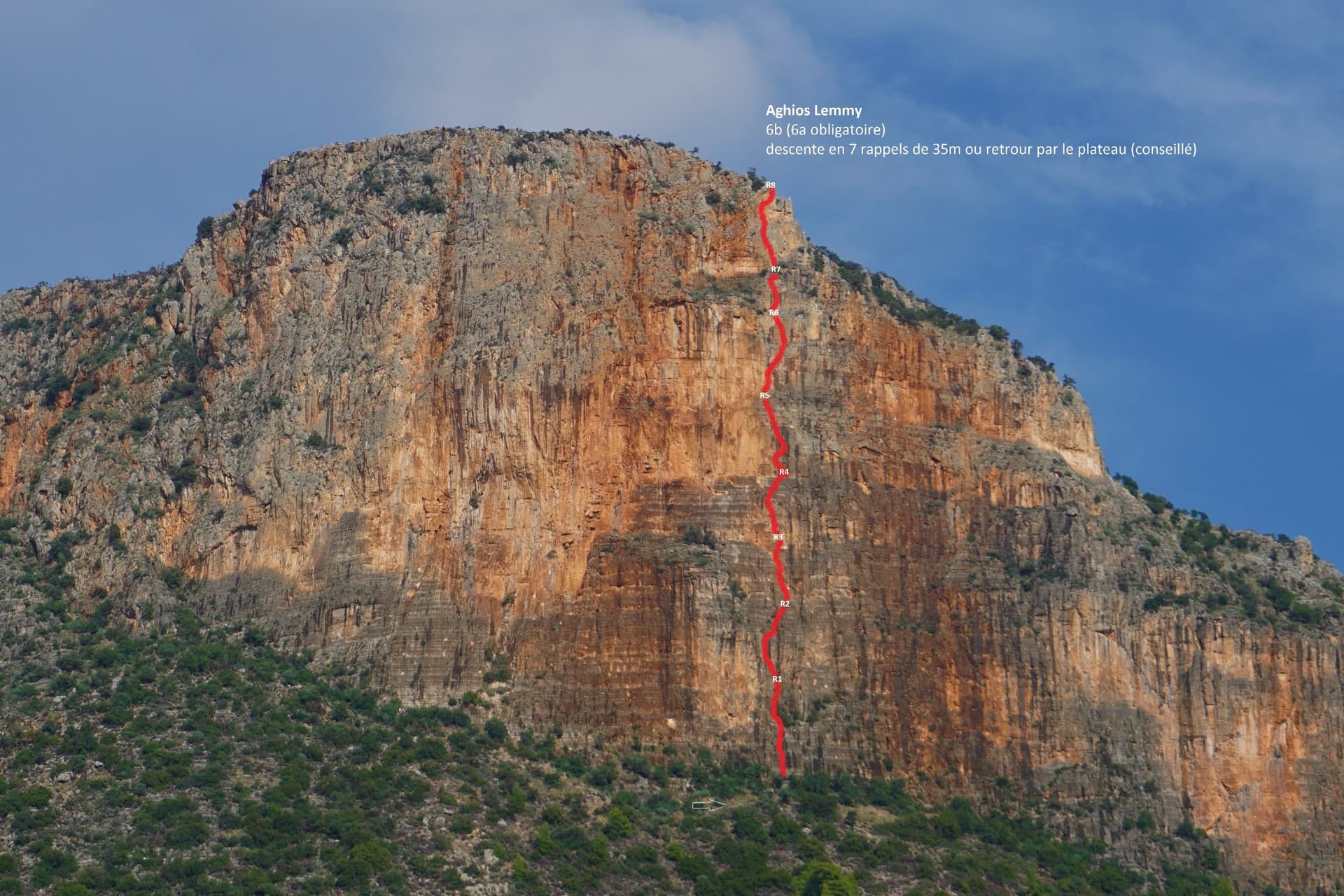
The Hospital / Red Rock buttress of Kokkinovrachos above Leonidio, with the line of Aghios Lemmy drawn in red.

Greece · Leonidio & Kyparissi

Aghios Lemmy

Short, mostly vertical pitches on beautiful multi-coloured limestone with varied climbing. It is sustained at 6a+/6b from P2 to the top. The route name is written at its base.

6b8 pitches160 m

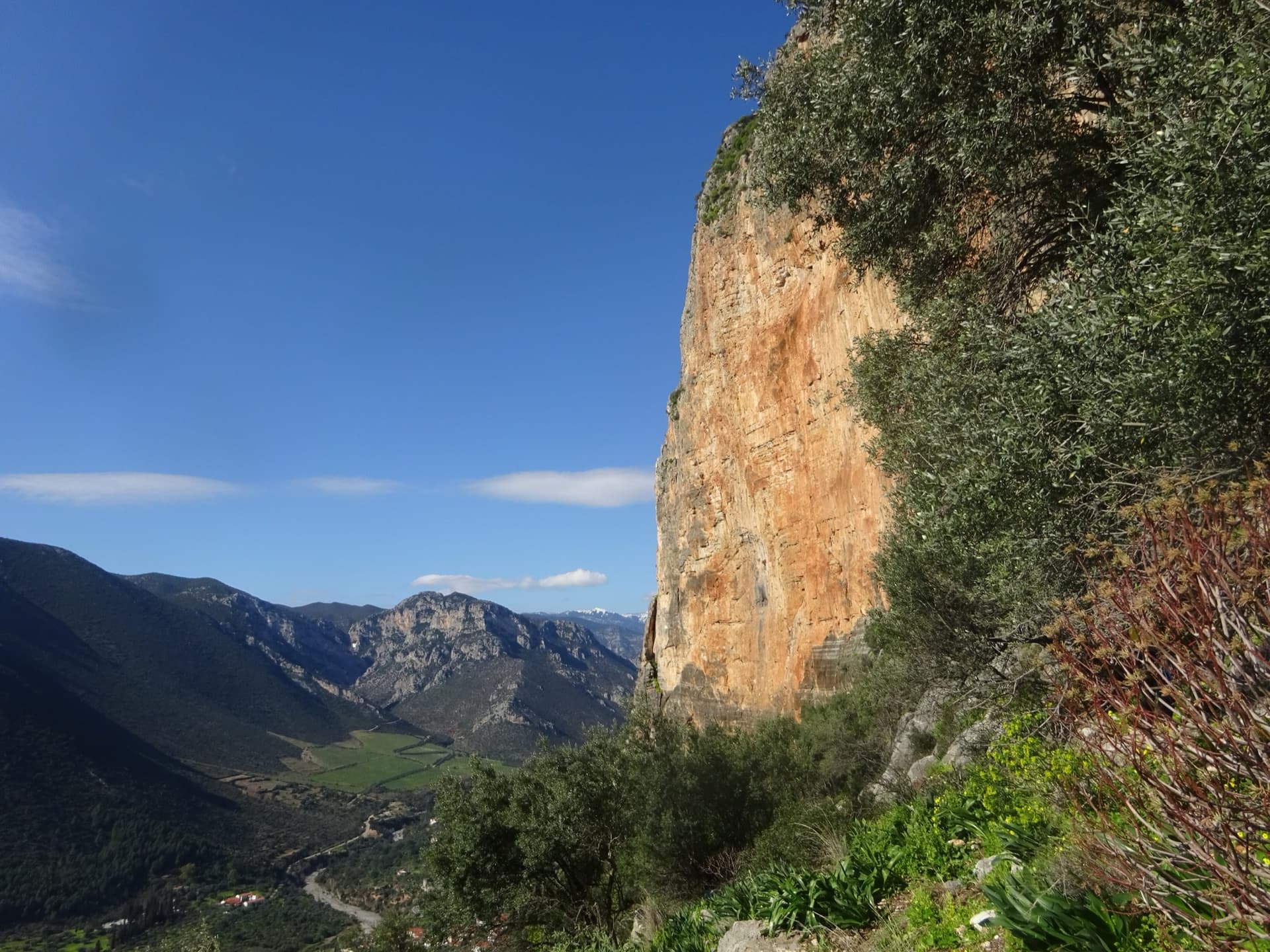
The orange Kokkinovrachos wall in profile above the Dafnon valley, seen from the foot of the cliff.

Greece · Leonidio & Kyparissi

Mira

Steep climbing on good holds through grey and then orange rock, including a fine steep crack and a sustained bulge out of the big orange niche you can see from town. For the last pitch take the 6b middle exit or the 5c traverse into Mignonette. The direct 'dead wall' exit is 6c+, much harder than the rest of the route.

6b7 pitches200 m

Around 7a · about 6 pitches

Similar elsewhere

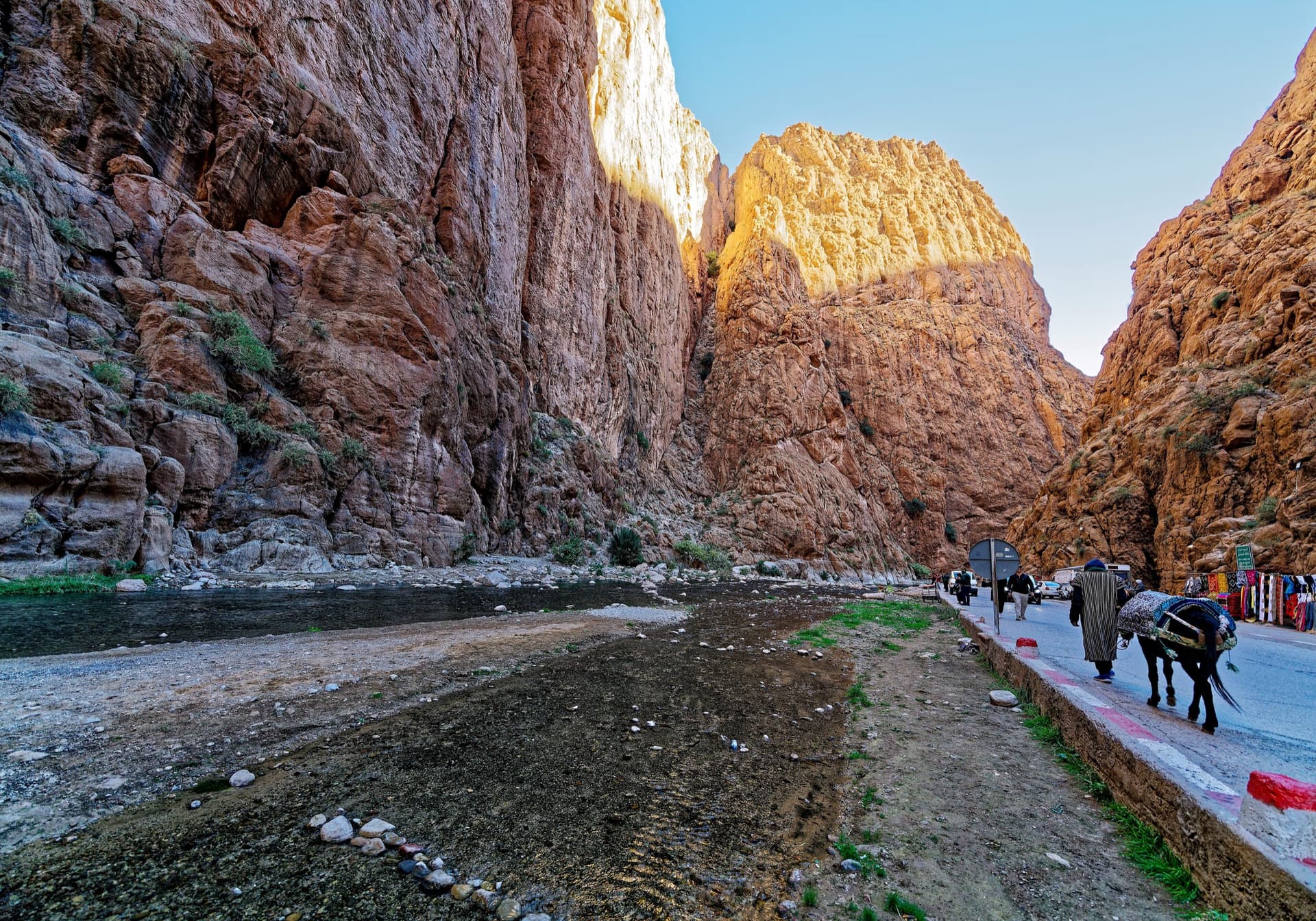
The narrows of the Todra Gorge in late afternoon light, a few minutes' walk upstream of the Mansour wall; a view of the gorge, not of this route's wall.

Morocco · Todra Gorge (Todgha)

China Perdida

Steep, fingery wall climbing that starts with your feet almost in the stream at the gorge entrance. The 7a second pitch is hard for only 2 to 3 metres and can be swapped for a 6b pitch on the neighbouring route, after which three pitches of 6b+ to 6c+ on pocketed and edgy rock lead to the top. Abseil descent.

7a6 pitches200 m

Read the cautions

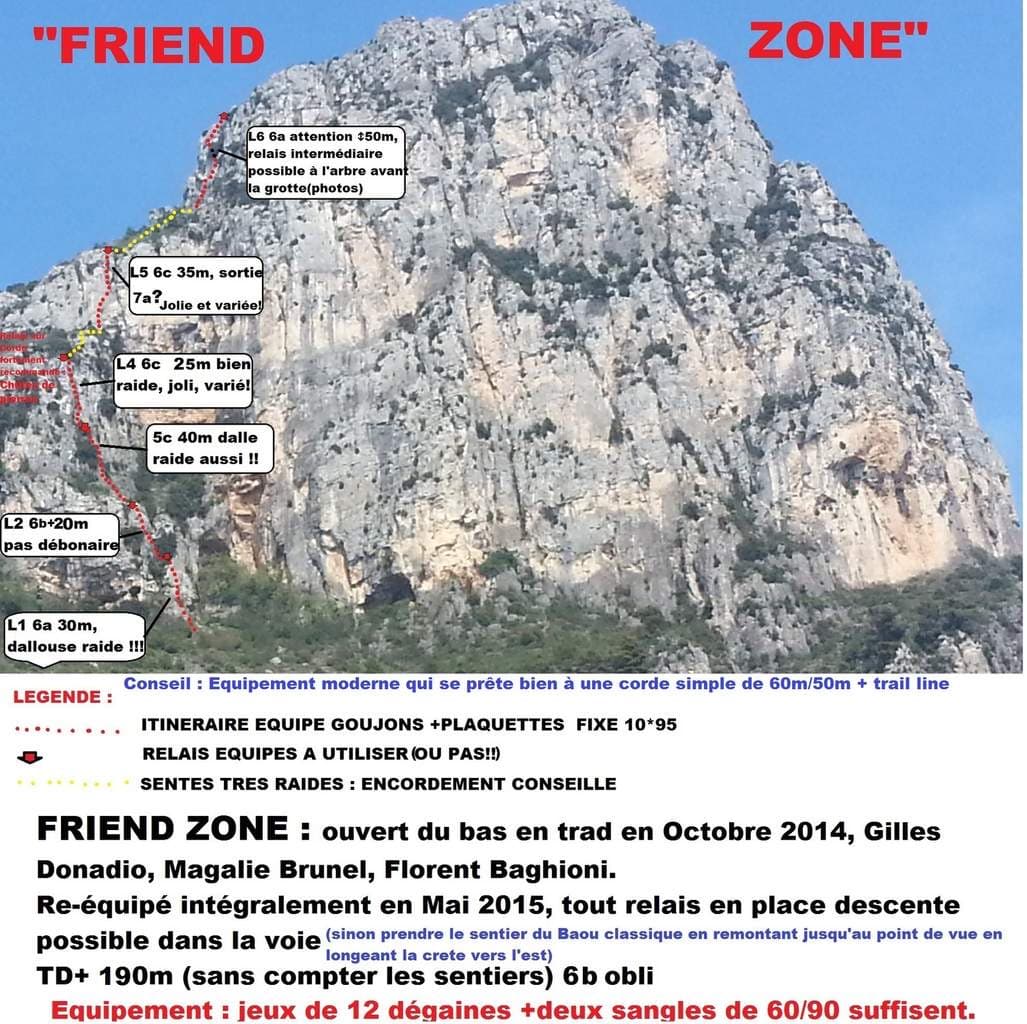
The opener's photo-topo of Friend Zone on the west side of the Baou de Saint-Jeannet, with pitch grades and lengths

France · Baou de Saint-Jeannet

Friend Zone

A modern bolted line up the left side of the Baou, starting beside the Péril Jaune cave: six varied pitches on unpolished rock, with a steep 6c wall and a fine crack and corner finishing with one hard move (7a on the topo, 6c or 6c+ to most parties). Two walking transitions through scrub break the climbing, so it has less exposure than the routes on the main face.

7a6 pitches230 m

The Petite Aiguille de l'Arcelin from the approach through the Cirque de l'Arcelin

France · Vanoise (Grand Bec)

Stop ou Encore

A short, wild, modern route on the grey limestone of the Petite Aiguille de l'Arcelin, in two halves: thin, technical slab low down, including a sustained 6b+ with obligatory moves, then steep walls with a very sustained 7a pitch of two bouldery cruxes. Seldom climbed for its quality.

7a6 pitches190 m

Read the cautions

The start of Alfredo Alfredo at the foot of the east face of Monte Oddeu

Italy · Sardinia

Alfredo Alfredo

Two pitches of bridging up a 60 m corner hung with tufas and stalactites (6c+, 6c), then grey water-drop walls and a short roof at 7a that goes in three moves of aid. Seven pitches of varied climbing on perfect, unpolished rock.

7a7 pitches220 m

Compiled from published sources and last verified October 2026. Bolts, anchors and access change. Climbing is dangerous and you are responsible for your own decisions: check a current topo and read the disclaimer.