Multipitch Atlas

Txubascos Baskos

Paret de Zaratustra · Vilanova de Meià (Roca dels Arcs) · Spain

Bail with caveatsBolting confidence: medium

The easy classic of Vilanova de Meià, on the small wall opposite the Roca dels Arcs: four short pitches on the horizontal strata and rounded knobs typical of the area. Popular and now very polished, above all on the first pitch, where the old grade of IV+ feels stiff.

Photo-topo of the Txubascos side of the Paret de Zaratustra, drawn for the newer Mar de Café (red); Txubascos Baskos and Mar de Núvols are among the other coloured lines to its leftPhoto: Simon Apretna · CC BY-SA 3.0

Topo

Photo-topo of the Txubascos side of the Paret de Zaratustra, drawn for the newer Mar de Café (red); Txubascos Baskos and Mar de Núvols are among the other coloured lines to its leftPhoto: Simon Apretna · CC BY-SA 3.0
Hardest pitch
5c
Pitches
4
Length
100 m
Approach
15 min
Aspect
S
South-facing
Rope
2×60 m

The route

Overview

The Paret de Zaratustra is the roadside wall lower down the gorge from the Roca dels Arcs, with short multipitch routes that are bolted far more generously than the big wall above. Txubascos Baskos is the most climbed of them and the usual first route for visitors: four pitches of about 20 to 30 m, graded 5c on camptocamp with 5b obligatory. The rock is excellent, but years of traffic have polished it; a Catalan party in 2014 called it extremely polished and did not recommend it, while a French party in 2024 still found it a pleasant introduction. Go in knowing that the first pitch is slippery.

The climbing

Pitch by pitch

Pitches of Txubascos Baskos
PitchGradeLengthNotes
P15+30 mSlightly leftwards on horizontal strata, about IV+ with a move of V+ to reach the belay, which is shared with Parachutti di Colori. Very polished.
P25a25 mDiagonally left, then straight up (V and IV+). The rock changes from strata to big rounded knobs.
P34+25 mStraight up on strata again, easier than pitch 1 (IV+).
P45+20 mFrom belay 3 follow the bolts on the left, up the left-hand rib of the summit facet; the line straight above belongs to the route on the right. The V+ move is short.

Getting there

Approach

To the parking

From Vilanova de Meià take the L-913 north towards Terradets. The climbing is in the gorge about 5 km above the village. From Tremp, drive south to the Terradets dam, cross it towards Llimiana and follow the LV-9121 and then the L-913 over the pass; the first car park is about 20 km from the dam. For the Paret de Zaratustra use the large dirt car park beside the road below the wall, lower down the gorge than the Roca dels Arcs lay-bys.

On foot · about 15 min

About 15 minutes. Park at the big dirt car park beside the road below the wall, which looks like a small quarry. Facing it, take the path that starts on the right and climb along the foot of the cliff, past the first sector (Enigma). The route starts on the right edge of the next sector, Primavera, with its name painted at the foot. In November 2024 the path was overgrown and the start hard to find; the party located it by the red bolts of the neighbouring Parachutti di Colori.

Map of the walk-in

  • Crag

Loading map

The point marks the crag, not the exact start of the route.

Coordinates · crag

42.01704, 1.03970

Point from camptocamp waypoint 156090 (Paret de Zaratustra)

For your phone or watch

Download GPX

Contains the route point. Opens in most mapping apps and GPS watches.

Points are compiled from published sources, with the precision stated above. They were not surveyed on the ground: check them against a current topo.

Getting down

Descent

By abseil; several lines are used. A 2015 party went down in two abseils with 60 m ropes on belays with chains and rings. A 2014 party abseiled belay 4 to 3, 3 to 2, then straight down from belay 2 to a big terrace with a tree and made a last short abseil from the tree. A 2024 party with 2×50 m made three abseils down the route Julia, further left, and found its anchors old and well rusted. Camptocamp also mentions diagonal abseils down the route itself.

Retreat

Bailing off the route

Bail with caveats

Abseiling is the normal way down and the belays have chains and rings, so you can retreat from any stance. The line is diagonal and the wall has trees, which is why parties use several different abseil lines.

Retreat from
Any belay; from belay 2 a line goes straight down to a terrace with a tree.
Point of no return
None.
Carry
Two ropes. A short final abseil from a tree is described on one line, so carry a sling you can leave.
Basis
Stated in the sourcesCamptocamp and three trip reports describe abseil descents from the belays.

Safety

Hazards

  • Polish, especially on pitch 1.
  • Trees on the wall make the abseils awkward in wind; keep the rope under control from the belay.
  • Abseil anchors vary in age from line to line; those on Julia were described as old and oxidised in 2024.
  • The Luis Alfonso guidebook photo places the route in the wrong sector (camptocamp); it is on the right edge of sector Primavera.

Sun and weather

Conditions

Camptocamp gives a south aspect; a July 2014 report says the wall stays in shade until about midday, so it probably faces a little west of south. Climbed in the logged outings from October to June. In mid-May 2015 a party started at 7:00 because 38°C was forecast.

Usual season · Mar to May, Oct to Nov

Sun on the wall · S-facing

Working out the sunlit hours for this month.

  • January: not yet worked out
  • February: not yet worked out
  • March (usual season): not yet worked out
  • April (usual season): not yet worked out
  • May (usual season): not yet worked out
  • June: not yet worked out
  • July: not yet worked out
  • August: not yet worked out
  • September: not yet worked out
  • October (usual season): not yet worked out
  • November (usual season): not yet worked out
  • December: not yet worked out

Sun on the wallDaylight, wall in shade● Usual season

Estimated from the wall's aspect only. Ignores surrounding terrain, gullies and the wall's exact shape. Clock times are local to the wall (Central European time), for the 15th of each month.

Climate figures for Vilanova de Meià (Roca dels Arcs) are not available yet

What to carry

Gear

10 quickdraws. Two ropes for the abseils (60 m is the figure most reports give). A prusik or other back-up is advised on the abseils.

Checklist

Quickdraws
10
Rope
2×60 m
Helmet
One each
Abseil device and prusik
The descent or the retreat involves abseiling
Slings
Mentioned for retreat

Derived from the route data; check it against a current topo

From climbers

Reader reports

Reader reports are not being collected yet. Until they are, check a current topo and the local club or guidebook publisher for recent changes to Txubascos Baskos.

Worth knowing

Tips

  • Allow 1.5 to 2 hours.
  • Mar de Núvols starts a few metres to the right and finishes at almost the same point, so the two combine well in a morning.
  • A corrected sketch of the sector is on onaclimb.com (linked from camptocamp).

Open questions

Where sources disagree

  • Aspect: south on camptocamp, but shaded until midday in July according to the 2014 blog.
  • Length: 100 m of height against 110 m of climbing (camptocamp).
  • Descent: two abseils of 60 m (2015), four shorter ones including a tree (2014), or three down Julia (2024).
  • Quality: 'extremely polished and not recommended' (2014 blog) against 'nice route to discover the local rock' (2024 outing).

Provenance

Sources

Same area

More in Vilanova de Meià (Roca dels Arcs)

All routes in Vilanova de Meià (Roca dels Arcs)
The south-east face of the Roca dels Arcs above the road from Vilanova de Meià, in the Montsec de Rúbies.

Spain · Vilanova de Meià (Roca dels Arcs)

El Somni de Quimfer

Four long, steep pitches on the left side of the Roca dels Arcs, sustained at 6a on good holds and not yet polished above the first pitch. The third pitch is the event: a reachy bulge to start, 30 m of gently overhanging strata, and a hard boulder move off a ledge to finish that most people grade 6c. That last move can be avoided by belaying on the neighbouring route.

6b+4 pitches160 m
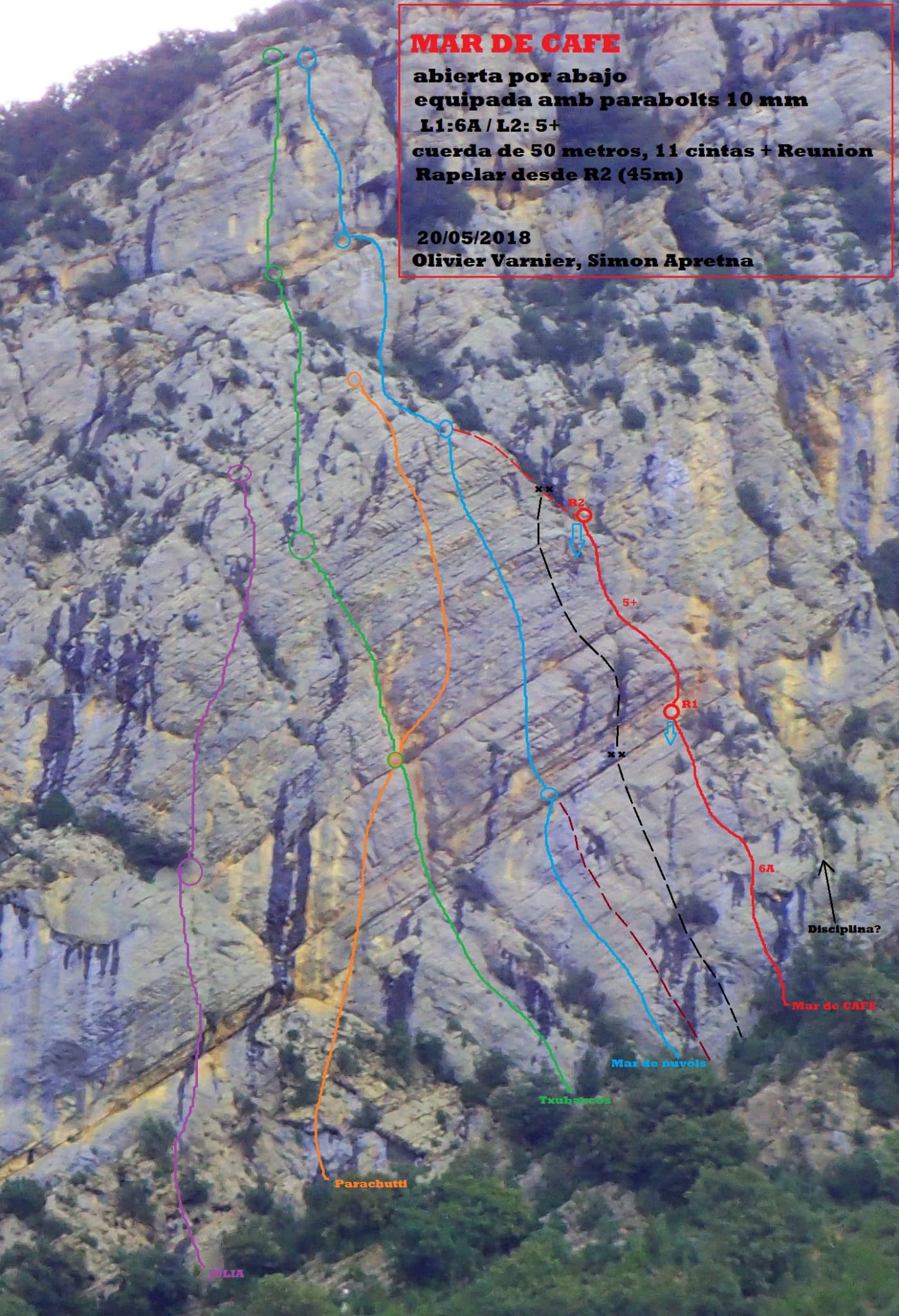
Photo-topo of the Txubascos side of the Paret de Zaratustra, drawn for the newer Mar de Café (red); Txubascos Baskos and Mar de Núvols are among the other coloured lines to its left

Spain · Vilanova de Meià (Roca dels Arcs)

Mar de Núvols

The best of the easier lines on the Paret de Zaratustra: steep climbing on big horizontal holds, a very vertical wall on the long second pitch and an overhanging 6a finish. Less polished than Txubascos Baskos next door, but with longer gaps between some bolts.

6a4 pitches110 m

Read the cautions

The two sectors of the Roca Alta above Vilanova de Meià

Spain · Vilanova de Meià (Roca dels Arcs)

Pornostar

Four varied pitches under and around the big roofs of the Roca Alta, the quieter wall above and west of the Roca dels Arcs. A start out of a tree, an overhang on big holds, a fine steep wall and a bouldery 6b+ finish, all of which can be eased by pulling on the close bolts.

6b+4 pitches150 m

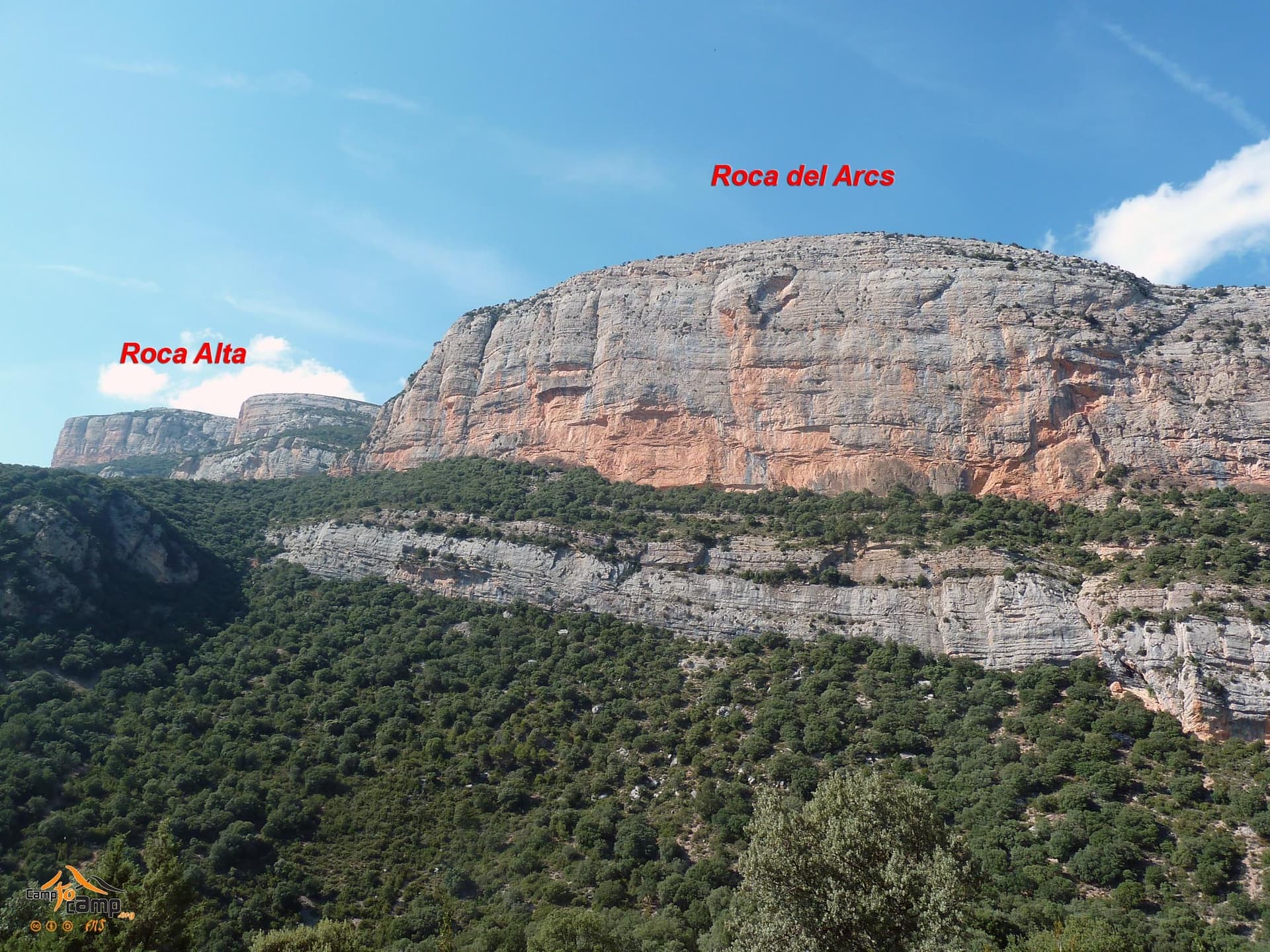
The Roca dels Arcs, with the Roca Alta behind on the left, seen from across the gorge above Vilanova de Meià

Spain · Vilanova de Meià (Roca dels Arcs)

Tierra de Nadie

Six steep, physical pitches on the right-hand side of the Roca dels Arcs, with a hard pull or two on every one: bouldery starts, big overhangs on jugs and little difference in effort between the 6a and the 6b pitches. Sport-bolted, which is unusual on this wall. Grades feel tight.

6b+6 pitches170 m

Around 5c · about 4 pitches

Similar elsewhere

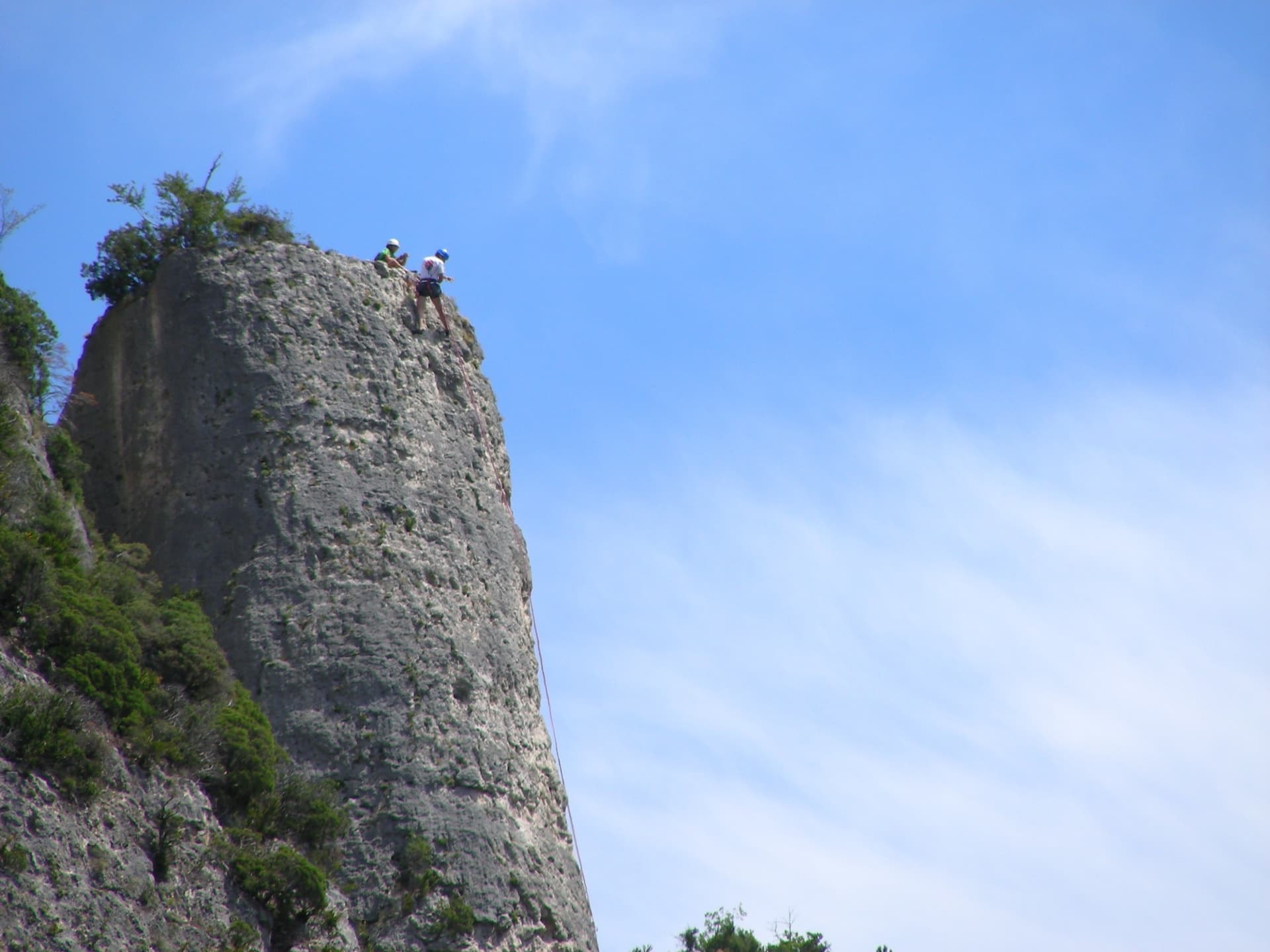
Climbers on the flat summit of the Bitard pillar, Gorges de la Jonte

France · Gorges de la Jonte

Le Bitard

The pillar that gives the sector its name, climbed in four short pitches on grey, well-featured rock. The third pitch is a sustained vertical crack and the best of the route. It is the usual first multipitch for visitors because the bolts are closer than elsewhere in the gorge.

5c4 pitches100 m

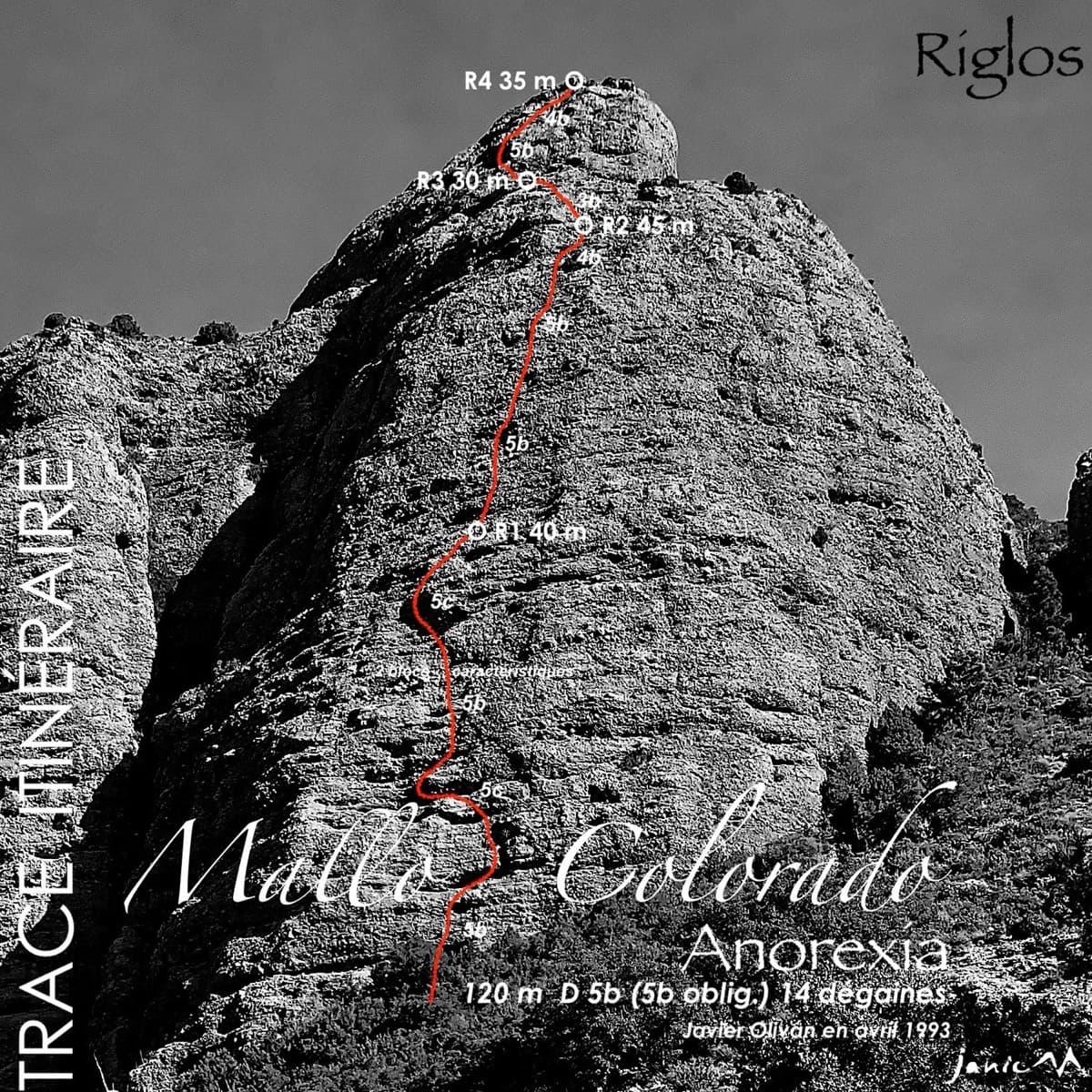
Topo of Anorexia on Mallo Colorado, Riglos

Spain · Riglos & Agüero (Mallos)

Anorexia

The best-known route on the Mallo Colorado. Two steep, juggy panza pitches have a well-protected boulder move, giving a short taste of real Riglos steepness at a friendly grade.

5c4 pitches150 m

The headland of Capo d'Uomo on Monte Argentario with its watchtower on top, and the island of Giannutri on the horizon. The multipitch wall drops towards the sea below the tower; the routes are not visible in this view.

Italy · Monte Argentario

Maria Mare

Four pitches on the sea-facing wall of Capo d'Uomo: a featured slab, an easy linking pitch, and two vertical, athletic pitches on sculpted grey limestone to the crest below the old watchtower. The final wall is the highlight. The lower pitches need care with holds.

5c4 pitches110 m

Read the cautions

The Velika stena, the big wall of the Osp collapse doline, seen along its length from the rim in autumn; Medo is on the right side of this wall.

Slovenia · Osp

Medo

The easiest line on Osp's famous overhanging Big Wall, following an obvious right-slanting ramp, the only non-overhanging part of the face. It is in shade until about 11:30 in July.

5c4 pitches110 m

Read the cautions

Compiled from published sources and last verified October 2026. Bolts, anchors and access change. Climbing is dangerous and you are responsible for your own decisions: check a current topo and read the disclaimer.