Multipitch Atlas

Blutwurst

Karlkopf south-west face (Breitlahnerkar), Ginzling · Zillertal · Austria

Bail with caveatsBolting confidence: high

The second plaisir route on the Karlkopf, ending at the same point as Herzblut. It starts on grippy slabs, then follows a cleft in the mountain that closes into a chimney: you climb two short pitches inside the rock. One pitch of UIAA 6+ lower down is the crux.

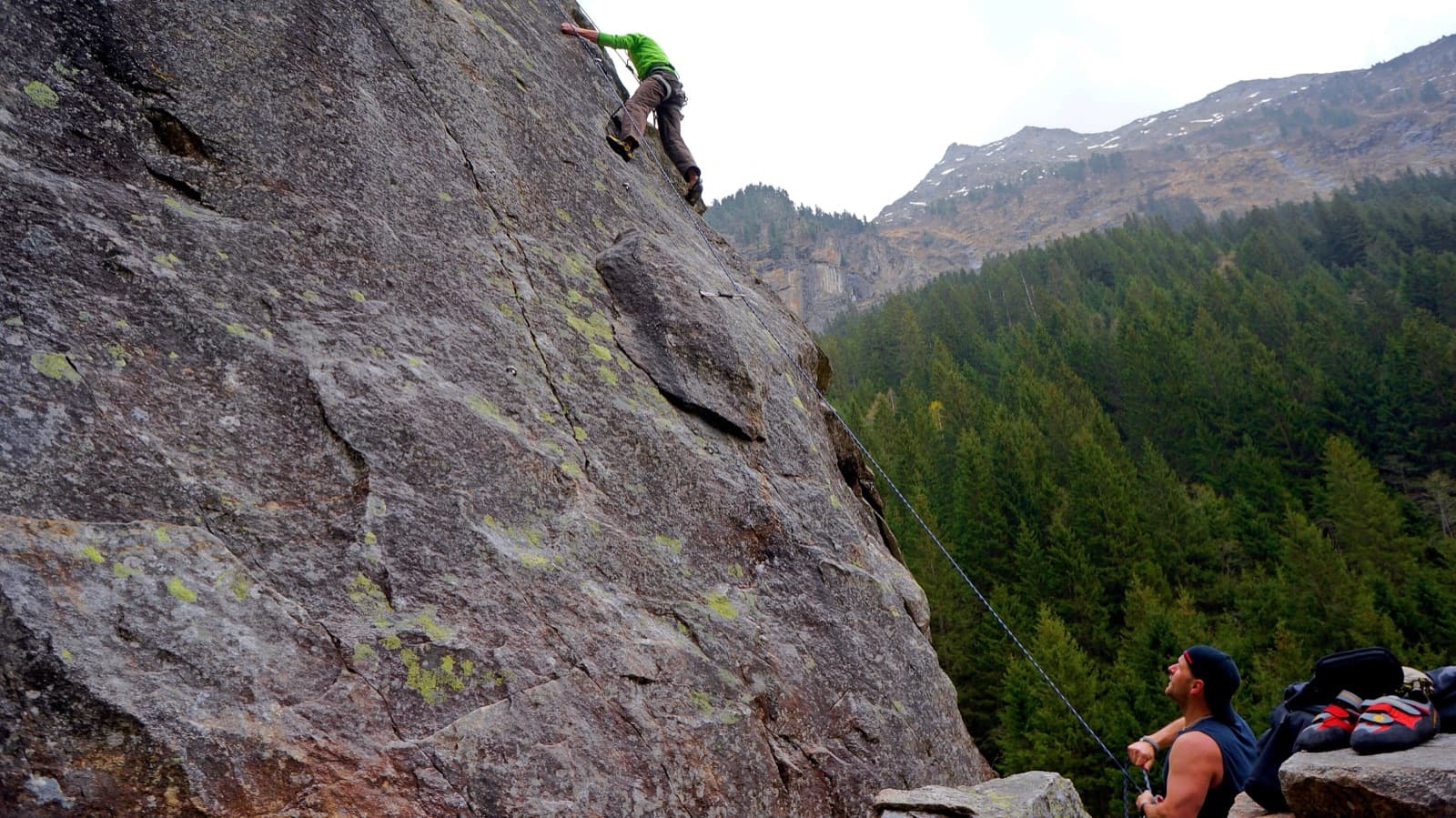
A view of the region, not this route's wall. Slab climbing at the Ewige Jagdgründe crag near Ginzling in the Zillertal; the Wiegelwand is the wall above this sector and is not in the picture.Photo: Fuchs Robert · CC BY 3.0

Photo

A view of the region, not this route's wall. Slab climbing at the Ewige Jagdgründe crag near Ginzling in the Zillertal; the Wiegelwand is the wall above this sector and is not in the picture.Photo: Fuchs Robert · CC BY 3.0
Hardest pitch
6a+
Pitches
8
Length
205 m
Approach
60 min
Aspect
SW
South-west-facing
Rope
2×60 m

The route

Overview

Blutwurst starts a little above Herzblut on the south-west face of the Karlkopf and shares its finish and abseil descent. Gerhard Gritzer and Bettina Hanser climbed it in 2021. The first four pitches are slab, crack and groove climbing up to UIAA 6+. The route then enters a cleft and climbs a chimney inside the mountain in two short pitches, which is the memorable part. If you do not want the chimney you can finish up Herzblut where the two routes cross.

The climbing

Pitch by pitch

Pitches of Blutwurst
PitchGradeLengthNotes
P15c+30 mUIAA 6. From the block with the sling climb the first step, go left round a small pillar and follow a grassy rock rib to the belay.
P25+30 mUIAA 5+. Cross the grass ledge leftwards to a slab with an obvious crack and follow the crack to the belay.
P35c30 mUIAA 6-. Over a small bulge, then left across the groove to a belay at a tree.
P46a+24 mUIAA 6+, the crux. Stay in the groove over slabby blocks to a big block, climb over its tip and belay on top of it.
P55a45 mUIAA 5. Up big flakes that push you out, until the entrance to the cleft opens; the route crosses Herzblut here. Go through the tunnel to the belay at its end.
P65c+15 mUIAA 6. Enter the chimney through a narrow slot that widens inside; proper chimney climbing. The belay in the middle of the chimney can be skipped.
P75c10 mUIAA 6-. Up the chimney to the belay at its exit. A route book sits before the chimney.
P85a20 mUIAA 5. Leave the chimney to the left and climb about 20 m to the last belay, shared with Herzblut.

Getting there

Approach

To the parking

Drive up the Zillertal past Mayrhofen to Ginzling and continue up the valley to the toll station at Gasthof Breitlahner. Park either at the Breitlahner or, just before it on the right, at the Ewige Jagdgründe crag; both car parks charge a fee. By public transport take the train to Mayrhofen and the bus to Gasthof Breitlahner.

On foot · about 60 min

At the Ewige Jagdgründe crag cross the stream by the suspension bridge to the east bank and walk round the big rock tower called Wig Wam, where a sign points to 'Tulfer'. Cross the fence behind it on iron rungs and go up the left edge of the pasture on a clear path to the forest. Shortly afterwards you reach a T-junction: turn right and follow the path level or slightly downhill for about 300 m. Just before an avalanche track interrupts the forest, turn up left and follow steep zigzags until the Breitlahnerkar opens out; the path fades for the last 20 m of height before the cirque. Above the tree line a good path leads to the start of Herzblut. Allow 1 hour. Continue up for about 50 m above the start of Herzblut. A sling on a block marks the start of Blutwurst, at about 1650 m.

Map of the walk-in

  • Route base
  • Parking

Loading map

The point marks the base of the route.

Coordinates · route base

47.06433, 11.76071

Parking

47.06640, 11.75196

Pay car park at the Ewige Jagdgründe crag, just before Gasthof Breitlahner

Point from bergsteigen.com map marker 'Einstieg (ungefähr)'

For your phone or watch

Download GPX

Contains the route point and parking. Opens in most mapping apps and GPS watches.

Points are compiled from published sources, with the precision stated above. They were not surveyed on the ground: check them against a current topo.

Getting down

Descent

From the last belay abseil three times down the Herzblut piste and return by the approach path. bergsteigen.com allows 45 minutes.

Retreat

Bailing off the route

Bail with caveats

Below the cleft you can escape by joining Herzblut where the routes cross, or abseil from the bolted belays. Once inside the chimney it is simpler to finish, since the exit is two short pitches away. The normal descent is by abseil from the shared top.

Retreat from
Bolted belays on pitches 1 to 4; the crossing with Herzblut on pitch 5.
Point of no return
The chimney on pitches 6 and 7, where abseiling back would be awkward (inferred).
Carry
Two 60 m ropes.
Basis
Part stated, part inferredThe Herzblut escape and the abseil descent are stated; retreat from the lower belays is inferred.

Partly inferred from the route facts

Safety

Hazards

  • Risk of a pendulum fall in the chimney.
  • The chimney is slippery when damp.
  • Hollow flakes are reported on the neighbouring routes of the same wall; test what you pull on.

Sun and weather

Conditions

South-west facing, start at about 1650 m. After rain let the route dry for a day, because the chimney becomes slippery. The best light in the chimney is in the afternoon. No season is published; June to October is an estimate from the altitude and aspect.

Usual season · Jun to Oct

Sun on the wall · SW-facing

Working out the sunlit hours for this month.

  • January: not yet worked out
  • February: not yet worked out
  • March: not yet worked out
  • April: not yet worked out
  • May: not yet worked out
  • June (usual season): not yet worked out
  • July (usual season): not yet worked out
  • August (usual season): not yet worked out
  • September (usual season): not yet worked out
  • October (usual season): not yet worked out
  • November: not yet worked out
  • December: not yet worked out

Sun on the wallDaylight, wall in shade● Usual season

Estimated from the wall's aspect only. Ignores surrounding terrain, gullies and the wall's exact shape. Clock times are local to the wall (Central European time), for the 15th of each month.

Monthly climate averages for Zillertal, 1991-2020
MeasureJanFebMarAprMayJun (usual season)Jul (usual season)Aug (usual season)Sep (usual season)Oct (usual season)NovDec
Mean daily high °C−11471217191915104−0
Mean daily low °C−9−8−5−2279951−4−8
Rain days 1 mm or more121215162021201814121313

● marks the usual climbing season. Averages for 1991-2020 at about 1432 m. Area climate from Open-Meteo reanalysis. Temperatures are adjusted to the height of the crag; rain comes from a grid cell of about 10 to 25 km, and summer highs on sea cliffs can read a few degrees low. The wall and valley can differ. Data: Open-Meteo, CC BY 4.0.

What to carry

Gear

2×60 m double ropes, 12 quickdraws and a helmet. A headtorch helps in the chimney, depending on the light. No nuts or cams.

Checklist

Quickdraws
12
Rope
2×60 m
Helmet
One each
Abseil device and prusik
The descent or the retreat involves abseiling

Derived from the route data; check it against a current topo

From climbers

Reader reports

Reader reports are not being collected yet. Until they are, check a current topo and the local club or guidebook publisher for recent changes to Blutwurst.

Worth knowing

Tips

  • If the chimney does not appeal, switch to Herzblut where the routes cross on pitch 5.
  • Take a small sack: the slot into the chimney is narrow.

Open questions

Where sources disagree

  • Pitch grades and lengths come from theCrag, which lists eight pitches matching the eight described on bergsteigen.com; its lengths add up to 204 m against 205 m.
  • Obligatory grade 6-/6 according to bergsteigen.com; theCrag gives no obligatory grade.
  • The bergsteigen.com page carries no information date; the first ascent year and a later user photo are the only dating.

Provenance

Sources

Same area

More in Zillertal

All routes in Zillertal
Slab climbing at the Ewige Jagdgründe crag near Ginzling in the Zillertal; the Wiegelwand is the wall above this sector and is not in the picture.

Austria · Zillertal

Schwarzer Teufel

A slab route on the left side of the Wiegelwand with steep passages on small edges; UIAA 7/7+ at the crux on pitch 3, 6 to 6+ obligatory. The easier pitches are a bit grassy. Often wet, so look from below first.

6b+5 pitches110 m
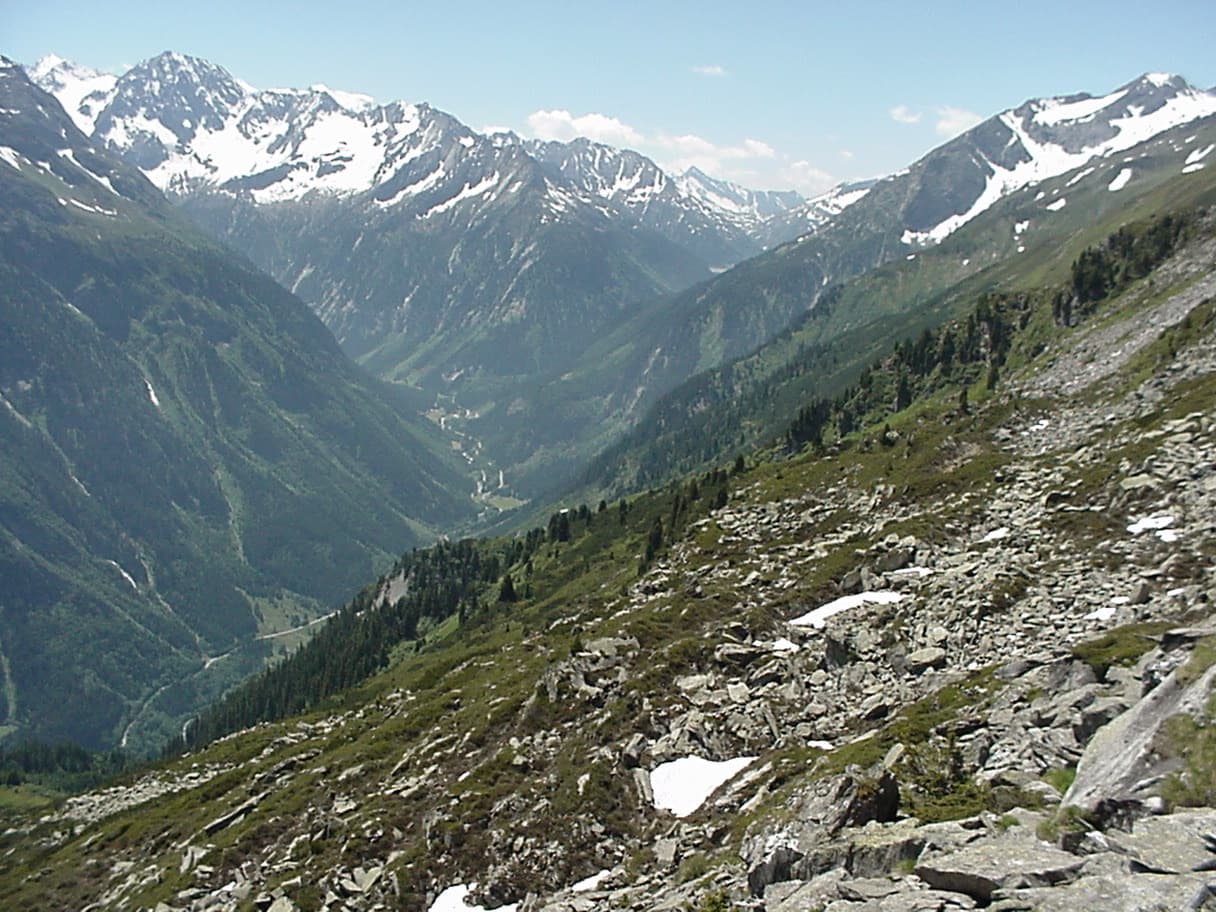
The upper Zemmtal with Gasthof Breitlahner on the valley floor, the starting point for the Karlkopf routes

Austria · Zillertal

Herzblut

bergsteigen.com counts it among the best easier multipitch routes in the Zillertal and one of the few true plaisir lines there. Six pitches of featured slabs, steep walls studded with quartz crystals and fine flakes, with very little smooth rock. Three pitches reach UIAA 6-.

5c6 pitches200 m

A view of the region, not this route's wall. Slab climbing at the Ewige Jagdgründe crag near Ginzling in the Zillertal; the Wiegelwand is the wall above this sector and is not in the picture.

Austria · Zillertal

Jakobsweg

Twelve long pitches of slab climbing up an unremarkable-looking wall near the Klausenalm, getting harder towards the top. The length, the bolting and the short approach are rare in the Eastern Alps. The price is the descent: a steep, rough scramble and four abseils that the sources call delicate.

5c+12 pitches570 m

Read the cautions

A view of the region, not this route's wall. Slab climbing at the Ewige Jagdgründe crag near Ginzling in the Zillertal; the Wiegelwand is the wall above this sector and is not in the picture.

Austria · Zillertal

Alpiner Spätaufsteher

A granite slab route beside a washed-out stream bed and a small waterfall, described as the new slab classic of the Zillertal. Mostly around UIAA 5 on fine slabs, with short harder passages and a 6/6+ exit. Never very exposed, with a view of the 3000 m peaks.

6a7 pitches255 m

Around 6a+ · about 8 pitches

Similar elsewhere

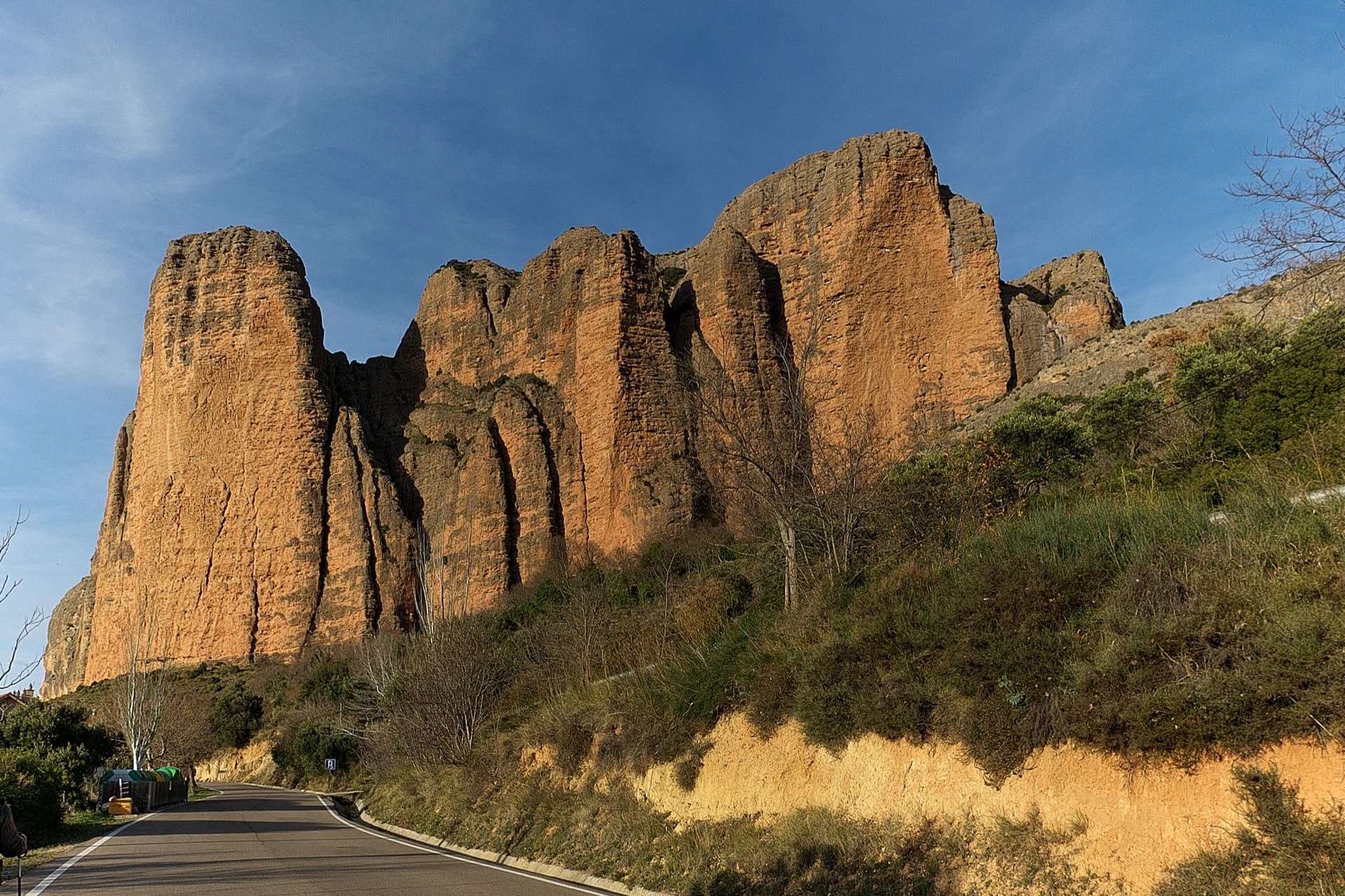
The south faces of the main Riglos wall in low sun, seen from the road into the village: Mallo Pisón on the left and the wall running right towards Mallo Frechín and La Visera at the right-hand end.

Spain · Riglos & Agüero (Mallos)

Negro sobre Rosa

Two chimney pitches, a crack, then a pillar with bulging panzas. The crux is one awkward clip on pitch 7, which you can pull through.

6a+8 pitches250 m

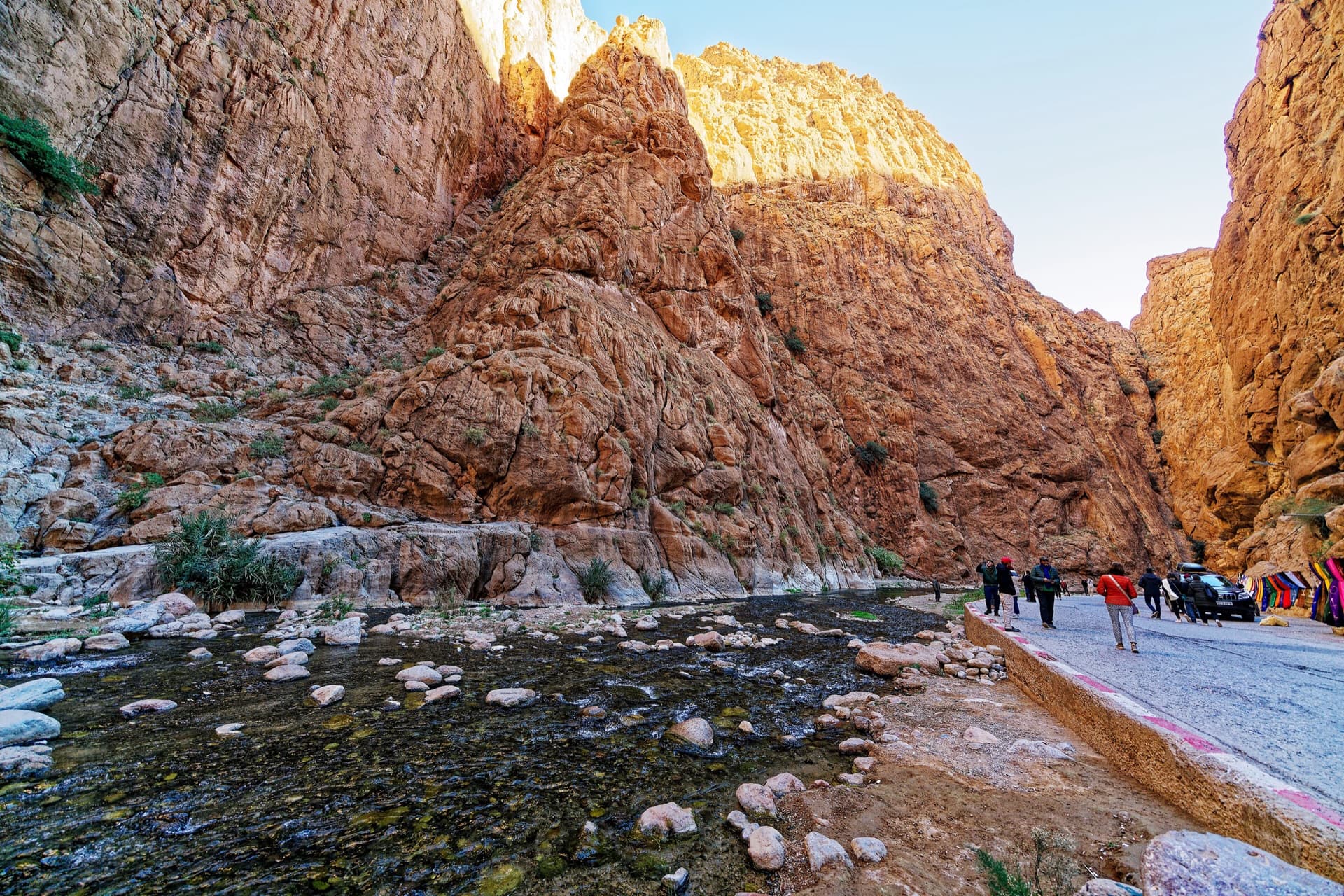
Inside the Todra narrows: the knobbly pointed buttress in the centre is the sector Les pieds dans l'eau, and the tall wall left of the gully beside it, in shade with a sunlit rim, is the Pilier du Couchant, which La Classique climbs.

Morocco · Todra Gorge (Todgha)

La Classique

The classic of the gorge, first climbed in 1977. Sustained and physical 6a climbing up cracks, corners and short bulges on the big pillar at the gorge entrance. The first pitch is the 6a+ crux, straight off the ground. Watch for loose blocks on the last pitch, shared with Chibania.

6a+9 pitches300 m

Read the cautions

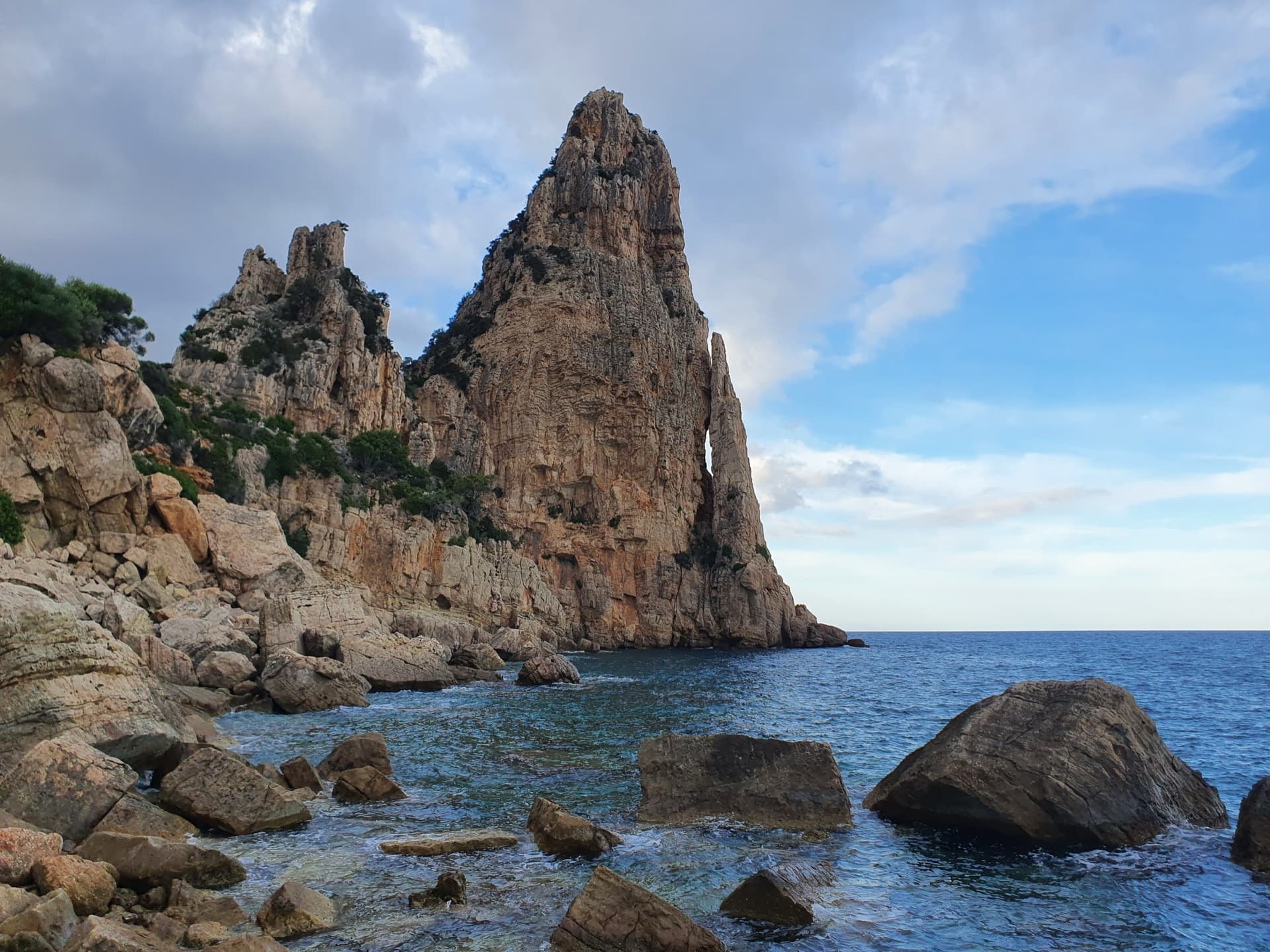
Pedra Longa, the 128 m limestone tower on the Baunei coast, seen from the shoreline rocks at its foot.

Italy · Sardinia

Marinaio di Foresta

An airy, mostly left-rising traverse that spirals round the Pedra Longa sea stack to its summit, on water-runnelled grey walls and pocketed white rock right above the sea. It has become one of the most popular routes in Sardinia, so expect queues.

6a+7 pitches190 m

Committing

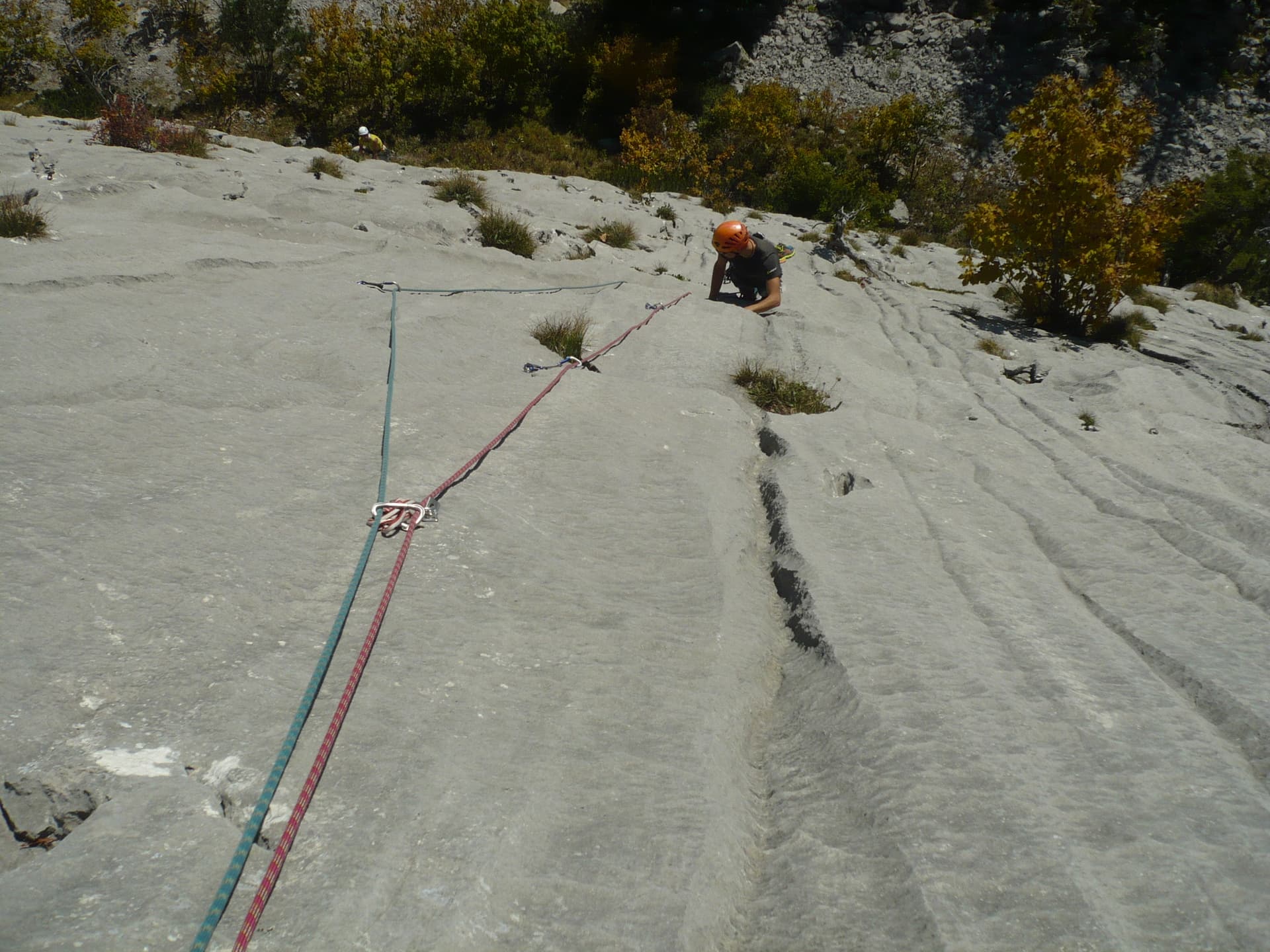
The water-worn runnels of the second pitch of Die Namenlose

Switzerland · Glarus (Brüggler)

Die Namenlose

The hardest of the Brüggler plaisir routes: an overhanging start on big holds, then smooth runnelled slabs, with a very blank 6a+ slab on pitch 3 that feels hard for the grade. The hardest moves there can be avoided by weaving left or right while still clipping the bolts. The top three pitches are easier.

6a+7 pitches200 m

Committing

Compiled from published sources and last verified October 2026. Bolts, anchors and access change. Climbing is dangerous and you are responsible for your own decisions: check a current topo and read the disclaimer.