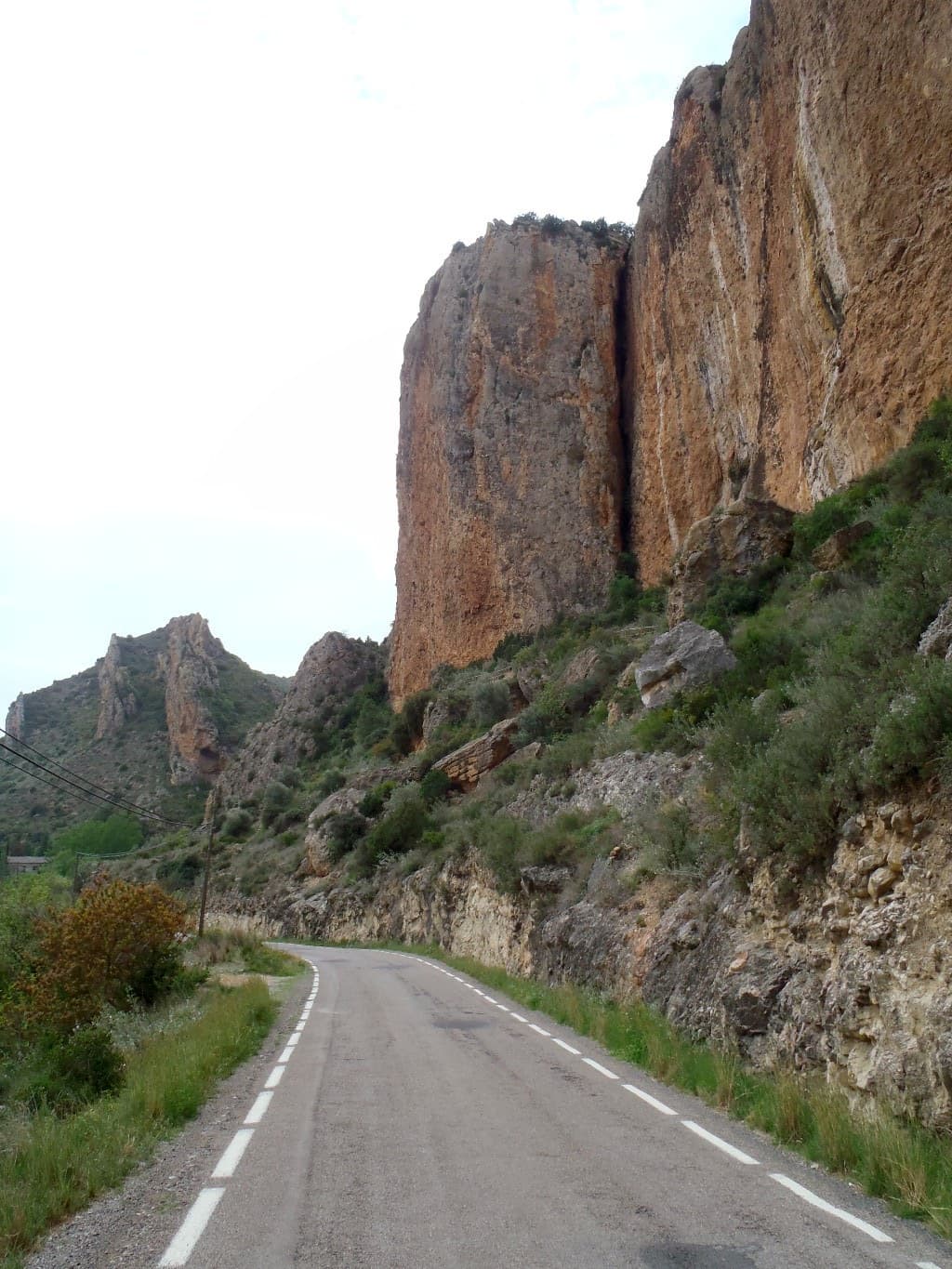
A popular easy classic on the Pala Alta: four pitches on beautifully sculpted grey and ochre limestone, with long traverses in the middle and a steep, airy last pitch on big holds. The bolts are close throughout, which makes it a good first multipitch on rock that still feels big.
Climbing mode: Big type, screen kept awake, tick pitches as you go.
Climbing modeBig type, screen kept awake, tick pitches as you go.
Overview
Brothers Ruiz is one of the best-known easy routes on the Pala Alta, the highest band of the Serra de Mont-roig above Camarasa. It starts in slabs below a set of big red roofs, traverses right for two pitches and finishes up a steep wall on big holds just below the plateau. The rock is excellent and well sculpted, and every source stresses how close the bolts are. Expect a lot of sideways climbing: manage rope drag and look after the second.
Worth knowing
Allow about 2 hours for the route.
Approach from Vilanova de la Sal and the hermitage; a 2022 party who came from the Coll d'Orenga side found it long and scrubby.
Topos are sold at the bar in Sant Llorenç de Montgai.
A steep start, then a traverse left before climbing to the belay. Original grade IV+.
P2
5aV+5.7
30 m
Traverse right. Original grade V; one party thought it V+, and the bolts are close enough to pull through at A0.
P3
4cV5.6
40 m
An ascending traverse right. Do not belay at the foot of the corner bounding the big roofs on the right; keep traversing right. An intermediate belay is possible.
P4
6aVI+5.10a
30 m
A fine, steep and airy pitch on big holds; go up the corner on the right rather than straight above the belay. Camptocamp gives V+ (5c); Topos versant espagnol gives 6a max with V+ obligatory, and Bloc Empotrat says the exit pitch is given V+/6a. Belay just below the plateau.
Approach
To the parking
From Balaguer or Camarasa drive to Les Avellanes and turn left to Vilanova de la Sal, then follow signs for the Ermita de Montalegre; the simplest is to park at the hermitage. Camptocamp also gives a parking area on the track below the cliffs.
On foot · about 15 min
About 15 minutes. From the hermitage follow the good path east along the crest; after about 5 minutes, where it rises, take a cairned path on the right that drops quickly to the track along the foot of the cliffs. Follow the track past the Diedro Blanqueta; a little further on you pass under big red roofs, and the route starts in the slabs below them, just right of the route Mariola.
Map of the walk-in
Crag
PParking
Loading map
The point marks the crag, not the exact start of the route.
On foot. Topos versant espagnol: go left along the crest to the top of the Pala Alta, then follow a path on the right flank of the crest back to the hermitage (about 30 min). Camptocamp: follow the path right (east) over small rises down to the Coll de Porta and the track below the routes.
Bailing off the route
Bail not documented
No source describes retreating. The belays are bolted, but pitches 2 and 3 traverse right, so abseiling straight down from them would not land you on the previous belays. From the first belay retreat should be easy (inferred).
Retreat from
Probably from the first belay; higher up the traverses make it awkward (inferred).
Point of no return
Not documented; in practice the start of the pitch 2 traverse.
Carry
If you want the option to retreat, take a spare maillon and cord; abseil hardware is not described.
Basis
Inferred from the route factsAll sources describe a walk-off; the retreat advice is inferred from the traversing line.
Marks the crag, not the route: give route and pitch.
Say what happened, how many are hurt, and where you are. Checked October 2026 (sourceofficial sources).
Hazards
The traversing pitches make a fall by the second swing; protect the second carefully.
The first belay is cramped for a party of three.
Gear
14 quickdraws. The route is walked off, so one rope long enough for 40 m pitches will do (rope length is not stated by the sources).
Checklist
Quickdraws
14
Rope
Not given
Helmet
One each
Maillons or spare karabiners
To leave behind if you retreat
Cord
Mentioned for retreat
Conditions
South facing at about 750 to 950 m; the wall goes into shade in mid-afternoon. Pleasant from autumn to spring; vultures and bearded vultures are often seen.
Forecast · next 7 days · 950 m
Loading the forecast.
Weather forecast for Sant Llorenç de Montgai & Mont-roig at 950 m, today and the next 6 days
Measure
– –
– –
– –
– –
– –
– –
– –
High °C
–
–
–
–
–
–
–
Low °C
–
–
–
–
–
–
–
Rain mm
–
–
–
–
–
–
–
Chance of rain %
–
–
–
–
–
–
–
Strongest gusts km/h
–
–
–
–
–
–
–
Model forecast for 950 m. It cannot tell you whether the rock is dry. Data: Open-Meteo, CC BY 4.0.
Time plan · 4 pitches
Working out sunrise and sunset.
Approach
15 min
Climbing
2 h 20 min to 3 h 45 min20% quicker to 25% slower.
Total on the way up
2 h 35 min to 4 h
Sunrise
–
Sunset
–
Start walking by
–
Descent
Not included: add time for the way down.
An estimate. Queues and route finding cost time, and shaded walls go dark before sunset. Local time (Central European time), flat horizon.
Sun on the wall · S-facing
Working out the sunlit hours for this month.
Jan
–January: not yet worked out
Feb
–February: not yet worked out
Mar ●
–March (usual season): not yet worked out
Apr ●
–April (usual season): not yet worked out
May ●
–May (usual season): not yet worked out
Jun
–June: not yet worked out
Jul
–July: not yet worked out
Aug
–August: not yet worked out
Sep
–September: not yet worked out
Oct ●
–October (usual season): not yet worked out
Nov ●
–November (usual season): not yet worked out
Dec ●
–December (usual season): not yet worked out
060912151821
Sun on the wallDaylight, wall in shade● Usual season
From the aspect alone; terrain is ignored. Local time, 15th of each month.
Monthly climate averages for Sant Llorenç de Montgai & Mont-roig, 1991-2020
Measure
Jan
Feb
Mar ● (usual season)
Apr ● (usual season)
May ● (usual season)
Jun
Jul
Aug
Sep
Oct ● (usual season)
Nov ● (usual season)
Dec ● (usual season)
Mean daily high °C
10
12
16
19
23
28
31
30
25
20
14
10
Mean daily low °C
1
1
4
7
11
15
18
18
14
10
5
2
Rain days 1 mm or more
6
5
7
10
9
7
6
8
8
9
7
6
● usual season. 1991-2020 averages at about 396 m; rain is for a 10–25 km grid cell. Weather and climate data: Open-Meteo, CC BY 4.0.
HarderLa Directa6bVII5.10c4 pitchesfaces SE2.6 km away
Straight-line distances, up to 30 km.
Reader reports
No reports yet.
Report a problem with this route
Bolts and history
Bolting
Fully bolted on expansion bolts in the pitches and at the belays; sources from 2011 to 2022 describe the bolting as generous and very close, and say you simply follow the bolts. It was bolted in 1991.
History
Opened in November 1991 by J. Gutiérrez, F. Martínez and J. L. Ruiz.
Guidebook
Guia d'escalada al Mont-roig, J. Escuer and J. Marmolejo (Geoconsultores Técnicos y Ambientales, 2014, in Catalan). Buy from kletterfuehrer.net.
Where sources disagree
Hardest grade: camptocamp gives V+ (5c) for the last pitch; Topos versant espagnol gives 6a max with V+ obligatory, and Bloc Empotrat says the exit pitch is given V+/6a. The atlas uses 6a.
Descent: the two sources describe different paths (west to the hermitage, or east to the Coll de Porta); both are on foot.
The classic of the Cilindre, a short Riglos in miniature: four steep, continuous pitches on big pebbles and pockets in sound conglomerate, with a polished crack-corner to start. The 6b second pitch is a long, slightly overhanging pull. Grades are considered generous for the style.
An exposed, airy line with unusually good holes and jugs for Montserrat, shaded in the afternoon. The 6a pitch is a sustained vertical 20 m. Going straight up instead of following the line is closer to 6b+.
The most accessible bolted multipitch on the Baou: four homogeneous pitches of French 5+ with one move of 6a, up a crack, corners and sculpted stratified walls, with an airy traverse on pitch 3. Short enough for half a day. Local grades are stiff, the first pitch is polished and the easy sections are run-out.
A short but superb sea-cliff route on beautifully sculpted limestone in an incredible setting near Pan di Zucchero. Corners and an airy pillar lead to a steep, rounded 6a wall. Camptocamp rates it 'great'.
6aVI+5.10a6aVI+5.10a4 pitches120 mTop▲ 170 m★★★
Researched and aggregated by AI from published sources, last compiled October 2026. It can be wrong, and bolts, anchors and access change: check a current guidebook and read the disclaimer.