Multipitch Atlas

L'étrier

South-west face, left of the Arête S · Baou de Saint-Jeannet · France

Read the cautionsBail with caveatsBolting confidence: medium

The most accessible bolted multipitch on the Baou: four homogeneous pitches of French 5+ with one move of 6a, up a crack, corners and sculpted stratified walls, with an airy traverse on pitch 3. Short enough for half a day. Local grades are stiff, the first pitch is polished and the easy sections are run-out.

L'étrier drawn on the south-west face of the Baou de Saint-Jeannet, with its four belaysPhoto: cab · CC BY-NC-ND 3.0

Topo

L'étrier drawn on the south-west face of the Baou de Saint-Jeannet, with its four belaysPhoto: cab · CC BY-NC-ND 3.0
Hardest pitch
6a
Pitches
4
Length
120 m
Approach
30 min
Aspect
SW
South-west-facing
Rope
1×50 m
walk-off
Read before you go

Bolted and popular, but the easy sections are run-out, the hangers are ageing and the belays are unlinked bolts with no abseil rings.

The route

Overview

L'étrier is a short route on the south-west face of the Baou, about 40 m left of the Arête S, first climbed in 1947 and now bolted. It is the usual first multipitch for visitors: one party places it among the top three accessible equipped routes on the cliff. The climbing is varied for its length, with a well-protected crack, a long second pitch on good holds, a corner and wide crack with an airy traverse, and a last wall of sculpted rock. It stops at the Vire Vernet ledge system rather than the summit. Do not expect sport-crag bolting: several parties note run-outs on the easier ground and suggest a margin at the grade.

The climbing

Pitch by pitch

Pitches of L'étrier
PitchGradeLengthNotes
P16a20 mClimb the well-protected crack to a steeper, slightly overhanging move that goes by laybacking (5+ with one move of 6a), then traverse left to a belay in a niche. The end of the traverse is easy (4) but sparsely bolted: parties note that a bolt seems to be missing before the belay. Polished.
P25+35 mTraverse 2 m right, then straight up. You pass a chained belay on a good step on the left; continue about 15 m above, slightly right, to the route's own belay (a 2023 party found a piece of fixed rope on a thread and one hanger there). Rope drag near the top.
P35+40 mStraight above the belay, then into an easy corner. Loop right to avoid an overhanging zone and climb a wide crack, then traverse left and mantel right onto a small ledge with the belay on the right near a shrub. The vertical wall is the hardest part and the traverse is airy. Follow the same pattern of hangers as lower down, not the newer bolts, which would make you miss the belay. Heavy rope drag: consider splitting the pitch.
P45+20 mStraight above the belay, then slightly right, and mantel above the first trees to the belay. Sustained for its grade with good sculpted rock; the bolts are spaced where the climbing is easier, and one party advises a couple of nuts or cams.

Getting there

Approach

To the parking

Saint-Jeannet is reached via Carros and Gattières from the north, La Gaude from the south-east, or Vence. Park in one of the car parks at the entrance to the village (about 410 m): driving through the village is reserved for residents and there is no parking inside it. Bus line 510 of the Alpes-Maritimes network is listed on camptocamp as serving the village.

On foot · about 30 min

30 to 40 min from the car park. Walk up through the old village and take the path towards the tiered crags (the 'voie rouge'), then fork left on the mauve-marked path before the first tier, as for the Arête S. Pass a metal box fixed to the rock and the start of the Arête S, then, from right to left, the grey wall of La Tonton Walker, the crumbly corner of Les 3 niches and the yellow wall of Si le grain ne meurt. Go down a little to the foot of a wide crack to the right of a big corner. The route starts in the crack itself: there are bolts a few metres to its right and to its left (Bureau des entrées), which belong to other routes.

Map of the walk-in

  • Crag
  • Parking

Loading map

The point marks the crag, not the exact start of the route.

Coordinates · crag

43.75082, 7.13748

Parking

43.75001, 7.14479

Saint-Jeannet village (camptocamp waypoint 122004); use the car park at the village entrance

Point from camptocamp waypoint 41705 (Baou de Saint-Jeannet)

For your phone or watch

Download GPX

Contains the route point and parking. Opens in most mapping apps and GPS watches.

Points are compiled from published sources, with the precision stated above. They were not surveyed on the ground: check them against a current topo.

Getting down

Descent

From R4 climb carefully a few metres to the Vire Vernet and follow it right (east) to the foot of the second tier of the south-east face. From there walk down the path through the tiers, marked red and mauve, to the village: 20 to 30 min. You can instead continue to the summit by the upper pitches of the original Arête S or by single-pitch routes on the tiers; the Arête S continuation is not rebolted and needs trad gear.

Retreat

Bailing off the route

Bail with caveats

Camptocamp states that the belays are not equipped for abseiling, and parties confirm they are unlinked bolts. A retreat would mean leaving maillons or carabiners at each stance. A chained belay belonging to a neighbouring line sits on a good step part-way up pitch 2. The route is only 120 m high and ends on a walking ledge.

Retreat from
R1 (20 m up) with a single 50 m rope; higher belays need more rope or intermediate stances.
Point of no return
Not stated. Pitch 3 traverses in both directions, which would make abseiling from R3 awkward; from there one easy pitch leads to the ledge.
Carry
Maillons or carabiners to leave on the unlinked belay bolts. Pitches 2 and 3 are 35 and 40 m, so two ropes would be needed to abseil them in one go.
Basis
Part stated, part inferredThe lack of abseil equipment is stated on camptocamp; the practical consequences are inferred from pitch lengths and descriptions.

Partly inferred from the route facts

Safety

Hazards

  • Run-outs on easy ground: the end of pitch 1 and parts of pitch 4, where a slip would be serious.
  • Belay bolts are not linked and there are no abseil rings.
  • Some rock is simply resting in place; stay on the line.
  • Route finding: other bolted lines cross and run alongside, and several parties started up the wrong one.
  • Polished holds on the first two pitches.

Sun and weather

Conditions

South-west facing, low on the Baou (the summit is at 800 m). A November party climbed in T-shirts from the start; overcast or windy winter days are cold. The first two pitches are slippery with polish.

Usual season · Jan to May, Oct to Dec

Sun on the wall · SW-facing

Working out the sunlit hours for this month.

  • January (usual season): not yet worked out
  • February (usual season): not yet worked out
  • March (usual season): not yet worked out
  • April (usual season): not yet worked out
  • May (usual season): not yet worked out
  • June: not yet worked out
  • July: not yet worked out
  • August: not yet worked out
  • September: not yet worked out
  • October (usual season): not yet worked out
  • November (usual season): not yet worked out
  • December (usual season): not yet worked out

Sun on the wallDaylight, wall in shade● Usual season

Estimated from the wall's aspect only. Ignores surrounding terrain, gullies and the wall's exact shape. Clock times are local to the wall (Central European time), for the 15th of each month.

Climate figures for Baou de Saint-Jeannet are not available yet

What to carry

Gear

12 quickdraws, two or three of them extendable, and a single 50 m rope. Slings or a cordelette to link the belay bolts. Two nuts or small cams are optional for the easier run-out sections of pitch 4. Helmet.

Checklist

Quickdraws
12
Rope
1×50 m (walk-off)
Helmet
One each
Maillons or spare karabiners
To leave behind if you retreat

Derived from the route data; check it against a current topo

From climbers

Reader reports

Reader reports are not being collected yet. Until they are, check a current topo and the local club or guidebook publisher for recent changes to L'étrier.

Worth knowing

Tips

  • Allow 2 h 15 to 3 h on the route.
  • Grades at the Baou are old-school: first-time visitors suggest adding half a grade to a full grade.
  • To reach the summit, parties continue by single pitches on the tiers such as Le mur de sa vie (5c/6a) and La Papillon (4c).

Open questions

Where sources disagree

  • Pitch grades: 5+/6a, 5+, 5+, 5+ in camptocamp's French text; 6a, 5c, 5b, 5a in the Spanish text. The French text is used.
  • Protection: camptocamp and a 2024 party call the route well equipped; a December 2023 party says several bolts are missing on pitch 4 and recommends two nuts or cams, and February and March 2023 parties describe spaced bolts on the easier ground.
  • Camptocamp's header gives a south-west aspect; the Arête S page beside it says south.

Provenance

Sources

Same area

More in Baou de Saint-Jeannet

All routes in Baou de Saint-Jeannet
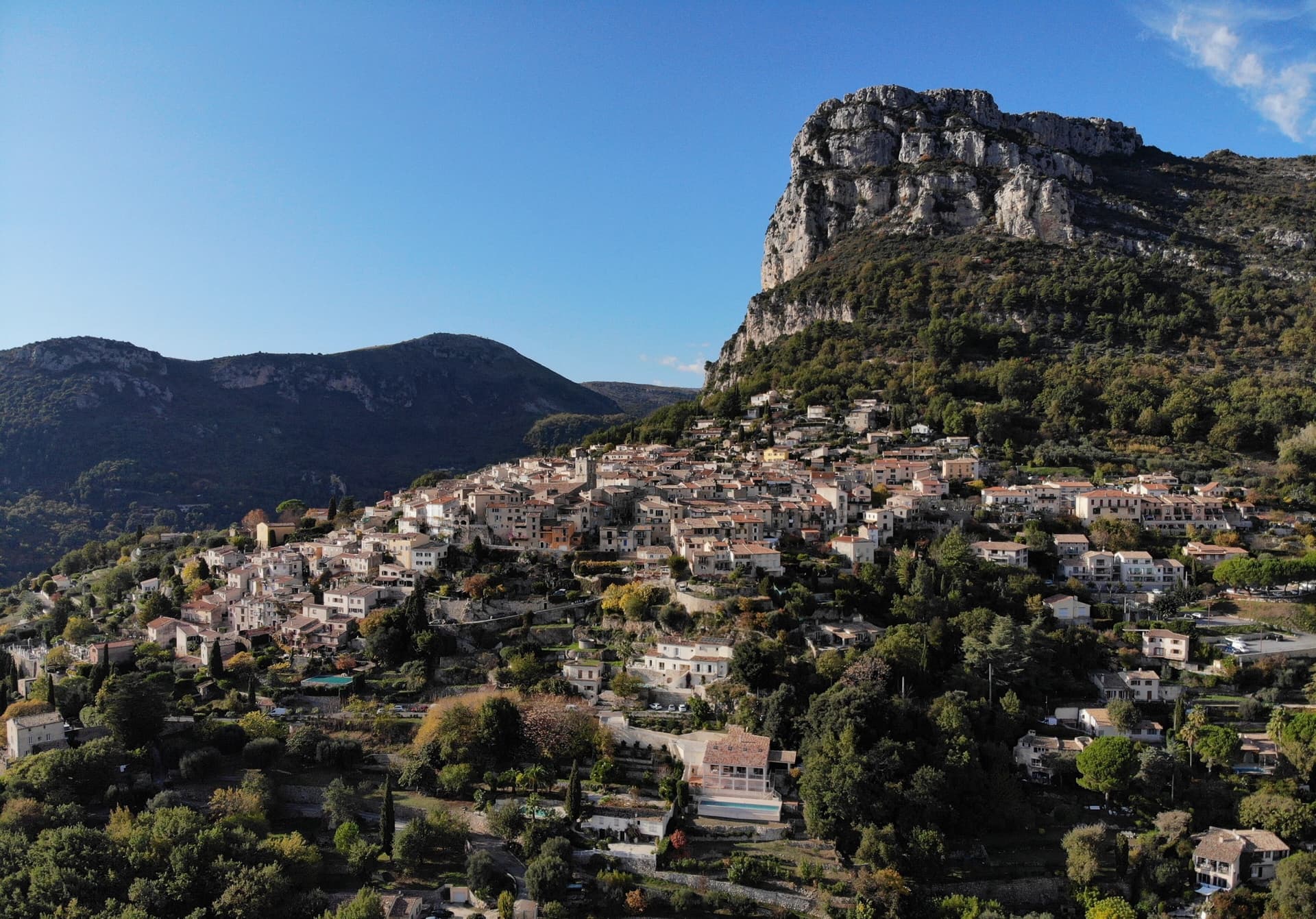
The village of Saint-Jeannet beneath the main cliff of the Baou de Saint-Jeannet; Jardins secrets is on this Grande Face, the exact line is not marked.

France · Baou de Saint-Jeannet

Jardins secrets

One of the essential long routes of the Baou: seven pitches that hardly drop below the sixth grade, each with a different problem, from thin slab to a steep bulge and a superb layback corner at 6c. The single 7a section on pitch 2 is closely bolted and can be aided. Expect a few loose blocks and a scrappy link pitch across the Vernet ledge.

7a7 pitches200 m

Read the cautions
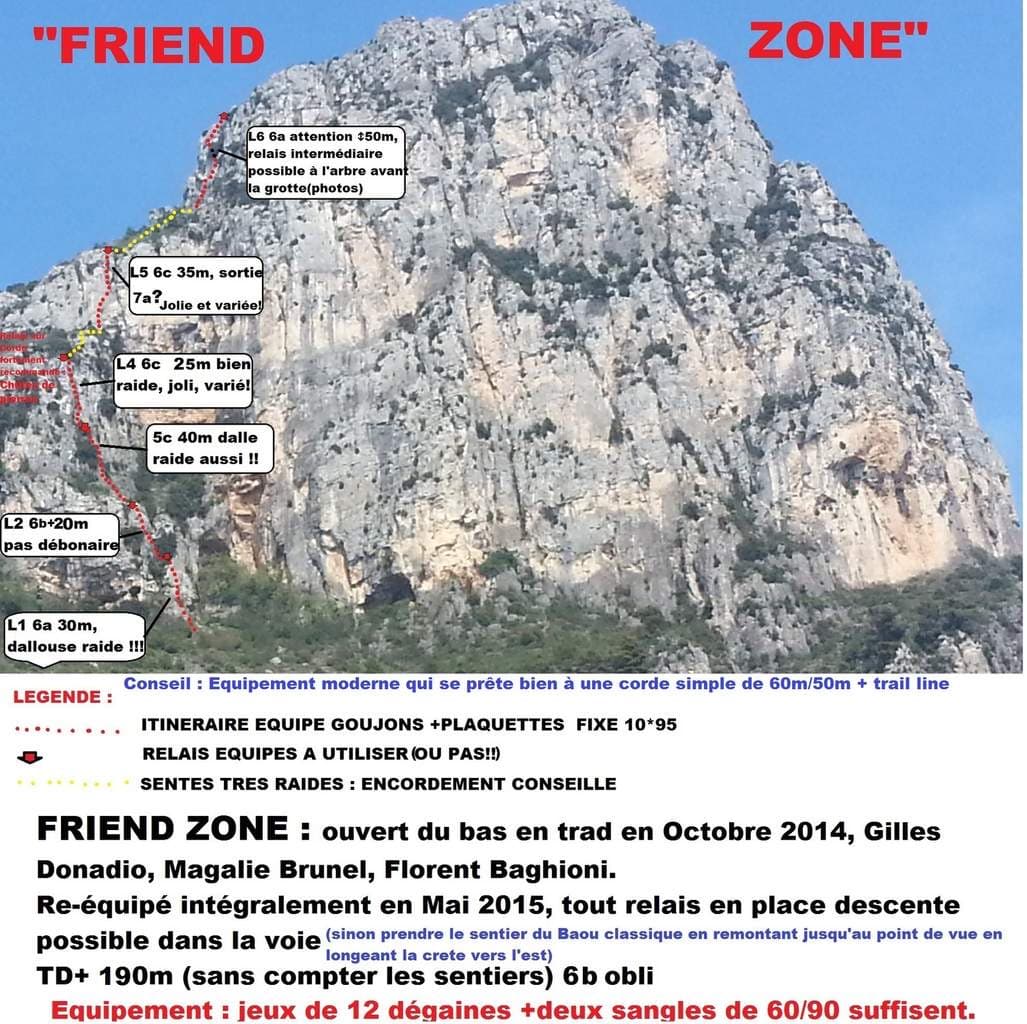
The opener's photo-topo of Friend Zone on the west side of the Baou de Saint-Jeannet, with pitch grades and lengths

France · Baou de Saint-Jeannet

Friend Zone

A modern bolted line up the left side of the Baou, starting beside the Péril Jaune cave: six varied pitches on unpolished rock, with a steep 6c wall and a fine crack and corner finishing with one hard move (7a on the topo, 6c or 6c+ to most parties). Two walking transitions through scrub break the climbing, so it has less exposure than the routes on the main face.

7a6 pitches230 m

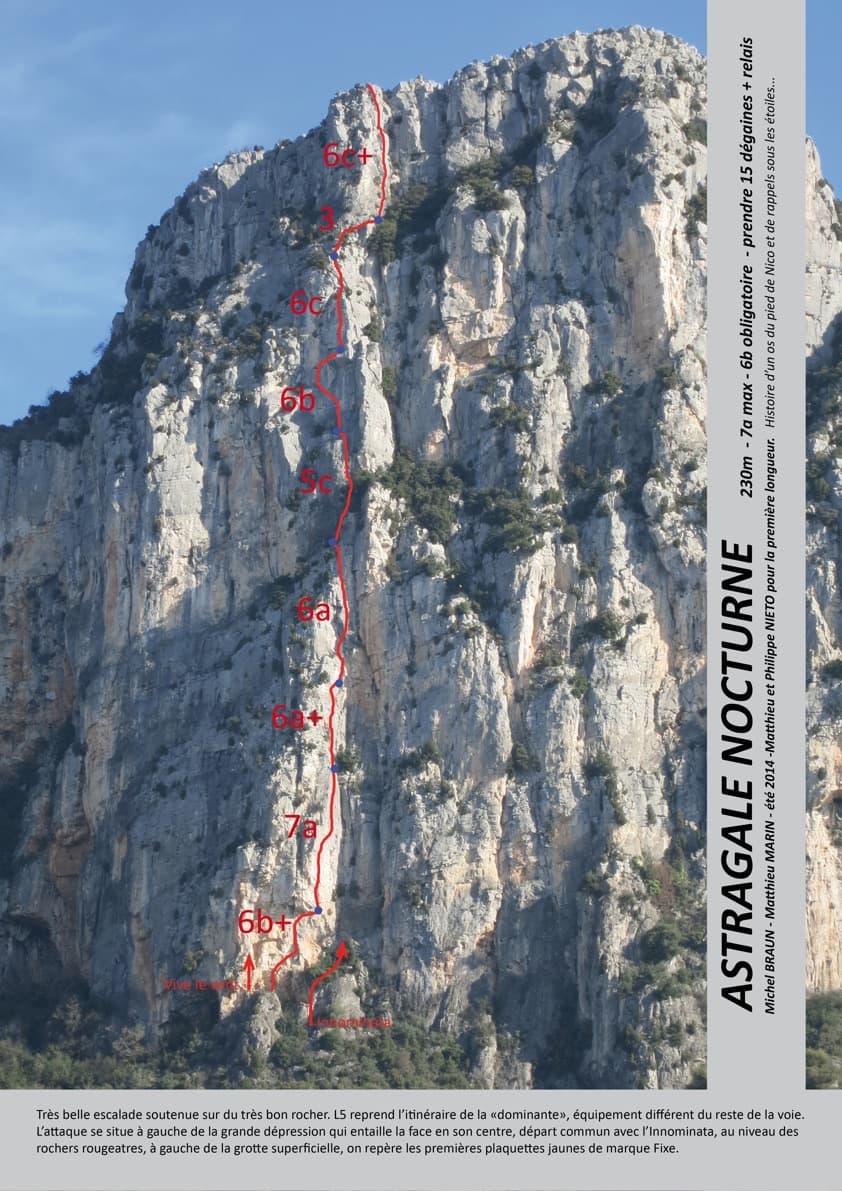
The first ascensionists' photo-topo of Astragale nocturne on the Grande Face of the Baou de Saint-Jeannet

France · Baou de Saint-Jeannet

Astragale nocturne

One of the best modern lines on the main face: nine pitches up a pillar left of the central depression, on overhanging stratified walls, thin slabs, a striking arête and a big flake. Sustained at 6a+ to 6c with one 7a pitch that parties find closer to 6c+, and 6b obligatory. The bolting lets you climb relaxed, but there are jammed blocks to treat gently.

7a9 pitches230 m

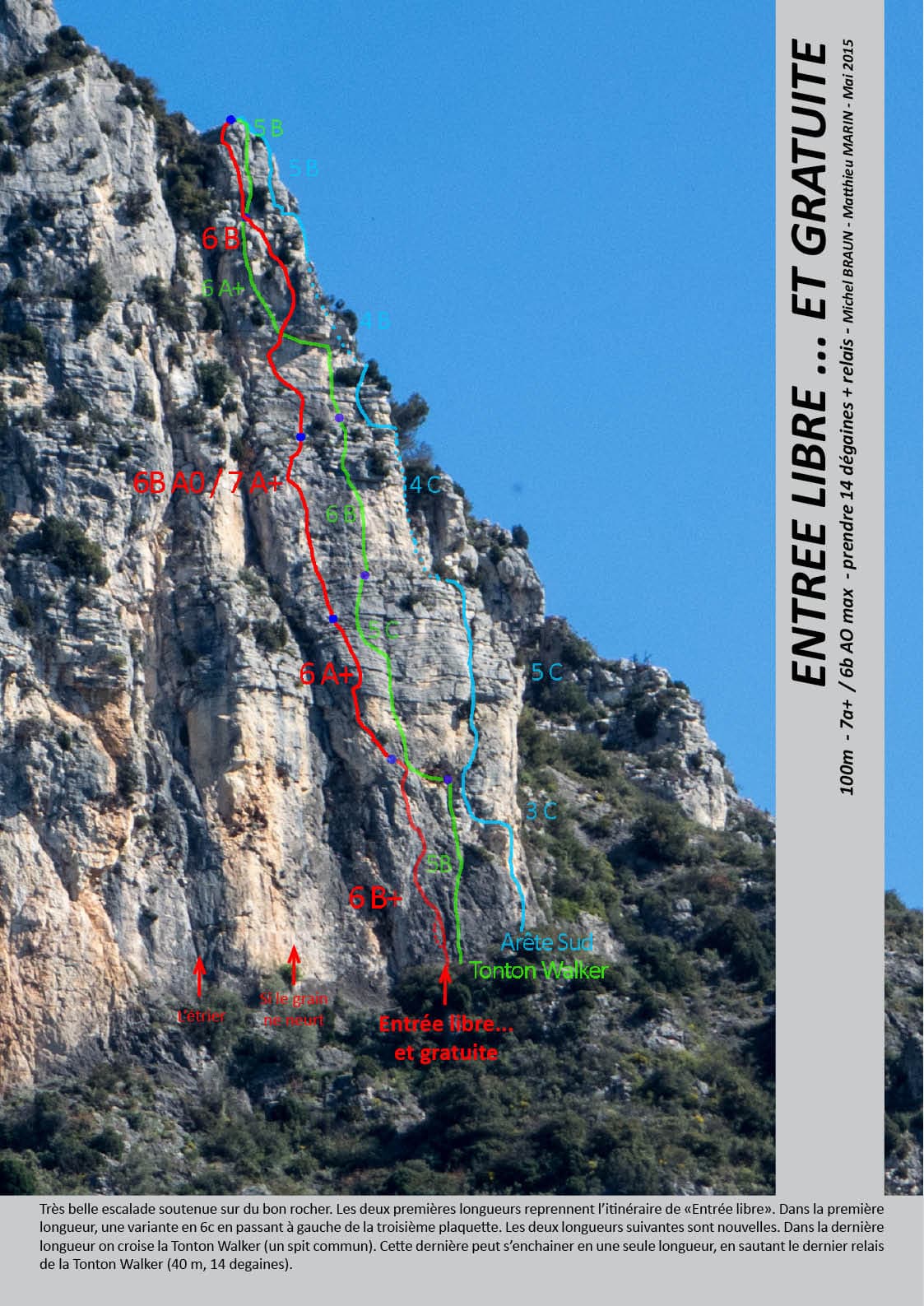
The equippers' photo-topo of Entrée libre (red) beside La Tonton Walker and the Arête S on the south pillar of the Baou de Saint-Jeannet

France · Baou de Saint-Jeannet

Entrée libre (Intégrale 2015)

A short, sustained and very well bolted line on the pillar left of the Arête S, parallel to La Tonton Walker. Thin walls, a steep stratified pitch on big holds and one blank slab move of 7a that most people pull through. The friendliest introduction to the harder routes of the Baou, and easy to extend to the summit by one of the routes above the Vire Vernet.

7a5 pitches100 m

Around 6a · about 4 pitches

Similar elsewhere

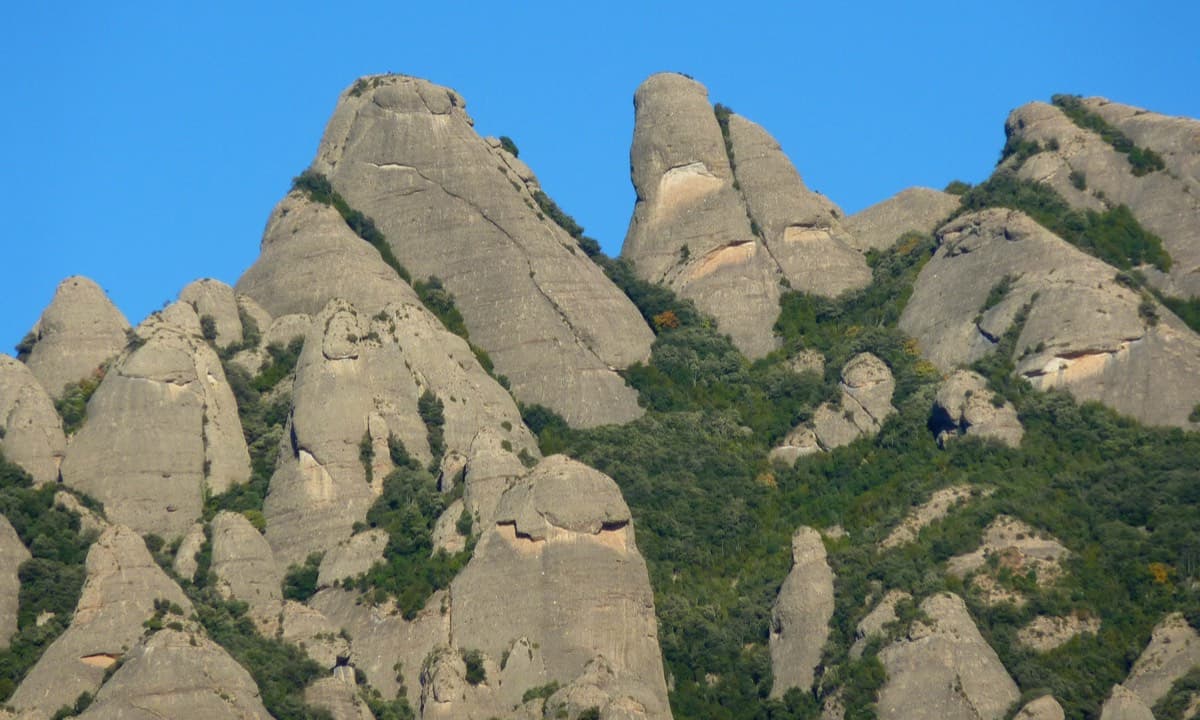
Gorra Frígia and Magdalena Superior seen from the south-west, Montserrat

Spain · Montserrat

98 Octanos

An exposed, airy line with unusually good holes and jugs for Montserrat, shaded in the afternoon. The 6a pitch is a sustained vertical 20 m. Going straight up instead of following the line is closer to 6b+.

6a4 pitches140 m

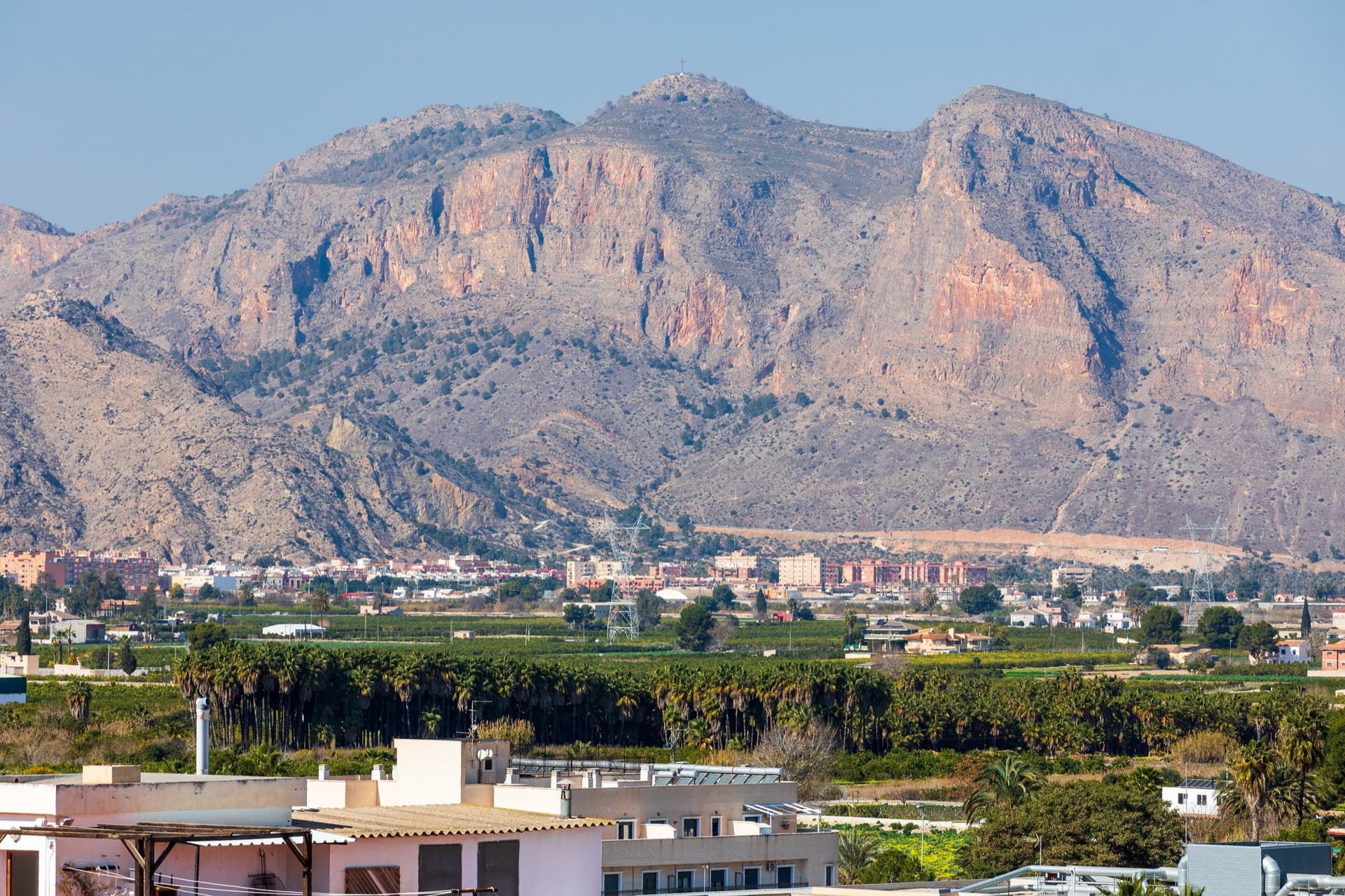
The south-east flank of the Sierra de Orihuela below the Cruz de la Muela, seen across the Vega Baja from Bigastro; Pared Negra is one of the walls on this flank (the exact wall is not marked).

Spain · Vega Baja (Orihuela & Callosa)

Código Vertical

A popular modern four-pitch classic on Pared Negra's compact grey limestone, around UIAA 6/6+ (about French 6a). Best on cool, sunny winter days.

6a4 pitches150 m

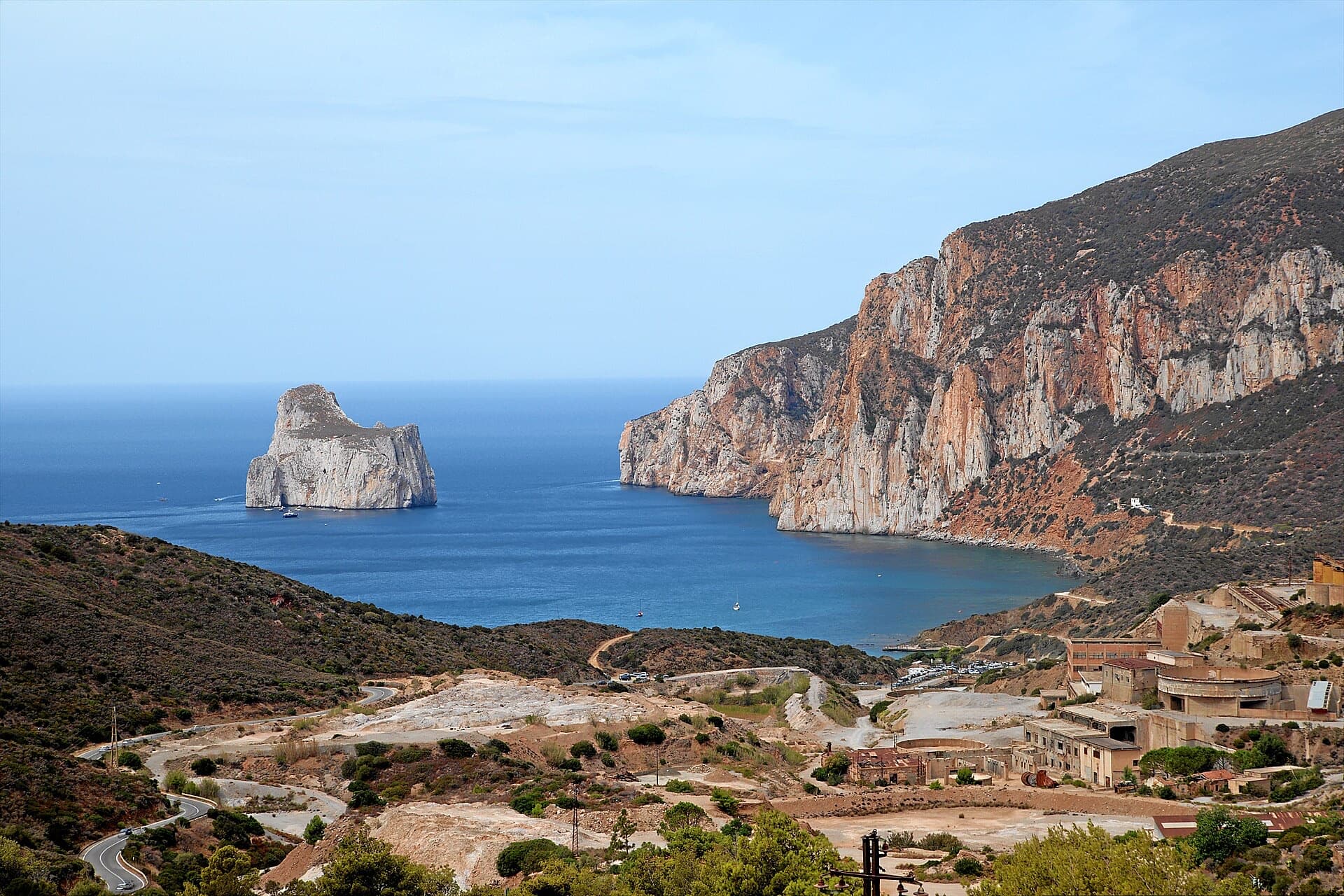
The orange limestone cliffs of Masua (right) above the old mine workings, with the Pan di Zucchero sea stack offshore.

Italy · Sardinia

L'Italia Liberata

A short but superb sea-cliff route on beautifully sculpted limestone in an incredible setting near Pan di Zucchero. Corners and an airy pillar lead to a steep, rounded 6a wall. Camptocamp rates it 'great'.

6a4 pitches120 m

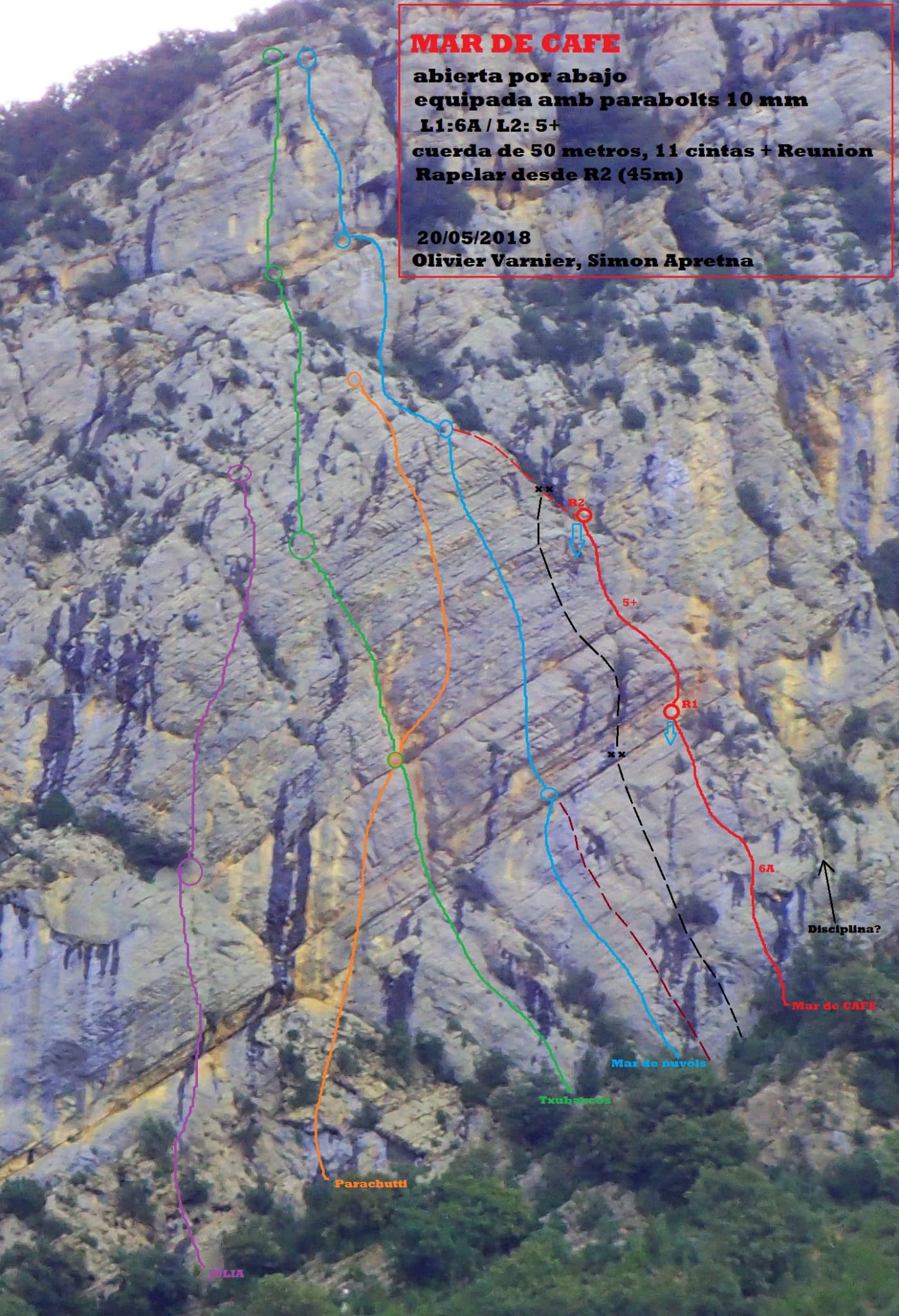
Photo-topo of the Txubascos side of the Paret de Zaratustra, drawn for the newer Mar de Café (red); Txubascos Baskos and Mar de Núvols are among the other coloured lines to its left

Spain · Vilanova de Meià (Roca dels Arcs)

Mar de Núvols

The best of the easier lines on the Paret de Zaratustra: steep climbing on big horizontal holds, a very vertical wall on the long second pitch and an overhanging 6a finish. Less polished than Txubascos Baskos next door, but with longer gaps between some bolts.

6a4 pitches110 m

Read the cautions

Compiled from published sources and last verified October 2026. Bolts, anchors and access change. Climbing is dangerous and you are responsible for your own decisions: check a current topo and read the disclaimer.