Multipitch Atlas

La Caída de los Dioses

Macizo del Pisón, Riglos · Riglos & Agüero (Mallos) · Spain

Read the cautionsEasy to bailBolting confidence: medium

Four 35 m pitches starting 3 m left of the Espolón del Adamelo and finishing at the same belay. Harder and more sustained than its neighbour.

Mallo Pisón above the village of Riglos, with El Puro on its leftPhoto: Marc Baysselance · CC BY-NC-ND 3.0

Photo

Mallo Pisón above the village of Riglos, with El Puro on its leftPhoto: Marc Baysselance · CC BY-NC-ND 3.0
Hardest pitch
6b
Pitches
4
Length
140 m
Approach
–
Aspect
S
South-facing
Rope
2×50 m
Read before you go

Fully bolted, but on 1989 bolts that are spaced on easier ground, with a crux often felt well above 6b and confusing parallel lines.

The route

Overview

A steep four-pitch line on the Macizo del Pisón, the first pillar right of the Pisón as seen from the village, starting 3 m left of the Espolón del Adamelo and joining it at a shared belay. It is the harder, more sustained alternative to its very busy neighbour: a string of bulges at about 6a with one 6b pitch, not too polished. The bolts date from 1989, close on the hard moves and spaced on easier ground. From the top you either abseil or carry on up easy ground to the Pisón col and its abseil descent, which also opens the way to the summit of the Pisón.

The climbing

Pitch by pitch

Pitches of La Caída de los Dioses
PitchGradeLengthBoltsNotes
P16a35 m8 boltsBulges and a wall. Graded V+ and 40 m with 8 bolts on the first ascensionist's topo. One 2022 party found the bolting on this pitch very spaced; others felt it harder than 6a.
P26a35 m9 boltsMore bulges, ending with a move left to the belay (9 bolts on the topo).
P36b35 m7 boltsThe crux, through a series of bulges (25 m and 7 bolts on the topo). The move over the first overhang is hard: parties have rated the pitch 6b+ and even 7a, and A0 is possible. You can escape right into the Espolón del Adamelo at this level.
P46a35 m10 boltsEasy ground, then more bulges to the belay shared with the Espolón del Adamelo (V+, 40 m and 10 bolts on the topo).

Getting there

Approach

To the parking

Riglos village (Las Peñas de Riglos) is about 45 km north-west of Huesca. From Huesca drive to Ayerbe, follow the A-132 towards Jaca and turn right after a few kilometres onto the small road to Riglos; from Pamplona or France (Somport, Jaca, Puente la Reina de Jaca) take the A-132 towards Ayerbe and turn left shortly after Murillo de Gállego. Parking is in the large pay car parks at the village entrance (3 EUR a day for cars, 6 EUR for vans in 2026). The refugio is the modern building on the left as you enter the village; there is a campsite at Murillo de Gállego.

On foot

From the car park follow the main street towards the mallos; at the end of the village take a lane up to the right onto the paths that lead to the base, about 5 minutes. Aim for the Adamelo spur, the first pillar right of the Pisón. The route starts 3 m left of the Espolón del Adamelo, with Doctor Infierno further left. A 2024 party found the name written on a pebble with an arrow at the base, and the first ascensionist's topo also marks an inscription. Earlier parties struggled to find the start, and one went wrong by starting too far left near a big corner.

Finding the route · 1 photo

  • OverviewRiglos village below the Mallo Pisón (big tower, centre left) and the Macizo del Pisón, the group of pillars to its right. The route is on the first pillar right of the Pisón; the red notes mark the Pisón descent.Photo: Sype · CC BY-SA 3.0

Approach photo

Map of the walk-in

  • Crag

Loading map

The point marks the crag, not the exact start of the route.

Coordinates · crag

42.35077, -0.72759

Point from camptocamp waypoint 136217

For your phone or watch

Download GPX

Contains the route point. Opens in most mapping apps and GPS watches.

Points are compiled from published sources, with the precision stated above. They were not surveyed on the ground: check them against a current topo.

Getting down

Descent

Two options. (1) Abseil: Camptocamp gives four 30 m abseils down the neighbouring Doctor Infierno to the left; the first ascensionist's topo says the route's own belays are equipped for abseiling. (2) Continue about 50 m of easy climbing (III to IV, shared with the Adamelo, sparsely equipped) to the Pisón col and use the Pisón descent. On the Adamelo page this is given as: follow the ledge with new cables to the first abseil in the gully, then abseils of 25 m, 30 m (free-hanging), 40 m (free-hanging) and 25 m, with walking sections on cables and old ropes in between. A 2022 party instead recommends abseiling the north-west face from the col (Circo de Verano side) in five 35 m abseils, to avoid the gully, which funnels stones.

Retreat

Bailing off the route

Easy to bail

Yes. The first ascensionist's topo says the route's own belays are equipped for abseiling, and camptocamp gives four 30 m abseils down the neighbouring Doctor Infierno as the standard descent. There is also a sideways escape at the crux: at the 6b third pitch you can move right into the easier Espolón del Adamelo. The fixed gear dates from 1989, and the wall is steep with bulges, so expect some abseils to hang clear of the rock.

Retreat from
Belays 1 to 4 by abseil. At pitch 3 you can traverse right into the Espolón del Adamelo. From belay 4 (shared with the Adamelo) you can abseil, or continue about 50 m of grade III to IV to the Pisón col and its abseil descent.
Carry
2×50 m. The topo gives pitches of up to 40 m, so a single rope will not reach belay to belay.
Basis
Part stated, part inferredThe first ascensionist's topo states the belays are equipped for abseil and camptocamp states the 4×30 m abseils down Doctor Infierno and the escape into the Adamelo; the remark about free-hanging abseils is inferred from the bulges.

Partly inferred from the route facts

Safety

Hazards

  • 1989 bolts with grey hangers (10 mm expansion bolts), spaced on easier ground. The first pitch in particular has been reported as run-out.
  • The 6b pitch is widely felt to be undergraded (6b+ to 7a reported); it can be aided.
  • Four routes share the face and the wall is covered in bolts: several parties have strayed onto Doctor Infierno, Yuma or the Adamelo.
  • Pisón gully descent: do not use the new stainless glue-in anchor on the left; it gives a free-hanging 60 m abseil and one climber had to climb 45 m back up the rope. The correct anchor is to the right, in line with the cable, and the last abseil then works with 50 m ropes.
  • The Pisón descent gully is a stone funnel, exposed when other parties are above.
  • The ground from the top of the route to the col is easy but loose and earthy.

Sun and weather

Conditions

South-facing, but in shade early in the day according to a late-May report. Very hot in summer: a July party advised being back down by 11:00. Climbed in reports from April to November.

Usual season · Feb to May, Oct to Dec

Sun on the wall · S-facing

Working out the sunlit hours for this month.

  • January: not yet worked out
  • February (usual season): not yet worked out
  • March (usual season): not yet worked out
  • April (usual season): not yet worked out
  • May (usual season): not yet worked out
  • June: not yet worked out
  • July: not yet worked out
  • August: not yet worked out
  • September: not yet worked out
  • October (usual season): not yet worked out
  • November (usual season): not yet worked out
  • December (usual season): not yet worked out

Sun on the wallDaylight, wall in shade● Usual season

Estimated from the wall's aspect only. Ignores surrounding terrain, gullies and the wall's exact shape. Clock times are local to the wall (Central European time), for the 15th of each month.

Climate figures for Riglos & Agüero (Mallos) are not available yet

What to carry

Gear

The first ascensionist's topo lists 10 quickdraws plus belay gear. 2×50 m ropes for the abseils. Helmet.

Checklist

Quickdraws
10
Rope
2×50 m
Helmet
One each
Abseil device and prusik
The descent or the retreat involves abseiling

Derived from the route data; check it against a current topo

From climbers

Reader reports

Reader reports are not being collected yet. Until they are, check a current topo and the local club or guidebook publisher for recent changes to La Caída de los Dioses.

Worth knowing

Tips

  • A good second-day route or rest-day outing: about 2 to 2.5 hours for the four pitches.
  • If the crux looks too much, you can move right into the Espolón del Adamelo at the 6b pitch.
  • From the col you can continue to the summit of the Pisón by its normal route or by El Vuelo del Buitre.
  • Reported pitch lengths vary, with pitches 1 and 2 at 40 m or more according to one party.

Open questions

Where sources disagree

  • Grades: Camptocamp gives 6a, 6a, 6b, 6a; the first ascensionist's topo gives V+, 6a, 6b, V+ plus a fifth pitch of IV. Trip reports find it harder than either, so the Camptocamp grades are kept.
  • Lengths: Camptocamp gives four pitches of 35 m (140 m); the topo gives 40, 35, 25 and 40 m plus a 50 m easy pitch shared with the Adamelo, 190 m in all.
  • Descent: Camptocamp says to abseil Doctor Infierno; the topo says the route's own belays can be abseiled.

Provenance

Sources

Same area

More in Riglos & Agüero (Mallos)

All routes in Riglos & Agüero (Mallos)
The Adamelo spur on Mallo Pisón, Riglos

Spain · Riglos & Agüero (Mallos)

Espolón del Adamelo

This is the gentlest way to sample Riglos. Polished pockets and two bulging 'panzas' lead to a 6a crux that can be pulled through on the bolts (A0). The upper spur is easy, and the Pisón towers loom close by.

6a7 pitches175 m

Read the cautions
Topo of Sendero Límite on the south face of Peña Rueba (Mallo Común)

Spain · Riglos & Agüero (Mallos)

Sendero Límite

A long beginner's big route on good conglomerate at a moderate angle. Pitches can be linked in pairs with a 60 m rope. A four-pitch headwall with a couple of panzas finishes high above the Gállego valley.

5c14 pitches375 m

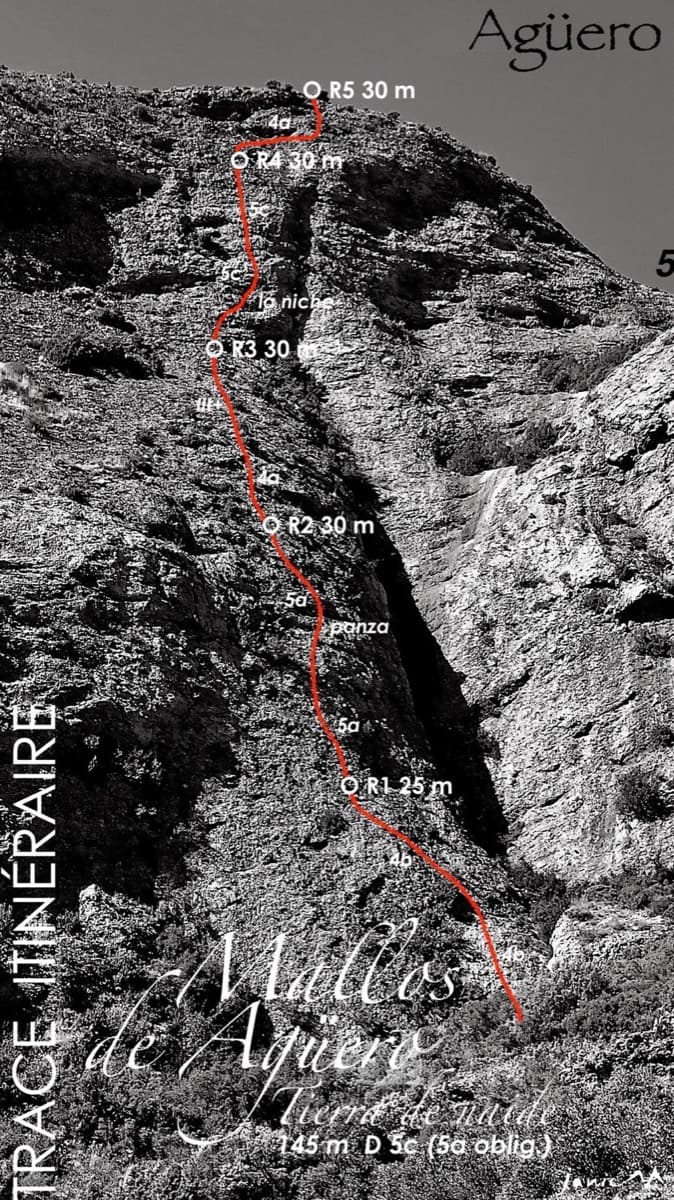
Topo of Tierra de Naide, Mallos de Agüero

Spain · Riglos & Agüero (Mallos)

Tierra de Naide

A morning-sun route at the quieter Agüero mallos. Easy slabs separate two fine steep walls, including a superb vertical 5c plaque on pitch 4. Take care with some loose cobbles on the last traverse.

5c5 pitches145 m

Around 6b · about 4 pitches

Similar elsewhere

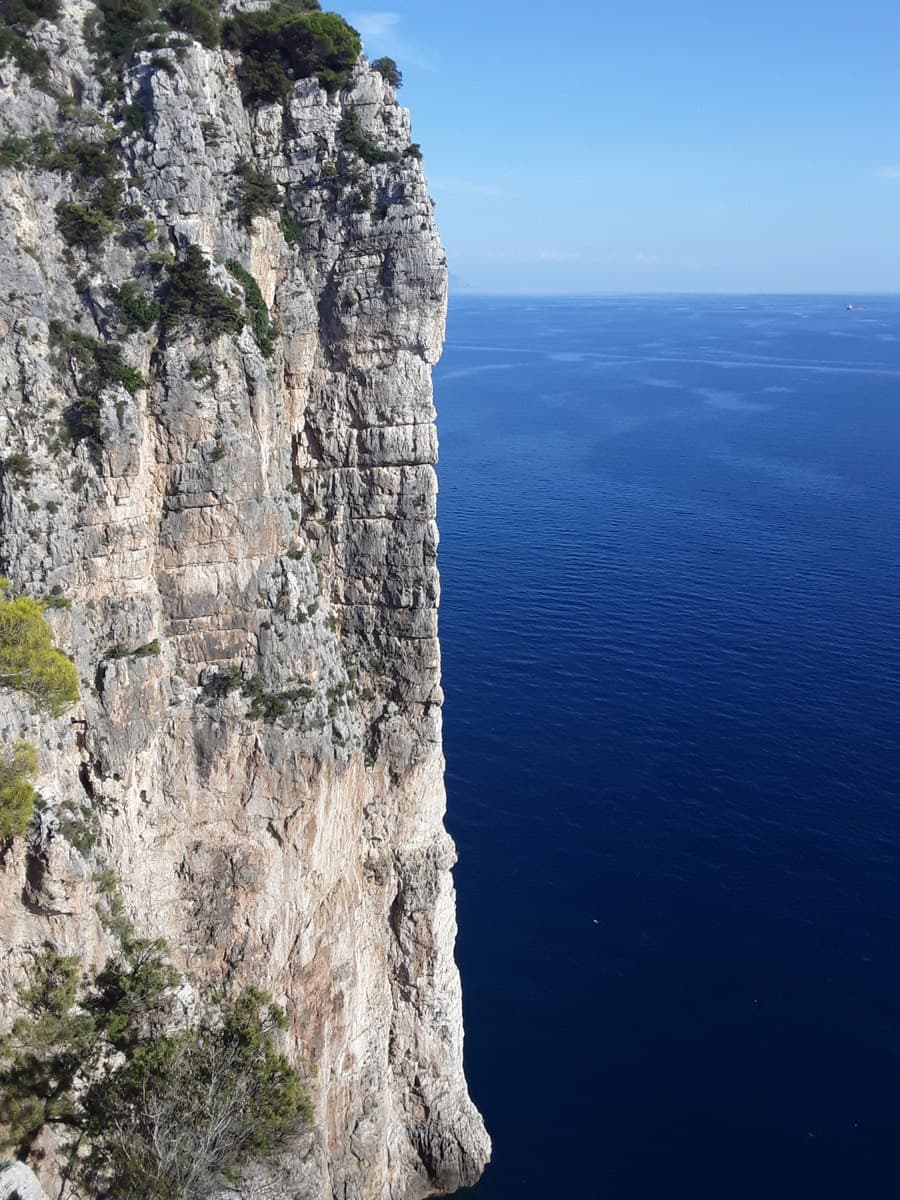
The spur of La Croce del Sud dropping into the sea at the Montagna Spaccata, Gaeta

Italy · Gaeta & Sperlonga

La Croce del Sud

The showpiece of the Montagna Spaccata: four steep, exposed pitches up a knife-edge spur that drops straight into the sea, reached by abseil. Sustained around 6a+ on good holds, with an overhang at 6b to finish.

6b4 pitches120 m

Read the cautionsCommitting

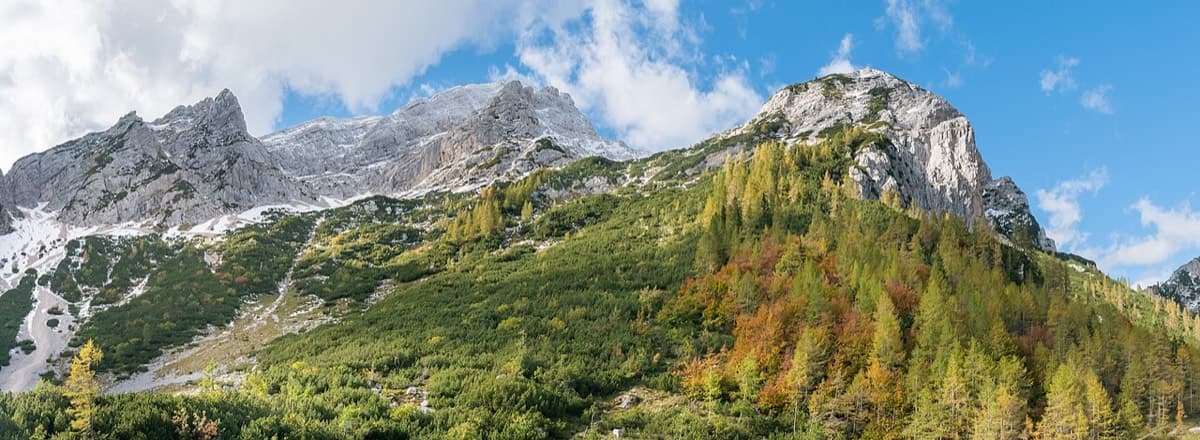
Mala Mojstrovka (left) and Nad Šitom glava (right) seen from the Vršič Pass

Slovenia · Vršič Pass (Julian Alps)

Mandolinca

A compact modern sport multipitch by Tomo and Dragica Česen, front-loaded with its longest and hardest pitch. It is close to the road and good for a half-day.

6b4 pitches90 m

Location of the School sector, Kalymnos (labelled)

Greece · Kalymnos & Telendos

Oraia Stithi

A short gem with slabs, crimps, water-drop pockets, a bulge and a traverse on superb rock, with the usual big Kalymnos view. It is the most popular guided 6a multi-pitch on the island.

6b4 pitches120 m

Read the cautions

Climber on pitch 3 of Allah bri des toits, Amellago

Morocco · Amellago

Allah bri des toits

The most accessible multipitch at Amellago: four short pitches broken by a walk along a ledge under the roofs, finishing with an exposed traverse on rough brown rock. Some doubtful rock at the start of pitch 3. In shade from mid-afternoon in winter.

6b4 pitches80 m

Read the cautions

Compiled from published sources and last verified October 2026. Bolts, anchors and access change. Climbing is dangerous and you are responsible for your own decisions: check a current topo and read the disclaimer.