Multipitch Atlas

Moon Bears

Piccolo Dain – Parete del Limarò (Sarche) · Arco & Valle del Sarca · Italy

Bail with caveatsBolting confidence: high

A popular plaisir line up the lower south-west wall of Piccolo Dain, starting at the gate of the weir in Sarche. Cracks and small corners lead to a fine 6a slab on water drops, then a long corner pitch. Expect queues: three routes share the opening traverse.

Hardest pitch
6a
Pitches
8
Length
235 m
Approach
15 min
Aspect
SW
South-west-facing
Rope
1×50 m
walk-off

The route

Overview

One of the standard well-bolted routes on the Parete del Limarò, the lower wall of Piccolo Dain directly above Sarche. Bergsteigen.com recommends it as a first route of a climbing holiday because of the short approach, good protection and moderate grades. The climbing is varied: a traverse start shared with Amazzonia, crack and corner pitches at 5b to 5c, a 6a slab and a long 5c corner. The name refers to the moon bears farmed for bile in Asia, a cause the first ascensionists wanted to draw attention to.

The climbing

Pitch by pitch

Pitches of Moon Bears
PitchGradeLengthBoltsNotes
P14b40 m7 boltsFrom the gate follow the first two traversing pitches of Amazzonia, run together, to a belay at the painted name Moonbears. Mostly grade II with one opening move of IV+. Changed in 2026 by the rockfall nets; check the current topo.
P24b23 m6 boltsBig holds up a small corner just right of the belay to a ledge.
P35b28 m7 boltsStill right of the belay to a short slab, easier on its left, then gradually easier rock to the belay.
P45c32 m9 boltsA fine pitch up a series of cracks and small corners, with obligatory moves. Take the crack right of the belay, delicate at first, then slightly left. The belay is in the middle of the slab with room for two.
P56a27 m7 boltsThe best pitch: a slab of water drops and cracks. Up a few metres, then diagonally left across the slab to the belay.
P6320 m5 boltsEasy broken rock on big holds straight up to the foot of the corner.
P75c35 m11 boltsThe slab left of the corner, then right into the corner and up it to a ledge with the route book. The squeeze in the corner just below the belay is awkward.
P84b30 m6 boltsA bulge to start, then an easy ramp to the last belay.

Getting there

Approach

To the parking

Sarche is in the Sarca valley about 20 km north of Arco. From the A22 leave at Trento and follow the road towards Riva del Garda to Sarche. Park in the village centre near the junction for Madonna di Campiglio (gulliver.it starts from the Albergo Bar Ideal). The lane to the weir is private with no parking.

On foot · about 15 min

About 15 min on the flat. Walk along the pavement of the SS237 towards Ponte Arche and Madonna di Campiglio, pass a petrol station and continue about 200 m. Before the bridge over the Sarca, cross the road and take the farm lane (gravel track along the river) to the gate of the weir directly under the wall. The route starts at the gate with the traversing pitches of Amazzonia.

Map of the walk-in

  • Route base
  • Parking

Loading map

The point marks the base of the route.

Coordinates · route base

46.04740, 10.94570

Parking

46.04630, 10.95240

Parking marked on bergsteigen.com

Point from bergsteigen.com touren/klettern/moon-bears-picol-dain

For your phone or watch

Download GPX

Contains the route point and parking. Opens in most mapping apps and GPS watches.

Points are compiled from published sources, with the precision stated above. They were not surveyed on the ground: check them against a current topo.

Getting down

Descent

On foot, about 45 min. From the last belay follow the track right to the rockfall fence, where the descent path starts by going uphill through the woods (red marks, about 10 min) to meet the path coming down from the summit of Piccolo Dain. Turn right and descend (signs for the via ferrata) past some fixed ropes to a junction marked on a boulder, and go down right, steeply, to Sarche. Near the houses take a track right to the bowls club car park; going left leads into private land and a locked gate.

Retreat

Bailing off the route

Bail with caveats

Gulliver.it states that abseiling the route is possible but discouraged because of the number of parties on the wall and the loose rock. The first pitch is a long traverse, so a retreat ends with a traverse or a diagonal abseil back to the gate.

Retreat from
From any belay, in principle; pitches are 20 to 35 m apart above the opening traverse.
Point of no return
None stated. Above pitch 5 the remaining climbing is easier (3, 5c, 4b) and finishing is usually quicker than descending.
Carry
With the single 50 m rope normally carried you cannot abseil the 27 to 35 m pitches in one go; take a second rope or a 70 m rope if you want to keep the option.
Basis
Part stated, part inferredAbseil possibility stated by gulliver.it; rope advice inferred from the pitch lengths.

Partly inferred from the route facts

Safety

Hazards

  • Very popular: three routes share the first two pitches from the weir gate, so expect to queue and expect people above you.
  • Loose rock and heavy traffic are the reasons gulliver.it advises against abseiling the route.
  • The first two pitches changed in 2026 when rockfall nets were installed.
  • On the descent, do not go left at the houses: it is private land with a locked gate.

Sun and weather

Conditions

South-west facing with the base at about 250 m. Good from spring to autumn outside hot summer afternoons, and on mild winter days. Bergsteigen.com gives 3 h 30 min for the climb.

Usual season · Mar to May, Sep to Nov

Sun on the wall · SW-facing

Working out the sunlit hours for this month.

  • January: not yet worked out
  • February: not yet worked out
  • March (usual season): not yet worked out
  • April (usual season): not yet worked out
  • May (usual season): not yet worked out
  • June: not yet worked out
  • July: not yet worked out
  • August: not yet worked out
  • September (usual season): not yet worked out
  • October (usual season): not yet worked out
  • November (usual season): not yet worked out
  • December: not yet worked out

Sun on the wallDaylight, wall in shade● Usual season

Estimated from the wall's aspect only. Ignores surrounding terrain, gullies and the wall's exact shape. Clock times are local to the wall (Central European time), for the 15th of each month.

Climate figures for Arco & Valle del Sarca are not available yet

What to carry

Gear

10 quickdraws and a single 50 m rope according to bergsteigen.com; gulliver.it counts 11 bolts on pitch 7, so 12 quickdraws lets you clip everything. No nuts or cams. A helmet is essential.

Checklist

Quickdraws
12
Rope
1×50 m (walk-off)
Helmet
One each

Derived from the route data; check it against a current topo

From climbers

Reader reports

Reader reports are not being collected yet. Until they are, check a current topo and the local club or guidebook publisher for recent changes to Moon Bears.

Worth knowing

Tips

  • Start early or go midweek to avoid the queue at the gate.
  • Orizzonti Dolomitici, already in this atlas, is on the same wall and makes a natural second route.

Open questions

Where sources disagree

  • Length: 235 m (gulliver.it, sum of pitches) against 265 m of climbing (bergsteigen.com).
  • Aspect: south-west (bergsteigen.com) against south (gulliver.it).
  • Quickdraws: bergsteigen.com says 10, but gulliver.it counts 11 bolts on pitch 7.
  • Grade: UIAA 6 on bergsteigen.com against 6a (5c obligatory) on gulliver.it; these are equivalent.

Provenance

Sources

Same area

More in Arco & Valle del Sarca

All routes in Arco & Valle del Sarca
The Parete Zebrata (Placche Zebrate) above Dro, with the lines of three other routes at its left end marked

Italy · Arco & Valle del Sarca

Rita

This is the archetypal long, easy Arco slab, first climbed in 1971. It wanders up the lower bands and then improves into a superb water-worn chimney system in the upper half. It is very polished and very busy, so start early. Original grade 6- UIAA per bergsteigen.com; gulliver gives 5c max.

5c16 pitches400 m

Read the cautions
No photo yet

Italy · Arco & Valle del Sarca

Orizzonti Dolomitici

A succession of short walls and slabs separated by ledges, with the first two pitches shared with Amazzonia. The crux is a single 5c/6a move just below the P5 belay. It's a relaxed, well-protected outing above the Sarche gorge.

5c10 pitches250 m

The Parete Zebrata (Placche Zebrate) above Dro, with the lines of three other routes at its left end marked

Italy · Arco & Valle del Sarca

Man-Ilia

An easy, relaxing sport route on low-angle Zebrate slabs, trending left to right to join Cane Trippa at the fifth belay. It's an excellent first multipitch. Gulliver gives UIAA III / II–III / IV / IV–IV+ for the first four pitches, converted here.

5b6 pitches240 m

No photo yet

Italy · Arco & Valle del Sarca

Via Roberto

Eight sustained pitches up the wall opposite the Laterna restaurant, rarely easier than 6a. The crux is a short overhanging wall on pitch 5 that can be pulled through on the bolts. Less cleaned than its neighbours, with some broken rock on pitch 6.

6c+8 pitches220 m

Around 6a · about 8 pitches

Similar elsewhere

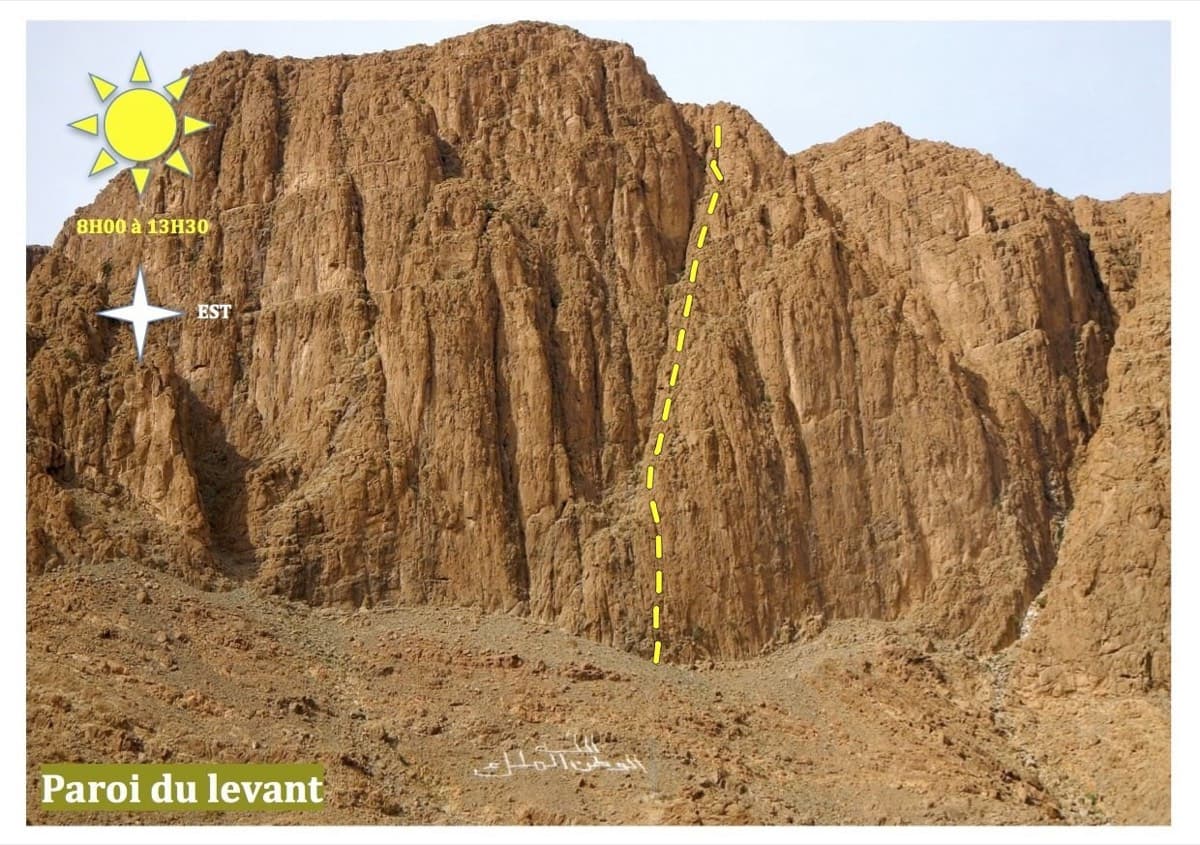
Line of Hannah chez les grands drawn on the Paroi du Levant, Todra Gorge

Morocco · Todra Gorge (Todgha)

Hannah chez les grands

Eight pitches up the middle of the Levant wall, with the 6a on the first pitch and steady 5a–5c above. Morning sun. Camptocamp rates the commitment a little higher than the gorge-floor routes because of the length.

6a8 pitches320 m

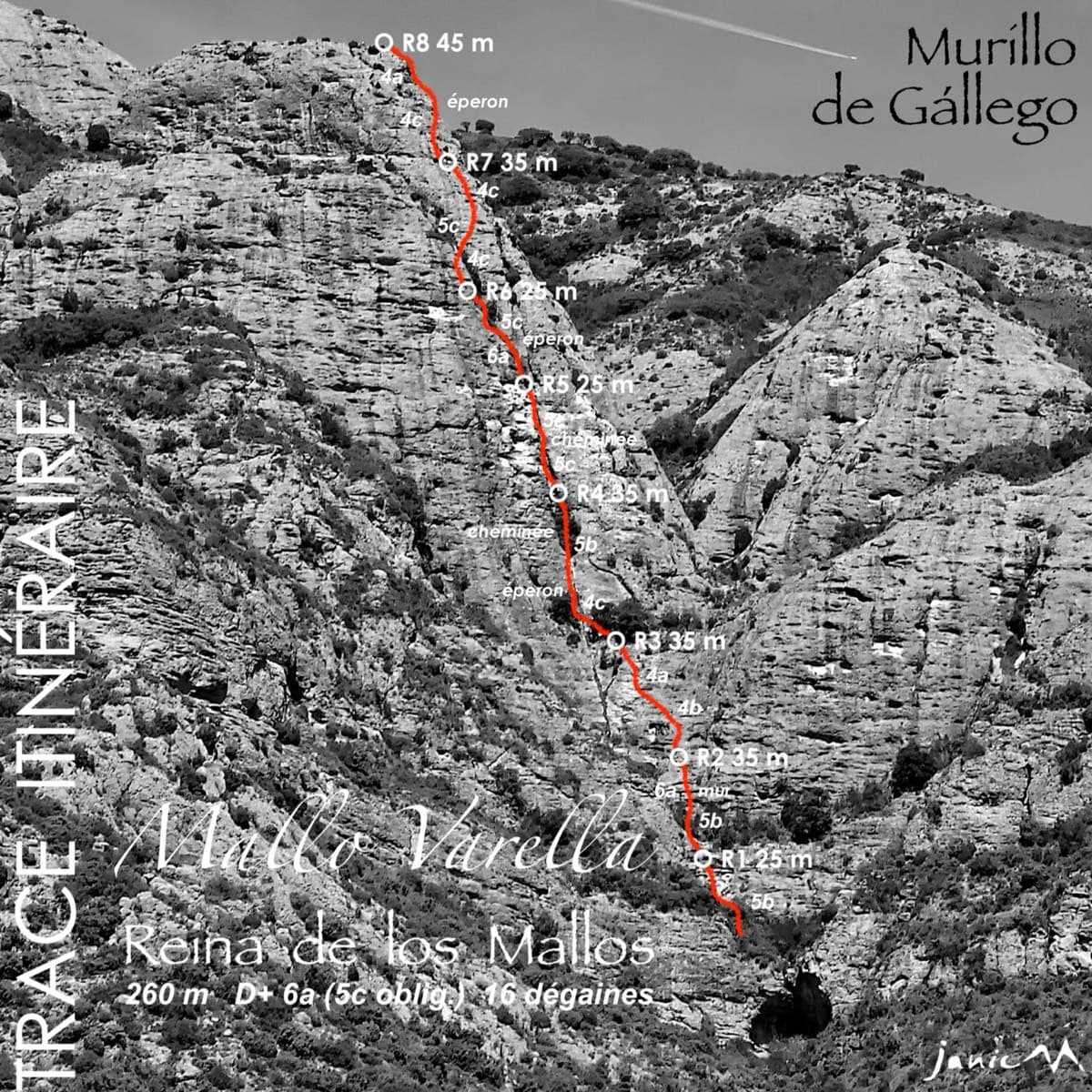
Photo-topo of Reina de los Mallos on Mallo Varella, Peña Rueba

Spain · Riglos & Agüero (Mallos)

Reina de los Mallos

A varied and unusual route: polished cobbles, a chimney belay in an old vulture nest, and an ochre corner. It is recent and not fully cleaned, and two earthy gullies are crossed on pitches 4 and 7.

6a8 pitches260 m

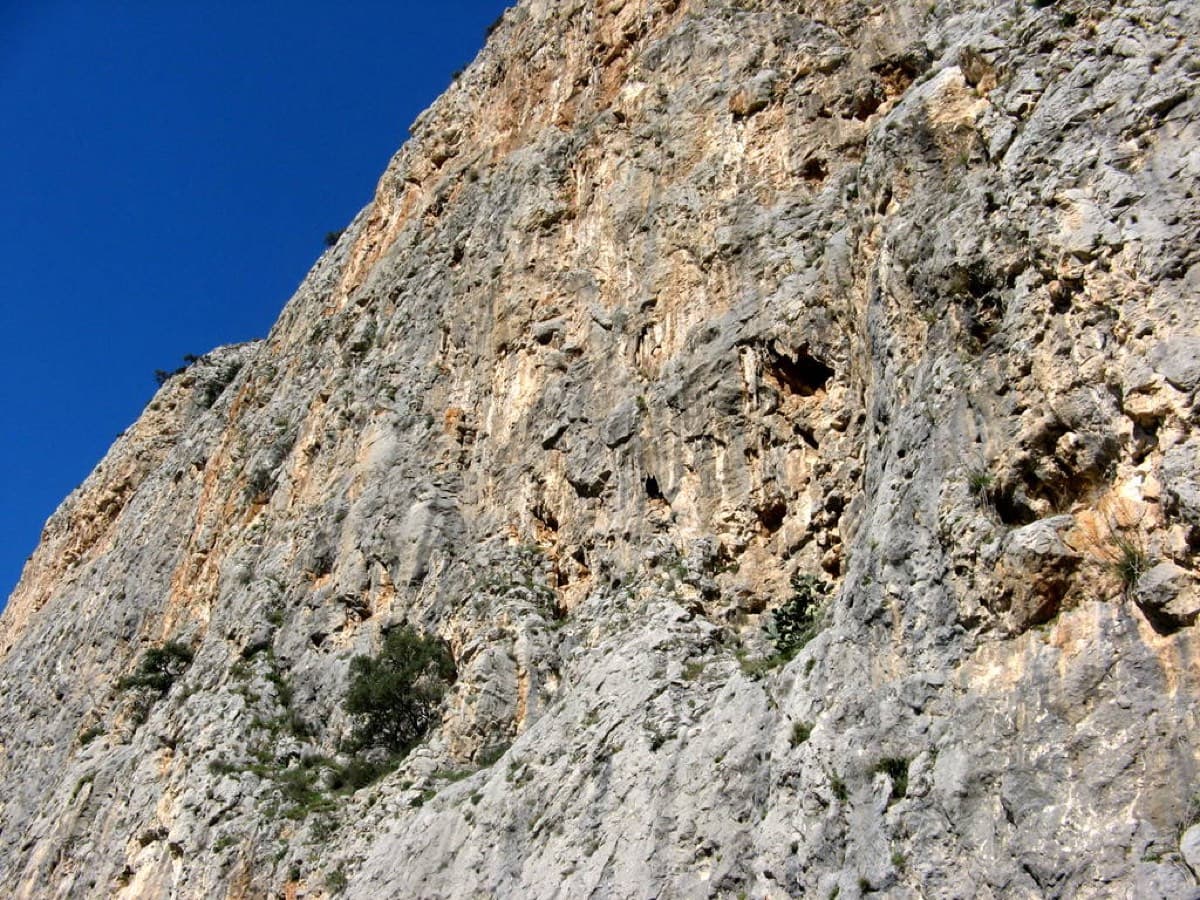
The Amptrax wall on Frontales, El Chorro

Spain · El Chorro

Amptrax

The absolute El Chorro classic: a physical, sustained line that feels tough for the grade, with a 6a traverse right under the roof. Polished in places from heavy traffic.

6a9 pitches182 m

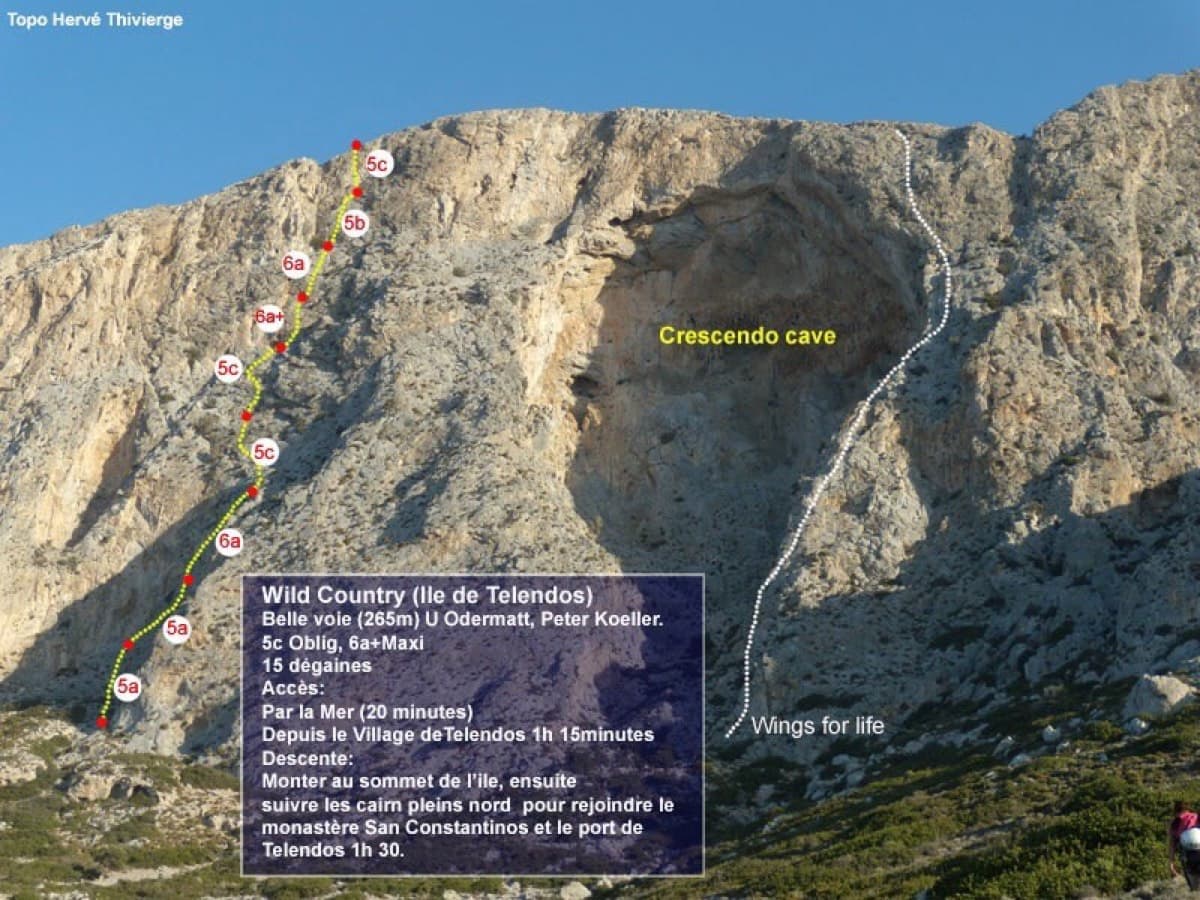
Topo of Wild Country, left of the Crescendo cave, Telendos south face

Greece · Kalymnos & Telendos

Wild Country

A sustained, varied line on sculpted limestone. It starts with an easy slab and builds to slightly overhanging jugs with huge exposure on the top pitch. Mountain Project and camptocamp grade the crux 6a+ (Rockfax says 6a). With a 70 m rope you can link several pairs of pitches.

6a9 pitches265 m

Compiled from published sources and last verified October 2026. Bolts, anchors and access change. Climbing is dangerous and you are responsible for your own decisions: check a current topo and read the disclaimer.