Multipitch Atlas

Obsesión

Espolón de los Agujeros, Barranco de la Maimona · Montanejos · Spain

Read the cautionsBail with caveatsBolting confidence: medium

Eight varied pitches on the pocketed pillar next to La Luna: pocketed slabs, bulges, a red corner that is the best pitch, and two short hard sections at 6c and 6c+ that can both be eased with a pull on the bolts. Opened in 1983 and rebolted in 2006. Some loose rock, especially on pitch 6.

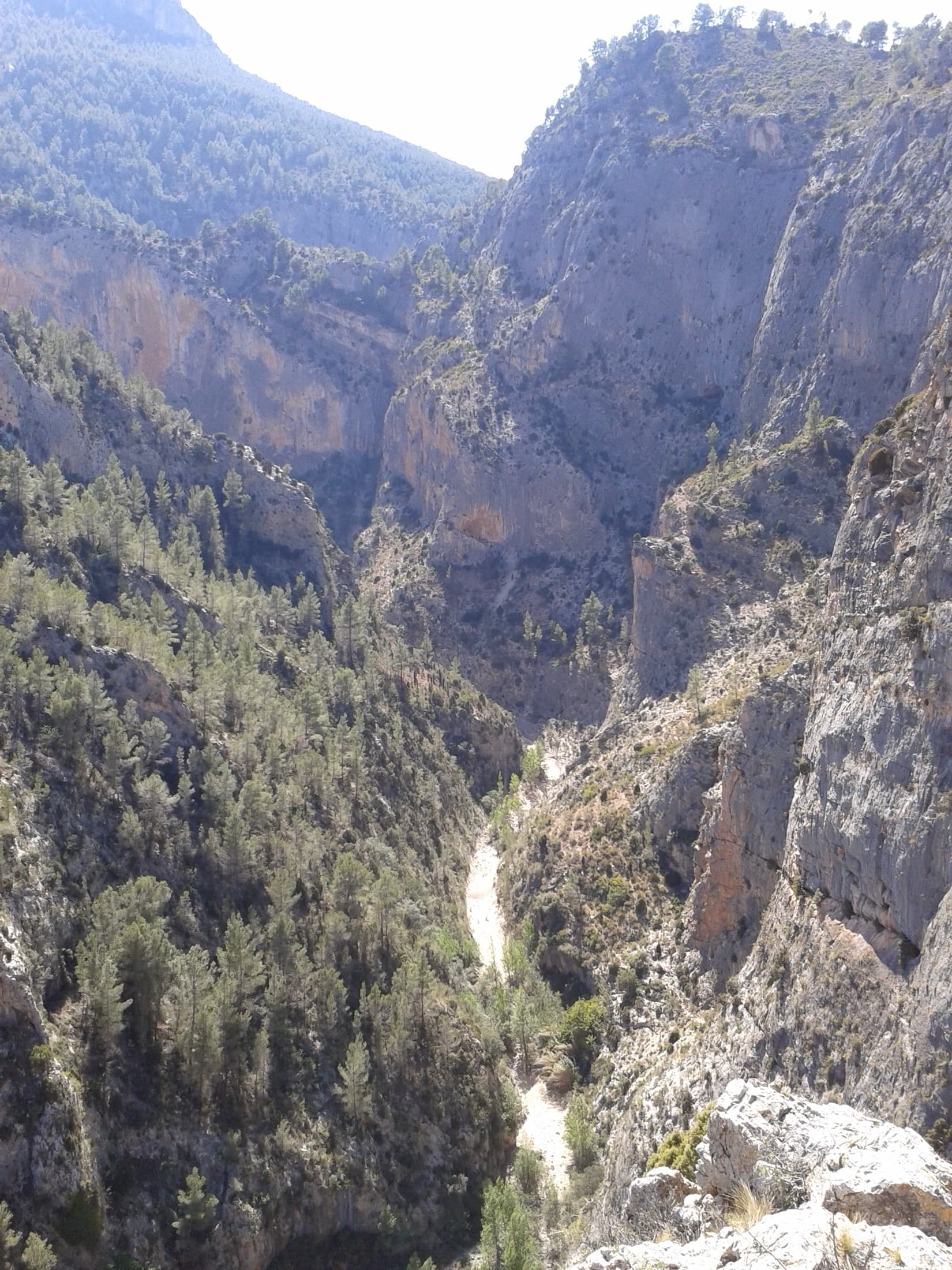
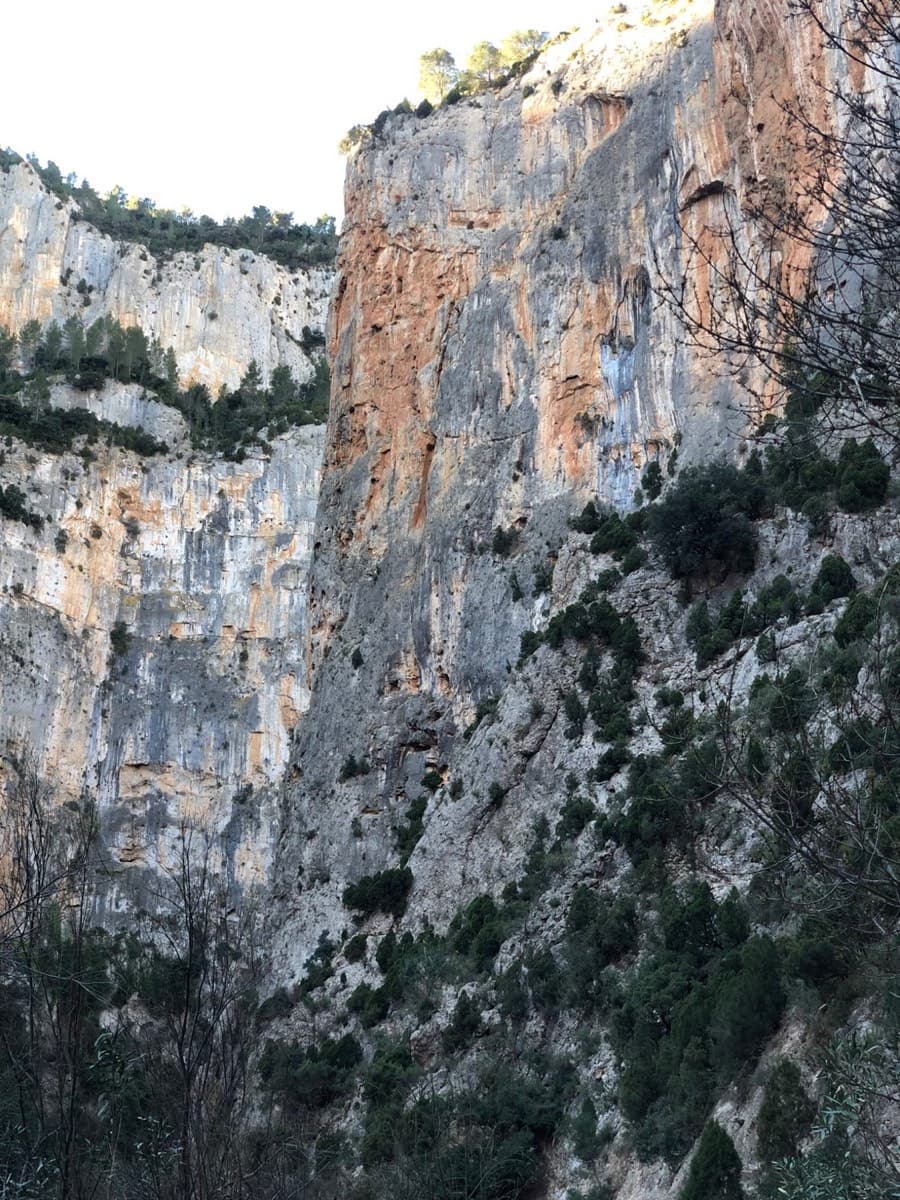
Looking down the Espolón de los Agujeros to the bed of the Barranco de la Maimona, photographed from the neighbouring route La Luna. Obsesión climbs the same pillar; its line is not marked.Photo: cyril · CC BY-NC-ND 3.0

Photo

Looking down the Espolón de los Agujeros to the bed of the Barranco de la Maimona, photographed from the neighbouring route La Luna. Obsesión climbs the same pillar; its line is not marked.Photo: cyril · CC BY-NC-ND 3.0
Hardest pitch
6c+
Pitches
8
Length
245 m
Approach
30 min
Aspect
E
East-facing
Rope
1×70 m
walk-off
Read before you go

Well bolted with A0 options, but there is loose rock on several pitches and a nesting closure for the first half of the year.

The route

Overview

The companion route to La Luna on the Espolón de los Agujeros, the pocketed pillar at the Plaza de las Catedrales bend, beyond the flood dam. It is a very varied climb: two easy pocketed slab pitches, bulges on big pockets, a fingery 6c wall, a red corner at 6b that all sources single out, and a short explosive 6c+ move near the top. Three topos agree on the line and on an obligatory grade of about 6a, so both hard sections can be aided on the bolts. Climb attentively: several sections have loose rock, pitch 6 most of all. The pillar is closed for nesting in the first half of the year.

The climbing

Pitch by pitch

Pitches of Obsesión
PitchGradeLengthNotes
P15+35 mA pocketed slab, always trending right. Comfortable belay. Camptocamp gives 5c, 30 m.
P25+30 mStraight up a slab with rounded holds, then right. Comfortable belay.
P36a35 mStart up a crack and small corner, then climb several bulges on good pockets. Very comfortable belay.
P46c30 mLeftwards on good holds at first, then a sustained, bouldery wall on small holds with poor footholds. Watch for loose rock near the end, in the corner.
P56b35 mThe red corner, visible from far away and the best pitch. Slightly dusty and physical; the small roof is well protected and good holds follow.
P66a30 mUp small corners and right. Easy and enjoyable, but this is the pitch with the most loose rock. The belay is on a terrace.
P76c+25 mAn explosive boulder move off the belay on a short wall, then a sustained thin crack on small holds. Camptocamp describes the hard step as very short and gives 6a with A0.
P84+20 mAn easy slab; loose rock at the exit. Can be linked with pitch 7. Camptocamp gives 10 m.

Getting there

Approach

To the parking

Montanejos is in inland Castellón province, on the CV-20 up the Mijares valley from Onda. The gorge starts at the climbers' refuge (Albergue El Refugio) by the Maimona bridge at the entrance to the village. Camptocamp says camping is not allowed, and that there is water at the village fountain or at the car park after the bridge. No source read gives public transport details.

On foot · about 30 min

About 30 minutes. From the refuge walk up the canyon to the flood-control dam. Climb the steps on its left, then descend with the help of a cable and a fixed rope back into the stream bed. About 300 m further the gorge bends at the Plaza de las Catedrales, with the pillar on the right. Obsesión starts on a dark slab before the prow, before an orange zone; camptocamp places it about 50 m right of La Luna. Two routes start together: Obsesión is the right-hand line and keeps trending right. If pools remain in the stream bed, cabled traverses pass the flooded sections.

Map of the walk-in

  • Area: approximate

Loading map

The point is approximate: it marks the area, not the crag.

Coordinates · area: approximate

40.07007, -0.53294

Point from camptocamp route 1705135 (El Tubo sector point in the Barranco de la Maimona); this route starts further up the gorge and no source gives its own point

For your phone or watch

Download GPX

Contains the route point. Opens in most mapping apps and GPS watches.

Points are compiled from published sources, with the precision stated above. They were not surveyed on the ground: check them against a current topo.

Getting down

Descent

Walking down is the advice of both camptocamp and elev-arte. Go up to the crest and follow it north to a signpost. Right ('to the dam by the Belle Époque slabs') drops down a gully back to the flood dam. Left ('to the refuge by the crest') descends a little, then follows a cable in several sections and cairns back up to a col, traverses and rejoins the GR path to Montanejos, about 1 hour. The route is equipped for abseiling, but camptocamp calls the abseils awkward above R3.

Retreat

Bailing off the route

Bail with caveats

The route is equipped for abseiling according to elev-arte and Luis Alfonso's topo, and camptocamp says abseiling becomes awkward above R3. Retreat from the first three pitches is therefore the reliable option; higher up, continuing to the top and walking off is usually the better choice.

Retreat from
R1 to R3 by abseil. Higher belays are also bolted, but the line traverses and the abseils are described as awkward.
Point of no return
Around R3, by camptocamp's account. Above it the hard moves on pitches 4 and 7 can be aided on the bolts.
Carry
Pitches are up to 35 m: a 70 m rope or two ropes.
Basis
Part stated, part inferredAbseil equipment and the awkward upper abseils are stated; the rope requirement is inferred from pitch lengths.

Partly inferred from the route facts

Safety

Hazards

  • Seasonal closure: climbing is banned for nesting on the Espolón de las Catedrales and the wall opposite, from the sign at the dam as far as the route Súbete Papel, until 30 June according to an elev-arte notice. The atlas entry for La Luna records the closure as 1 January to 30 June. Check locally before going.
  • Loose rock on several sections: the end of pitch 4, pitch 6 and the exit of pitch 8.
  • Abseiling from above R3 is awkward; plan to top out.
  • The approach passes a dam with a cable and a fixed rope, and the gorge floods after rain.

Sun and weather

Conditions

East-facing (camptocamp). A party on the neighbouring La Luna in February climbed entirely in shade and felt cold; the pillar catches the wind. The stream bed must be nearly dry to reach the start; it was reported almost dry in October 2013 and October 2025. With the nesting closure, autumn is the season.

Usual season · Sep to Dec

Sun on the wall · E-facing

Working out the sunlit hours for this month.

  • January: not yet worked out
  • February: not yet worked out
  • March: not yet worked out
  • April: not yet worked out
  • May: not yet worked out
  • June: not yet worked out
  • July: not yet worked out
  • August: not yet worked out
  • September (usual season): not yet worked out
  • October (usual season): not yet worked out
  • November (usual season): not yet worked out
  • December (usual season): not yet worked out

Sun on the wallDaylight, wall in shade● Usual season

Estimated from the wall's aspect only. Ignores surrounding terrain, gullies and the wall's exact shape. Clock times are local to the wall (Central European time), for the 15th of each month.

Monthly climate averages for Montanejos, 1991-2020
MeasureJanFebMarAprMayJunJulAugSep (usual season)Oct (usual season)Nov (usual season)Dec (usual season)
Mean daily high °C111215182125292824201512
Mean daily low °C335710141718141164
Rain days 1 mm or more657997489866

● marks the usual climbing season. Averages for 1991-2020 at about 700 m. Area climate from Open-Meteo reanalysis. Temperatures are adjusted to the height of the crag; rain comes from a grid cell of about 10 to 25 km, and summer highs on sea cliffs can read a few degrees low. The wall and valley can differ. Data: Open-Meteo, CC BY 4.0.

What to carry

Gear

13 to 14 quickdraws and belay kit. Helmet. Luis Alfonso's topo says the route can be climbed in four long pitches with a single 70 m rope.

Checklist

Quickdraws
14
Rope
1×70 m (walk-off)
Helmet
One each
Abseil device and prusik
The descent or the retreat involves abseiling

Derived from the route data; check it against a current topo

From climbers

Reader reports

Reader reports are not being collected yet. Until they are, check a current topo and the local club or guidebook publisher for recent changes to Obsesión.

Worth knowing

Tips

  • Both hard sections (pitch 4 and the start of pitch 7) are short and can be aided, giving about 6a obligatory.
  • Pitches 7 and 8 link in one.
  • La Luna (6b+), on the right-hand side of the same pillar, is the obvious companion route.

Open questions

Where sources disagree

  • Obligatory grade: 6a (elev-arte text, Luis Alfonso, camptocamp's A0 note) against 6b A0 in the elev-arte page title and 6a+ in camptocamp's rating field.
  • Pitch lengths: elev-arte and Luis Alfonso give 35, 30, 35, 30, 35, 30, 25 and 20 m; camptocamp gives 30, 30, 30, 25, 25, 25, 25 and 10 m, and 180 m of height.
  • First ascent: elev-arte names Jesús García, Paco Martos and Vicente Lillo in 1983; Luis Alfonso's topo gives 1985 and names Vicente Lillo, Francisco Martos and Jesús Rodríguez.
  • Closure dates: the elev-arte notice says 'until 31 June' without a start date; the atlas entry for La Luna gives 1 January to 30 June.
  • Start: camptocamp places the route 50 m right of La Luna, while the La Luna entry puts La Luna on the right-hand side of the prow. Follow the topos on site.

Provenance

Sources

Same area

More in Montanejos

All routes in Montanejos
The walls of the Barranco de la Maimona at Montanejos, photographed on an ascent of La Luna.

Spain · Montanejos

La Luna

Eight pitches up a vertical prow deep in the Maimona canyon, on orange rock full of pockets (agujeros means holes). Sustained at 6a+ to 6b and physical throughout, with a huge roof start to the crux pitch and a bench to sit on at the third belay. Closed from January to June.

6b+8 pitches235 m

Read the cautions
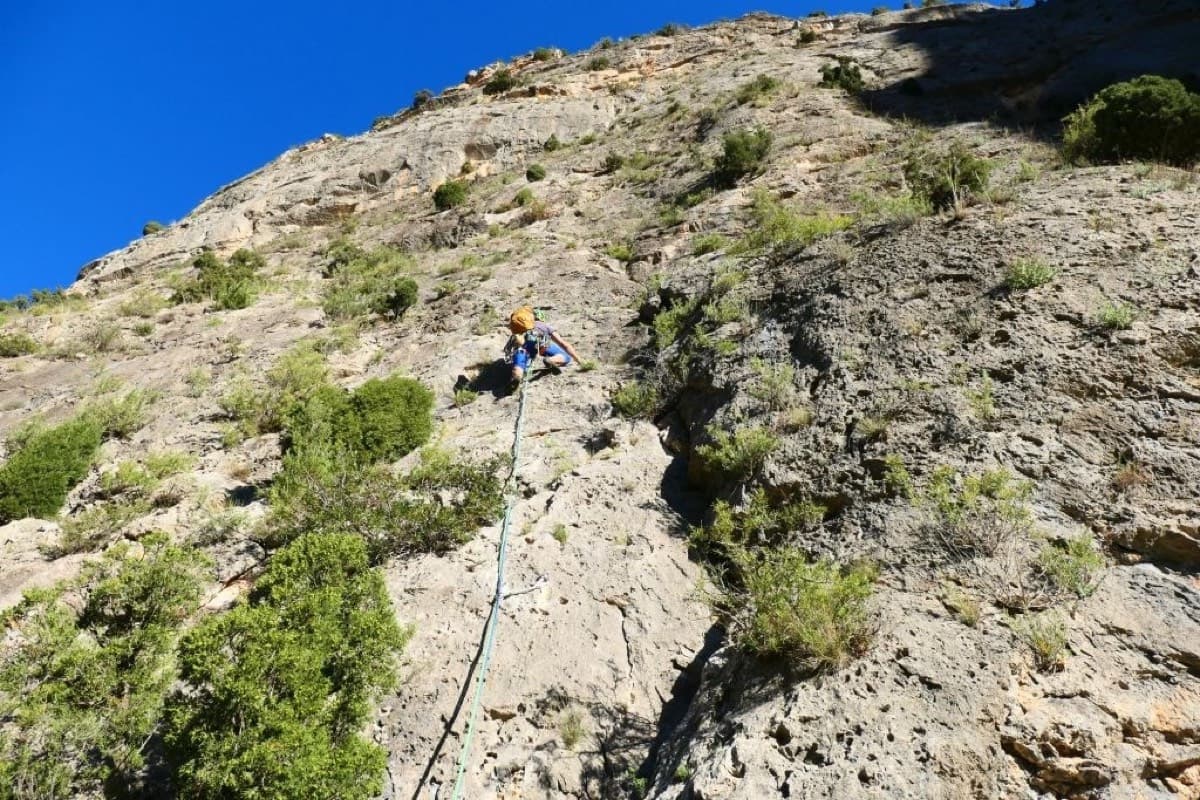
A leader on the first pitch of Monsieur at the Los Calpes sector, Montanejos.

Spain · Montanejos

Monsieur

Seven varied pitches in two halves split by a big ledge: vertical walls and cracks below, then an overhanging red wall and a traverse on a carpet of sharp little spikes beneath giant roofs. In the sun from the morning, unpolished, with an easy walk down.

6b+7 pitches170 m

The Barranco de la Maimona at Montanejos seen from above. The multipitch sectors line the walls of the gorge; the route itself is not identifiable in this view.

Spain · Montanejos

La Magia de tu Melena

The easy multipitch of the Maimona gorge, bolted in 2019 as a first long route: four pitches of grade 4 slabs and walls with one 5+ pitch. The line climbs the grey wall on the right of the Tubo sector, beside Parados al Sol. The exits of most pitches have loose rock, so a helmet matters more than the grade suggests.

5+4 pitches125 m

The Barranco de la Maimona at Montanejos seen from above. The multipitch sectors line the walls of the gorge; the route itself is not identifiable in this view.

Spain · Montanejos

Parados al Sol

A moderate four-pitch line up the middle of the Tubo sector: a grade 5 corner, a cracked corner with a traverse at 6a, a slab that steepens to 6a between two junipers, and an easy finish. All four belays are described as comfortable. A good step up from La Magia de tu Melena next door.

6a4 pitches130 m

Around 6c+ · about 8 pitches

Similar elsewhere

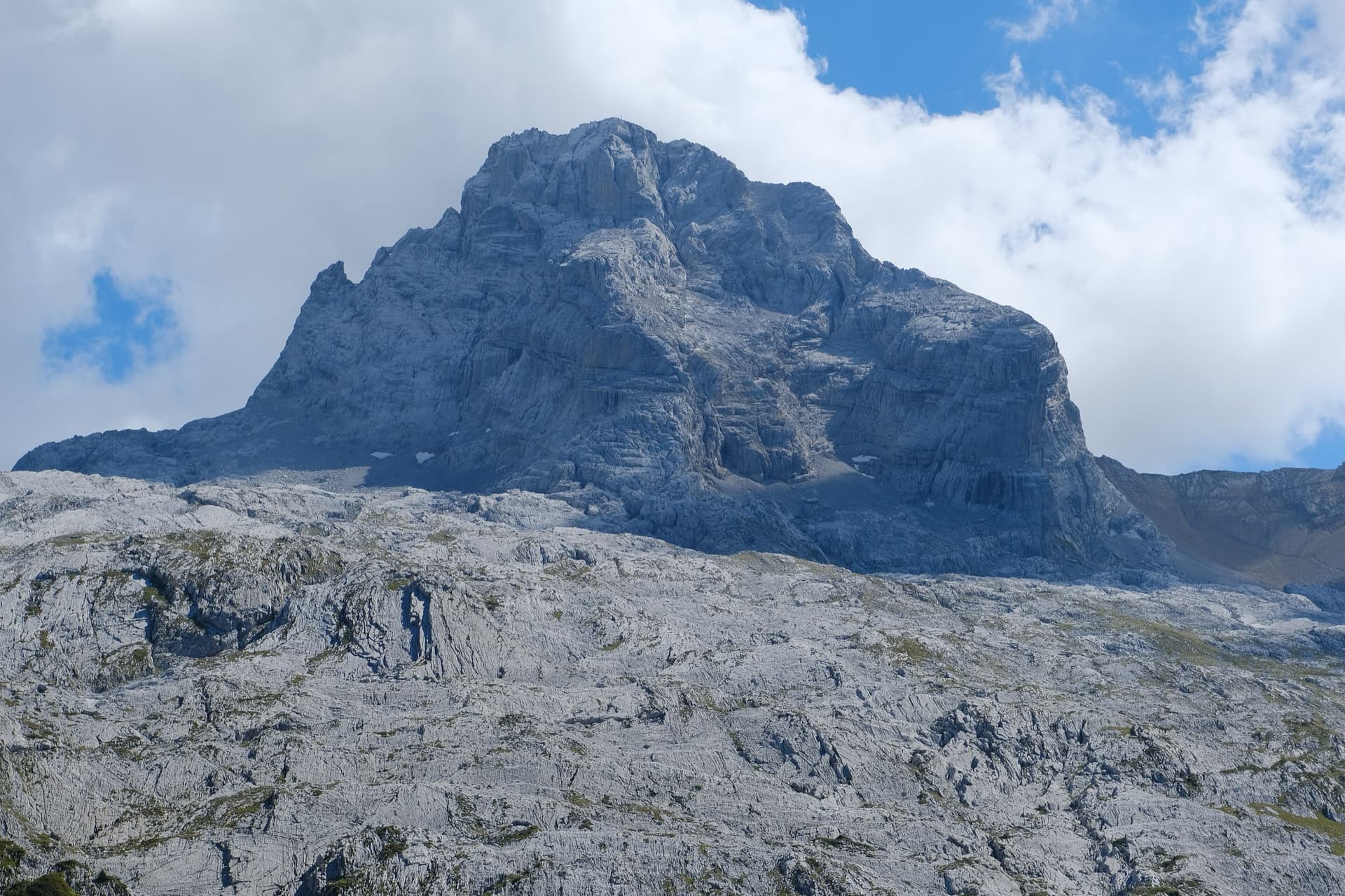
A view of the region, not this route's wall. The Pointe Percée above the limestone pavement of the Gramusset plateau, seen from the north-west; Le sirop pour machin starts from the crags near the hut and finishes on the summit, the exact line is not marked.

France · Aravis

L'échelle de Jacob

A fine modern line up the pillar that props up the Pointe Blanche, at 2200 m above the Col de la Colombière. Sustained 6a+ to 6b with one violent bulge of 6c+ at the start of pitch 3, then two pitches of perfect runnels, a short down-climb and two more steep 6a+ pitches. The approach and descent are alpine in feel.

6c+8 pitches250 m

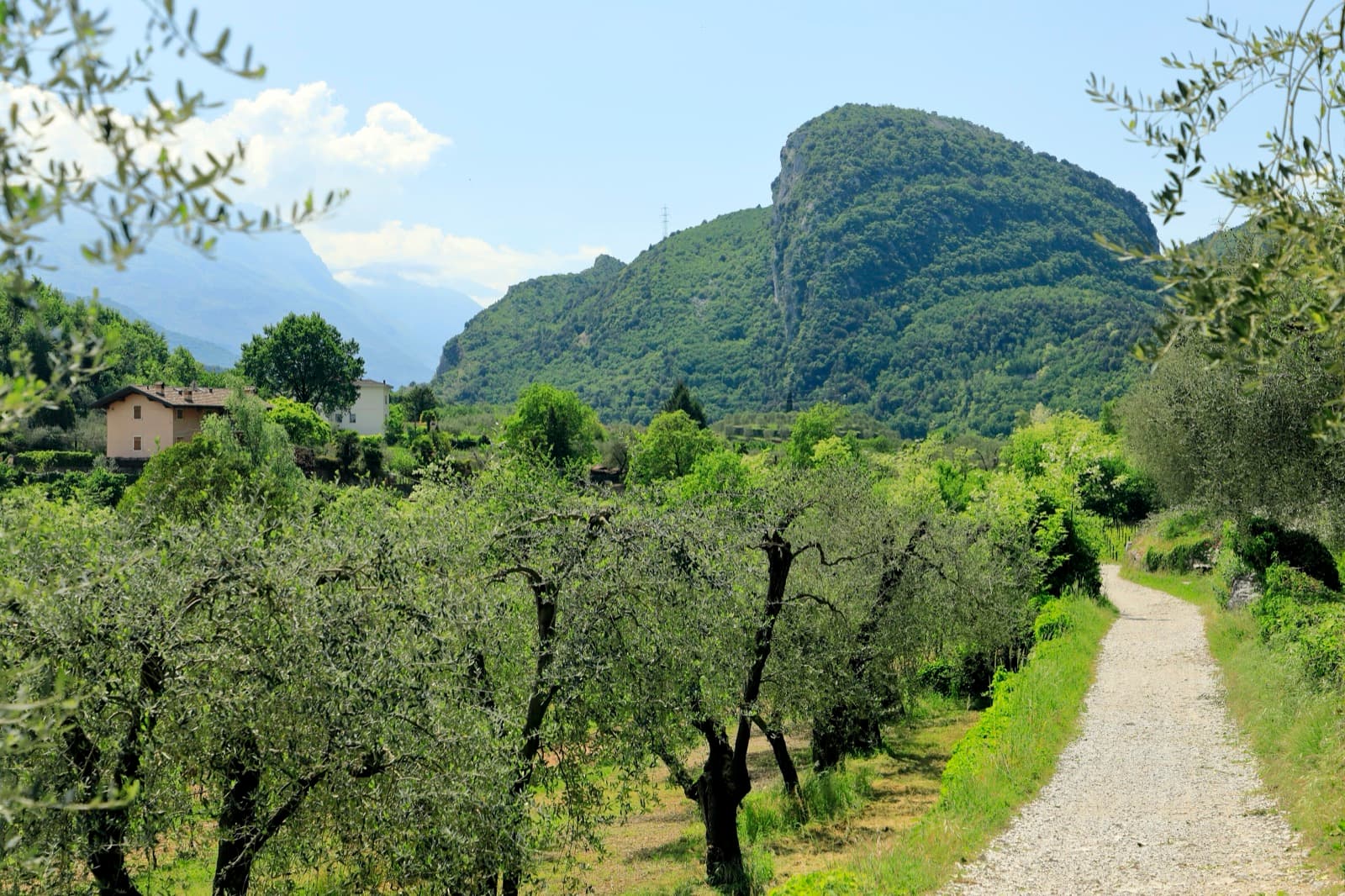
Monte Colt (Croce Colt) seen across olive groves from the west bank of the Sarca north of Arco; a band of steep limestone shows on its east-facing flank, the side the Parete San Paolo routes are on.

Italy · Arco & Valle del Sarca

Via Roberto

Eight sustained pitches up the wall opposite the Laterna restaurant, rarely easier than 6a. The crux is a short overhanging wall on pitch 5 that can be pulled through on the bolts. Less cleaned than its neighbours, with some broken rock on pitch 6.

6c+8 pitches220 m

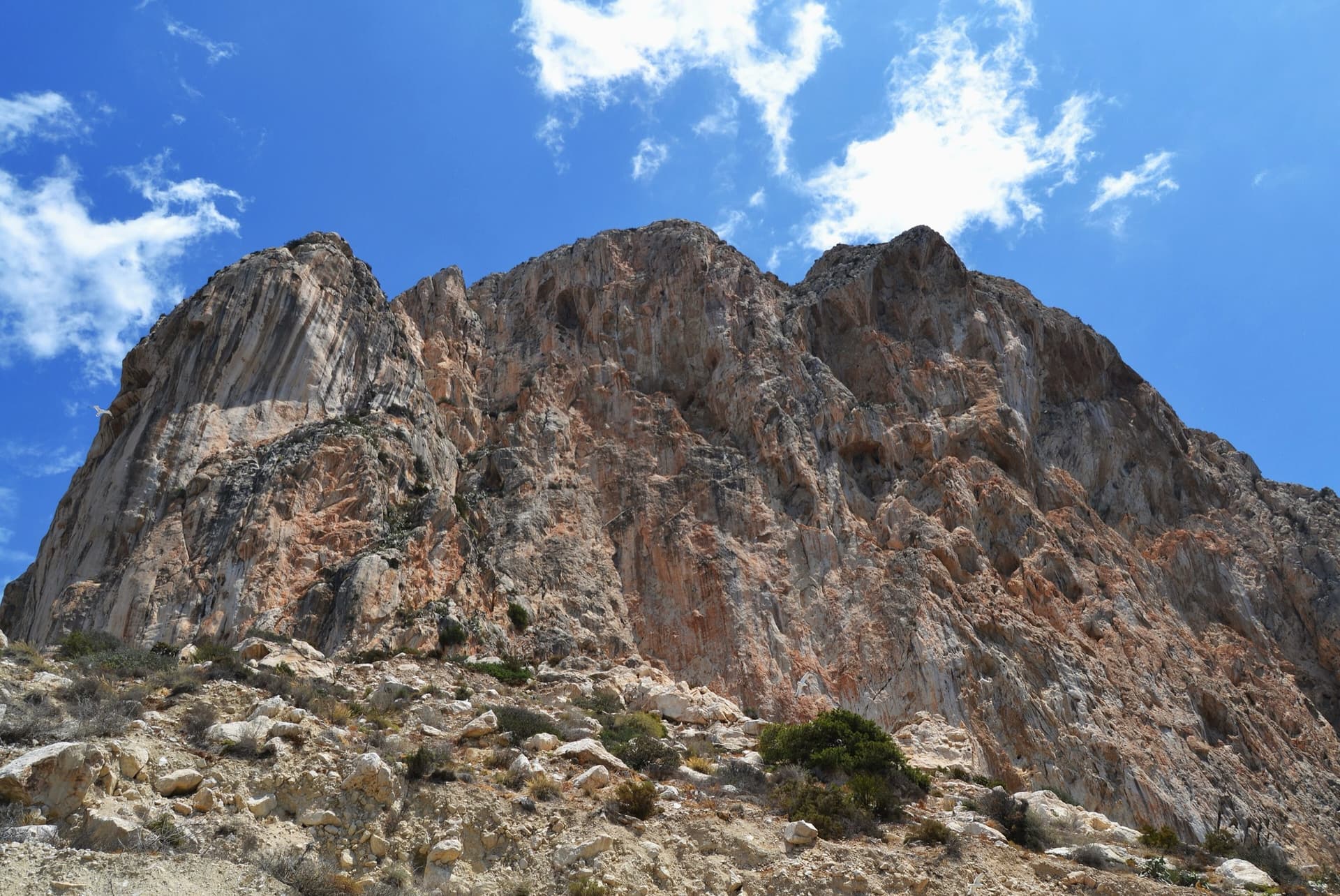
The south face of the Peñón de Ifach from the path below the cliffs, Calpe: 300 m of orange and grey limestone. Costa Blanca climbs this wall.

Spain · Costa Blanca (Peñón de Ifach)

Costa Blanca

The sport classic of the Peñón: a thin slab, a corner crack that steepens into an overhang, a pillar, then a wild exit from a big cave 200 m above the sea. Sustained at 6b with a 6c fifth pitch on polished slopers and a 6c+ last pitch whose crux can be pulled through on a bolt.

6c+7 pitches220 m

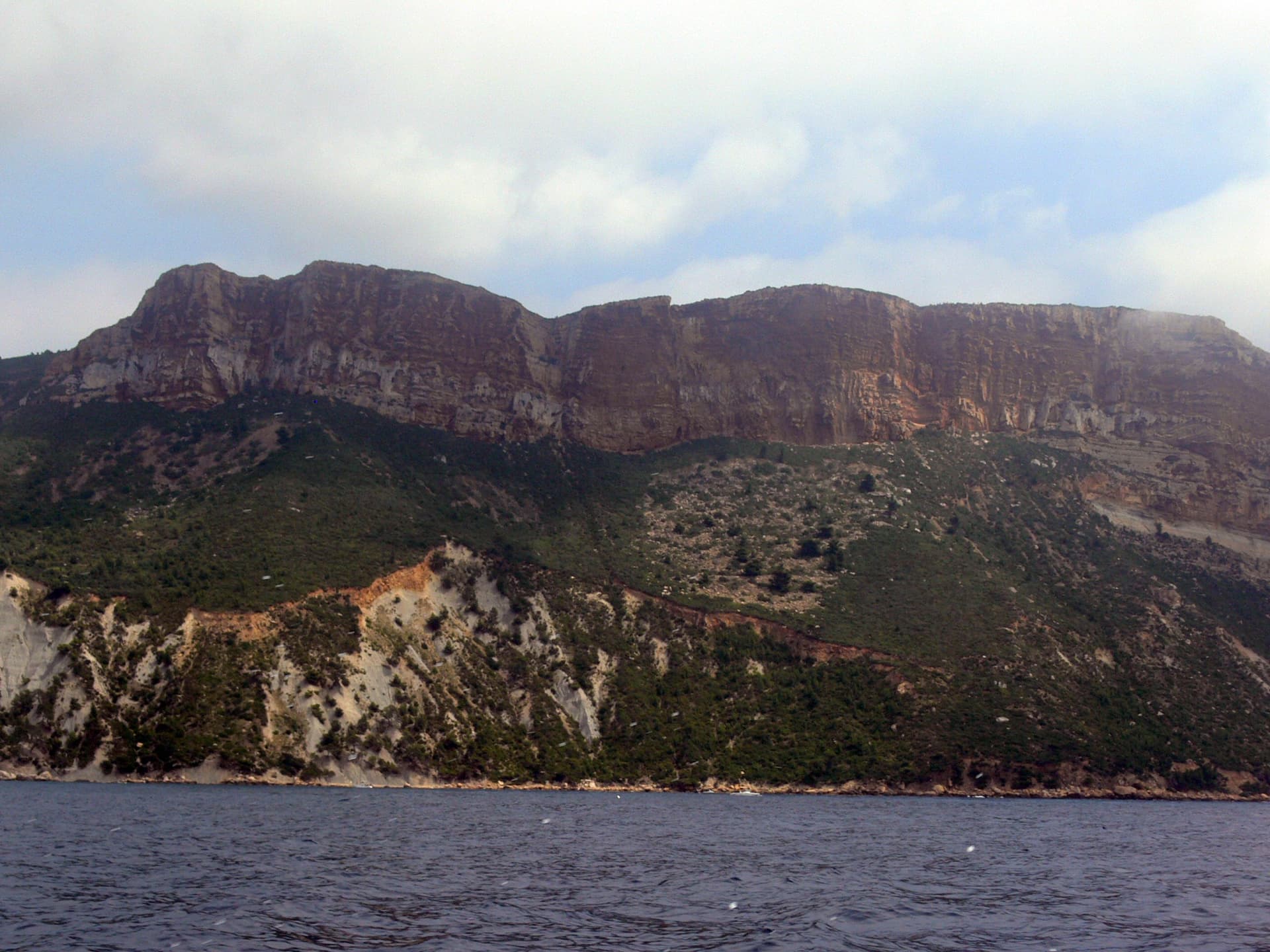
The cliffs of Cap Canaille seen from the sea, Cassis end; the Sémaphore sector is further south-east on the same line of cliffs

France · Calanques

Sables émouvants

Seven short, steep pitches up the ochre sea cliff of Cap Canaille, through three kinds of rock: overhanging jugs low down, a leftward traverse on huge fragile holds into a cave, a big roof and a thin wall of sandstone, then vertical conglomerate where you choose your cobble. Homogeneous at 6b to 6b+ with one harder move leaving the roof. The lower two pitches are sandy and friable.

6c+7 pitches150 m

Read the cautionsCommitting

Compiled from published sources and last verified October 2026. Bolts, anchors and access change. Climbing is dangerous and you are responsible for your own decisions: check a current topo and read the disclaimer.