Multipitch Atlas

Radio Patio

Paredón del Alguacil, Barranco de la Maimona · Montanejos · Spain

CommittingBolting confidence: high

Four steep pitches up the orange wall of the Paredón del Alguacil, on pockets and big holds on vertical to gently overhanging rock. The second pitch is the one parties rave about; the third has the 6b+ move on smaller holds near its end. Short, sustained and sunny, with a 43 m first pitch.

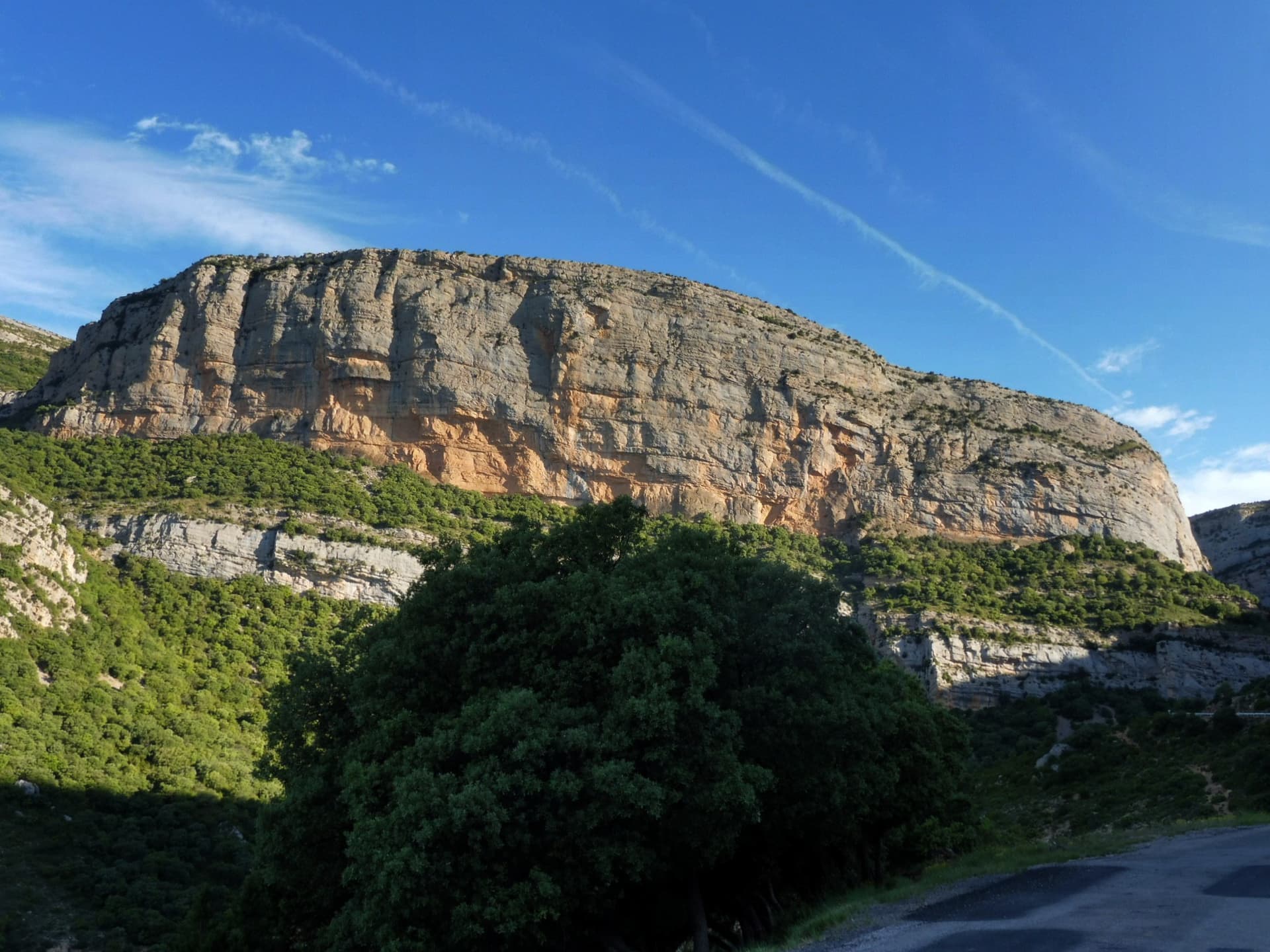
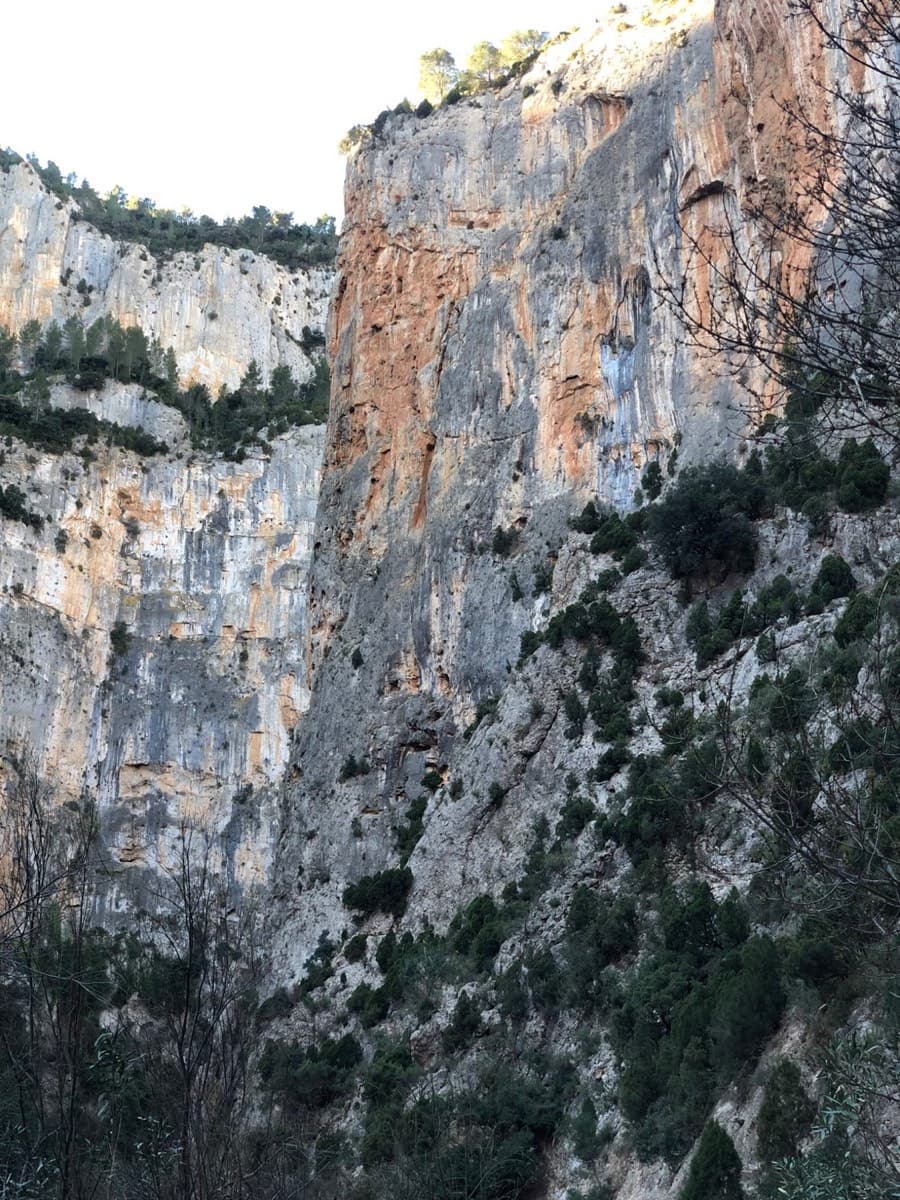
The Paredón del Alguacil from the first pitch of the neighbouring route Pitufosis. Radio Patio climbs the orange upper wall; its line is not marked.Photo: eusebio · CC BY-NC-ND 3.0

Photo

The Paredón del Alguacil from the first pitch of the neighbouring route Pitufosis. Radio Patio climbs the orange upper wall; its line is not marked.Photo: eusebio · CC BY-NC-ND 3.0
Hardest pitch
6b+
Pitches
4
Length
115 m
Approach
25 min
Aspect
S
South-facing
Rope
1×60 m for the walk-off
2×60 m to use the sector abseils

The route

Overview

A short, steep sport multipitch on the orange face of the Paredón del Alguacil, left of Los Guardianes del Templo and right of El Tordo y el Flaco. After a long 6a approach pitch on grey rock, three pitches of 6b to 6b+ climb the orange wall on pockets and good holds. The equipper's topo says the rock was awkward on the first repeats and has cleaned up with traffic, with a section on pitch 3 still needing attention; a 2025 camptocamp party agrees. Allow about two hours on the route.

The climbing

Pitch by pitch

Pitches of Radio Patio
PitchGradeLengthNotes
P16a43 mA long pitch up the grey lower wall to the foot of the orange rock. Start at the thread with the faded red cord.
P26b34 mThe pitch of the route: sustained climbing on good holds and pockets up steep orange rock.
P36b+22 mGood holds, then a thinner section near the end. The rock needs some care here.
P46b24 mA steep, demanding wall to the top. Camptocamp gives 6b to 6b+.

Getting there

Approach

To the parking

Montanejos is in inland Castellón province, on the CV-20 up the Mijares valley from Onda. The gorge starts at the climbers' refuge (Albergue El Refugio) by the Maimona bridge at the entrance to the village. Camptocamp says camping is not allowed, and that there is water at the village fountain or at the car park after the bridge. No source read gives public transport details.

On foot · about 25 min

About 20 to 25 minutes. Walk up the bed of the Barranco de la Maimona from the refuge until the Paredón del Alguacil, a wall of about 150 m, shows up high on the right. Find the orange spur left of the El Tubo sector and scramble up the gully by the easiest line (grade II); elev-arte describes a scramble protected by steel cables about 200 m beyond the wall. The first protection point is a rock thread with a faded red cord at about 5 m. El Tordo y el Flaco starts just to its left.

Map of the walk-in

  • Crag

Loading map

The point marks the crag, not the exact start of the route.

Coordinates · crag

40.07007, -0.53294

Point from camptocamp route 1705135 (own point, El Tubo sector, the same wall); the gorge position agrees with OSM node 5238792821 (Sector Xulo Panderas). The camptocamp Montanejos waypoint 189249 is a rough point about 1.4 km away and was not used.

For your phone or watch

Download GPX

Contains the route point. Opens in most mapping apps and GPS watches.

Points are compiled from published sources, with the precision stated above. They were not surveyed on the ground: check them against a current topo.

Getting down

Descent

The route is not equipped for abseiling. Either walk off: head right from the top to the descent path, which brings you back above the refuge. Or abseil elsewhere: go up and left to the abseil line of the Paredón del Alguacil (the route Cornelius Moliarte is the one elev-arte names), which camptocamp recommends, or go right, aim for a lone pine, descend a stony gully to a first anchor on a small platform and abseil the Tubo sector (about 60 m to a cabled ledge, then 30 to 40 m).

Retreat

Bailing off the route

Committing

Both sources say the route is not equipped for abseiling, and the first pitch is 43 m. The belays are bolted, so a retreat is physically possible with two ropes if you leave maillons or karabiners, but nobody describes doing it. The climbing is steep, so the ropes hang free of the wall on the upper pitches.

Retreat from
Any bolted belay, leaving your own gear (inferred).
Point of no return
Not described. Above the first belay you are on sustained 6b ground with no easier exit.
Carry
Two ropes of at least 50 m and maillons to leave on the belay bolts.
Basis
Part stated, part inferredCamptocamp and the equipper's topo both state the route is not abseilable; what a retreat would take is inferred from the pitch lengths and bolted belays.

Partly inferred from the route facts

Safety

Hazards

  • Some fragile rock remains, mainly on pitch 3, according to both the equipper and a 2025 party.
  • The first pitch is 43 m: you cannot be lowered off it on a single 60 m or 80 m rope, and the route has no abseil rings.
  • The approach gully is unroped grade II with cabled sections.

Sun and weather

Conditions

South-facing (camptocamp). A February 2026 party on the neighbouring route had sun from about 09:00 and shade from about 16:00. Ascents are logged in February; the wall suits clear days from autumn to spring.

Usual season · Jan to Apr, Oct to Dec

Sun on the wall · S-facing

Working out the sunlit hours for this month.

  • January (usual season): not yet worked out
  • February (usual season): not yet worked out
  • March (usual season): not yet worked out
  • April (usual season): not yet worked out
  • May: not yet worked out
  • June: not yet worked out
  • July: not yet worked out
  • August: not yet worked out
  • September: not yet worked out
  • October (usual season): not yet worked out
  • November (usual season): not yet worked out
  • December (usual season): not yet worked out

Sun on the wallDaylight, wall in shade● Usual season

Estimated from the wall's aspect only. Ignores surrounding terrain, gullies and the wall's exact shape. Clock times are local to the wall (Central European time), for the 15th of each month.

Monthly climate averages for Montanejos, 1991-2020
MeasureJan (usual season)Feb (usual season)Mar (usual season)Apr (usual season)MayJunJulAugSepOct (usual season)Nov (usual season)Dec (usual season)
Mean daily high °C111215182125292824201512
Mean daily low °C335710141718141164
Rain days 1 mm or more657997489866

● marks the usual climbing season. Averages for 1991-2020 at about 700 m. Area climate from Open-Meteo reanalysis. Temperatures are adjusted to the height of the crag; rain comes from a grid cell of about 10 to 25 km, and summer highs on sea cliffs can read a few degrees low. The wall and valley can differ. Data: Open-Meteo, CC BY 4.0.

What to carry

Gear

15 quickdraws and belay kit (both sources). Helmet essential, says the equipper's topo. Single rope if you walk off; two 60 m ropes for the Tubo abseils.

Checklist

Quickdraws
15
Rope
1×60 m for the walk-off; 2×60 m to use the sector abseils
Helmet
One each
Abseil device and prusik
The descent or the retreat involves abseiling
Maillons or spare karabiners
To leave behind if you retreat

Derived from the route data; check it against a current topo

From climbers

Reader reports

Reader reports are not being collected yet. Until they are, check a current topo and the local club or guidebook publisher for recent changes to Radio Patio.

Worth knowing

Tips

  • El Tordo y el Flaco (6b+, 2020) immediately left is of the same style and quality and combines well in a day.
  • Pitches 3 and 4 are short (22 and 24 m).
  • A recent party found the abseil down the slab of La Cabra Loca quick and easy to reach from the top of this wall.

Open questions

Where sources disagree

  • History: the equipper's topo and elev-arte date the route to February and March 2014 by Javier González (Pitxi); camptocamp's history field says 2002, Lolo Lence and Ángel Requena. The topo is followed.
  • Pitch lengths: topo 43, 34, 22 and 24 m; camptocamp 43, 35, 25 and 25 m.
  • Pitch 4: 6b on the topo, 6b/6b+ on camptocamp.

Provenance

Sources

Same area

More in Montanejos

All routes in Montanejos
The walls of the Barranco de la Maimona at Montanejos, photographed on an ascent of La Luna.

Spain · Montanejos

La Luna

Eight pitches up a vertical prow deep in the Maimona canyon, on orange rock full of pockets (agujeros means holes). Sustained at 6a+ to 6b and physical throughout, with a huge roof start to the crux pitch and a bench to sit on at the third belay. Closed from January to June.

6b+8 pitches235 m

Read the cautions
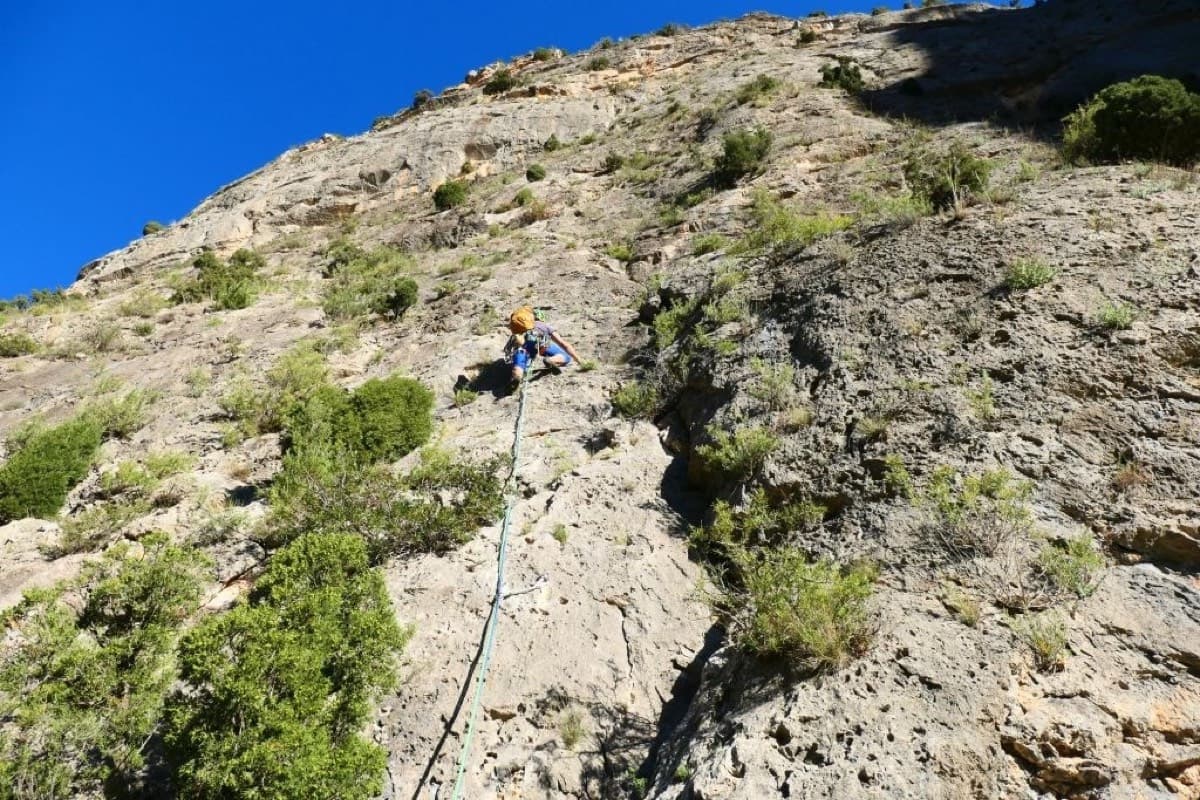
A leader on the first pitch of Monsieur at the Los Calpes sector, Montanejos.

Spain · Montanejos

Monsieur

Seven varied pitches in two halves split by a big ledge: vertical walls and cracks below, then an overhanging red wall and a traverse on a carpet of sharp little spikes beneath giant roofs. In the sun from the morning, unpolished, with an easy walk down.

6b+7 pitches170 m

The Barranco de la Maimona at Montanejos seen from above. The multipitch sectors line the walls of the gorge; the route itself is not identifiable in this view.

Spain · Montanejos

La Magia de tu Melena

The easy multipitch of the Maimona gorge, bolted in 2019 as a first long route: four pitches of grade 4 slabs and walls with one 5+ pitch. The line climbs the grey wall on the right of the Tubo sector, beside Parados al Sol. The exits of most pitches have loose rock, so a helmet matters more than the grade suggests.

5+4 pitches125 m

The Barranco de la Maimona at Montanejos seen from above. The multipitch sectors line the walls of the gorge; the route itself is not identifiable in this view.

Spain · Montanejos

Parados al Sol

A moderate four-pitch line up the middle of the Tubo sector: a grade 5 corner, a cracked corner with a traverse at 6a, a slab that steepens to 6a between two junipers, and an easy finish. All four belays are described as comfortable. A good step up from La Magia de tu Melena next door.

6a4 pitches130 m

Around 6b+ · about 4 pitches

Similar elsewhere

Mala Mojstrovka (left) and Nad Šitom glava (right) from the Vršič Pass in autumn; the routes are on the pale rock wall of Nad Šitom glava above the larches.

Slovenia · Vršič Pass (Julian Alps)

Črni panter

Sustained slab climbing up a striking black streak, clearly visible from the pass, on surprisingly good rock for this face. The crux is a move from slab into a corner on P2.

6b+4 pitches105 m

Read the cautions

The south-east face of the Roca dels Arcs above the road from Vilanova de Meià, in the Montsec de Rúbies.

Spain · Vilanova de Meià (Roca dels Arcs)

El Somni de Quimfer

Four long, steep pitches on the left side of the Roca dels Arcs, sustained at 6a on good holds and not yet polished above the first pitch. The third pitch is the event: a reachy bulge to start, 30 m of gently overhanging strata, and a hard boulder move off a ledge to finish that most people grade 6c. That last move can be avoided by belaying on the neighbouring route.

6b+4 pitches160 m

The Zucco dell'Angelone above the Valsassina, seen from Pasturo, with the antenna on its summit. The climbing spurs are the pale limestone ribs on the sunny side of the mountain above Barzio; individual spurs and routes are not marked.

Italy · Lecco & Valsassina

Foto di Gruppo con Signorine

Three friendly pitches up a striking arched flake and compact slabs, then a short wall with one hard, reachy move that most people pull through. A 1980 route by the Savonittos and Alessandro Gogna, and the usual first half of a link-up with Gli Schiavi della Pietra on the spur above.

6b+4 pitches90 m

Read the cautions

The Puig de Son Nasi (left) and the pointed Puig de s'Alqueria, the Sa Gubia peak, seen from the Sóller railway to the east. The climbing walls are out of sight in the gorge on the far side.

Spain · Mallorca (Sa Gubia)

Mongol Express

A big line up the full height of the Bomberos wall: a 40 m tufa pitch that is a popular climb in its own right, easy broken ground, a steeper 6a, and a long, steep, technical 6b+ wall to finish. The top pitch cannot be aided past its crux, so this is a route for a solid 6b+ leader.

6b+4 pitches155 m

Read the cautions

Compiled from published sources and last verified October 2026. Bolts, anchors and access change. Climbing is dangerous and you are responsible for your own decisions: check a current topo and read the disclaimer.