Multipitch Atlas

Utopía

El Cantal, Baños de Panticosa · Aragonese Pyrenees (Tena & Canfranc valleys) · Spain

Bail not documentedBolting confidence: high

Fifteen pitches up a broken granite wall that nobody had climbed on before 2023, probably the longest bolted route at Panticosa. Corners, steps and slabs at around 5b, cut by ledges and terraces, with isolated moves of 6a and a 6a+ corner on the last pitch that are not obligatory. Sun from first thing. The length is the attraction; repeat parties find the climbing pleasant but discontinuous.

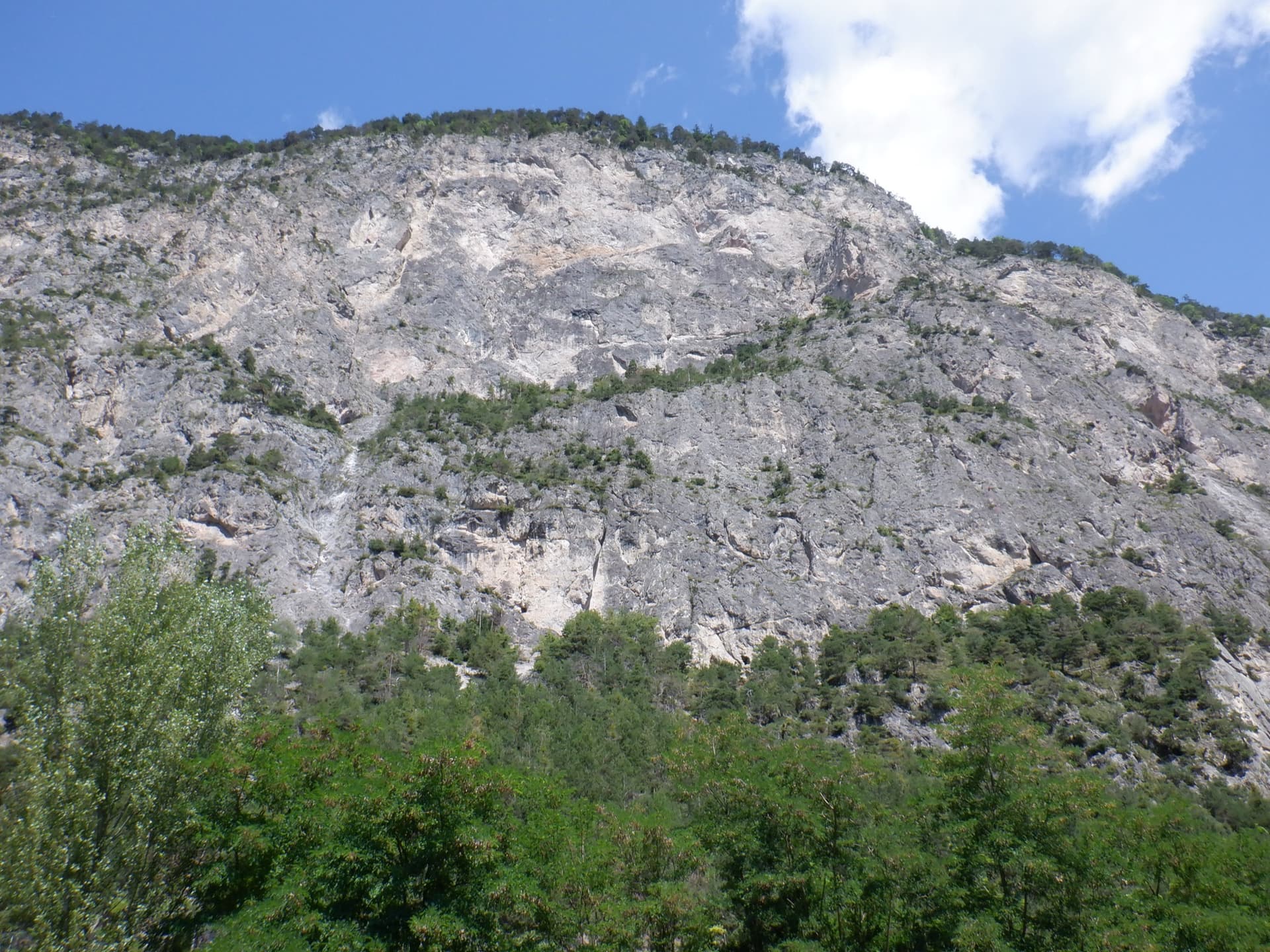
The El Cantal wall below Baños de Panticosa with the line of UtopíaPhoto: janic · CC BY-SA 3.0

Topo

The El Cantal wall below Baños de Panticosa with the line of UtopíaPhoto: janic · CC BY-SA 3.0
Hardest pitch
6a+
Pitches
15
Length
550 m
Approach
30 min
Aspect
E
East-facing
Rope
60 m
(pitch 7 is 60 m); double ropes help with drag

The route

Overview

Utopía takes the wall called El Cantal, beside the road a little below Baños de Panticosa. The opener gives 625 m of climbing in 15 pitches; camptocamp gives 550 m of height. The average difficulty is grade IV to V with a few isolated moves of V+ to 6a and one 6a+ move in a vertical corner on the last pitch, none of them obligatory. Ledges break the wall up, which takes away continuity but makes for a relaxed day. From the road the wall does not look like much; on it, the line winds through steps, corners and big terraces with a high-mountain feel. Allow 4 to 6 hours on the route.

The climbing

Pitch by pitch

Pitches of Utopía
PitchGradeLengthNotes
P15b50 mPleasant slabs; in the second half you cross a small gully to the right.
P25b50 mA good corner.
P35b55 mSimilar to pitch 2. Belay on a large pine; you can also belay on another tree a few metres lower.
P46a30 mLeave the corner for a belay on a pine to the left.
P54c30 mA good start up some walls.
P64b50 mA transition section, then a step climbed from left to right.
P75b60 mThe difficulty is one move about 20 m above the belay, easier taken left of the bolt than direct. You can belay at a pine after about 40 m, or continue right along the ledge to two bolts.
P85c40 mA very good pitch.
P95c/6a30 mOne harder move in the first part.
P104c50 mThe second half is a sloping grass field.
P115c40 mThe only hard move is leaving the belay.
P125b45 mManage the rope drag, above all at the last bolts. Belay on a pine.
P133b35 mA transition pitch.
P145b/5c25 mA good short pitch.
P156a+35 mOne 6a+ move in a vertical corner. Belay on a pine with two cords, round on the other side of the crest, where you cannot hear your partner.

Getting there

Approach

To the parking

Drive up the Tena valley through Panticosa towards Baños de Panticosa. About 600 m before the concrete building that was meant to be a multi-storey car park, the road widens beside a weather station and several cars fit. Park there, or at the Balneario: either way you walk about 10 minutes of road at one end of the day. A 2025 party reports that a landslide in August 2025 damaged parts of the access road.

On foot · about 30 min

The opener gives about 20 min from the weather-station lay-by; a 2025 party took 30 min and a 2026 party an hour from the main car park. Since the August 2025 landslide the first part is an awkward scree with no cairns or path, which does not stop you reaching the route.

Map of the walk-in

  • Crag
  • Parking

Loading map

The point marks the crag, not the exact start of the route.

Coordinates · crag

42.75126, -0.24416

Parking

42.75957, -0.23461

Baños de Panticosa (camptocamp access waypoint 131736). The opener's lay-by by the weather station is about 10 minutes down the road.

Point from camptocamp waypoint 1654042 (Baños de Panticosa - El Cantal)

For your phone or watch

Download GPX

Contains the route point and parking. Opens in most mapping apps and GPS watches.

Points are compiled from published sources, with the precision stated above. They were not surveyed on the ground: check them against a current topo.

Getting down

Descent

Two options from the last belay. The short one: go up about 60 m and traverse horizontally right across the head of the gully (20 min) to the point where the summit ridge ends. The long one: scramble unroped up the spur for about 150 m of height to the left-hand top of the crest (30 min), then follow the ridge, grade III to IV with a few fixed ropes (another 30 min), to the same point. From there follow cairns and then blue-and-white paint marks down to the main Garmo Negro path and Baños; camptocamp describes this descent as passing a col and going down towards the Ordicuso lake. A 2025 party took 1 h 30 in descent.

Retreat

Bailing off the route

Bail not documented

No source describes a retreat or says the belays are rigged for abseiling. Belays are a mix of bolts and pines and the pitches are up to 60 m, so plan on finishing once you are established on the wall.

Retreat from
Not documented
Point of no return
Not documented
Carry
Not documented
Basis
Inferred from the route factsNeither the opener nor the camptocamp outings mention retreat.

Partly inferred from the route facts

Safety

Hazards

  • Still quite a few loose blocks on a wall that is generally clean; a 2026 party trundled several.
  • Belay cords on the pines are sun-bleached: carry slings to replace or back them up.
  • Rope drag on the long, wandering pitches.
  • A long route with a long descent: 15 pitches, many of 45 to 50 m.
  • The long descent option includes an exposed grade III to IV ridge.

Sun and weather

Conditions

East facing, about 1600 m to 2250 m, in the sun from first thing in the morning. Parties report it in May (18°C with some wind) and September.

Usual season · May to Oct

Sun on the wall · E-facing

Working out the sunlit hours for this month.

  • January: not yet worked out
  • February: not yet worked out
  • March: not yet worked out
  • April: not yet worked out
  • May (usual season): not yet worked out
  • June (usual season): not yet worked out
  • July (usual season): not yet worked out
  • August (usual season): not yet worked out
  • September (usual season): not yet worked out
  • October (usual season): not yet worked out
  • November: not yet worked out
  • December: not yet worked out

Sun on the wallDaylight, wall in shade● Usual season

Estimated from the wall's aspect only. Ignores surrounding terrain, gullies and the wall's exact shape. Clock times are local to the wall (Central European time), for the 15th of each month.

Monthly climate averages for Aragonese Pyrenees (Tena & Canfranc valleys), 1991-2020
MeasureJanFebMarAprMay (usual season)Jun (usual season)Jul (usual season)Aug (usual season)Sep (usual season)Oct (usual season)NovDec
Mean daily high °C447914192222171375
Mean daily low °C−3−3−11591112850−2
Rain days 1 mm or more141314181816141413141413

● marks the usual climbing season. Averages for 1991-2020 at about 1564 m. Area climate from Open-Meteo reanalysis. Temperatures are adjusted to the height of the crag; rain comes from a grid cell of about 10 to 25 km, and summer highs on sea cliffs can read a few degrees low. The wall and valley can differ. Data: Open-Meteo, CC BY 4.0.

What to carry

Gear

About 18 quickdraws, fewer if you skip bolts, with many extendable ones against rope drag. Slings for the tree belays and to back up bleached cords. A 60 m rope at least: pitch 7 is 60 m. Helmet.

Checklist

Quickdraws
18
Rope
60 m (pitch 7 is 60 m); double ropes help with drag
Helmet
One each

Derived from the route data; check it against a current topo

From climbers

Reader reports

Reader reports are not being collected yet. Until they are, check a current topo and the local club or guidebook publisher for recent changes to Utopía.

Worth knowing

Tips

  • The dense bolting helps you find the way through the maze of blocks even if you do not clip everything.
  • A party of three took 6 h and thought 4 h optimistic for a pair.
  • The opener's other long route here, Espolón Ordicuso, is on the next wall up the valley and shares the last part of the descent.

Open questions

Where sources disagree

  • Length: 625 m of climbing according to the opener, 550 m on camptocamp.
  • Approach: 20 min (opener, from the lay-by), 30 min (2025), 1 h (2026, from the main car park).
  • Climbing time: 4 to 5 h according to the opener; 6 h for parties of three in 2025 and 2026.
  • The opener grades in Roman numerals (mostly V, with 6a on pitch 4 and 6a+ on pitch 15); the French grades here are camptocamp's.

Provenance

Sources

Same area

More in Aragonese Pyrenees (Tena & Canfranc valleys)

All routes in Aragonese Pyrenees (Tena & Canfranc valleys)
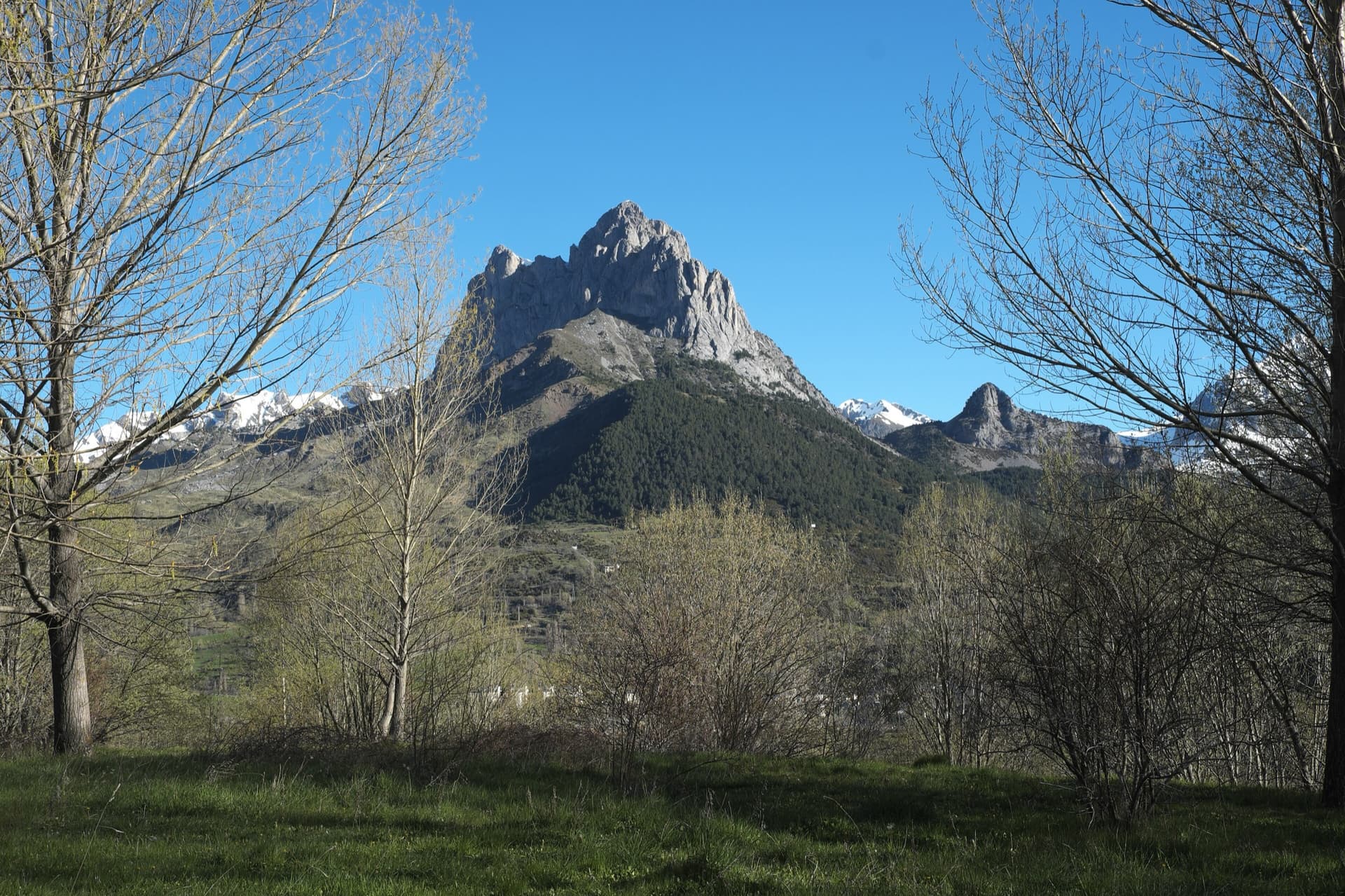
The twin limestone summits of Peña Foratata above the forest, seen from Sallent de Gállego in spring.

Spain · Aragonese Pyrenees (Tena & Canfranc valleys)

La Joya del Gállego

Varied, sustained limestone of chimneys, dihedrals and compact fluted slabs high above the Tena valley. Bearded-vulture nesting closes the face from 1 Dec to 31 Jul unless lifted early, so check montanaregulada.org.

6a+10 pitches265 m

Read the cautions
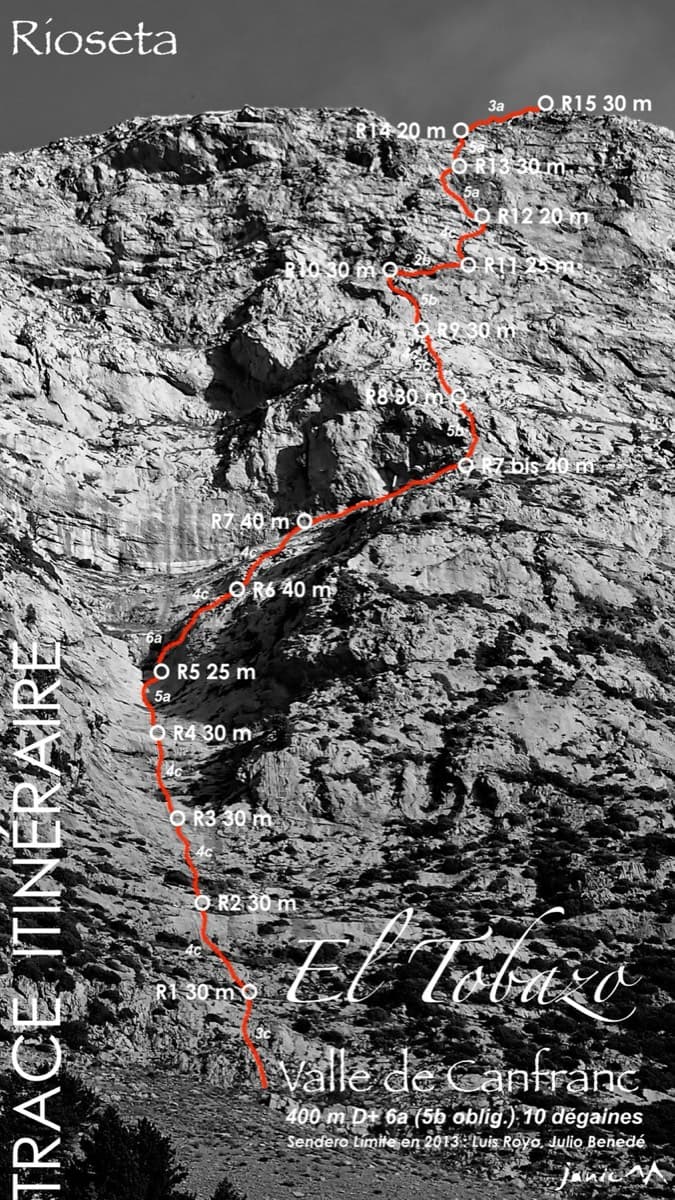
Topo of Valle de Canfranc on the south face of El Tobazo

Spain · Aragonese Pyrenees (Tena & Canfranc valleys)

Valle de Canfranc

A long, mostly easy slab-and-dihedral route with a single 6a slab on pitch 6, in a fine setting facing away from Candanchú. Wait about 30 h after rain because the lower gully drains water.

6a15 pitches400 m

Topo of Roca por un Tubo, Pared de la Tubería (Cerro Gascón), Baños de Panticosa

Spain · Aragonese Pyrenees (Tena & Canfranc valleys)

Roca por un Tubo

High-mountain granite slabs and dihedrals above the Panticosa spa. Three 6a cruxes mix friction slab with a short flaky roof on pitch 7.

6a9 pitches300 m

Read the cautions

The Pared del Ibón above Baños de Panticosa with the line and belays of Vía del Ibón

Spain · Aragonese Pyrenees (Tena & Canfranc valleys)

Vía del Ibón

A mountain-style line on dark, weathered granite twenty-five minutes above the spa of Baños de Panticosa. It links ramps, a short overhanging break, slabs and a rounded boulder, with one well-bolted 5c move and the rest 4b to 5b. The rock between the good sections is earthy and lichenous, but the friction is excellent and the bolting generous.

5c7 pitches260 m

Around 6a+ · about 15 pitches

Similar elsewhere

The rock towers of the Ratengrat on the Röthelstein above Mixnitz, where the first half of the route climbs

Austria · Grazer Bergland

Don Kamille und Pepperone

Possibly the longest route in the Grazer Bergland: sixteen pitches that start up the Ratengrat (Don Kamille) and continue up the Breite Wand (Pepperone). The lower half is among the best climbing on the Ratengrat; the upper half begins gently over slabby steps in the forest and then steepens. Two passages of UIAA 7- and several of 6+.

6b16 pitches440 m

The Geierwand above Haiming seen from the car park; Alhambra climbs the full height of the wall, crossing the vegetated ledge at mid-height

Austria · Inntal (Haiming Geierwand)

Alhambra

The longest route on the Geierwand and its most popular easy outing: rough slabs low down, a walk across the big ledge, then steeper, pocketed and more exposed climbing above. The crux is a short traverse to the belay on pitch 10. The last two pitches are scrambling over loose ground.

6a+12 pitches430 m

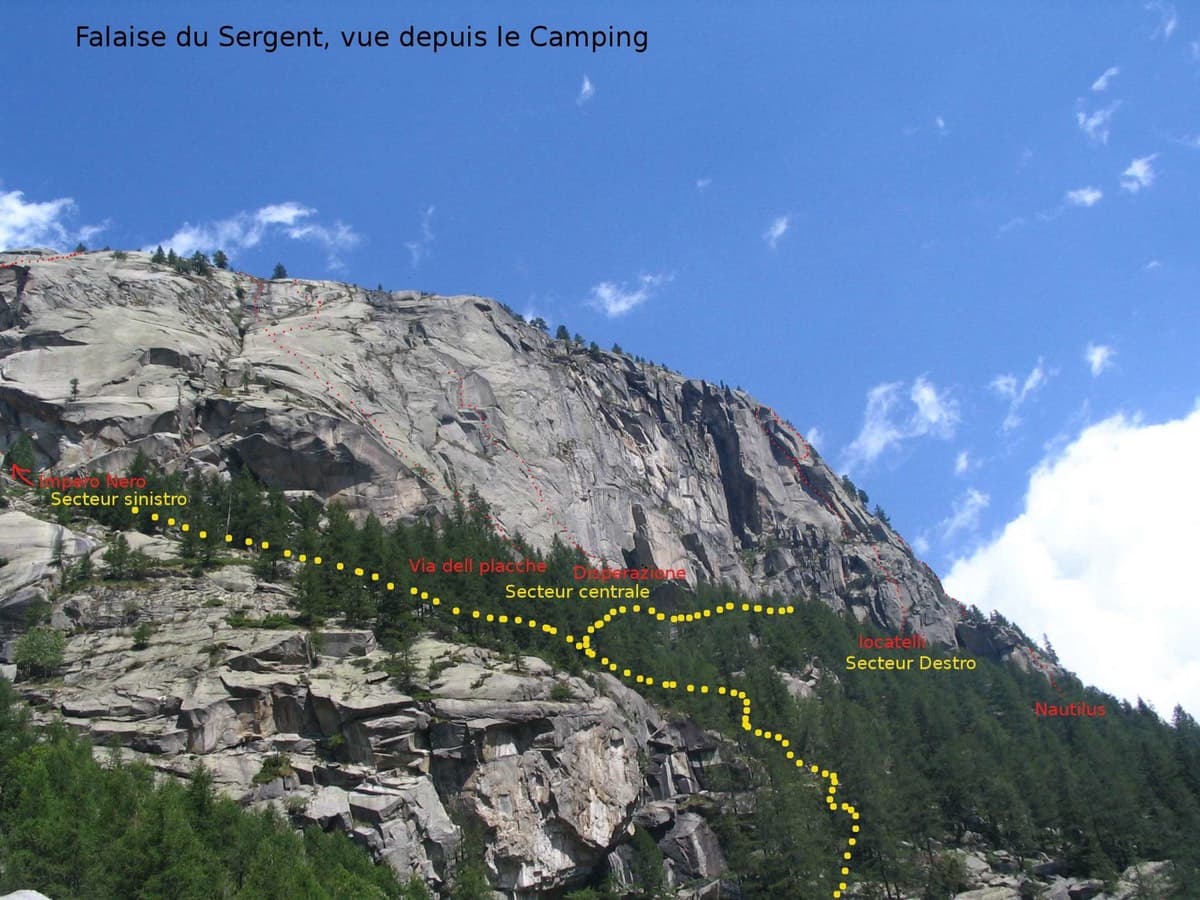
The Sergent seen from the campsite, with sector names and a few lines marked (left-hand sector at left)

Italy · Valle dell'Orco

Via per Giorgio

A rare fully bolted slab line on the Sergent, the home of Orco trad. It's mostly easy-angled granite slabs with a vertical corner on P3 and an overhanging start to the final 6a+ pitch (5c obligatory, A0 possible).

6a+12 pitches350 m

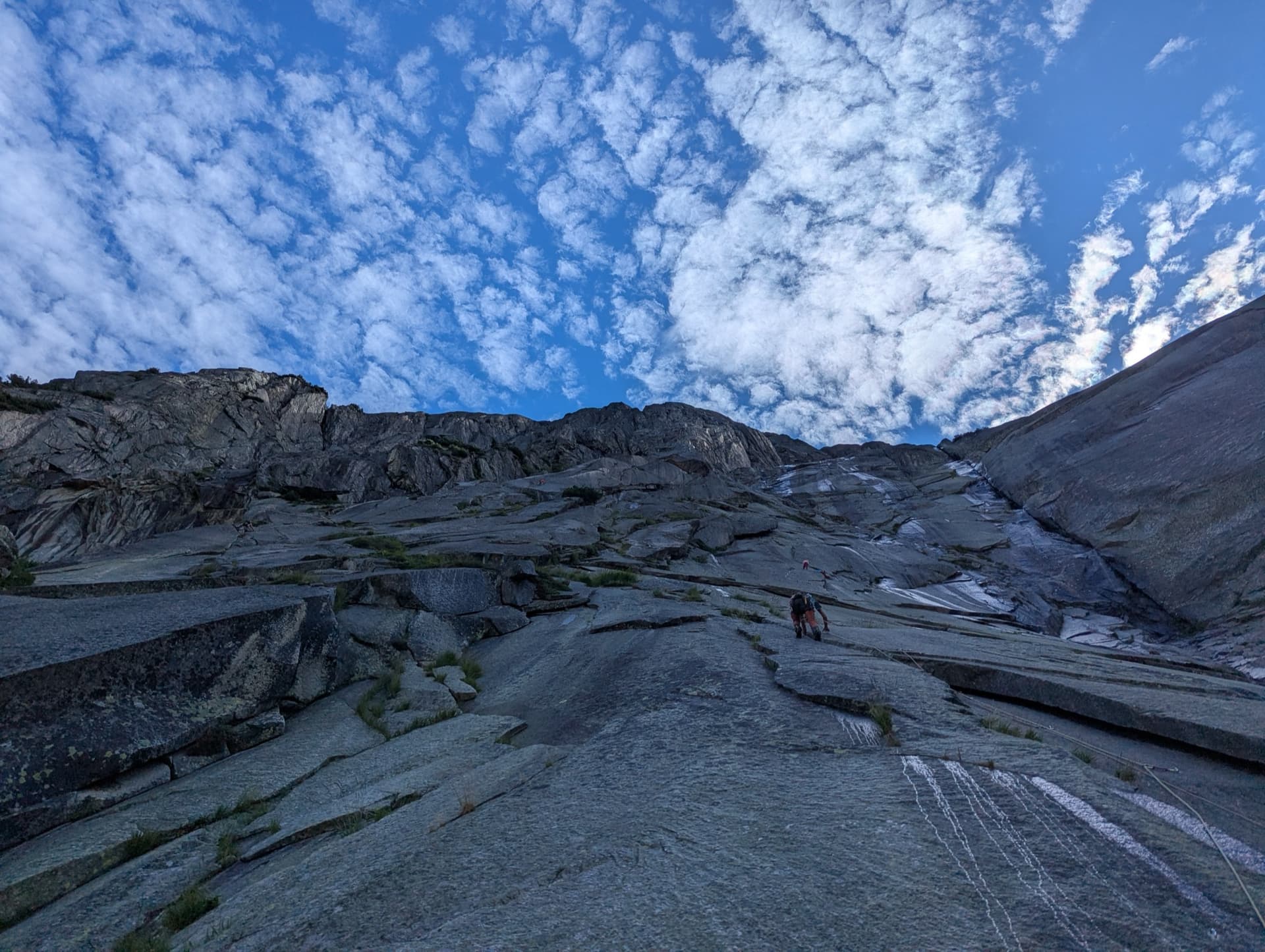
The granite slabs of the Gelmerfluh under a mackerel sky, photographed from pitch 3 of Savoir Vivre.

Switzerland · Grimsel

Sagittarius

A Grimsel granite classic: low-angle slabs lead to the famous 6a+ crack pitches and a thin 6b traverse, then steeper, sculpted ground. Sustained at 5c/6a throughout.

6b13 pitches400 m

Compiled from published sources and last verified October 2026. Bolts, anchors and access change. Climbing is dangerous and you are responsible for your own decisions: check a current topo and read the disclaimer.