.jpg)
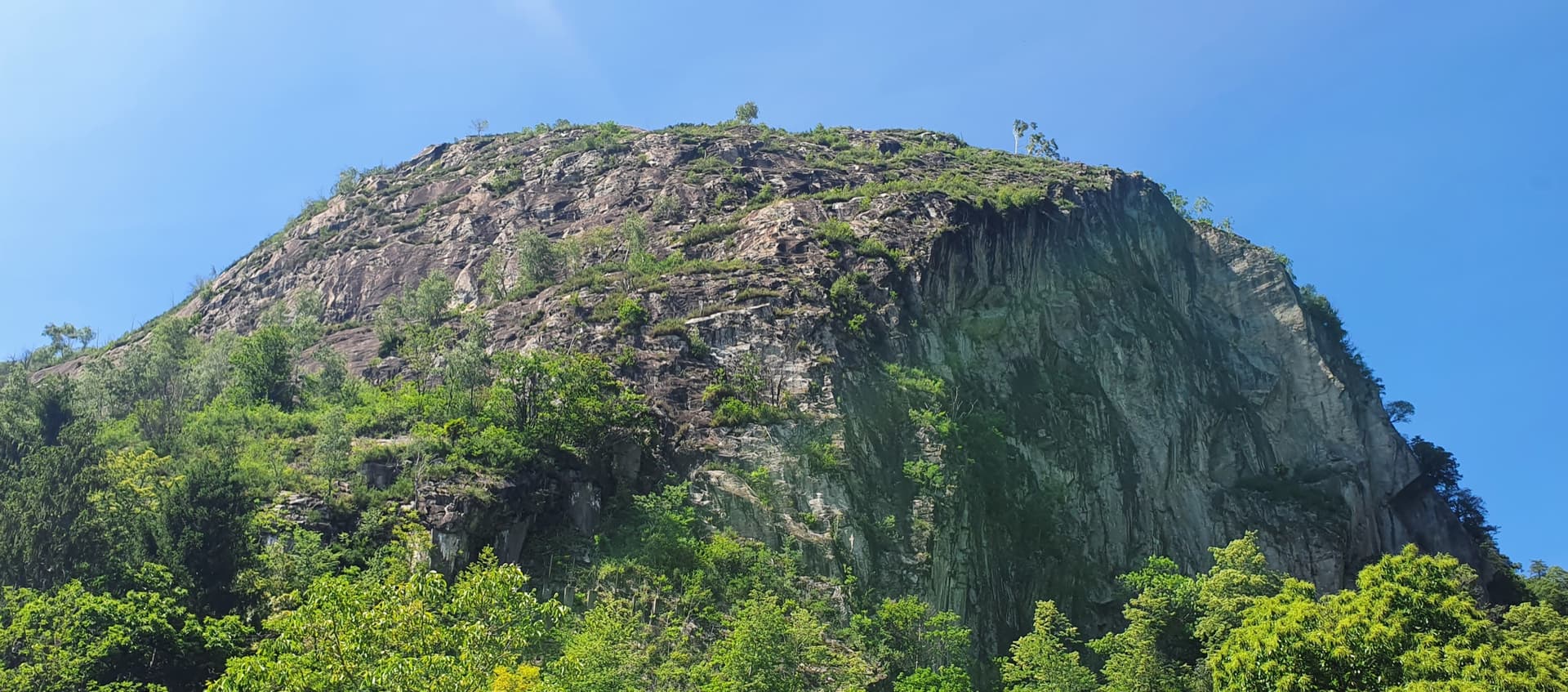
Switzerland · Ticino
Quarzader
Slab pitches give way to a vertical wall threaded with quartz veins, which gives the route its name. It is shady in the morning, and the pitches are short (about 35 m), so 11 go quickly.
6a11 pitches400 m
Monte Garzo (Ponte Brolla) · Ticino · Switzerland
Read the cautionsBail with caveatsBolting confidence: medium
The long classic of Monte Garzo: eighteen pitches from the valley floor. The first ten are compact slabs that punish the feet, then a 40 m walk leads to a steeper upper wall with athletic pitches up to 6b+. Sustained, obligatory and long; allow six to eight hours.
Sound bolts and no gear to place, but they are spaced, with obligatory 6a+ to 6b climbing on a long and committing wall.
The route
Alhambra climbs the whole west flank of Monte Garzo, the gneiss wall facing the Speroni across the mouth of the Valle Maggia at Ponte Brolla. Hans Müller opened it in 1997 and it starts two pitches lower than the other Monte Garzo routes. The first part is a long run of compact slabs up to 6a+; after a walk across a wooded ledge the wall steepens for seven more pitches with two of 6b+ and two of 6b. It is a full day at the top of this atlas's range for commitment: the bolts are sound but spaced and the grade between them must be climbed.
The climbing
| Pitch | Grade | Notes |
|---|---|---|
| P1 | 5a | Easy slabs and ledges on the plinth, often damp after rain. |
| P2 | 5b | Similar ground. These two pitches lead to the level where the Pinocchio-sector routes start. |
| P3 | 5c+ | Slab, a short ledge, then slab to the belay. |
| P4 | 6a+ | A technical slab, polished by many ascents. |
| P5 | 5c+ | Slightly easier slab. |
| P6 | 6a | More slab with a harder exit. |
| P7 | 5c+ | Ledgy ground, sparsely protected but on good holds. Gulliver gives 5c. |
| P8 | 6a+ | Slab, then a cracked corner that is awkward. |
| P9 | 6a | Broken climbing with a short delicate traverse left. |
| P10 | 6b+ | A hard slab pitch: traverse right, then straight up to the belay. The first 6b+ and, for one party, one of the better pitches. |
| P11 | 6b+ | A hard zigzagging pitch, then a traverse right through vegetation. Camptocamp gives 6b+/6c. A 40 m walk to the right follows. |
| P12 | 6a+ | The upper wall begins: slabs alternating with steps, technical. |
| P13 | 6b | Similar and a little harder. |
| P14 | 5a | An easy pitch up to a tree. |
| P15 | 6b | Featured and hard, 6b/6b+ on camptocamp, with an awkward and fairly obligatory mantel by a fixed kevlar sling. Keep something in reserve for it. |
| P16 | 5b+ | An easy diagonal to the left. |
| P17 | 6a | A superb vertical section on good holds; several parties' favourite pitch. |
| P18 | 3c | Easy rock to the top. |
Getting there
From Locarno follow the Valle Maggia road for about 4 km to Ponte Brolla. Go over the level crossing and continue a short way up the valley to the first pedestrian bridge over the Maggia (a red iron footbridge, not a true suspension bridge although some descriptions call it one); park opposite it or in the bays along the cantonal road. Spaces are limited at weekends. Ponte Brolla has a railway station on the Locarno to Domodossola line and buses from Locarno, and the SAC portal times the approach from the station. For Monte Garzo, park on the verge of the cantonal road on the right, just before a small road climbs away from it.
Take the small surfaced road uphill; it becomes a track and then a path heading north-west through the wood. After about 800 m, having crossed a stream bed, turn right up a path marked by cairns (a big cairn on a boulder). At a large boulder go left, then shortly right, to the lowest slabs, where the name is painted. A 2015 party warns that the turn-off to the true start is not obvious and that the black, low-angled first slabs are often wet. About 20 minutes and 100 m of ascent.
Loading map
The point marks the crag, not the exact start of the route.
Parking
Tegna – Ponte Brolla access point (camptocamp waypoint 219851); roadside parking along the cantonal road
Point from camptocamp waypoint 42331 (Monte Garzo)
Contains the route point and parking. Opens in most mapping apps and GPS watches.
Points are compiled from published sources, with the precision stated above. They were not surveyed on the ground: check them against a current topo.
Coordinates: 46.19239, 8.76199 (crag) · Parking: 46.18700, 8.75235
Getting down
About 1 hour. From the top go up a little, then follow red paint marks and cairns down to the left to reach a crest, pass a first pylon and descend with cables and a metal ladder to a second pylon. Just below it is the first big abseil ring: five or six abseils of about 22 to 25 m, more or less straight down, lead to the foot of the Brunone sector, from where a path passes close to the start. A 2022 party stresses that one abseil is almost exactly 25 m and that you should not try to link them. Abseiling the route itself is not recommended: Gulliver says it needs two ropes and abseils of nearly 40 m.
Retreat
Bail with caveats
Retreat by abseiling the route is possible but discouraged: Gulliver says it needs two ropes and the abseils are close to 40 m, and the normal descent is on foot with short abseils from the top. If you climb on a single rope, as most do, you cannot abseil the pitches. There is a natural break at the wooded ledge after pitch 11, but no source describes an escape from it.
Partly inferred from the route facts
Safety
Sun and weather
West-facing gneiss from about 410 m to 1100 m. This is a valley-floor route: camptocamp says not to think of it in summer, and reports are from March, May, September, October and November. The first two or three pitches are black, low-angled slabs that hold water after rain; in May 2019 they were damp the day after rain while the rest was dry. The gneiss is slowly polishing on the popular slab pitches.
Sun on the wall · W-facing
Working out the sunlit hours for this month.
Sun on the wallDaylight, wall in shade● Usual season
Estimated from the wall's aspect only. Ignores surrounding terrain, gullies and the wall's exact shape. Clock times are local to the wall (Central European time), for the 15th of each month.
| Measure | Jan | Feb | Mar (usual season) | Apr (usual season) | May (usual season) | Jun | Jul | Aug | Sep | Oct (usual season) | Nov (usual season) | Dec |
|---|---|---|---|---|---|---|---|---|---|---|---|---|
| Mean daily high °C | 6 | 7 | 11 | 14 | 19 | 23 | 25 | 25 | 20 | 16 | 10 | 6 |
| Mean daily low °C | −2 | −2 | 1 | 5 | 9 | 13 | 15 | 15 | 12 | 8 | 3 | −1 |
| Rain days 1 mm or more | 9 | 9 | 11 | 13 | 16 | 16 | 14 | 14 | 13 | 14 | 12 | 10 |
● marks the usual climbing season. Averages for 1991-2020 at about 432 m. Area climate from Open-Meteo reanalysis. Temperatures are adjusted to the height of the crag; rain comes from a grid cell of about 10 to 25 km, and summer highs on sea cliffs can read a few degrees low. The wall and valley can differ. Data: Open-Meteo, CC BY 4.0.
What to carry
12 quickdraws and a single rope; Gulliver lists a 50 m rope, but with one abseil of almost exactly 25 m a 60 m rope gives a margin. Nuts and cams are useless on this rock. Helmet.
Derived from the route data; check it against a current topo
From climbers
Reader reports are not being collected yet. Until they are, check a current topo and the local club or guidebook publisher for recent changes to Alhambra.
Worth knowing
Open questions
Provenance
Same area
Switzerland · Ticino
Slab pitches give way to a vertical wall threaded with quartz veins, which gives the route its name. It is shady in the morning, and the pitches are short (about 35 m), so 11 go quickly.
6a11 pitches400 m
Switzerland · Ticino
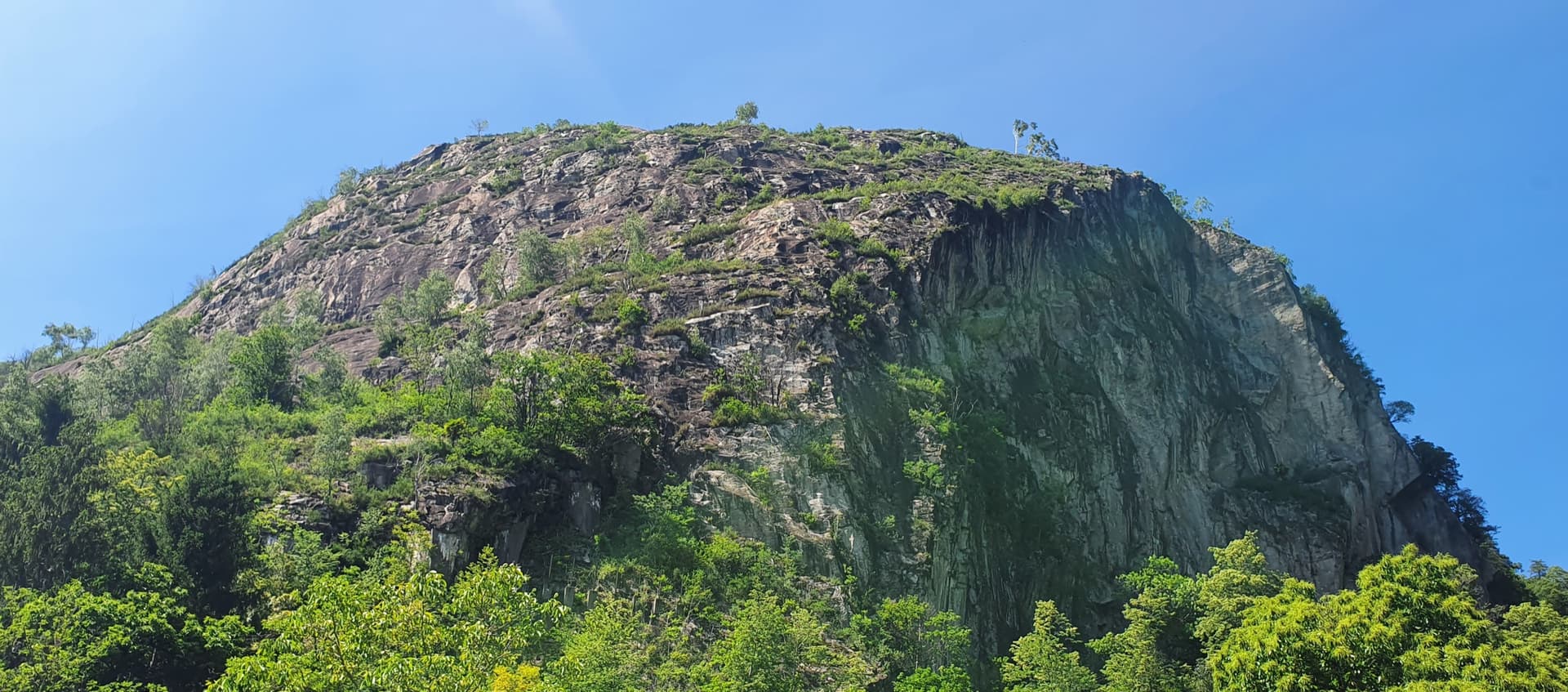
The easy neighbour of Quarzader: seven pitches of gneiss slab and small steps up the right-hand spur above the Maggia, at 4b if you take the right-hand finish. Much quieter than Quarzader and very well bolted. Finish with a swim in the river.
4b7 pitches250 m
Switzerland · Ticino
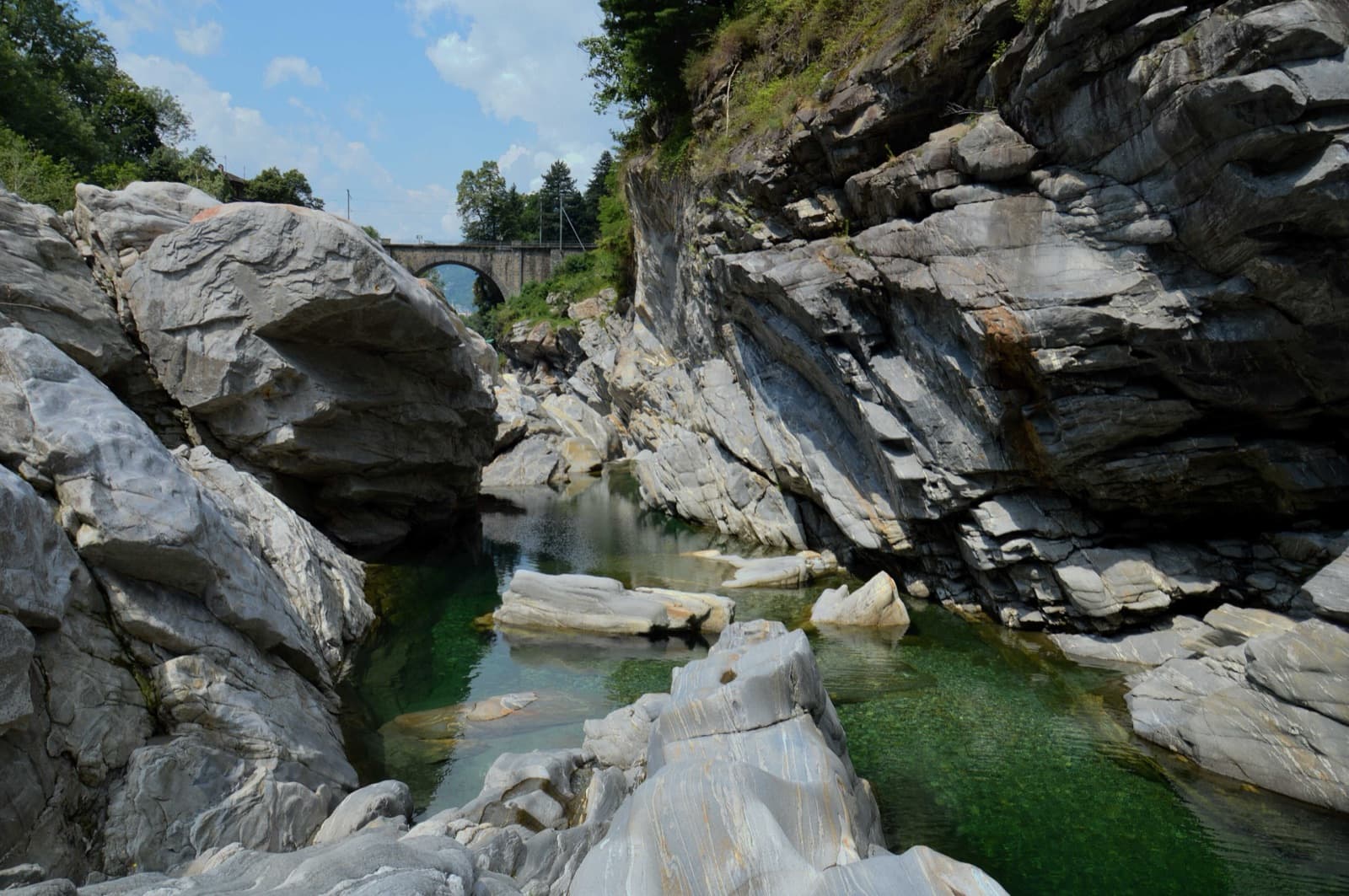
An easy, sustained slab route following the edge of the spur just left of Quarzader. Every pitch is about 4c on compact gneiss, so there is no real crux and no real rest. Impossible to lose and often crowded.
4c7 pitches210 m
Switzerland · Ticino
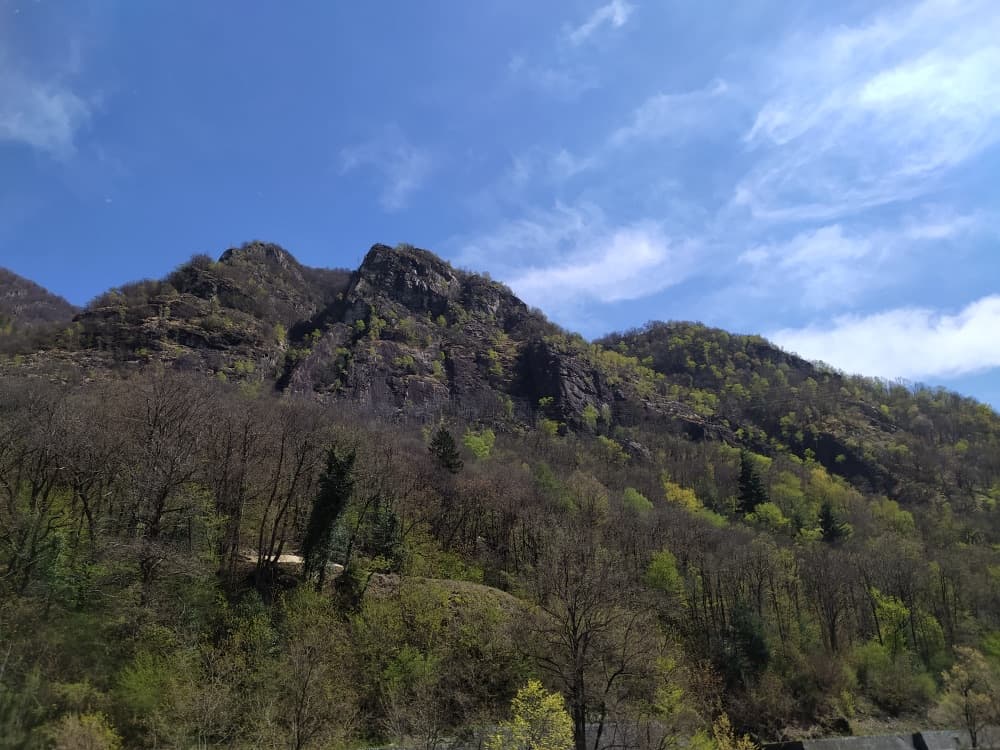
A short four-pitch route on the black wall a little right of Quarzader. Slabs lead to short vertical walls where the difficulties are concentrated and well protected. Stiff grades, and a good fallback when the classic next door has a queue.
6a4 pitches120 m
Around 6b+ · about 18 pitches
France · La Bérarde (Écrins)
Fifteen pitches up the steeper centre of the face: steep cracks and walls in the first third, then a long sequence of sometimes very thin friction slabs. Mostly 5c to 6a+ with one short 6b+ that goes at A0. Rated among the best on the wall and much quieter than its famous neighbour.
6b+15 pitches400 m
Austria · Grazer Bergland
Possibly the longest route in the Grazer Bergland: sixteen pitches that start up the Ratengrat (Don Kamille) and continue up the Breite Wand (Pepperone). The lower half is among the best climbing on the Ratengrat; the upper half begins gently over slabby steps in the forest and then steepens. Two passages of UIAA 7- and several of 6+.
6b16 pitches440 m
Spain · Aragonese Pyrenees (Tena & Canfranc valleys)
A big, fully bolted mountain route straight up the middle of a wall of the Peña Foratata to its summit. Three technical corner pitches at 6b+ low down and a 6b and a 6a above the grass terrace, separated by easy transition pitches. Short pitches by design, a long descent, and a seasonal closure for bearded vultures until the end of July.
6b+14 pitches420 m
Read the cautions
Austria · Inntal (Haiming Geierwand)
bergsteigen.com calls this the best route on the Geierwand: steep, almost always vertical pocket climbing on the left side of the wall. The hardest move comes on pitch 2, but the upper half stacks several 6b pitches one after another and tires the forearms. Recommended to climbers who are comfortable at 6b.
6b+13 pitches355 m
Compiled from published sources and last verified October 2026. Bolts, anchors and access change. Climbing is dangerous and you are responsible for your own decisions: check a current topo and read the disclaimer.