Menu

Pedra de Tartera

Paret Bucòlica, between Oliana and Coll de Nargó · Coll de Nargó & Oliana (Alt Urgell) · Spain

Read the cautionsBail not documented

Five pitches of slabs on excellent grey limestone, on a sunny wall with a quick approach from the road. The difficulty builds to a 6b+ third pitch, with the odd bouldery move over small bulges. Closely bolted with parabolts and a good introduction to the Paret Bucòlica.

Climbing mode: Big type, screen kept awake, tick pitches as you go.

The Paret Bucòlica above the Segre between Oliana and Coll de NargóPhoto: Frédéric Bunoz · CC BY-SA 3.0
Hardest pitch
6b+6b+
Pitches
5
Length
160 m
Approach
–
Aspect
SE
South-east-facing
Rope
–

Highest point about 850 m above sea level (estimate: terrain height at the mapped point plus the height of the route).

Rock
limestone
Season
Mar to May, Oct to Dec
Bolting confidence
Medium
Last verified
October 2026 · Aggregated by AI from published sources
Read before you go

Well bolted, but a pitch 1 hanger was broken by stonefall for years; it was reported replaced in 2022.

Photo

Climbing modeBig type, screen kept awake, tick pitches as you go.

Overview

Pedra de Tartera is a 2005 sport line on the Paret Bucòlica, a sunny grey limestone wall beside the C-14 road tunnels between Oliana and Coll de Nargó. It is mostly slab climbing on sharp, featured rock, building from 5c to a 6b+ third pitch and a 6b fourth before an easy finish. The neighbouring routes (Terra de dinosaures, Balsam del tigre, Pas d'estrès) are often climbed the same day. The one known problem, a broken hanger on pitch 1, has reportedly been fixed.

Worth knowing

  • Allow 2 to 2.5 hours on the route.
  • Topos are sold at the Tahussà bar in Coll de Nargó.
  • Luichy's topo (La Noche del Loro 2) has the line drawn.

Pitch by pitch

The atlas doesn't show topos: they are the work of the people who bolt and document these routes. See the topo at La Noche del Loro 2 – Paret Bucòlica, Pedra de Tartera (2013), Camptocamp – Paret Bucòlica (crag) and parking waypoint 819876, or in Oliana: free route topos (reseñas).

Pitches of Pedra de Tartera
PitchGradeLengthNotes
P15c40 mSlab with a bulge (Luichy grades it V+). A hanger at the bulge (the second according to Luichy in 2013, the third according to 2014 and 2015 reports) was broken by stonefall, making the bulge committing; in 2022 a new hanger was reported next to the old one.
P26a+30 mSlab.
P36b+30 mThe crux pitch; a 2022 party found the 6b+ fair for the grade.
P46b30 mTechnical slab. Luichy's topo grades this pitch 6a+ then V, not 6b.
P54c20 mEasier ground (IV/IV+ on Luichy's topo) to R5 on the descent ledge.

Approach

To the parking

The wall is on the C-14 between Coll de Nargó and Oliana, in the Segre valley. From Coll de Nargó go through two tunnels; about 300 m after the second, just before a third, at about km 150, take the old road on the left (signed no entry to vehicles) and park in the small car park facing the wall. From Oliana, turn right just before the fourth tunnel. A 2016 party warns that parking in front of the road-maintenance buildings is forbidden.

On foot

Walk back about 50 m and take the cairned path (red marks) up a steep ravine towards the wall. Do not climb too high (that is the descent path); turn right fairly soon and reach the foot of the routes without a path. Approach time is not given.

Map of the walk-in

Point from camptocamp waypoint 221384 (Paret Bucòlica)

For your phone or watch

Download GPX

Contains the route point and parking.

Points from published sources, not surveyed.

Descent

On foot, without difficulty: follow the descent ledge, which is airy but not really exposed, then the scree and the cairned ravine back to the road. Parties describe it as tedious, especially in rain.

Bailing off the route

Bail not documented

Retreat is not documented. The route is described with a walk-off and no source mentions abseiling it, although the belays are bolted.

Retreat from
Not known.
Point of no return
Not documented.
Carry
Cord and maillons if you plan to retreat; abseil hardware is not described.
Basis
Inferred from the route factsSources describe only a walk-off.

Spain

In an emergency

In an emergency · Spain

112Emergency

Call 112

Emergency

Position of the crag

42.13938, 1.30840

Marks the crag, not the route: give route and pitch.

Say what happened, how many are hurt, and where you are. Checked October 2026 (source).

Hazards

  • Stonefall broke a pitch 1 hanger in the past (replaced by 2022); check it before relying on it.
  • Loose stones on the descent ledge and in the ravine.
  • Terraces between pitches carry gravel and bushes.

Gear

12 quickdraws. Rope length is not given; the route is walked off.

Checklist

Quickdraws
12
Rope
Not given
Helmet
One each
Maillons or spare karabiners
To leave behind if you retreat
Cord
Mentioned for retreat

Conditions

Plan B nearby

  • EasierMatute6b4 pitchesfaces E28 km away
  • HarderChiricahua6c6 pitchesfaces W17 km away
  • Shadier sideTanger6a+10 pitchesfaces NE28 km away

Straight-line distances, up to 30 km.

Reader reports

No reports yet.

Report a problem with this route

Say what and where. Reports are checked before they appear; no name or email is stored.

Bolts and history

Bolting
A modern route equipped in 2005 and rated P1 on camptocamp. Luichy's 2013 topo says it is fully equipped with parabolts ('totalmente equipada con parabolts', 'muchos seguros', 12 quickdraws) and draws bolted belays R1 to R5; reports call the bolting reassuring and 'muy chapada'. A pitch 1 hanger broken by stonefall was reported from 2013 to 2018 (a 2014 party called the bulge 'very committing, risk of a ground fall'); a 2022 party says a new hanger has been fitted next to it.
History
Equipped in 2005 by Alfons Gastón and Xavier Grané.
Guidebook
Local topo sold at the Tahussà bar in Coll de Nargó; online topo on La Noche del Loro 2 (Luichy). Free topo.

Where sources disagree

  • Pitch lengths are from Luichy's topo (about 40, 30, 30, 30 and 20 m); the approach time is not published.
  • Pitch 4: camptocamp gives 6b, Luichy's topo 6a+ then V. Luichy gives 170 m including an optional 6c sixth pitch (Bakalao al pil-pil) above the descent ledge.
  • Which hanger was broken on pitch 1: the second (Luichy 2013) or the third (camptocamp outings 2014, 2015).

Sources

Around 6b+ · about 5 pitches

Similar elsewhere

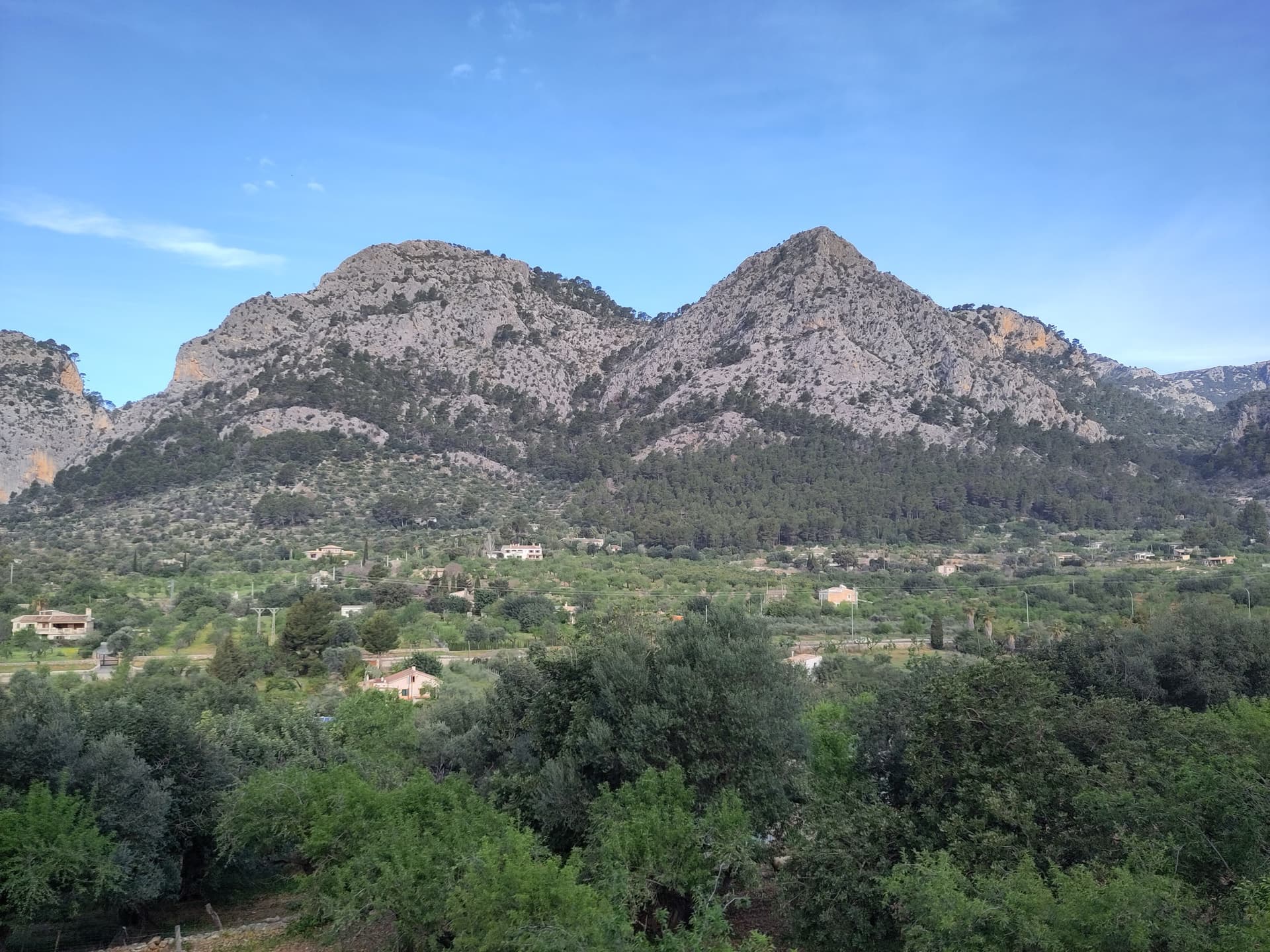
The Puig de Son Nasi (left) and the pointed Puig de s'Alqueria, the Sa Gubia peak, seen from the Sóller railway to the east. The climbing walls are out of sight in the gorge on the far side.

Spain · Mallorca (Sa Gubia)

Sexo Débil

A weaving line up the shady right-hand side of the bay through dramatic ground: an exposed wall, a traverse under a bulge to tufas and bolted-on holds, a superb rising leftward traverse on immaculate rock to a hanging belay, and a traverse back right to an open groove. Originally an aid pitch in the middle, now free at 6b+.

6b+6b+5 pitches100 m

Read the cautions

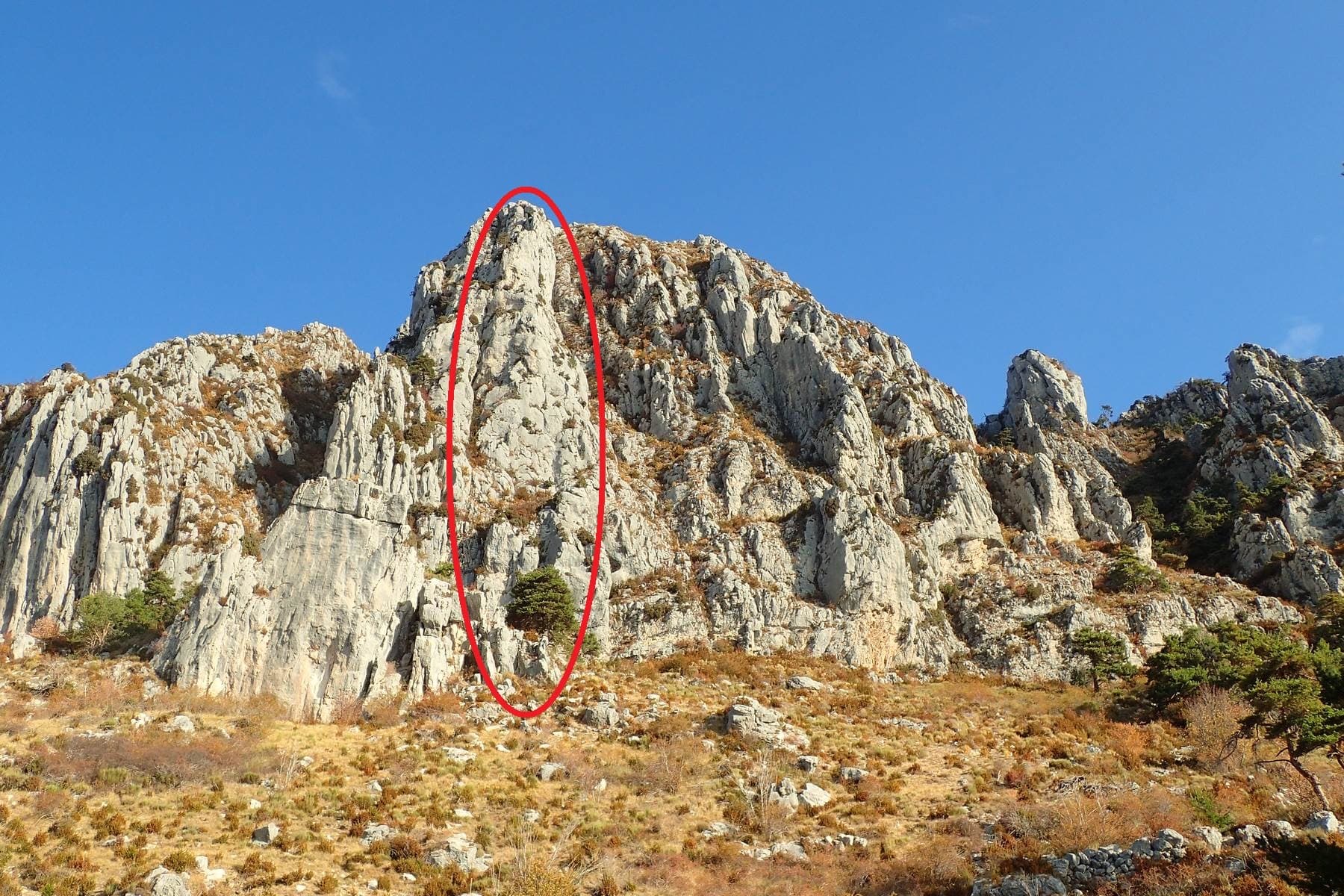
The pillar of Aylan above Séranon, ringed in red

France · Préalpes d'Azur

Aylan

A modern line up a limestone pillar above Séranon, steep and varied: crack, corner, a physical bulge and a delicate slab. Five well-bolted pitches in the 6a to 6b+ range, with a short walk between the first and second.

6b+6b+5 pitches165 m

A view of the region, not this route's wall. The painted stone that marks the start of Strada del Sole at the foot of the Nösslachwand

Austria · Ötztal

Caipirinha

A mix of slabs and steep, juggy passages in the Sonnenblume sector, mostly around 5b to 5c+. The one hard move is a small roof on pitch 4 (6b+), which goes easily on aid.

6b+6b+5 pitches170 m

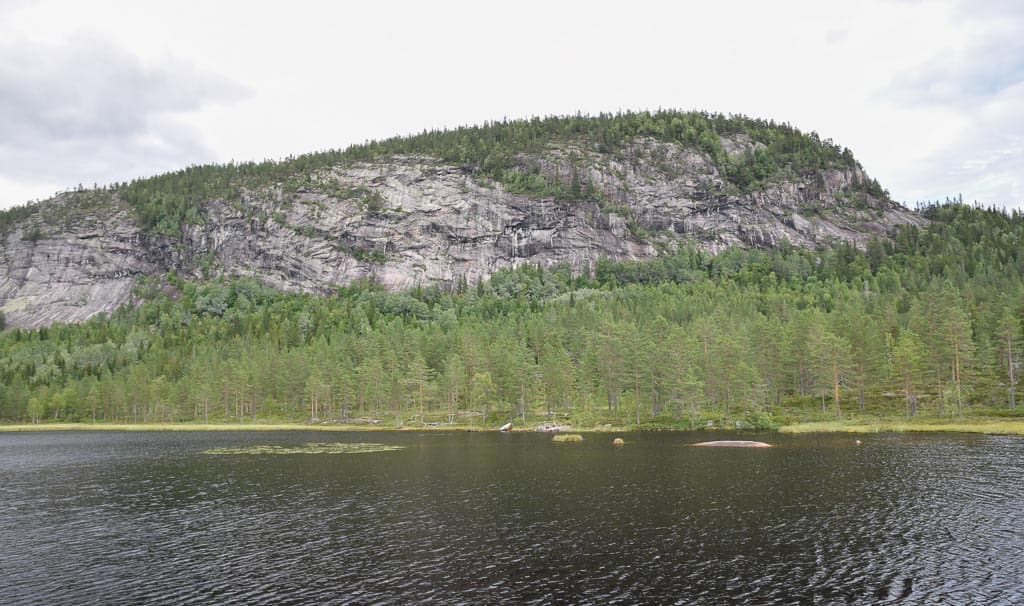
Andersnatten seen across the lake Andersnatttjenn, with the streaked slab wall above the forest

Norway · Andersnatten (Eggedal)

Den svarte stripa

The obvious black streak up the south-east face of Andersnatten. Three pitches of pure, technical slab are followed by steeper wall climbing. It feels hard for the grade if you are new to slab and soft if you are confident on it. Expect more footwork than strength.

6b+6b+5 pitches200 m

Read the cautions

Researched and aggregated by AI from published sources, last compiled October 2026. It can be wrong, and bolts, anchors and access change: check a current guidebook and read the disclaimer.